Jump to ratings and reviews
Rate this book

Medea and Other Plays

Rate this book
Four devastating Greek tragedies showing the powerful brought down by betrayal, jealousy, guilt and hatred

The first playwright to depict suffering without reference to the gods, Euripides made his characters speak in human terms and face the consequences of their actions. In Medea, a woman rejected by her lover takes hideous revenge by murdering the children they both love, and Hecabe depicts the former queen of Troy, driven mad by the prospect of her daughter's sacrifice to Achilles. Electra portrays a young woman planning to avenge the brutal death of her father at the hands of her mother, while in Heracles the hero seeks vengeance against the evil king who has caused bloodshed in his family.

Translated with an Introduction by PHILIP VELLACOTT

208 pages, Paperback

First published January 1, 432

161 people are currently reading
2359 people want to read

About the author

Euripides

2,822 books1,972 followers
Euripides (Greek: Ευριπίδης) (ca. 480 BC–406 BC) was a tragedian of classical Athens. Along with Aeschylus and Sophocles, he is one of the three ancient Greek tragedians for whom any plays have survived in full. Some ancient scholars attributed ninety-five plays to him, but the Suda says it was ninety-two at most. Of these, eighteen or nineteen have survived more or less complete (Rhesus is suspect). There are many fragments (some substantial) of most of his other plays. More of his plays have survived intact than those of Aeschylus and Sophocles together, partly because his popularity grew as theirs declined—he became, in the Hellenistic Age, a cornerstone of ancient literary education, along with Homer, Demosthenes, and Menander.
Euripides is identified with theatrical innovations that have profoundly influenced drama down to modern times, especially in the representation of traditional, mythical heroes as ordinary people in extraordinary circumstances. This new approach led him to pioneer developments that later writers adapted to comedy, some of which are characteristic of romance. He also became "the most tragic of poets", focusing on the inner lives and motives of his characters in a way previously unknown. He was "the creator of ... that cage which is the theatre of William Shakespeare's Othello, Jean Racine's Phèdre, of Henrik Ibsen and August Strindberg," in which "imprisoned men and women destroy each other by the intensity of their loves and hates". But he was also the literary ancestor of comic dramatists as diverse as Menander and George Bernard Shaw.
His contemporaries associated him with Socrates as a leader of a decadent intellectualism. Both were frequently lampooned by comic poets such as Aristophanes. Socrates was eventually put on trial and executed as a corrupting influence. Ancient biographies hold that Euripides chose a voluntary exile in old age, dying in Macedonia, but recent scholarship casts doubt on these sources.

Ratings & Reviews

What do you think?
Rate this book

Friends & Following

Create a free account to discover what your friends think of this book!

Community Reviews

5 stars
793 (35%)
4 stars
953 (42%)
3 stars
410 (18%)
2 stars
60 (2%)
1 star
15 (<1%)
Displaying 1 - 30 of 215 reviews
Profile Image for Krystal.
2,191 reviews488 followers
November 29, 2018
Medea (22/11/18)

Dang that Medea is one frosty ICE QUEEN. She's upset because the man she moved overseas for (after killing her bro - but that's another story) decided to shack up with another woman so I kinda can't blame her? But then she kinda goes next level and it's definitely tragic.

How about these quotes though:

'If only children could be got some other way,
Without the female sex! If women didn't exist,
Human life would be rid of all its miseries.'
(Jason)

'O Zeus! Why have you given us clear signs to tell
True gold from counterfeit; but when we need to know
Bad men from good, the flesh bears no revealing mark?'
(Medea)

Girl, I hear you. That Jason is an A-grade A-hole.

Like, I'm secretly just a little bit proud of her for standing up for herself.

Just not, you know, that last bit. That was probably going a little too far.

***

Hecate (25/11/18)

Man, I really feel for Hecate in this one! Interesting to kind of read a snippet of what may have gone down after the Trojan War. Hecate is a fascinating character, and I enjoyed the way she reasoned things out.

Gotta admit, I LOVE revenge stories, so this one was fun. I feel sorry for all the kids getting the raw deal in all their parents' drama, though.

The 'Chorus' character does confuse me a little, with them all speaking as one.

Also this, like Medea, has some serious gender battles.

'... To be brief,
I'll say just this: all the abuse that men have heaped
On women in time past, all they are saying now
Or will ever say, I can sum it in one phrase:
No monster like a woman breeds in land or sea;
And those who have most to do with women know it best.'


Savage.

I probably liked this a bit more than Medea, though; I think because Hecate's grief is more powerful, and her cause more justified.

***

Electra (28/11/18)

Although I liked how short and (not so) sweet Medea was, this was probably my favourite in terms of themes.

Electra's peasant husband is a cool cat; very respectful and I was happy for Electra in that respect. I really enjoyed her discussing revenge with her bro because it felt like finally we had a good cause to root for. Even though killing people is not the answer, blah, blah, blah. But the way the themes twisted and wrung out different emotions was quite powerful.

The explanations from Clytemnestra were quite interesting, as well! I mean, she kinda sounds like a savage, but good on her not putting up with that, 'a woman must agree with her husband on everything' crap. Huh. Kinda seems like Euripides was a feminist waaaaay ahead of his time.

One to go!

***

Heracles (29/11/18)

Guh, this one was the worst.

It hurt my heart.

We all know Hercules/Heracles, the half-god-half-mortal son of Zeus (and, according to this, also some other guy called Amphitryon? I need to brush up on my Greek myths) who did a bunch of tough tasks that we all refer to as labors. Then you get this tragic ending where H is off slaying Cerberus (poor puppy) and in the meantime this psycho king is planning to kill his wife and kids. (I have a lot of love for Megara because I always picture her as the sass queen from the Disney version.)

Herc is a hero. I really like him. So to read his tragedy was a little heart-breaking.

Here's some good quotes though!

'Friends, life's a brief and trivial thing, Such as it is,
As you pass through, find as much pleasure as you can ...'


'Good-bye to all my famous labours! They're a waste of time, while I
Neglected to help my own.'


***

Overall, a really great, tragic collection. Highly recommend for those interested in a more creative take on some well-known legends.
Profile Image for Άννα  Morta &#x1f480;.
92 reviews127 followers
September 12, 2023
'Your words are gentle: but my blood runs cold to think what plots you may be nursing deep within your heart'

The 4 Greek tragedies focus on the characters of Medea, Hecabe, Electra and Heracles. Central topics are vengeance, murder, madness, betrayal, envy, wrongfulness and abomination. Euripides masterfully conveys theatrical devices by using foreshadowing, imagery, chorus and irony, offstage action and dramatic suspense.

Reading those plays felt like rotting from the inside out, a bloody, gruesome and hideous nightmare in the best artistically beautiful way. I was poisoned by the words, paralyzed by the plot and rescued by the antidote - the magnificent ending. Medea is the outstanding play in this edition, I relished reading it twice! 🖤 Highly recommended, timeless classics.
Profile Image for Joy.
192 reviews23 followers
October 30, 2017
[Review for just the Medea in this collection.]

Overall, a great take on Medea's story. My usual complaint with plays is crazy jargon, but I liked how James Morwood's translation made the text pretty easy to understand. I wasn't so caught up on trying to understand every single word -- I could really just enjoy reading the play. And after reading about Euripides's version of Medea, I found that I actually liked this story better than Apollonius of Rhodes's (Jason and the Golden Fleece). 3.5
Profile Image for Crystal.
122 reviews17 followers
December 3, 2018
this play made me stressed because Jason is the dumbest piece of shit in greek antiquity. if i had the chance i would punt homeboy into the sun. Medea on the other hand is haunting and powerful and wild, and remains one of the most enduringly ambiguous figures in Greek tragedy for me. Condemnation of Medea is something i will forever yell about - homegirl transcends her feminine character confinements and enters this wild androgynous space where she's both ruthless and logical but also emotional and maternal so audiences can't even hate her?? plus she's literally just using the revenge logic that male heroes use for everything, suck on that Aristophanes

also she's the ultimate inversion of the helper maiden trope, where princesses betray their kingdoms for some random hero and help him do whatever, and then once they escape the hero ditches the princess on some island (what up ariadne) because the fact that the girl has had some part in the dude's success undermines the c l a s s i c qualities of independent strength and valor, god forbid a woman in greek antiquity proves to be actually useful. you can always count on men to be afraid of power in the hands of a woman, and thats the tea
Profile Image for Jasmine.
105 reviews214 followers
May 24, 2015
"Of everything that is alive and has a mind, we women are the most wretched creatures. First of all, we have to buy a husband with a vast outlay of money - we have to take a master for our body. The latter is still more painful than the former. And here lies the most critical issue - whether we take a good husband or a bad. For divorce brings shame on a woman's reputation and we cannot refuse a husband his rights...I would rather stand three times in the battle line than bear one child." Medea (230-51)

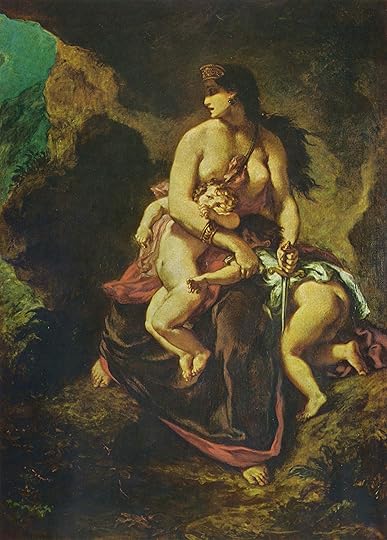
description

Medea by Eugène Delacroix, Musée des Beaux-Arts, Lille France (wikiArt.org)

"This kind of speech outraged the Christian writer Origen, who criticised Euripides for inappropriately making women express argumentative opinions (Contra Celsum 7.36.34-6); in 'Frogs' Euripides claimed to have made tragedy 'more democratic' by keeping his women - young ones and old ones - talking alongside their masters (498-50).

Until recently critics were debating whether Euripides was a misogynist or a feminist. But the only certainties are that he repeatedly chose to create strong female characters, and that as a dramatist he had a relativist rhetorical capacity for putting both sides of the argument in the sex war. "

(From the introduction by Edith Hall, p. xxvi+xxvii).
Profile Image for Irmak ☾.
285 reviews53 followers
December 6, 2021
Overall Rating: 4.5 stars.

•Medea ‣ 5 stars. (reread.)

•Hippolytus ‣ 4.5 stars.

•Electra ‣ 4 stars.

•Helen ‣ 5 stars.


Profile Image for Daniel Chaikin.
593 reviews71 followers
August 28, 2016
53. Medea & Other Plays: Medea, Hecabe, Electra, Heracles by Euripides, translated by Philip Vellacott
translation 1963
format: 200 page Penguin Classics paperback, 1968 reprint
acquired: 2006, from my neighbor
read: Aug 20-25
rating: 3 stars

Reading all these Greek tragedies, in a sort of sum affect, makes the Greek mythological stories seem ridiculous. I think this especially true with Euripides. There is this sort of un-serious element, a sense of mockery. Each of the three tragic Greek playwrights finds the most extreme, hardest to fathom elements of the mythology, and foregrounds it in their plays. And, it just seems that in same way Hollywood today mocks our religious and moral background, undermining in sum, even if not in intention, Greek drama undermines Ancient Greek beliefs and moral standards.

Well, that was a bit convoluted. I'm trying to compensate, because this book didn't offer much to me. Medea was a re-read. Hecabe was forgettable, Heracles is over-dramatic and Electra has it's own issues. Not my favorite plays.

Medea 431 bce

This is really a great and disturbing play and re-reading it does add a bit, but doesn't make it any more pleasant. Reviewed here

Hecabe (aka Hecuba) 424 bce

Hecabe is Hector's mother. So, she loses everything in the Trojan war and lives a bit to suffer through it. That's the setting here. She has to experience watching her last daughter, Polyxena, condemned to be a human sacrifice to Achilles. Then, immediately after, she learns of the murder of her one remaining son, Polydorus, who had been sent off to another kingdom for protection. He was murdered by his protector, King Polymestor of Thrace. Lots of inadequate dramatic words. All is not lost, as Hecabe gets a chance to get revenge on Polymestor. Her fellow Trojan woman slaves will set a trap, blind Polymestor and kill his sons. So, at least it's a happy ending...

Electra 420 bce

The Sophocles play of this same name is powerful, and complex and interesting. With that in mind, I found this play bewildering in its plainness. At one point Euripides makes fun of a scene in Aeschylus's play with Electra, The Libation Bearers. It's legitimately funny and it's all told straight, with only sarcastic humor. After that scene, I tried to read sarcasm into the entire remaining play...and it all made perfect sense. I guess a lesson is one should be careful not to take these too seriously.

Heracles 416 bce

Heracles probably deserves some more reflection, but it was so over-dramatic, like a constant high pitched scream, that the thought-provoking affect was lost one me.

With Heracles away, we watch his wife, Megara, human father, Amphitryon, and his children deal with being condemned to pubic execution. They go back and forth between hope and acceptance. At the last moment Heracles arrives and saves them. But, then, immediately, the Goddess Iris has the goddess Madness drive Heracles into an insane episode where he kills his wife and children. An accountant might point out that he came out one family member ahead, Amphitryon lives.

In the emotional fall out, Heracles goes through emotional episodes that include an expression of doubt of all the gods, since gods can only do good. He is doubting what is essential to his own existence, as his real father is Zeus. (I should point out that the actors seem a bit uncertain on this).

There is a lot going on in the play. Notable is, first, how the family responds to being condemned to die, and, second, the doubt in the belief in the gods expressed by Heracles. Euripides is supposedly reflecting his times and the tangled debate going on in and around 5th-century bce Athens about what to believe. This is interesting, and maybe I will get something out of it on a re-read, but right now I need a play with less melodrama.

Profile Image for Sharon.
1,464 reviews103 followers
October 7, 2023
CW: child death, murder, violence, infidelity, human sacrifice, war

The Greeks only wrote certified bangers.

Medea: 5/5
(Reread - read for the first time in high school mythology class)
The original Good For Her™ (except for, like, the dead kids or whatever)
I love rereading classics after I have more life experience. Because now I've been to Corinth!!! I lived there!!! I know where this takes place!!!! And I helped excavate part of their port!!! so!!!

Hecabe: 4.5/5
Polyxena is metal AF.
Also, something, something slavery is bad @ Colonial Europeans and Americans.

Electra: 4.5/5
Girlie pop, your dad was not worth the energy, but I guess you do you.

Heracles: 4/5
This play, coming after the original Gaslight, Gatekeep, Girlbross trilogy: 🎶'Cause I'm just Ken...🎶
Profile Image for Shawin.
119 reviews10 followers
February 3, 2023
Lots of murdered sons and avenged fathers that’s all I can say
Profile Image for C. B..
482 reviews81 followers
October 24, 2020
I greatly appreciated this selection for introducing me to Euripides. Having read some Sophocles before this, I detected some differences in style. Although the high emotion and melodrama of Greek tragedy is shared by all three surviving authors, I could sense a zesty sort of irony in Euripides which isn't present in Sophocles, whose work gave me a dark sense of dread and left me with weird nightmares. Medea, Hecabe, and Electra make a wonderful selection, as they all use myths and legends as a means to discuss gender relations. I found these very intriguing. I'm chiefly fond of Heracles for the monologue of the Theban elder:

'If the gods had understanding
And wisdom, as men conceive it,
A second youth should be awarded
To distinguish those whose lives were virtuous.
Such men after one death
Would rise again into the sun's beams
And run a double course of life,
While ignoble natures enjoyed but one span.
. . .
But gods make no clear division
Between goodness and wickedness;
Time, as the years turn,
Brings no more than increase of wealth.' (p. 173)
Profile Image for Arden.
362 reviews97 followers
Read
September 1, 2024
medea is essentially a perfect play.
Profile Image for Kobi.
434 reviews21 followers
April 28, 2018
"Because you suffer, why should you so arrogantly include all women in one general approach?"

"Strange how in human life opposites coincide; how love and hate change with the laws men recognize, which can turn bitter foes to friends, old friends to foes."

"Agamemnon: Was ever any woman so misused by Chance?
Hecabe: None, unless Misery herself be a woman."

"Yes, I can endure guilt, however horrible; the laughter of my enemies I will not endure."


This collection took me so long to finish. I originally read Medea for my Literature class in early 2017, and I loved it so much that I decided to delve into more of Euripides' plays. Unfortunately I can't exactly say I enjoyed all of them as much as I enjoyed Medea. Hecabe and Heracles left me really disappointed, and I had to literally force myself through them. I felt that they dragged on and the subject matter they dealt with was really boring. But Electra and Medea were as incredible as ever. I'm not sure what it was specifically about Electra that made me fall in love with it, but when I finished it I was genuinely upset that it wasn't longer. Medea on the other hand I LOVED analysing for class and questioning the morality of the actions of Medea and Jason. I would never have picked this up if it wasn't for my literature teacher's encouragement, and I am extremely grateful that I had the opportunity to read through this, even if I didn't love it as much as I would have liked to.
Profile Image for grllopez ~ with freedom and books.
325 reviews90 followers
February 20, 2025
RE: Medea

Well, well, well...a woman turns psycho after her two-timing husband decided to upgrade and marry a princess to advance his own agenda. What could possibly go wrong?

I thought I liked Jason of the Argonauts, but he left his wife Medea to help Creon, ruler of Corinth, and married his daughter, leaving Medea devastated. She was in such turmoil she threatened to kill her own two children. Creon was naturally concerned for his own life, and he banished Medea and her children from the land. However, she successfully convinced Creon to give her one last day before she left for good, and he granted it, which was a big mistake.

In the hours leading up to her departure, she met with Jason, who, for whatever reason, had compassion on her, though he conveniently blamed women for all that was wrong with society.

"But you women have sunk so low that, when your sex life is going well, you think that you have everything, but then, if something goes wrong with regard to your bed, you consider the best and happiest circumstances utterly repugnant. The human race should produce children from some other source and a female sex should exist. Then mankind would be free from every evil."

In their time together, each had a moment to share his/her side of the story. Jason also explained why Medea was being exiled by Creon: because she dares curse the royal family. Medea described losing one's native land as the worst misery.

After her meeting with Jason, Aegeus paid Medea a visit. He had a problem which Medea could help him with, and in return, he would offer her protection in his land, which she would need after she followed through with her wicked plot to kill Jason's new wife.

She asked Jason to persuade his new wife permission for her children to stay behind and be raised with Jason and her. Medea provided gifts, a robe laced with poison, to appease her.

Immediately the princess put on the robe and the poison began to work. She was like a girl on fire. And Creon embraced his daughter, and died with her.

Next, Medea prepared to flee to Athens, but not before seeking ultimate revenge on Jason by murdering her children. Afterward, Medea and Jason had a few choice words for one another, but in the end, Jason was left to suffer.

LAST WORDS

I felt awful after reading this play. There were so many verbal insults and offenses exchanged between Medea and Jason, and obviously nothing good came out of this story. Of course, Euripides challenged the status quo of women in society of his day, as he portrayed a woman who violently acted out her scorn and abuse by her husband, Jason. She sought the worst kind of revenge by murdering her own babies. Certainly she punished herself in the process, though I did not get that impression. I imagine audiences must have been shocked to watch this play. I would have.
Profile Image for Karin.
1,824 reviews33 followers
September 26, 2017
It’s not that there were no passages I liked, but for the most part I am not a fan of Greek tragedies. It seems to all be based on murder and revenge, including family. At least now I can say I’ve actually read all of Electra (and I did like her peasant husband—he was probably the best, most noble person of all the characters in all four plays. It helps that he didn’t kill anyone, but there was more to it than that).

Medea plots to kill her husband’s new bride as well as her sons to seek revenge for him leaving her after she saved his life prior to their marriage. I just can’t get past the “kill my sons to get back at my husband part” enough to find anything to like in her. Hecabe has two halves, more or less, and since the point is that revenge can be worse than the original crime it’s hard to enjoy. Electra is the best of the three, and I’m not sure why they are suddenly so guilty for killing their mother (the sister of Helen) who killed their father if revenge by death is supposed to be good. I get why they’d regret it afterward, of course. Then the last one in this book, Heracles, is fairly boring overall although naturally death and violence come up in it.

If, however, you like Greek tragedies, you may well like this one.
Profile Image for Riley.
208 reviews13 followers
December 4, 2020
Medea is the best try change my mind you can't.
Profile Image for Katie.
225 reviews82 followers
March 6, 2018
6th March 2018: Have only read Medea at this point (for MA thesis) but will likely go back and finish this volume. This want to ensure I have correct translation logged. An absolutely fascinating play and I cannot wait to track its late seventeenth-/eighteenth-century adaptations and representations.
Profile Image for Samantha Kilford.
211 reviews107 followers
April 24, 2018
Ok but Medea riding off in the sky with the bodies of her dead children in Helios' golden chariot pulled by dragons is easily the most badass exit to ever exist.
Profile Image for One Sassy Reader.
563 reviews7 followers
July 12, 2021
MEDEA: 12/07/2021

I only read Medea, but I loved it. Absolutely incredible. If you're wondering why I loved it, bearing in mind how sexist and misogynous Ancient Greek society was, you're right to wonder.

Although Medea is villanized by men - like all great women in Ancient Greek tales - this play was a perfect example of this and it doesn't make it any less entertaining. It is a great tragedy, but wouldn't I like to reanimate Euripides and punch him for being a misogynous ass? Absolutely!

Still, what an amazing tragedy: there was blood, revenge, women scorned who beat the patriarchy. We love it. Also if Ancient Greek men had to resort to defaming women in order to come out on the winning side, just proves how cowardly they were! I mean, the only they could get the better of women was by cheating on them and then insulting them. They were so scared of us, this was the only way to "beat" us into submission.

Also, talk about double standards, a woman murders her own children (horrible, yes. It literally chilled my blood!), but if it was a man no one would be batting their lashes at it.

I will read the rest of the plays at a later date.
Profile Image for March.
243 reviews
March 11, 2018
This is a review of the Penguin edition edited and translated by Philip Vellacott first published in 1963. The plays included are Medea, Hecabe, Electra, and Heracles.

Vellacott's introduction includes such haughty pronouncements as "Latinism in Hellene affairs is almost always to be deplored" (16). Moreover, it is very brief, omitting a general discussion of Euripides's life and work because such a discussion is offered in Vellacott's introduction to Alcestis and Other Plays (7). Nice marketing tactic! And while he assigns a date to each play, he does not inform us why the plays are presumed to have been written in those years, nor in the case of Medea--the only one of the four plays that can be reliably dated--does he mention the fact that its trilogy took third prize at the Dionysia festival in 431 BCE.

So yeah, the editorial apparatus gets a D-. But the translations! They are taut, exciting, irresistibly carrying the reader along. Comparing Vellacott's renderings of Medea and Heracles to those by Stephen Esposito, both of which I had checked out of the library, there was no question which is to be preferred. Time and again Vellacott's verse had greater clarity, directness, energy, and force. Vellacott's translation of Medea's great first scene with Jason, for example, is vividly dramatic. An excerpt:

To me, a wicked man who is also eloquent
Seems the most guilty off them all. He'll cut your throat
As bold as brass, because he knows he can dress up murder
In handsome words. He's not so clever after all.


Here is Esposito's rendering of the same lines:

For me, the man who is a villain, but clever
in speech, would have to pay the highest fine;
confident of cloaking his villainy in fine words
he dares anything; still, he's not overwise.


Esposito's "pay the highest fine" may more closely shadow the original than Vellacott's "seems the most guilty," but in every respect Vellacott's language is more vivid and Esposito's comparatively flat and prosaic. Or compare the beginning of the following choral song.

Vellacott:

Visitations of love that come
Raging and violent on a man
Bring him neither repute nor goodness.
But if Aphrodite descends in gentleness
No other goddess brings such delight.


And Esposito:

When passionate desires
descend in full force they never enhance
men's fame or virtue,
but if Aphrodite approaches
with reserve, there is
no goddess so gracious in her favors.


The contrast is striking between Vallacott's vivid language (raging, violent, descends in gentleness, brings such delights) and Esposito's colorless and prosaic choices (full force, enhances, approaches with reserve, gracious in her favors).

One last comparison, of the words of the chorus after Medea exits to murder her children. At this point we have arrived at the emotional and dramatic climax of the action. A comparison with Esposito shows how much better Vellacott's translation rises to the occasion.

Vellacott:

Earth, awake! Bright arrows of the Sun,
Look! Look down on the accursed woman
Before she lifts up a murderous hand
To pollute it with her children's blood!


Esposito:

Earth and dazzling ray of Sun,
look down, look down on this murderous woman,
keep her from laying her bloody,
kin-murdering hands on her own sons.


From the Heracles, here is a section from the messenger's heartrending and stomach-turning account of the mad Heracles' familicide:

Down by the altar steps, hoping he was unseen,
Another boy was crouching. Heracles aimed at him;
The child was quicker -- he darted to his father's knees,
Reached for his beard and neck and cried, "I am your son --
Yours, not Eurystheus'. Father dear, don't kill your son!"
His father's eyes were like a Gorgon's -- twisted, cruel.
He could not use his arrows -- the boy stood too close;
So, like a blacksmith forging iron, he raised his club
High, and upon his son's fair head he crashed it down,
Shattering the skull.


And Esposito:

And he was aiming his bow at another, who had cowered
around the altar's foundation, thinking that he was hidden,
and the wretch feel at his father's knees first,
and throwing his hands towards his father's chin and neck
said, "Dearest father, don't kill me;
I am yours, your child, you won't be killing Eurystheus'."
But he, since his child stood within the ruinous bow's range,
rolling his wild-looking Gorgon's eyes,
raised his club above his head, like a smith forging iron,
struck it against the child's blond head,
and shattered the bones.


The contrast in pathos and horror between the two renderings is stark. Esposito's child "thinks" he may he unseen, but Vellacott's "hopes" it; Esposito once uses the ugly term "wretch" for the poor child while Vellacott continually uses terms like boy, child, and son. And so on. Vellacott makes the reader feel the horror and tragedy.

(Of other translations of Euripides I have enjoyed, Paul Roche's translations compare with Vellacott for vitality--and Signet collects ten of them in a single affordable paperback--but in the choral songs Roche sacrifices poetry of expression to the constraints of the rhyme schemes he imposes and his opinionated commentary is very intrusive.)
Profile Image for Hannah.
146 reviews3 followers
December 28, 2020
Technically I just read Hecabe this time around, but it was excellent!
Profile Image for Leah.
72 reviews5 followers
October 19, 2021
I wish I knew what was in the water that made all these ancient Greek playwrights write about the coolest female characters to ever exist #justiceformedea.
Profile Image for Molly.
98 reviews37 followers
February 4, 2019
Well, well, well. I thought Electra and other plays was good. Medea and other plays, is even better. I finally understand why people only talk about Euripides’ Medea and Herakles! Its amazing!! Please read his works!
Profile Image for Jacob.
9 reviews
September 22, 2025
Utter bleakness without hope

Medea **** 1/2
Hecabe *****
Electra ****
Heracles ****

(as far as it's possible to rate Ancient Greek tragedies)
Profile Image for Cameron.
57 reviews2 followers
July 7, 2025
Medea and Electra are the strongest but all bangers! Obviously Medea is lauded but it was the first text I read at uni that hooked me so I do love it. This collection is also nicely tied together by the theme of the tenuous reputation of women.

Also reading Euripides' Helen reminded me of one of my favourite little tidbits. Stesichorus wrote a poem that followed the traditional story of Helen (her fleeing to Troy). However, he was struck blind, and interpreted this as the wrath of Helen. So in his next poem he backtracked hard, writing "that story is not true, you did not go in the well-decked ships, nor did you come to the citadel of Troy" (fr.192 PMG) . I don't know why I like that so much, I just find it silly.
Profile Image for Mika.
17 reviews
May 8, 2023
Medea: 3/5
Hippolytus: 4/5
Electra: 5/5
Helen: 5/5

My ancient Greece obsession never dissapoints. I don't know exactly why I liked Medea less than the others. Probably a combination of having to get back into reading tragedies and just not liking the character Medea. I think Electra was my favourite. It was quite thrilling and moving and the ending was not too trite or "easy." Helen was also surprisingly funny from time to time due to the great amount of irony involved. I also liked the chorus verses in Helen and the myths they referred to.
Profile Image for Zanna.
676 reviews1,087 followers
December 3, 2015
With beautiful clarity and realism, Euripedes crafted dramatic interpretations of Homeric tales with moral subtlety and timeless resonance. I will definitely keep coming back to this collection.
Profile Image for Daniel Wright.
624 reviews90 followers
May 27, 2016
Women who, against all the customs and strictures of their society, take their fate into their own hands - and get away with it, in a world that does not care.
Displaying 1 - 30 of 215 reviews

Can't find what you're looking for?

Get help and learn more about the design.