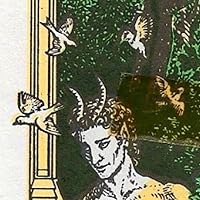
For years readers have enjoyed Charles Waterton's intriguing book, Wanderings in South America, about his adventurous travels in Guiana, West Indies. Waterton, a famous English eccentric and naturalist, returned to England in 1821 from an expedition to Guiana, where he had collected hundreds of specimens of South American wildlife, all carefully preserved. On a second expedition to Guiana he acquired the head of an amazing specimen he described as the "Nondescript," a fur-covered, manlike creature native to the South American jungle. Adding a touch of intrigue to this compelling narrative is the rumor that the Nondescript bears a startling resemblance to an overzealous customs inspector who had caused him so much grief upon his return in 1821. It is popular opinion that Waterton, in his own peculiar way, was literally trying to "make a monkey" out of an annoying tax collector.
Naturalist and explorer Charles Waterton (1782-1865) was born in Yorkshire, England, to a family eminent in the service of the state. In 1796, he pursued higher studies at Stonyhurst, where he developed his early passion for natural history. Determined to start exploring the hinterland of Guiana at intervals of four years, he made the four adventurous expeditions described in the well-known Wanderings in South America.
I was hoping for an account of natural life in a remote part of the world (and the few passages where he reported on beautiful scenery or animals in their habitats were written well and evoked lovely detailed imagery). HOWEVER, what I got was racism, including a story seemingly intended to glorify a slave owner. Also a lot of animals being killed, stuffed and subjected to poison experiments. Certainly not what I was expecting and reading sections was often repugnant.
Read primary source accounts; first person narratives from other centuries. What a weird and charming opportunity to time travel. A reminder to do more than the omni-colon-subtitled-meta-history-non-fictions that give you 10% of the actual.
And as for fiction, the funniest novel is still Don Quixote.
The imagery of the book was very well done. I could easily imagine the beauty of the forests. A lot of the speech came off a bit flowery, but not so much that you needed footnotes to explain what they meant.
The details were, at times, a bit painful to read (I refer specifically to the times some act of animal cruelty was mentioned - i.e. poisoning of the dog to show just how lethal and fast acting a certain poison was).
Some of my favorite parts was when he was describing the animals, specifically the sloths, and out of all the journeys, the third was my favorite solely because a large chunk of it talked about the animals there.
My only complaint is how the book was broken up. It's great he separated the journeys but I wish there were chapter breaks in the journeys because running it all together made it seem a little tedious and, at times, confusing.