This book seeks to answer a seminal question about Nation state formation in Post colonial India, “Who got us our Freedom and how?” Was it due to the violence of Bose and His INA- or was it due to the peaceful and non-violent agitation of Mahatma Gandhi? Where we are going depends a lot on where we came from. The author has painstakingly analysed the documents now available in the British Transfer of Power Archives. He has methodically identified the key British decision makers in London and New Delhi in the critical period from 1945-1947, and examined their letters and reports about the INA trials and their violent aftermath (November-December 1945) and then the mutiny in the Royal Indian Navy (February 1946). Relevant letters from the Viceroy and military appreciation of the situation by Fd Mshl Auchinleck, alongwith reports from the Governors of the various provinces, as also the report of the Director IB, have been reproduced in the original alongwith Letters from the Prime minister Lord Clement Attlee and Secretary of state for India, Pethik Lawerence. The documentary paper trail is chillingly clear. The British were shaken by the wide spread violence in support of the INA and the serious question mark it raised about the continued loyalty of some 2.5 million Indian soldiers then being de-mobilized after the war. There were less than 40,000 British troops in India then. They were war-weary and home-sick. How could they have quelled a revolt by 2.5 million combat hardened Indian Soldiers? It was this stark maths that forced the British to leave when they did. Nelson Mandela in South Africa, continued with the non-violent methods of the Mahatma. Unfortunately South Africa got its freedom only in April 1994. The unfortunate fact is that the British left but handed over power to an anglophile elite that faithfully carried on with the narratives and constructs of the Raj.
The book challenges notional or traditional views. We have been raised shouting slogans in appreciation of Gandhi all our lives. Deservedly so; many think. However, it is interesting and also good to see many people coming with other debating points. The book has a scientific approach and the author has certainly touched on some very interesting points of merit. However, ultimately, it is up to the masses to decide. Bose played a major role in winning freedom for India and there cannot be any counter to this fact. Likewise, Gandhi's role was important and it cannot be questioned either. However, still, there are things that we have to differentiate and ponder. The book does the same. A very interesting and valid read.
This book gives the account of how Bose's INA pressurised the British and forced them to move out of India. The book contains various letters circulated between the C-I-Cs, King, Prime minister and field marshals of Britain; every letter tells almost the same things. First 40% of the book is quite informative and the rest of the book seems like repetition of the same things, with proofs. A must read book for all Indians, who have been hearing only Nehru history of India; it's a different narrative which isn't told usually. Biased historians have downplayed the role of revolutionaries in the Indian freedom struggle. We aren't even told that Sepoy mutiny happened in 1856, but all we know is Dandi march, quit India movement, non cooperation movement.
Very good that factually puts the debate to rest for once & all that it was the INA of Bose that won the independence for India.
The author done well to provide the actual communication between the viceroy, the prime minister, the various governors of the provinces & the report of IB. All this material is provided in full from the Transfer of Power archives from London.
The only drawback is that few of the points have been repeated on numerous occasions. Maybe he wanted to emphasize these points to the reader.
Overall, very good book with solid documentary evidence.
This book debunks the false narrative propagated by Britishers and later on the Anglophile left liberal class. Every indian must read this such that they can get to know about the real struggle for indian independence. This
Wonderful book, We are being thought wrong history. Contributions of Nethaji and his INA are comfortably put aside while writing about India's independence. The Anglophile attitude of so called scholars are evident even today after 70 yrs of independence.In our history books there is no mention about "Redfort trials" & Indian Royal Navy mutiny in which 20,000 Indian soilders participated and it was the only reason for the Britishers to vacate India in 1947,not because of the Non violent struggle as it is portrayed by sycophants of elite ruling class and Anglophile scholars.
A must read book for everyone. This book brings out the actual facts together with proofs be it government records, eyewitnesses' verbatim or interviews. All those who are in search for the answer to the question as depicts the title of the book may get a plethora of hints. All you need is patience and a practical approach to understand.
If the book is to be believed and is 100% authentic then it has many shocking facts related to Nehru-Gandhi legacy and raises some serious question also fills the lacunae which were never addressed by history thought to us in schools and through out our lives. I believe the facts stated are true because the same incidents are cited in no. Of books by various authors who were ex judges of imperial and independant india Makes a good read if you are little aware of the facts already they just provide more veritable facts
History has often been a controlled weapon and manipulated often to suite the narratives of the historians. Such has been the history of India under marxist and Maucalay-istic historians such as Romila Thappar and Ramchandra Guha etc.
In his book 'Bose or Gandhi', the author instead of just expressing his opinions, provids factual information such as letters and confidential instructions being written by British administrators to their co-workers and also the British officials in Britain. The book is exceptionally detailed and well-researched.
The author covers how it has often been proclaimed that it was Gandhi and Gandhi alone who was majorily responsible for the freedom of India. However, the obvious fallacies in this logic are indicated by the fact that the Quit India movement had been stopped years before Independence. The contibutions of the INA and Netaji Subash Chandra Bose are often not given the due credit because of the narrative contol. Even the former British PM Atlee had said that Gandhi's non-violence movement had 'minimal effect'.The book uncovers the depth of effect the INA had on the masses and how the British officials were more worried about the possibility of revolt in the armies and the anger among the masses against the Red Fort Trials.
I wanted to include the relevant paragraphs from the book however my notes have somehow got deleted. So, will update soon ig.
Provides proof to things we knew all along. Full respect to Major General G.D. Bakshi for understanding and explaining the nuances and the circumstances in the way to India's independence.
First 18 years of my life I was schooled the one sided doctored narratives of Freedom struggle. I am glad I read this book.
Neither Bose's brilliant strategy, courage nor INA collective efforts got any recognition till 70 years of Independence. Though they got what they decided their life was for- The Independence of India.
It was not one person's lone efforts which made dacoit Britan leave India. A lot of compelling evidences, archives, letters between beaurocrats are discussed in the book to prove had it been ahimsa, soft power and persuasion methods, India would have got it's Independence with South Africa in 1994.
I wanted to take 1 star away. I felt a lot of texts/verses were repeated multiple times and editor could have done a better job. But for the added postscript talking about how 5 of the remaining INA soldiers were part of republic day parade in 2018 after a lot of effort from Doval, present govt and him, I kept it at 5.
This entire review has been hidden because of spoilers.
General Bakhshi is familiar from debates on Republic, with his patient manner and courtesy even to those who seem to deserve far less. But here, he astounds with this work that fills a gap in discourses of Indian history that younger India was unaware of existence of, despite its having been lived by their elders who were adults or even teens during WWII and its aftermath.
And he's very good at this, and not only because of honesty, but more.
Internet has familiarised us with key points - Attlee’s response to queries on his visit to India, for the most important part, and the reality of there having been uncertainty regarding the air crash that Netaji Subash Chandra Bose supposedly died in; official history allowed during six decades of congress and allies regimes pushed all of that under carpet if not locked in a basement closet, key lost.
But General Bakhshi not only lays it all spread in light, he has us see a whole, especially in the fourth chapter, unlike other doubles that have brought out vital parts.
And he writes naturally - he writes as he speaks, so one gets the feeling while reading that one can hear him. This tends to give not a concise argument as much as repetition sometimes, but then he surprises just when one may be a tad lulled, and springs a very coherent and complete picture of the situation as it was then, not generally mentioned by most other historians - establishment tending to avoid it, swept under the carpet, on the whole.
His brilliantly presented summation comes in chapter 10, after having examined evidence available in declassified documents of British government through chapters before.
He astounds even more in the next chapter, discussing concept of nation and facts thereof, after having denounced those that deny the very nationhood of India.
A myth, perpetrated perhaps during the six decades of congress and allies regimes, persists about military consisting of marionettes or robots who are incapable of thought, has persisted - despite the very illuminating conversations on Republic media that various anchors hold with various experienced military veterans, whom one is fascinated to hear due to their very brilliant and astute analysis of various situations, so much so, one is furious often with otherwise much loved anchors for interrupting them.
Reading this book destroys that myth. A mind that produces this work isn't just the experienced veteran who instantly knows answers and gives them to lay audience at leisure over a pipe reflectivity, but someone who can tear lies built up by supposedly scholars over decades, centuries, with evidence - and analyse further.
If anything, it's another area of nation's needs where he's served with excellence, matching his record in armed services. ***
General Bakhshi credits Gandhi for being the first one to demand independence instead of petitioning for home rule.
Didn't Lokamanya Tilak do that, much before arrival of Gandhi? He was known for telling off British, "Its my birthright, and I WILL have it"?
"There were three distinct strands in the freedom struggle of India. The Anglophile Indian elite had begun the freedom struggle in a very effete way by appealing to Imperial Justice—pleading and putting up petitions and memoranda to the Queen Empress for a measure of autonomy or home rule. They considered themselves as loyal subjects of the Empire and petitioned the queen against their local colonial rulers. Even this request for Home Rule or Dominion status was turned down on racist grounds. India participated enthusiastically in the First World War, in the fond hope of earning British gratitude. What it got instead was the racist massacre of Jallianwala Bagh in Amritsar. This, just a year after the war, in which 1.3 million Indians had participated and some 72,000 had laid down their lives. This was a critical turning point in India’s Freedom Struggle.
"Mahatma Gandhi appeared on the scene at this stage and carried out a mass mobilisation of the Indian peasantry. This was a movement of non-cooperation with the British rulers. How could they rule the people of India without their consent? He asked the people of India to boycott British goods. This mass mobilisation shook the British. Gandhi however kept it non-violent, and the British soon found non-violence to be entirely within their tolerance thresholds. In fact, they even tacitly encouraged this strain of the freedom struggle. While practising democracy at home, they could not allow themselves to be seen as not encouraging it in their colonies.
"The third strand of this struggle was the violence of the Revolutionaries like Bhagat Singh and Chandra Shekhar Azad. This worried the British and they were ruthless in its suppression. What finally led to the eclipse of the British Empire in India, however, was the violence of Netaji Subhash Chandra Bose and his Indian National Army (INA). Though it lost the battles of Imphal and Kohima, it won the War for India’s Independence by instigating massive armed rebellion in the Indian Armed Forces. The military men of the INA and the regular armed forces were however rapidly marginalised, by a set of collaborators and closet Anglophiles, as was Mahatma Gandhi."
Author has overlooked the long tradition that connects them to much older, righteous warriors for nation and self respect, chiefly in spirit if not political ideology - going back in time via Lokamanya Tilak and Sri Aurobindo, to Chapekar brothers and Surya Sen, Vasudev Balwant Phadke and Queen Laxmibai of Jhansi, Peshawas and Maratha Empire of Shivaji, Rana Pratap and Queen Padmini of Chittor Garh, Prithviraj Chauhan and even further, right back to Rama. ***
Author proceeds to discuss various schools of thought about the concept of nation, and comes to democratic citizenship and equality amongst defining characteristics.
" ... What then really welds a modern nation together are three critical factors:
"Democratic Conception of Citizenship
"Extensive market for manufactured goods and services
"Advances in Communications
"Without these modern prerequisites, nation state formation is impossible, aver the scholars. Hence India was never a nation state before 1947."
But there are monarchies in Europe which obviously do not have this equality of citizens, so does UK not qualify as a nation?
" ... The magnificent spread of Buddhism across the whole of Asia by a saffron clad army of Indian monks is yet another feat of communication that would be difficult to replicate even in today’s era of the Internet and satellite communications."
"To sum up this discussion, therefore, ancient or modern, the following characteristics are needed for the formation of a nation state: A self-designating name A written history A degree of cultural uniformity, often as a result of and sustained by religion Legal Codes An authoritative centre The conception of a bounded territory
"On each of these criteria, ancient India qualifies as a nation. Its self-designating name was Bharat and later Hindustan (from the Arabic for Hindu based on Sindhu—the cradle river of the Indian civilisation). It had an extensive oral and written history in the form of the Vedas, the Puranas and the national epics of the Ramayana and the Mahabharata, which still exercise such an extensive hold upon the popular imagination. ... "
Sindhu being cradle is associated with Aryan invasion theory, and equally false; trusting indigenous knowledge of India, the very word Sindhu literally means ocean, and such an epithet for not the largest river of India is only factual going by India having witnessed vanishing of an ocean as Himalayan ranges rose out of the ocean, while the river flowed in place of where the ocean was.
Author has referred to Jambudweepa and interpreted it as Asia, but more likely it's another name for India before India hit Asia and Himalayan ranges rose out of the ocean that separated India from Asia. ***
General Bakhshi asserts something that's, at best, hidden so far.
" ... To settle the question of who got us our freedom it would be essential to first examine the final push of the Congress towards freedom that took place in the Form of the Quit India Movement in 1942. This was the final and allegedly decisive phase of the peaceful freedom struggle of Gandhi. So, did it succeed? It would be essential to examine how it fared for that alone can help us to settle this historical debate in a logical fashion. The simple fact is that though it was Mahatma Gandhi who had initially forced Bose out of the National Congress and virtually forced him to leave India, towards the mid-point of the Second World War, both men had developed a sneaking admiration for one another. Bose had called Gandhi the Father of the Nation because of his undisputed role in graduating the freedom struggle in India from the old-style effete debating clubs of the original Congress to a mass-based grass-roots movement that Gandhi had spread to the villages. He had involved the Indian peasantry to make it a genuine grass-roots movement with mass participation. After Bose had left India, Gandhi openly admired his courage, will power and tenacity of purpose. As time went on, he increasingly began to veer towards Bose’s view that the British would not leave unless they were really forced to go. The tragic experience of World War I clearly indicated how ungrateful they could be after the war was won. Even Gandhi realised, as time went on, that World War II presented a rare and unique opportunity for India to make an all-out attempt to win her freedom. This presented a narrow window of time in which to act and this would last only as long as the war lasted."
Why in that case did Gandhi not make his thinking known publicly? It couldn't be that he was afraid of British, after 1947, even though India was still a Dominion! He could have simply declared he intended to speak to nation on radio, and announced that he wanted Netaji brought back, to be honoured!
So it could only have been ego in the way of doing the right thing, a bad choice, instead of admitting growth of consciousness!
But far more true is that the younger man was realist, and whatever his thinking, about Gandhi being wrong as a strategist of freedom struggle, he'd never given any disrespect; on the contrary, he'd simply found his way around and out, despite being maneuvered out of congress by the older man, that too so unceremoniously, and gone on to prove the truth of his own thinking - in action.
It's possible that he respected Gandhi, too, rightly or wrongly; but at the very least he'd never been less than courteous to the elder. He knew he was right, and he didn't need to use despicable tactics of manipulation, fraud or lack of courtesy. He simply carved his way to fight for independence of India. ***
"Lord Louis Mountbatten had taken over from Field Marshal Wavell as India’s last Viceroy and later its first Governor General. He had, rather arbitrarily and whimsically, advanced the date of British withdrawal from India from the earlier target date of June 1948 to August 15, 1947 simply because that happened to be the anniversary of his South East Asia Command’s Victory over Japan. ... "
There are two separate parts, the hurry and the date. The hurry was because he didn't care for his almost regal position in India, and wanted to get back to his career, to achieve the position denied his father Battenberg in WWI due to the family having been German.
" ... This led to the holocaust of partition in which over 2 million Indians and Pakistanis were killed and some 14.5 million were uprooted and displaced. ... "
After Jinnah had ordered Direct Action Day, and it'd been executed in Calcutta in massacre of thousands of Hindus, followed by massacre of 150,000 Hindus in Noakhali, there's very little possibility that the partition massacres would have miraculously not taken place, without a crackdown by several foreign troops on duty, protecting minorities in each of the regions intended to become Pakistan.
" ... It saw the most massive mass migrations in human history. ... "
Wonder if stats were compiled regarding migrations, rather fleeing of residents, of ares in Europe ahead of nazi occupation? Those happened not only in France, Paris and other Northern French fleeing southwest as nazis advanced, but largely in regions East, especially Eastern Poland and contiguous regions, where people attempted to flee East as Germany attacked Russia. Nazi pilots dived down and shot them point blank, and victims could see the face of the pilot shooting, while victims were often old people, women, children and babies, with baby carriages or carts as only alternative to walking.
But numbers in India were eleven million Hindus massacred, and muslims to the tune of slightly over 400,000, as per Koenraad Elst, with Sikhs number in between. Possibly they match or exceed civilians in Europe victimised by nazis. ***
In chapter six he mentions something not usually mentioned in context of pre-independence history, making Calcutta Direct Action Day seem like an aberration in a city quiet and harmonious until that point.
"4. Casey flew up to see me on Sunday afternoon and went back the next day. I had a long talk to him about the Calcutta riots. They seem to have been in two phases.
"The first was the procession of students which was stopped by the police; Casey describes it as a collection of quite hysterical young men, with whom it was impossible to reason, but who were not violent; they eventually dispersed, probably from sheer exhaustion, after some 15 hours shouting and demonstrating.
"The feature of the next phase was attacks on all forms of transport, large numbers of lorries and private cars being stopped and burnt, road blocks formed across many of the streets, and some of the railway lines stopped by crowds sitting on them.
"There was no obvious connection between the two phases, but there was certainly a good deal of organisation behind the second phase; it looks as if some of the extreme elements had taken advantage of the first phase to attack the transport system possibly as a dress rehearsal for something bigger later on; possibly in the hope that something big might develop of itself. This phase also ended as suddenly and unaccountably as it had begun.
"On top of all this was the strike of the Calcutta Corporation employees, which was purely an industrial dispute and had no connection with the riots, but naturally added to the difficulties and anxieties of the Government."
So, pretty much like the naxal disturbances of sixties to seventies, Calcutta was routinely disturbed by riots before August 1946, too.
Direct Action Day was only different in being a specifically ordered, communal pogrom, signalling future massacres of Hindus intended and executed as per Jinnah’s orders and more, and being perhaps first in the ordered category in comparatively modern times, but in reality a continuation of islamic butchering of Hindus over a millennium, restarted since Kerala riots after failure of Khilafat.
"Casey was impressed by the very strong anti-British feeling behind the whole demonstration, and considers the whole situation still very explosive and dangerous.
"The root cause of it all, he thinks and I agree, lies in the inflammatory speeches of the political leaders during the last month or two, working on the unstable minds of the youthful Bengali. So long as this violent speaking goes on, we shall have to expect outbreaks of this kind."
It's unclear if the said leaders were local or not, Congress or otherwise.
"Though one American was killed (burned alive in an ambulance) and a number injured, Casey does not think the Americans were in any way specially attacked; he says they behaved with admirable restraint, and carried out his requests to keep off the streets during the trouble as far as possible. Casey was not impressed by the methods or staff work of the police. He intends to hold an official enquiry on the firing, and to overhaul the police arrangements. He is sending one of his officers down to Bombay to study their procedure for dealing with crowds and disturbances. I think Casey himself handled the affair admirably, and that without him it might have developed more seriously."
Why did this fail quite so badly in August, just ten months later, which was not too long after this communication? Were the British deliberately helping Jinnah’s massacre of Bengali Hindus succeed? Was that according to instructions?
If so, was it a vengeance pogrom, revenge against the intellectual leadership in Bengal? Or was it far more, a subtle ruse to flush out Netaji from Russia, while British were still in power? ***
"5. The need for a firm attitude about violence has been brought home to me by a recent intelligence report I have received.
"The following are some extracts from a single day’s report:
"In the course of one meeting at Nagpur, R. S. Ruikar threatened the British Government that if mercy was not shown to the I.N.A. personnel, Indians would not spare their last drop of blood in saving their lives and asked the people to hold themselves in readiness for a movement “more powerful and mightier than that of 1942.”
"“In Delhi, large handwritten posters in red ink recently appeared threatening death for ‘twenty English dogs’ for every I.N.A. man executed.” In the Central Provinces, the President of the Mahakoshal Provincial Congress Committee is reported to have stated privately that the movement which Congress now visualised, unless Gandhi gave a clear-cut directive to the contrary, would not only be of a violent character but would be reinforced by the co-operation of released I.N.A. personnel and other revolutionary elements trained in guerilla warfare; he declared another movement inevitable.
"6. The I.N.A. trials are in progress again, and it is becoming more and more clear that the distorted publicity which has attended them is doing a very great deal of harm to Government and constitutes a threat to the morale of the Indian Army. All parties have taken the same line though Congress are more vociferous than the others. It cannot fail to be disturbing to the Indian Army to find that the vocal part of the country at any rate has an entirely different set of values from that which the Indian Army has been taught to observe.
"There are undoubtedly many ex-prisoners of war who are extremely angry and resentful about this hero worship of traitors, but the great bulk of vocal opinion is the other way. One of the troubles in India is that the opinion that is heard is only that of a very small urban population which, though it is very far from being ....
"The British left in an atmosphere of total bonhomie. They had placed people in power who would ensure them a warm send-off for looting the people of India for 200 years and more. So loyal would the Congress under Nehru remain to the legacy of the Raj that it would treat the INA men as traitors, refuse to take them back into the army and key tabs on relatives of Subhash Bose and keep reporting on them to the MI5 in London. Above all it would strive to declare Bose as dead even as it perhaps had information that he was in a Siberian prison cell undergoing torture and privation."
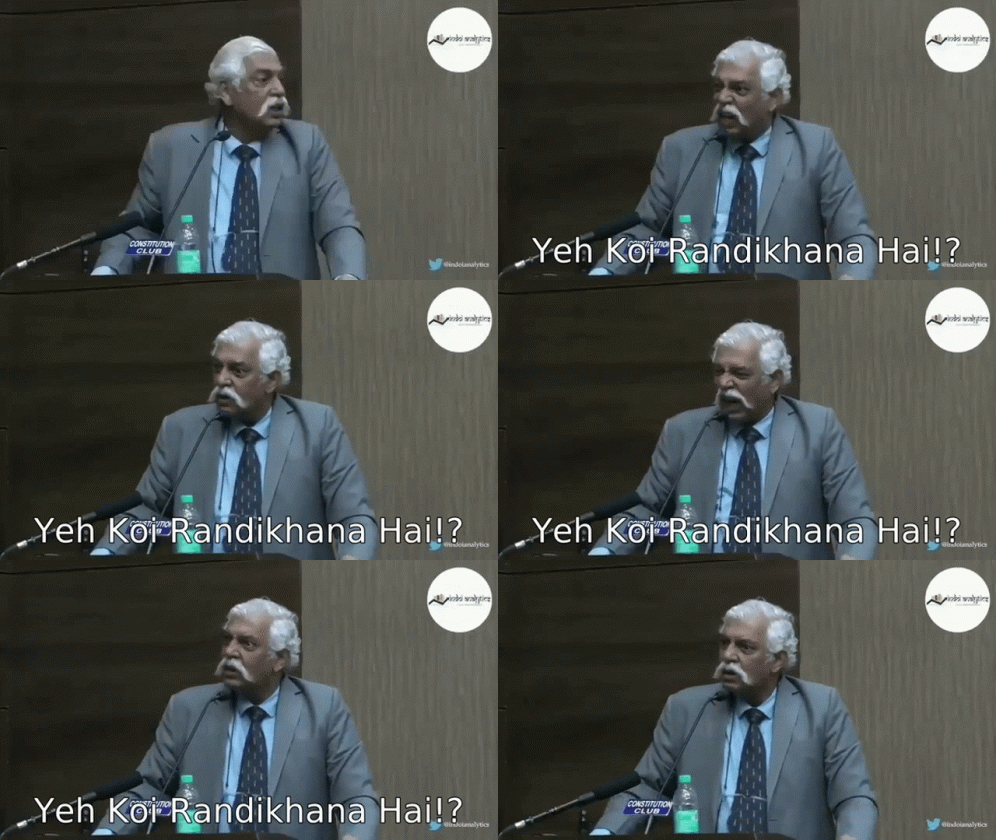
I had always wanted to use this meme and finally I had gotten the chance. Jokes apart this is a good book which blasts the narrative of the departing British that India got the freedom from them due to ahimsa which is non-violence.
Major General Gagan Deep Bakshi is a decorated war hero and a retired army officer of India. He has presented the facts in an organized manner and then deduced the conclusion based on the Transfer of Power archives. He has presented that how the then Congress leadership stripped INA soldiers of their right of joining the Indian armed forces. Moreover, the INA soldiers were treated like traitors. A couple of points I would like to highlight -
1) Gandhi was never considered as a serious threat to the British Raj. His non-violent protests and dharnas were given full media coverage. Whenever the protests went out of hand, Gandhi was jailed. Once he was out after a few days, he used to go into hibernation. That's why we could see gaps in the non-violent struggle between Non-Cooperation and Quit India movements. Almost 22 years. Additionally, same non-violent method was used by the South Africa and they got freedom in 1994.
2) Nativization: The British used native Indian folks to recruit in their 2 million strong army. The same army was used to suppress people. As soon as INA trials began, there was a strong dissent among the Indians in the army. Furthermore, the Naval Mutiny further confirmed the fears of the British officers and hence they planned to leave.
It is a good book but editing could have better. Sometimes, the letters from the officers drone on and on. Additionally, it does not showcase Netaji Bose's life but more of INA trials. However, I would recommend the movie Gumnami for interesting details.
The books content is too repeatative. Though all the points and arguments are valid and worth knowing as citizens of this country, constant repeatation sometimes bores you through the read. The evidence provided are serious eye openers. Every Indian citizen should know about the details and lettes and communications mentioned in this book.
Who got India her freedom? One might think that this question would be asked only in the classrooms, by kids trying to prove the superiority of one hero over another in a majestic process, like asking the name of the strongest Avenger. The fact that this question is almost never asked in classrooms is a proof of our distorted post-colonial academic system. 'Court Historians' pampered and patronised by Congress regime have left no scope for anybody to challenge the rhetorical claims towards Gandhi and his ostensible noble visions achieving freedom for India single-handedly. Until now. Now, finally, questions are being asked, by people experienced in the affairs of the world, especially by those who are well-acquainted with war & peace. The answers they are coming across shatter the myth perpetuated by lies and half-truths fostered by an Anglophile elite. This book is one such exercise. It diligently produces documents that clearly, coldly, unceremoniously provides is with the answer. It was Bose and his INA, duly supported by the disastrous (from the British point of view) decision to have the INA trials conducted publicly. The book leaves no doubt with respect to this. It was a fast, breezy read. However, the author is no academic or professional scholar. Like a patriot who knows which hill he has to take and which enemy to kill, he has~ — repeated certain things again and again; — incorporated certain things and views that are entirely political and personal, rather than keeping the narrative impersonal; — has added to the core narrative a theoretical framework related to definition and nature of Nation-State, that's not entirely relevant to the present discourse. Nevertheless, unlike the ancient regime where Bose and his warriors were considered untouchables, this regime has allowed a proper and strategic assessment of their contribution. Utilising that opportunity the author has carried out this exercise that allows us to draw our own conclusions and answers. On the 75th Independence day, this was a most satisfactory read, indeed. Jai Hind!
Awesome book. Some of the facts shown in this book are Mind-blowing. The Author, G. D. Bakshi tries to represent the circumstances of Bharat from 1940-1947 (and even after). After reading this book & facts shown in this book, I have now firm faith that The True Liberator of India was INA & its Leader Subhash Chandra Bose. The book lack Precise & Crisp writing. Some of the sentences/phrases are repeated again & again. But overall, the book reveled the True face of INC during pre-independence as well as post-independence. How Congress failed to Unite India during the events of Independence. And Yes, Partition of could've been avoided. There had been lot of opportunities in front of Congress (or Nehru) to avoid Partition of India, but they failed 'cause of "Lack of Leadership". Nehru was Incapable & Incompetent leader; he was just English speaker (or Possess English Language) & Lawyer. Whatever, the books shows the Reality of Indian Independence Movement after almost 70 Years later.
Author is military man hence biased and tilted towards Bose.
Content of the book, is based on Indian Historians, who according to me have no sense at all.
Indian historians can neither understand British nor Gandhiji and same applies to author. I will explain in simple way in cricket terms: Do u think English Captain Alistair Cook (any other English player) ever praise Sachin during cricketing days?(they will take the name of low profile player)
How would, then UK PM Atlee praise Gandhiji who alone has given difficult times and has dented British legacy for almost 25 yrs ? (Remember British are proud of their legacy)
GANDHIJI was the most dominant leader and may revolutionaries including Bose were the products of his movements.
The question that has been tackled in the book is a very common and legitimate question. Of the actual effectiveness of NonViolence and the deep marginalisation of all others including Bose. However the book is repetitive in multiple parts to the extent that you begin to question yourself if your are suffering from acute sense of Deja-vu. The book also relies heavily on the archives of "Transfer of Power" wherein it is produced in full in the main book instead of its rightful place as part of appendix or else, as well as heavily quotes Mithi Mukherjee, that too multiple times in a repetitive context.
In multiple places it's a laborious read and purely from a book perspective notwithstanding the topics covered, can be skipped.
Following are the three statements on which the entire book is based- 1. Indians were divided and an alien power was needed to rule. 2. Trial of INA soldiers 3. Failed 1942 quit India movement.
One can read the penultimate chapter to get the gist of the entire book.
Writes looks confused a lot of times. His only agenda seems to shame the freedom stalwarts and compare the actions of both Bose and Gandhi.
No doubt he praised Gandhi and his actions, but he forgot one thing, the freedom of 1947 was a continual process and not some last moment decision.
He has captured external factors, like WW2, defeat of Japan, etc which ultimately paved the way for 1947.
Just to stress his point, he also played with statements and historical dates.
The Quit India Movement started, floundered, and ended all within 1942, but it somehow led to the British leaving India in 1946? This book properly shines the spotlight on Netaji's efforts in actually FIGHTING for freedom, working across continents, and how the ensuing INA trials actually caused the mutiny in the British Indian Army, which made British stay India untenable. The Congress and Marxist historians have done a great disservice to generations of Indians by suppressing the contributions of the revolutionaries like Netaji.
Biased book!!! Indian historians n ex military man have very low IQ level. They cannot understand the British mentality. Brits have always divided the indians successfully whether territory, people, or opinions. Take example, will Alistair cook praise sachin before or after match in the series? How will atlee praise Gandhiji who has hit their proud legacy???
Gandhiji one if the gr8 test n tallest leader, who gave us freedom.
Must read book for every Indian. Many of us heard and studied only Gandhian version of our freedom struggle. But there are many unknown facts in history our independence. This book will give true answer to many unknowns, what is the real reason for the British to quit India. With proof of "Transfer of Power" documents in British achieves Maj Gen G.D Bakshi tells us that, the real reason for British to quit India is Bose and his INA
The book is good and informative, definitely one must read it. But it needs lot of editing...there are way too many Repetitions of same idea/text...at times word to word. At times at other places in the book and sometimes just below each other...sometimes feels like while editing some rephrasing was tried below the original text and eventually forgot to delete the earlier version.
If properly edited, it can be a good crisp read and will reduce at 50 pages.
A page turner,fact based and in depth analysis, dissection of events and conclusion based on facts,this is what makes this book a must read for those who are interested in history of Indian independence,go ahead read this one as General has done a great service to our nation with his book.
This books has lot of facts and evidences to prove that British left due to the INA of Subhash Chandra Bose rather than the highly popularized theory of non violence. The writing style of the author is also too factual, somewhere down the line I had to fast forward. But overall a good read.