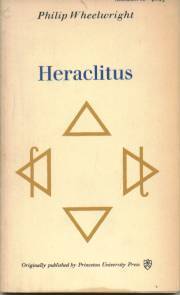
Heraclitus, the philosopher of bitter paradox and hard metaphor, who found in change itself the one unchanging attribute of reality. He was frequently described by such epithets as the Dark, the Obscure, and the Riddling .His work has survived only as fragments, mostly in the form of short sentences or aphorisms. The first compilation of these was made in Germany over a century ago, and this is the first book written in English to introduce him to the general reader. The more than one hundred fragments are arranged topically in groups to preface eight chapters, which examine the various aspects of Heraclitus' thought : his speculations on the universe in its composition and functioning, and on man in his relation to his environment, his fellow man, and his own soul. Most interesting among Professor Wheelwright's many accomplishments in this book is his success in helping the reader strip off any twentieth-century preconceptions and take part in the adventure of a brilliant Greek mind exploring reality with the resources of the late sixth century B.C. 'HERACLITUS provides an excellent introduction to the present state of Heraclitean studies. The translated fragments are topically arranged, interpreted and annotated.' - Hibbert Journal . ' . . . these aphorisms about life and the cosmos have lost none of their piercing, haunting quality, their uncanny appeal to the imagination . . . peculiarly in key with the desperate uncertainties of our own age . . . This book presents the fragments in a fresh translation, examines the various aspects of Heraclitus's thought and makes them accessible to a wider audience than is reached by more specialized works.' - Scientific American . . . 'Wheelwright's remarkably revealing enterprise must not escape the attention of any interested party, of whatever scholarly persuasion.' - The Classical Journal . . . 'will interest both literary and philosophical readers, since it stresses the wedding of content and linguistic form and the attitude of searching out the hidden harmony of things.' - James Collins in Cross Currents.
An out of copyright book that -- in my opinion -- stands as one of the best introduction to the philosopher. Heraclitus has reputation of being obscure, even accused of being deliberately so by his fellow philosophers. In this book however, Philip Wheelwright does fantastic job introducing his ideas to the masses.
In this particularly short book Wheelwright grouped Heraclitus' fragments according to their themes. It should be noted that before this the fragments were classified by Hermann Diels and Walter Kranz -- assigned so-called DK-numbers -- grouped not on themes but status of veracity. So right on there provided leg-up for the readers. (For who non-classicist among us would comb through them? Not me...)
Building on that, however, is his lucid explanation about what is what on Heraclitus' philosophy. It is refreshing to see, for once, a popular philosophy book that just explains in everyday language. Indeed it struck me how there are virtually no footnotes. Perhaps this is how they wrote pop-philosophy book back in the day? (It was published in 1959)
All in all pretty good and edifying book. I have been interested in Presocratic Philosophers for a while now, and this was my gateway to the thought of Heraclitus.
PS: since the book is out of copyright here's the download link at The Internet Archive.
A good translation, and the notes are worth reading, as he talks about the difficulties of translating from the Greek; he elucidates the puns that Heraclitus originally made, and also gives some background as to what was going on philosophically in Greece at the time, which is great for people like me who aren't familiar with it.
Well... there's significantly fewer of Heraclitus' fragments still around than I assumed when buying this lol. The few fragments I knew going in are some of my favourite thoughts... full stop. But I would say they're the best known for a reason lol.
The analysis of the fragments by Wheelwright was edifying enough I guess.
It's also the case that I bought this older copy because the reviews of the newer Penguin translation were full of people moaning it was a travesty of a translation, and the analysis totally pomo nonsense trying to ground Heraclitus work in a far newer school... but some of the examples they gave of a 'misread' by the new translators is word for word the same read Wheelwright has (fire as a metaphor for change). If anything it's made me want to read the new text too just to see what they have done with the translations.
...but I won't because I have 14,000 other books to read.
This is also the second book in a row I've read assuming they'd be lots of fragments of an ancient Greek work to read and there wasn't. In this case there was far fewer than expected (that's on me for not checking) but Helen in Egypt same issue, got it to read fragments, no fragments.
So I should avoid any Greek texts in fragments for a while. As the neighbours of those thinkers in Magna Graecia would say, 'caveat emptor'.
Contemporaries may have called him the "dark one" but Wheelwright's examination of the fragments of Heraclitus' writings are nothing short of illuminating, helping the reader avoid the contaminating "modern idols" that would further obscure the already paradoxical nature of the philosophy being espoused. By pointing out what he sees as errors of interpretation or translation by other scholars, Wheelwright strips modern philosophical impositions away from Heraclitus' words so they become unadulterated and unadorned and therefore more instinctively understood. I mean if one were really intelligent they would cut out the middleman and get that good good uncut philosophy right from the Greek source but for me this was suitable enough.
The first thing I noticed about Heraclitus when googling him was all the translation discourse. People saying the most common translation, the one showing up in Penguin's edition of the book, wasn't very good so I looked at the translations that people most often cited as the best and this was one of them and I found it to be a really good introduction to Heraclitus.
This edition has really interesting analysis of each of the segments and talks a lot about the translating and history of the text. It also talks a little bit about Heraclitus' use of language which is quite interesting, especially his use of paradoxes.
It's easy to see how influential this text was, there's a lot of Hegel in this (though admittedly I haven't read any but from what I've heard about Hegel's dialectic and view of history a lot of the phrases in here are very similar). I also hazard to guess that this could've been quite influential on Spinoza. Really interesting text that doesn't get mentioned nearly enough.
With my interest in Greek philosophy before traveling to Athens, i was able to order this small but concise book from the archives of the library system to add to my Greek immersion of thought. Heraclitus is thought to have been one of the earliest Greek philosophers. There are only fragments left of his writings. The writings cover topics of nature, the human soul, relativity, and harmony. “It is by disease that health is pleasant; by hunger, satiety; by weariness, rest.”
A nice introduction situates Heraclitus' position in the disparate sea of pre-Socratic philosophy before grouping sets of fragments together with a common theme and providing a meticulous dissemination of them. Excellent read for any fan of one person Nietzsche thought wasn't a total asshole.