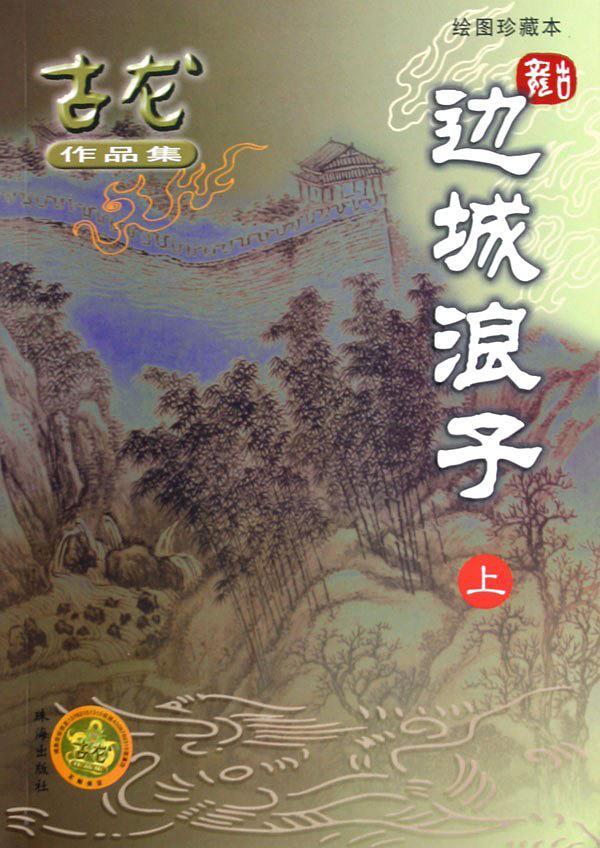
Xiong Yaohua (Chinese: 熊耀華) (7 June 1938 – 21 September 1985), better known by his pen name Gu Long, was a Chinese novelist, screenwriter, film producer and director. Xiong is best known for writing wuxia novels and serials, which include Juedai Shuangjiao, Xiaoli Feidao Series, Chu Liuxiang Series, Lu Xiaofeng Series and Xiao Shiyilang. Some of these works have been adapted into films and television series for numerous times. In the 1980s Xiong started his own film studio, Bao Sian, to focus on adaptations of his works. He graduated from Cheng Kung Senior High School in Taipei and from the Foreign Language Department of Tamkang University.
Xiong was born on 7 June 1938 in Hong Kong but his registered identity claimed that he was born in 1941. His ancestral home was in Nanchang, Jiangxi, China, and he lived in Hankou in his childhood. He moved to Taipei, Taiwan in 1952 with his parents, who divorced in 1956. With help from his friends and using the money he earned from part-time work to fund his education, Xiong graduated from the Foreign Language Department of Tamkang University. He found a job in the United States Army Advisory in Taipei later.
In 1960, Xiong published his first wuxia novel, Cangqiong Shenjian (蒼穹神劍), under the pen name "Gu Long". From 1960 to 1961, Xiong published eight novels but did not achieve the results he desired. He moved to Ruifang Town (瑞芳鎮) and lived there for three years, after which he changed his perspective and adopted a new writing style. Between 1967 and the late 1970s, Xiong rose to prominence in the genre of modern wuxia fiction for his works. As the sole representative of excellence in the wuxia genre from Taiwan for an entire decade, Xiong was named along with Jin Yong and Liang Yusheng as the "Three Legs of the Tripod of Wuxia".
While he was still in university, Xiong lived with a dance hostess, Zheng Yuexia (鄭月霞), and had a son, Zheng Xiaolong (鄭小龍), with her. However, later, he started a relationship with another dance hostess, Ye Xue (葉雪), who also bore him a son, Ye Yikuan (葉怡寬). Shortly after that, Xiong met a senior middle school graduate, Mei Baozhu (梅寶珠), who became his first legal spouse and bore him his third son, Xiong Zhengda (熊正達). Xiong's extramarital affairs with other women caused him to break up with Mei later.
In the later part of his life, Xiong suffered from depression and the quality of his works declined rapidly. He had to employ ghostwriters to co-write many of his later works because of his ailing health. He died on 21 September 1985 at the age of 48 due to illness wrought by alcoholism, namely cirrhosis and esophageal hemorrhage, at around 6pm. Xiong's friends brought him 48 bottles of XO at his funeral.
Xiong was said to be influenced not only by wuxia fiction, but also by the works of Ernest Hemingway, Jack London, John Steinbeck and Friedrich Nietzsche. His novels are usually made up of short sentences and paragraphs, and mostly dialogues between characters like a play script.
In contrast with Xiong, other writers such as Jin Yong and Liang Yusheng take an alternative route in writing wuxia fiction, incorporating Chinese history, culture and philosophical ideas in their works. Xiong initially intended to follow them but changed his decision after exposure to western works such as the James Bond series and The Godfather novels. The influence of these works, which relied on the idiosyncrasies of human life, razor-sharp wit, poetic philosophies, mysterious plots and spine-tingling thrills to achieve success, enabled Xiong to come up with a unique way of writing.
(source: wiki)
Gu Long and Khu Lung are the same person, the latter is the Hokkien pronunciation in Indonesia.
05.10.2020 “Lúc còn thanh thiếu, lão phu cũng có ý nghĩ đó, cho rằng có rất nhiều việc không thể không làm. Nhưng sau này, dần dần lão phu thể hội sự tình, trên đời không có việc gì mà con người bắt buộc phải làm, không thể không làm... Chỉ cần ngươi nhẫn nại trong lúc đó thôi. Rồi ngươi thấy ngay việc không thể không làm đó, nó không còn giá trị đáng cho ngươi làm nữa.”
mỗi lúc mỗi ngậm ngùi khác nhau
29.03.2014
Đọc đoạn đầu cảm thấy rất thú vị, đọc tiếp cảm thấy rất nguy hiểm, đọc tiếp nữa cảm thấy hơi chán, nhưng đọc đến gần cuối thì lại thấy hay ._.
Mắc cười nhất là đọc trên kindle nên tình cờ ngó xuống thấy mình đọc hoài đọc hoài đọc hoài mà nó chỉ dừng ở 56% 8-x Có cảm tưởng nó dài tới vô tận... dài gì mà dài dữ vậyyyy???? Đọc riết không chịu hết hàààà!!!! Hồi sau sau sau sau... mới phát hiện mình đọc nó trong cái ebook Cổ Long Collection, hèn chi nó mãi mãi dừng lại ở mốc 56% =)). Bịnh quãããã!!!
Pi ét: Vì chị Sâm bảo thích anh Phó Hồng Tuyết nên đã đọc đó :P. Lúc đọc đã hết sức thắc mắc sao mãi mà mình chưa thích anh í vậy nhỉ o.o. Và cuối cùng đã bể tim vì anh í đùng một cái khi nào không hay. Hehe.
The premise of this novel is a revenge tale. The protagonist, Fu Hongxue, was raised to master the use of a black sabre, and the purpose of it is to one day search out the remaining survivors who murdered his father and his father's family members 20 years before. Suffice it to say that this tale of revenge and the use of the black sabre, common knight-errant novel tropes, are depicted very differently from other similar stories.
The first time I read this book was back in 2016, but at the time, my Chinese reading comprehension level was not as advanced as it is now. Previously, what mainly captivated me was the plot, characters and ideas. This time around, I am able to appreciate the style of writing so much more.
I would liken Gu Long to Ernest Hemingway in the way he uses dialogue. I would also compare him to William Faulkner in the way he is able to describe the setting and use it to tell the story of the characters who are situated in that setting.
There is too much to say about this book, but I feel that it's best to say simply that once I've read Gu Long, I find it very hard to go back to reading Jin Yong. The styles are so different, and this style just affects me on a much deeper emotional level because of its brevity. The language is so compact, yet so poetic and so meaningful. Sometimes, less is more.