Jump to ratings and reviews
Rate this book

The Ebb-Tide: A Trio and Quartette

Rate this book
Stevenson described the protagonists of The Ebb Tide (1894), who commandeer a schooner in pursuit of riches and adventure, as a "troop of swine." Yet in their murderous greed for pearls amidst the cruel splendor of Attwater's island, these characters lay bare the dilemmas of men morally at sea, their ideals and refinements corrupted by colonial illusions and cast adrift in unknown waters.

145 pages, Paperback

First published January 1, 1887

20 people are currently reading
434 people want to read

About the author

Robert Louis Stevenson

6,834 books6,940 followers
Robert Louis Balfour Stevenson was a Scottish novelist, poet, and travel writer, and a leading representative of English literature. He was greatly admired by many authors, including Jorge Luis Borges, Ernest Hemingway, Rudyard Kipling and Vladimir Nabokov.

Most modernist writers dismissed him, however, because he was popular and did not write within their narrow definition of literature. It is only recently that critics have begun to look beyond Stevenson's popularity and allow him a place in the Western canon.

Ratings & Reviews

What do you think?
Rate this book

Friends & Following

Create a free account to discover what your friends think of this book!

Community Reviews

5 stars
72 (12%)
4 stars
195 (34%)
3 stars
202 (35%)
2 stars
80 (14%)
1 star
15 (2%)
Displaying 1 - 30 of 67 reviews
Profile Image for Ian.
982 reviews60 followers
March 6, 2023
The Ebb Tide, which I listened to on audio, isn’t one of RLS’ better known novels, but my own impression is that it’s an underrated gem. It was published in 1894, the year of Stevenson’s tragically early death. As with many of his later stories, it is set among the islands of the south Pacific, though at an earlier time during the 19th century.

The novel is subtitled “A Trio and a Quartette”, and it opens with three losers who are literally “on the beach” in Tahiti, by which expression is meant that they are reduced to vagrancy. Herrick is an Englishman from a once wealthy family who lost their money, and he himself is a weak character who has failed at everything he has tried. Davis is an alcoholic American sea captain, in disgrace and unemployable after losing a ship whilst drunk, whilst Huish is a Cockney – a working class Londoner. He is in some sense the opposite of Herrick, for whilst that character is honest but incompetent, Huish is competent but dishonest. The three hit upon a desperate scheme to change their fortunes.

The quartet is created when the trio, in the course of their scheme, stumble upon that staple of 19th century maritime fiction, the uncharted island. It turns out to be ruled by one Attwater, an upper class Englishman.

RLS is well-known of course, for creating some of the most famous characters in literature, especially Jekyll and Hyde, and Long John Silver. I feel that Attwater is another strongly drawn persona. As with many of RLS’ characters, there’s a noticeable duality to him. He’s a genuinely devout Christian and a man of razor-sharp intelligence, but is also a scary, intimidating person and one who is ruthless when he feels he needs to be.

The novel contains some dated racial language - if you decide to read a novel from the 1890s, expect the language of that period. It is noticeable though, that none of British and American characters appear in much of a positive light. Native Polynesian and Melanesians don’t feature that much in the text but when they do they are generally portrayed more favourably.

A dark but compelling tale, in my opinion very well written. We can only speculate how RLS’s writing might have developed had his life not been cut so short.
Profile Image for Louie the Mustache Matos.
1,427 reviews140 followers
October 23, 2023
The Ebb-tide is an 1894 adventure / character study, classic novel written by Robert Louis Stevenson about 3 down-on-their-luck sailors in the South Pacific. This story is a darker story than the typical RLS adventure novel, (although after reading the Suicide Club, I'm not quite as certain any more) but somehow taps into an even deeper darkness than Dr. Jekyll. The ending is not readily anticipated, nor predicted, which should cause a greater desire to read it, IMHO.

The three main characters seem to be beyond redemption, but even in the exploration, the reader hopes for their growth, betterment, change. Continuing with my opinion, the tale is strong with profound resonance that followed me even after reading the final sentence.
Profile Image for Owlseyes .
1,805 reviews305 followers
February 26, 2019


(Stevenson's home at Vailima,Samoa)

For those who know a bit of his biography...Stevenson the Scotsman writer had been for his lifetime a world drifter. He'd been in America too (in San Francisco!),... ...before settling in Samoa, for the rest of his life. So, this novel apparently has biographical lines, enmeshed into it. He knew what it meant "new horizons".


Three miserable-looking-and-feeling outcasts gather in one of the Pacific isles of Tahiti. They’re Robert Herrick, American Captain Davis and Huish. The poor starving men sit under the Purao tree, nearby the beach contemplating past and future,... if any.

R. Harry, the most refined of them all (still has in his pocket a book by Virgil, the poet), had had chances back in England: an Oxford scholarship …studies in music and metaphysics; but it all seems, he’s blown it away. He finds himself face to face with a “career failure”; feeling incompetent,shy ….having dropped from his job as clerk in New York. He tried in San Francisco streets…no success: he became a beggar….a skulker. Last resort for the remainder dollar: change his name and embark on a ship to Papeete. But Papeete is hell again: raged by the Peru influenza .

“[sick Huish] The most pitiable of them all”: the London clerk, coughing continuously; a cockney clerk.

-what would they do if…?

Husih: if I had a “ring to rub” or “raise Belzebub"?
….I would go to London travelling in the carpet of Mohamed Ben of the Arabian nights.

On the horizon they’ve seen a schooner with a yellow flag: the sign of pestilence.

They’re strolling the beach like “lame geese”.

Luckily, they find someone who provided them with a breakfast (“eaten with the greed of hounds”) in a small “dingy schooner” with five kanakas.

Now, they’re at their “place”: the calaboose. The captain managed to get them paper “to write home”.

Herrick tries his wording: “forget about me…I have failed in life….I’m well and happy”…in his letter to Emma.

Captain Davis reveals his true name: I’m john Davis: the sea ranger.

Huish: “I had got rich and married a queen in the islands”. But he tore it into pieces.

Herrick is the most desperate it all seems: he’s written on the walls: “destiny knocking at the door” a famous phrase from the 5th symphony, he explains to Davis. Herrick should have stayed in England. Better to die at home.

In the midst of all this desperation captain Davis shows up with a solution: he’s been invited to take over the Farallone, the yellow flag schooner whose captain died of small pox. He tells Herrick about his plan: though the champagne cargo is meant to Australia (“Sydney will never see me!”)… he’s set to sell the ship when arriving to Peru. Quite reluctantly Herrick agrees.

New horizons parading for the trio….they’ve just left Tahiti.
Though a "landsman", now Herrick is Faralonne's shipmate.


"'My name is Attwater,' continued the stranger. 'You, I presume, are the captain?'
...
Twenty-nine,' said Attwater. 'Twenty-nine deaths and thirty-one cases, out of thirty-three souls upon the island.—That's a strange way to calculate, Mr Hay, is it not? Souls! I never say it but it startles me.'
...
'There can be no reason why I should affect the least degree of secrecy about my island,' returned Attwater...

'What brought you here to the South Seas?' he asked presently.
'Many things,' said Attwater. 'Youth, curiosity, romance, the love of the sea, and (it will surprise you to hear) an interest in missions.

...But religion is a savage thing, like the universe it illuminates; savage, cold, and bare, but infinitely strong.' "

Profile Image for Debbie Zapata.
1,980 reviews58 followers
October 6, 2017
Stevenson's final finished novel, this was published in 1894 and co-authored by his stepson Lloyd Osbourne. Like most of the world, I've read the usual RLS titles (Treasure Island, Strange Case Of Dr, Jekyl And Mr. Hyde, Travels With A Donkey In The Cevennes) and a few short stories, but this work was new to me.

The Ebb-Tide is a South Pacific tale about three men who have given up on life, or believe life has given up on them. They are beachcombers in Tahiti, which is not as romantic a condition as you might think. Out of work, no money, no prospects, they were bums, trying to stay alive while they wondered about their destinies. Would they die from the flu that had come to the island? Or from the exposure to storms in their weakened conditions? Or maybe they would just take a long swim in the ocean and let the water solve their problems?

Then the Captain, Huish, and Herrick stumble across a way out of their sad situation. A ship in the harbor lost its captain and first mate to smallpox. Someone needs to take it to Sidney, but no other qualified seaman is willing to risk going aboard. Our three heroes do, and the rest of the story follows their journey. Do they prove themselves true men after all or are they still just bums, ruled by the faulty characters that landed them as vagrants on the beaches in the first place?

The story is intense: a close look at men who for whatever reason feel they have not had their fair chance at life, or else have thrown it away due to drink or lack of character in the first place. At times I had the feeling that I was reading something by Joseph Conrad, because the atmosphere and the focus on the darker aspects of the men's characters reminded me of that author. I was surprised at this. I plan to put RLS on my lists and work my way through his other titles to see what else I've missed.

Profile Image for Jim.
2,414 reviews798 followers
June 30, 2016
Some writers are all too easy to underestimate. I read this book on the recommendation of Jorge Luis Borges, and I was not disappointed. It is one of those stories which, while they progress naturally from scene to scene, cannot in any sense be foreseen.

The Ebb-Tide: A Trio and Quartette by Robert Louis Stevenson and Lloyde Osbourne is set in the South Seas. There are three layabouts lying on the shore in Papeete, Tahiti: Herrick, Captain Davis, and Huish. Somehow Davis manages to get a new ship command -- a schooner that had limped into port quarantined for smallpox.

The schooner Farallone plans to sail for Peru but come instead on an island that is barely charted. There they encounter Attwater, who himself has survived a smallpox epidemic. The three plan to kill Attwater and steal the pearls he has accumulated ... but things don't work out as they had planned:
Then came over Davis, from deep down in the roots of his being, or at least from far back among his memories of childhood and innocence, a wave of superstition. This run of ill luck was something beyond natural; the chances of the game were in themselves more various; it seemed as if the devil must serve the pieces. The devil? He heard again the clear note of Attwater's bell ringing abroad into the night, and dying away. How if God...?
The ending is a surprise which I do not wish to divulge.

The Ebb-Tide deserves to be considered along with Stevenson's best work.
Profile Image for Anima.
431 reviews80 followers
Read
February 15, 2020
‘The isle—the undiscovered, the scarce believed-in—now lay before them and close aboard; and Herrick thought that never in his dreams had he beheld anything more strange and delicate. The beach was excellently white, the continuous barrier of trees inimitably green; the land perhaps ten feet high, the trees thirty more. Every here and there, as the schooner coasted northward, the wood was intermitted; and he could see clear over the inconsiderable strip of land (as a man looks over a wall) to the lagoon within—and clear over that again to where the far side of the atoll prolonged its pencilling of trees against the morning sky. He tortured himself to find analogies. The isle was like the rim of a great vessel sunken in the waters; it was like the embankment of an annular railway grown upon with wood: so slender it seemed amidst the outrageous breakers, so frail and pretty, he would scarce have wondered to see it sink and disappear without a sound, and the waves close smoothly over its descent.’
Profile Image for Roger Brunyate.
946 reviews741 followers
July 25, 2017
His Bedevilled and Dishonoured Soul
In all this there was no thought of Robert Herrick. He has complied with the ebb-tide in man's affairs, and the tide had carried him away; he heard already the roaring of the maelstrom that must hurry him under. And in his bedevilled and dishonoured soul there was no thought of self.
The Ebb-Tide, written with his stepson Lloyd Osbourne and published in 1894, was Robert Louis Stevenson's last completed novel. By this time, he had settled in Samoa, and although he still wrote Scottish subjects (such as Catriona and the unfinished Weir of Hermiston), he surroundings stimulated him to write a number of tales that reflected his new environment in the South Pacific; this is one of them.
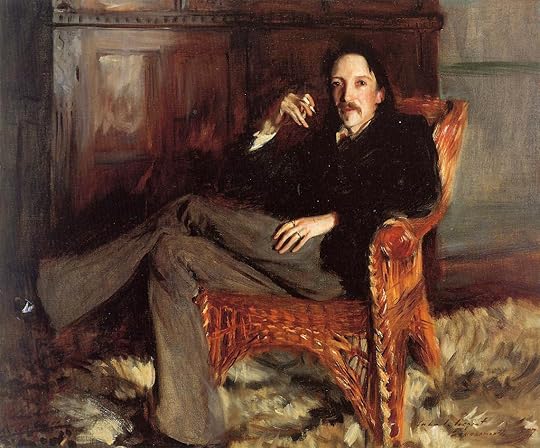

Robert Louis Stevenson by John Singer Sargent

Subtitled "A Trio and Quartette," it begins in Papeete, with three down-and-out Europeans living on the beach. Davis is a disgraced American ship captain, now living like the others under a false name. Huish is a diminutive Cockney clerk, described as "vulgar and wholly vile." In contrast, Robert Herrick, the book's protagonist, is an Oxford man of good family, who has nonetheless failed at every profession to which he has set his hand. Herrick travels with a copy of Vergil in his pocket, and is equally at home quoting Shakespeare or Heine. His literary references still further extend the range of diction in the novel—a constant fascination for Stevenson—which, on the scale of comprehension, run all the way down to the very un-politically-correct pidgin of the native crewmen and the Cockney patter of Huish:
"No, but I want to know," said Huish. "It's within the sp'ere of practical politics for you and me, my boy; we may both be bowled over, one up, t'other down, within the next ten minutes. It would be rather a lark, now, if you only skipped across, came up smilin' t'other side, and a hangel met you with a B. and S. under his wing. 'Ullo, you'd s'y; I tyke this kind."
Not the man's most incomprehensible utterance by any means; I quote it also because he is talking about death and the world to come. All three men, in one way or another, are occupied with the thought of how their ruined lives might end. When Davis wrangles a commission to sail to Australia, captaining a schooner, the Farfallone, whose officers have all died of smallpox, the three seize upon it as a way of escaping Tahiti, fully intending to steal it and its contents. But this also begins to feel like the voyage of the soul into the unknown.
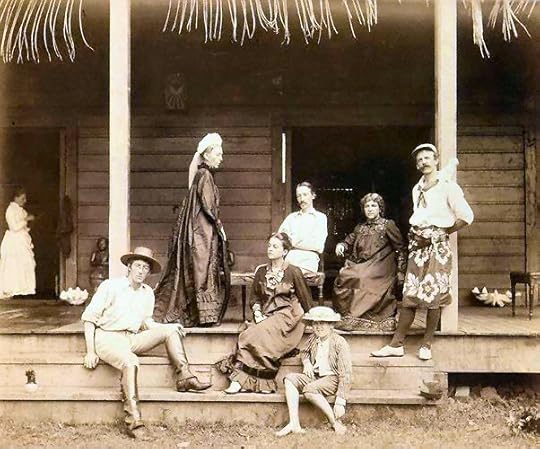

Stevenson (seated) in his house in Samoa

This is where the "Trio" turns into the "Quartette." After the perils of a mismanaged and storm-tossed sea passage that show Stevenson the adventure writer at his very best, the lookout sights an unmarked atoll. Anchoring the Farfallone in the shelter of its arms, the three encounter the master of the place, a tall upper-class Englishman named Attwater, most of whose people have also died of smallpox. The similarity of Attwater to Conrad's Kurtz in Heart of Darkness will not go unnoticed; there are also similarities to parts of Lord Jim and other novels. Although the two authors never met, Conrad professed great admiration for the older writer.*

Attwater is more complex that Kurtz, however; although capable of great cruelty, he is also a fervent Christian. Indeed, I get the sense that Stevenson sets him up as a symbol, combining in one figure the compassionate, vengeful, and all-knowing attributes of the Biblical God. Being Stevenson, the author brings his story to climax in a sequence of violent action, but this made me very much aware of the allegorical structure behind the adventure. Others have seen the "Trio" half of the novel as an allegory of colonialism. I am more aware that, when the addition of Attwater turns this into a "Quartette," the moral placement of the four characters is especially well chosen: the lapsed Davis, the unreconstructed Huish, the intellectual atheist Herrick, and the missionary Attwater. And the ending of the book says more about the human soul than about the adventures of beachcombers in the South Seas.

======

*
See Robert Louis Stevenson and Joseph Conrad: Writers of Transition, by Linda Dryden, Stephen Arata, and Eric Massie
Profile Image for Vittorio Ducoli.
580 reviews83 followers
March 3, 2022
Il “Romance” che giunge all’essenza del colonialismo

Commentando poco tempo fa Rapito, avevo notato come tale grande romanzo per ragazzi fosse stato edito da Robert Louis Stevenson nello stesso anno (1886) della pubblicazione in volume de Lo strano caso del Dr. Jekyll e di Mr. Hyde, rimarcando la sostanziale diversità delle due opere, non solo in relazione al diverso pubblico cui si rivolgono.
Nella bella introduzione a questa edizione de Il riflusso della marea, il curatore Fabrizio Bagatti fa un’analoga osservazione. Sentiamolo:
”In apparenza niente lasciava intuire, all’altezza de Il fanciullo rapito (1886), che Stevenson potesse pubblicare contemporaneamente un libro come Lo strano caso del Dr. Jekyll e di Mr. Hyde. Passa, tra i due romanzi, la differenza che può intercorrere fra un testo ancora pienamente inserito nei gusti e nei modi del romanzo ottocentesco e uno che, invece, si trova già con più di un piede nel nuovo secolo.”
Questa affermazione lapidaria mi ha incuriosito, innanzitutto perché – avendo appena letto Rapito - non mi ritrovo appieno nella sua catalogazione come romanzo pienamente ottocentesco: se infatti la cornice di bildungroman avventuroso può richiamare i grandi modelli romantici europei e su tutte, nell’ambientazione scozzese, la lezione di Sir Walter Scott, la sua vena picaresca e il richiamo esplicito al Robinson Crusoe, che rimandano alla letteratura di epoche precedenti, sono altrettanto evidenti; ma soprattutto il tema tipicamente stevensoniano dell’indagine dell’ambiguità del carattere umano - in cui coesistono male e bene - condizionato dalle circostanze in cui si trova ad agire, è già tema che preannuncia il novecento.
Stabilito quindi che Stevenson è sé stesso (al netto della fisiologica evoluzione di ogni autore che si rispetti) sia quando scrive Rapito o – anni dopo - il suo seguito Catriona, sia quando scrive Dr. Jekyll e di Mr. Hyde, Il riflusso della marea o il farsesco La cassa sbagliata, restava per me la necessità di indagare, di conoscere meglio la poetica di un autore capace di raggiungere vette narrative altissime cimentandosi in generi così diversi.
Mi ha aiutato il fatto che Stevenson ha dato alle stampe anche parecchi saggi inerenti la sua poetica e la sua visione della letteratura: tra questi ne ho selezionato tre che reputo particolarmente significativi, risalenti agli anni in cui lo scrittore scozzese stava facendo irruzione sulla scena letteraria britannica: si tratta di A Gossip on Romance (1882), di A Note on Realism del 1883 e di A Humble Remonstrance, del 1884.
Negli anni in cui Stevenson scrive questi tre saggi la letteratura europea e anche quella britannica sono fortemente influenzate dal naturalismo di stampo francese, il cui assunto fondamentale è dato dalla neutralità del narratore, che deve limitarsi a descrivere esattamente e dettagliatamente la realtà che lo circonda. Stevenson polemizza con questa visione della letteratura, contrapponendo al novel di stampo realistico il romance, il romanzo storico avventuroso.
In A Humble Remonstrance, polemizzando con inarrivabile ironia con Henry James, di cui in seguito diverrà amico e al quale a mio avviso lo legano non poche affinità di fondo, afferma: ”Nessuna arte, per usare l'audace frase di Mr. James, può con successo "competere con la vita" […] La vita ci precede, con la sua infinita complessità, frequentata dalle più varie e sorprendenti meteore, facendo appello allo stesso tempo all’occhio, all’orecchio, alla mente – sede della meraviglia - al tatto – così delicato da essere commovente - e allo stomaco, tanto imperioso quando è affamato”. E poco più avanti: ”Competere con la vita, il cui sole non riusciamo a guardare, le cui passioni e malattie ci devastano e ci uccidono, competere con il sapore del vino, la bellezza dell’alba, il bruciore del fuoco, l’amarezza della separazione e della morte: questo è davvero il progetto per una scalata al cielo, queste sono le fatiche per un Ercole in frac, armato di penna e dizionario per raffigurare le passioni, oppure armato di un tubetto di biacca superiore per ritrarre l’insopportabile sole”.
Più avanti, a proposito di cosa dovrebbe fare un giovane scrittore, dice: ”Non si preoccupi se si è disinteressato di migliaia di attributi al fine di perseguire instancabilmente quello che ha scelto. Non se ne abbia se ha tralasciato il tono della conversazione, il pungente dettaglio materiale sugli usi del tempo, la riproduzione dell’atmosfera e dell’ambiente. Tali elementi non sono essenziali [...] E come essenza della questione, ricordi che il suo romanzo non è una trascrizione della vita, da giudicare in base alla sua esattezza, quanto una semplificazione di qualche lato o punto della vita, che sta in piedi o cade a seconda della sua significativa semplicità. Spesso ciò che osserviamo e ammiriamo nei grandi artisti che hanno lavorato a grandi tematiche è la loro complessità, tuttavia una verità rimane immutabile al di là delle apparenze: che la semplificazione fu il loro metodo, e la semplicità la loro eccellenza.”
Il saggio quindi termina con la celebre sentenza ”il pericolo è che, cercando di raffigurare la normalità lo scrittore raffiguri il nulla, e scriva il romanzo (novel) della società in luogo del romanzo (romance) dell’uomo”.
Quindi Stevenson come propugnatore di un’arte slegata dalle circostanze sociali e dalla vita, in quanto quest’ultima risulta irrappresentabile? Stevenson come alfiere de l’art pour l’art? Come la sua intera opera dimostra, il discorso è sicuramente più complesso, e alcuni passi tratti dagli altri due saggi citati possono fornire importanti indizi in tal senso.
In A Gossip on Romance, a proposito della differenza tra teatro e letteratura, scrive: ”Il dramma teatrale è la poetica del comportamento, il romanzo (romance) la poetica delle circostanze. Il piacere che proviamo nella vita è di due tipi: attivo e passivo. A volte siamo consci che qualcosa di grande comanda il nostro destino; subito siamo presi dalle circostanze, come da un'onda che si infrange, e precipitati non sappiamo come nel futuro. Altre volte siamo soddisfatti del nostro comportamento, quindi semplicemente compiaciuti di ciò che ci circonda”. Il romance dunque come poetica delle circostanze: e di quali e quanti tipi possano essere le circostanze che precipitano l’uomo nel futuro Stevenson era pienamente conscio, come vedremo.
È però in A Note on Realism che Stevenson chiarisce bene come l’oggetto dei suoi strali sia non il realismo in sé, ma la pretesa, tipicamente positivista e naturalistica, di fare del romanzo quasi un trattato scientifico, in grado di rappresentare oggettivamente e dettagliatamente una realtà compiutamente conosciuta. Non a caso nel breve saggio sono citati, come esempi di questa tendenza, Zola e Daudet. In proposito ritengo particolarmente significativi i seguenti due estratti.
”Tutta l'arte rappresentativa che possa dirsi viva è insieme realistica e idealistica, e il realismo di cui discutiamo è puramente esteriore. Non è un culto speciale della natura e della veridicità, ma il semplice capriccio di una moda deviata, che ci ha fatto voltare le spalle all'arte più grande, più varia e più romantica del passato”. Ed ancora, poco sotto: ”La questione del realismo, sia ben inteso, non riguarda minimamente l’essenza fondamentale di un’opera d’arte, ma solo il metodo della sua scrittura. Sii quanto idealista o astratto ti aggrada, nondimeno sarai veritiero; ma se sarai debole, correrai il rischio di essere noioso e inespressivo; e se sarai molto forte e onesto, potresti avere a che fare con un capolavoro”.
Circa un decennio separano queste considerazioni dalla scrittura de Il riflusso della marea, un decennio in cui per Stevenson sono cambiate molte cose: il suo successo editoriale si è consolidato con la pubblicazione di alcuni romanzi e molti racconti, la sua salute è sempre più minata dalla tubercolosi; lasciata definitivamente la Scozia, inizialmente per gli Stati Uniti, dal 1889 si è stabilito, con Fanny e i figli di lei, in Polinesia.
Nonostante questi cambiamenti radicali a mio avviso Il riflusso della marea, scritto nel 1893, come pure Il relitto, che lo precede di un paio d’anni, sono esempi perfetti della applicazione coerente degli assunti teorici contenuti in quei vecchi articoli alla sua produzione letteraria.
Prima di analizzare questo splendido romanzo, mi sia però consentita una considerazione che ritengo d’obbligo. Il riflusso della marea e Il relitto non sono accomunati solo da quanto detto poco sopra o dal fatto di essere entrambi ambientati in quei Mari del Sud di cui ormai Stevenson era abitante: entrambi sono stati scritti a quattro mani da lui e dal figliastro Lloyd Osbourne. In entrambi i casi l’apporto di Osbourne non fu affatto marginale, e nel caso de Il riflusso della marea l’idea stessa del romanzo venne a quest’ultimo, che scrisse i primi tre capitoli prima di leggerli ad un entusiasta Stevenson e collaborò alla pari alla stesura degli altri. Ritengo quindi iniquo che i due romanzi vengano attribuiti al solo Stevenson, relegando nell’oscurità il ruolo importante che, da un punto di vista sia prettamente letterario sia di sostegno psicologico al malato Stevenson, Osbourne ebbe nella nascita di alcuni capolavori letterari.
Ne Il riflusso della marea non è difficile rintracciare le stimmate del romance, sia pure ambientato nella modernità. I tre personaggi principali, i tre reietti alla deriva che ci vengono presentati nei primi capitoli, mostrano tratti archetipici atti a definire un’epica del fallimento. Il capitano Davis, marinaio che ha perso una nave perché ubriaco in una notte di tempesta, che pure ”… era un uomo: aveva avuto ricchezze, tratti gentili e un carattere risoluto”; poi lo spregevole scrivano londinese Huish, tanto abietto da essere trattato come un cane da tutti a Tahiti; e infine il giovane Robert Herrick, laureato a Oxford, amante di Virgilio ma spinto dalle circostanze della vita verso il detestato mestiere di contabile, ed affondato a Tahiti per la totale mancanza di carattere e volontà, dopo infiniti licenziamenti sulle due sponde dell’Atlantico. Ai tre, che stanno insieme per disperazione, elemosinando i pasti e dormendo nei ruderi della vecchia prigione, capita l’occasione del riscatto. Nella baia è alla fonda uno schooner, il Farallone, che ha issato sul pennone la bandiera gialla dell’epidemia. Il capitano ed un ufficiale sono morti di vaiolo in mare, e il resto dell’equipaggio, composto di indigeni kanaka, è riuscito non si sa come a raggiungere Tahiti. La nave deve portare un carico di champagne californiano a Sidney, ed il console inglese si è visto rifiutare l’offerta di comandarla da tutti i capitani di Tahiti, per tema del vaiolo. È così giunto ad offrire la nave a Davis, che naturalmente ha accettato, concependo subito un losco piano per arricchirsi: dirigersi non a Sidney ma in Perù, dove i tre avrebbero venduto in proprio lo champagne e la nave.
Huish è subito d’accordo ed Harrick supera presto i suoi scrupoli morali: così in poche ore il Farallone (nome a chiave? Far Alone) lascia Tahiti al comando di Davis. Presto il capitano e Huish iniziano a dar fondo allo champagne sino a ridursi ubriachi dalla mattina alla sera: il comando della nave viene di fatto preso da Harrick; la tensione fra i tre sale alle stelle sino a che non scoprono che gran parte delle bottiglie sono riempite di acqua. Truffatori truffati, capiscono anche che le provviste imbarcate sono insufficienti per giungere in qualsiasi porto; avvistano però un’isola non riportata sulle mappe il cui signore, Attwater, è un mercante di madreperla e perle che accumula servendosi di nativi sottomessi con un pugno di ferro ammantato di misticismo cristiano. Per inciso: che preziosa eredità lasciata nelle mani di Conrad in tutto il romanzo, ma soprattutto in questo personaggio, a mio avviso vero padre putativo venale di Kurz. Lascio al lettore scoprire cosa accade nella seconda metà del romanzo, che è anche carico di suspense.
Tranne l’eroe buono e l’amore (quasi sempre bandito dalla letteratura stevensoniana), nel romanzo ci sono tutti gli ingredienti del romance: paesaggi incantati, abiezione umana, crimine, avventura. E se il romance è la poetica delle circostanze, qui molte sono le circostanze che determinano gli avvenimenti indipendentemente dai comportamenti dei protagonisti. Solo che in molti casi queste circostanze non sono determinate dal destino, ma hanno origini ben precise. Per rimanere a quanto citato della trama, il vaiolo che consegna il Farallone ai tre protagonisti è un portato della colonizzazione occidentale delle isole, mentre la circostanza che lo champagne sia in realtà acqua (sorta di miracolo di Cana alla rovescia) è la plastica denuncia del carattere fraudolento del commercio internazionale, in confronto al quale i tre appaiono davvero dei rubagalline. E che dire della figura di Attwater, la circostanza decisiva per la sorte dei nostri antieroi, perfetta incarnazione della sovrastruttura religiosa e civilizzatrice di cui venivano ammantati i più efferati crimini coloniali, oggi sostituita dalla mistica della democrazia e dei diritti umani, come insegnano anche le cronache afghane di queste ore? ”La mia missione rende” dice Attwater ad un certo punto, e raramente sintesi fu più felice nel delineare il carattere di gran parte delle imprese coloniali.
Come ne Il relitto e forse più nettamente, in questo romanzo appare a mio avviso la drastica e lucida condanna di Stevenson, ormai Tusitala, per lo scempio che delle isole, delle sue civiltà, dei suoi abitanti il capitalismo imperialista sta ormai facendo. Scrivere un romance è così davvero, come affermato da Stevenson dieci anni prima, un metodo tecnico per rendere avvincente il romanzo, le cui circostanze (ma anche, ad essere sinceri, i comportamenti dei protagonisti) fanno comunque emergere l’essenza del colonialismo,al di là di qualunque realismo.
Resta da dire che, soprattutto nel personaggio di Robert Herrick, ma anche in quello del capitano Davis, si ritrova il tema della complessità e dell’ambiguità della personalità umana, e resta soprattutto da dire che il romanzo è scritto splendidamente, con alcuni capitoli (su tutti a mio avviso il terzo, che tra l’altro dovrebbe essere stato redatto da Lloyd Osbourne) indimenticabili.
Tra l’altro la traduzione in questa edizione mi è parsa ottima, soprattutto perché Fabrizio Bagatti è riuscito nell’arduo compito di rendere in italiano le differenze di linguaggio tra lo yankee Davis, il cockney Huish e l’oxfordiano Herrick, così evidenti nell’originale, senza ricorrere a forzature linguistiche, così frequenti in casi analoghi.
Profile Image for Elizabeth.
695 reviews57 followers
September 14, 2024
What on earth did I just read? This was one of the most bleak, meandering, maddening tales I've read in a long while. It was hard to connect to the characters or to understand them, and eventually, it was hard to care. They're well-drawn and interesting enough as characters; the problem (for me) is that they lack the context a better plot would have given them. We are introduced to them only after they have lost all hope and are pushed to desperation. How did they come to this? Stevenson explains, kind of. A little. But it was hard for me to appreciate the gravity of their situation, especially Herrick and Huish, when it seemed as though they could still pretty easily solve their problems and go home. Instead, they become criminals, and even then, they are still mean to each other! Stevenson is a gifted author, and the tension did build slowly and steadily toward the dramatic climax . . . and then what? An epilogue that doesn't wrap things up, some characters that seem suddenly a little out of character—and how does a story that drags on so long even manage to create such an abrupt ending? Tedious, but interesting enough, I suppose. If you got something out of this, then great! I have enough respect for Stevenson to recognize his skill, even if the finished product leaves me scratching my head.
Profile Image for Marianna Flessa.
121 reviews
August 22, 2020

https://vivliosimeia.blogspot.com/202...

Ο Ρόμπερτ Λούις Στίβενσον (1850-1894) δεν είναι ένας άγνωστος συγγραφέας. Οι περισσότεροι έχουμε διαβάσει στα παιδικά μας χρόνια «Το νησί των θησαυρών», στην εφηβεία μας ή την περίοδο που πειραματιστήκαμε με τα θρίλερ διαβάσαμε ή είδαμε κάποια κινηματογραφική εκδοχή του «Δόκτωρος Τζέκυλ και κυρίου Χάιντ». Πολλοί θεωρούμε τα βιβλία του ως παιδικά και δυστυχώς διαβάσαμε διασκευές και περιλήψεις τους που τους αφαίρεσαν ένα σημαντικό τμήμα από την ανάλυση των χαρακτήρων των ηρώων τους, δίνοντας μεγαλύτερο βάρος στην πλοκή, την περιπέτεια και στο κυνήγι του χαμένου θησαυρού. Οι εκδόσεις Printa φέρνουν στα χέρια μας τους «Τυχοδιώκτες» που είναι το τελευταίο ολοκληρωμένο μυθιστόρημα που γράφει ο συγγραφέας και συνεπώς μπορούμε να το θεωρήσουμε ως έργο της συγγραφικής του ωριμότητας.

Τίποτα δεν προδιέθετε ότι ο Ρόμπερτ Λούις Στήβενσον, που γεννήθηκε στο Εδιμβούργο το 1850, θα γινόταν συγγραφέας. Η οικογένειά του, ήταν οικογένεια μηχανικών που εξειδικεύτηκε να κτίζει φάρους. Το μεγαλύτερο ποσοστό φάρων που ακόμα και σήμερα υπάρχουν γύρω από το νησί της Βρετανίας, κτίστηκε από τον πατέρα του και τους αδερφούς του (που ακολούθησαν το επάγγελμα του πατέρα τους). Το ίδιο αναμενόταν ότι θα έπραττε και ο συγγραφέας αλλά καθώς ήταν φιλάσθενος, περνούσε πολλές ώρες διαβάζοντας και γράφοντας από νεαρή ηλικία. Όταν έφτασε η ηλικία να σπουδάσει, όχι μόνο δεν εγγράφεται στους μηχανικούς αλλά απορρίπτει κάθε προσπάθεια να παρακολουθήσει κάποια σχολή και ζει μία μποέμικη ζωή. Γνωρίζει ανθρώπους οι οποίοι στηρίζουν τις συγγραφικές του ανησυχίες και πολύ σύντομα ρίχνεται σε περιπέτειες και ταξίδια που θα τον γεμίσουν έμπνευση για τα μελλοντικά του έργα. Παντρεύεται μία γυναίκα διαζευγμένη, την οποία η οικογένειά του δεν εγκρίνει και δε σταματάει να ταξιδεύει παρά την κλονισμένη υγεία του. Γράφει ασταμάτητα και τα έργα του αρχίζουν κι έχουν απήχηση και διαβάζονται μανιωδώς. Θα αφήσει την τελευταία του πνοή στους τόπους που περισσότερο τον ενέπνευσαν και όπου τοποθέτησε την εξέλιξη πολλών μυθιστορημάτων του: στη Σαμόα, ένα νησιωτικό σύμπλεγμα του Νότιου Ειρηνικού Ωκεανού και σε ηλικία μόλις 44 ετών.

Στο μυθιστόρημα περιπέτειας «οι Τυχοδιώκτες», τρεις Αγγλοαμερικανοί άντρες, που η μοίρα τους έχει ξεβράσει σε μια ξεχασμένη παραλία της Ταϊτής, το Παπεέτε, ζουν μέσα στη φτώχεια και την απόγνωση. Οι ελπίδες τους να αποδράσουν είναι ελάχιστες και μέρα με τη μέρα βυθίζονται στην απελπισία. Άστεγοι, στην ουσία, οι μουσώνες των νοτίων κλιμάτων τούς χτυπούν ανελέητα ενώ στις ατυχίες τους έρχεται να προστεθεί η γρίπη που μαστίζει το νησί με αναρίθμητα θύματα από τον ντόπιο πληθυσμό. Η απόγνωσή τους έχει φτάσει στο απόγειο και ίσως η μόνη λύση που τους απομένει, είναι μια βουτιά χωρίς επιστροφή στον ωκεανό. Όμως, η τύχη τους χαμογελά, όταν ένα, από τα δεμένα στο λιμάνι, καράβι βρίσκεται χωρίς καπετάνιο και πλοηγό εξαιτίας μιας επιδημίας ευλογιάς και οι τρεις άντρες είναι οι μόνοι που έχουν την ικανότητα να οδηγήσουν το πλοίο πίσω στο λιμάνι του, το Σίδνεϊ. Είναι μια απίστευτη ευκαιρία που τους δίνεται και οι ελπίδες τους αναζωπυρώνονται. Ο Ντέιβις, ο Χούις και ο Χέρρικ ρίχνονται σε μια καινούργια περιπέτεια. Η άστατη θάλασσα κατά το ταξίδι τους, τους φέρνει και προσδένουν σε μια ατόλη, σε αχαρτογράφητα νερά. Εκεί με έκπληξη διαπιστώνουν ότι κύριος και αφέντης τους νησιού είναι ένας Ευρωπαίος, ο Αττγουότερ,ο οποίος πολύ γρήγορα γίνεται ο τέταρτος της παρέας τους και τους αποκαλύπτει το θησαυρό που κατόρθωσε να συγκεντρώσει. Μια μεγάλη ποσότητα μαργαριταριών, έναν αμύθητο θησαυρό. Οι τυχοδιώκτες γρήγορα καταλαβαίνουν ότι αυτό είναι το εισιτήριό τους για μία καλύτερη ζωή. Τα πάντα θα άλλαζαν και θα γίνονταν πολύ διαφορετικά αν κατάφερναν να αποσπάσουν τα απίστευτα αυτά πλούτη για τον εαυτό τους. Αλλά τα πράγματα δεν εξελίσσονται όπως τα έχουν σχεδιάσει. Όλα ανατρέπονται, λες κι ο ίδιος ο διάβολος να προστάτευε τον Αττγουότερ και τον θησαυρό του. Ένας ανελέητος αγώνας ξεκινάει για την απόκτησή του. Μια περιπέτεια πραγματική με μη αναμενόμενες ανατροπές.

Ο Στήβενσον γράφει μία περιπέτεια που ικανοποιεί κάθε μικρό και μεγάλο αναγνώστη που αγαπάει τα βιβλία περιπέτειας. Η αφήγηση εξελίσσεται πολύ ομαλά χωρίς σκοτεινά σημεία και ανεξήγητα άλματα. Όλα όσα εξιστορούνται είναι πιθανά και ικανά να συμβούν στον τολμηρό τυχοδιώκτη που θα αποφασίσει να αναζητήσει την τύχη του στους Τροπικούς. Αλλά μόνο εκεί. Η γλώσσα του είναι λιτή, περιγραφική ίσως και λίγο λυρική όπως αρμόζει σε συγγραφέα του 19ου αιώνα.

Οι χαρακτήρες του Στήβενσον είναι μία ιδιαίτερη πτυχή των μυθιστορημάτων του. Πολλές φορές η πλοκή επισκιάζει τους ήρωές του και φυσικά στις διασκευές των έργων του που διαβάσαμε όταν ήμασταν παιδιά, οι χαρακτήρες απλοποιούνται εντελώς. Χάνουν το βάθος τους και φυσικά ο αναγνώστης δεν αντιλαμβάνεται την αξία του έργου του σε αυτό το επίπεδο. Στο μυθιστόρημα «Οι Τυχοδιώκτες» για ακόμη μία φορά εγείρεται το ερώτημα της αξίας της ανθρώπινης ζωής. Της ζωής των ιθαγενών που εκμεταλλεύεται ο Αττγουότερ. Ποια είναι η αξία της ζωής του ίδιου του σκληρόκαρδου εκμεταλλευτή τους, του Αττγουότερ. Αναζητούνται απαντήσεις σε ερωτήματα για το κατά πόσο η ζωή είναι δίκαιη και ίση για όλους. Οι τρεις φίλοι αναρωτιούνται συχνά αν αξίζουν την εύνοια ή την απαξίωση της τύχης και αν κάποια θεία δύναμη ή ο σατανάς τους εκδικείται για τις ανόσιες πρότερες πράξεις τους. Η αιώνια μάχη του καλού με το κακό.

Οι Τυχοδιώκτες με γύρισαν πίσω στο χρόνο τότε που παιδί ταξίδευα με καράβια πειρατών σε τυρκουάζ νερά και αναζητούσα χαμένους αμύθητους θησαυρούς. Ταυτόχρονα το ψυχογράφημα των ηρώων του με προσγείωσε στην ρεαλιστική πραγματικότητα των ενηλίκων. Η διεισδυτική ματιά του συγγραφέα στον τρόπο που αποφασίζουν να δράσουν οι ήρωές του κάνει την ιστορία ακόμη πιο ενδιαφέρουσα. Είναι η ακμή της συγγραφικής ικανότητας του Στήβενσον και στις σελίδες του βιβλίου του εξετάζονται θέματα που αργότερα θα προβληματίσουν κατά κόρον την ανθρώπινη κοινωνία: η δουλεία, ο ρατσισμός, η σύγκρουση του παραδοσιακού με το μοντέρνο, η αποικιοκρατία.
Profile Image for Roisin.
179 reviews5 followers
September 15, 2021
Mandy’s toxic trait is loving Stevenson and making us all read him in every class
Profile Image for Illiterate.
2,780 reviews56 followers
December 24, 2021
Colonialism, violent exploitation, religious hypocrisy, personal disintegration.
Profile Image for Sonia (huellasdelibros).
187 reviews16 followers
April 11, 2022
Un libro increíble de aventura, suspenso y misterio, con su dosis necesaria de crítica a diversos temas, entre ellos la colonización. Y sobre todo lleno de reflexiones sobre el actuar del hombre, la eterna disputa entre el bien y el mal, personajes que harán que uno sienta repugnancia por ellos.
Profile Image for Marco Beneventi.
323 reviews8 followers
January 30, 2021
Tahiti, città di Papeete, tre uomini, Roberto Herrick, uomo erudito e dalla ferrea morale ma con una lunga scia di fallimenti alle spalle, John Davis, capitano marittimo in disgrazia e l’ex commesso Tomkins, uomo rozzo, indolente e violento, si trovano degradati, per la lunga scia di disgrazie che li accompagna, al ruolo di paria.
L’occasione per riemerge peró gli si presenterà quando avranno l’opportunità di riportare al porto di partenza una vecchia goletta, la “Farallone”, alla partenza le promesse di lealtà di due membri si tramuteranno purtroppo in qualcosa di ben più venale e fuorilegge, i casi della vita e le vie del mare peró li faranno giungere in un luogo sconosciuto alle mappe marittime, un isola abitata e gestita dall’enigmatico Attwater, uomo tutto d’un pezzo e forte credente che porterà diversi sconvolgimenti nella vita dei tre marinai.

“Il riflusso della marea” scritto a due mani da Stevenson e il figliastro Lloyd Osbourne nel 1894 è il classico libro in cui si puó trovare un’avventura marinaresca vecchio stile, dalla scrittura a volte un pó lambiccosa ma incredibilmente evocativa e fotografica, questo breve romanzo ha in se il pregio di avere una storia credibile e particolarmente ritmata.
I personaggi, molto ben descritti, pregni di umanità e debolezze reali, figure “sostanziose” con cui risulta impossibile non empatizzare sono resi tali anche grazie a dialoghi ben scritti, ogni personaggio ha infatti cucito a se un certo modo di esprimersi che dice davvero tanto della sua personalità permettendo così al lettore una chiara lettura dei pensieri dei protagonisti.
Questo romanzo oltre ad essere una bella avventura di mare ha anche in se diversi passaggi che rimandano ad misticismo religioso tipico dell’epoca in cui venne scritto, ci troveremo quindi a confrontarci con personaggi abietti, senza scrupoli né morale e li vedremo mutare e redimersi proprio attraverso la vicinanza a Dio e alla preghiera.
Un breve romanzo questo “Il riflusso della marea”, inserito nel solco delle migliori avventure marinaresche che riesce, grazie alle sue scelte narrative, a tenere il lettore attaccato alle pagine sino alla fine.
Personalmente uno fra i migliori scritti di Stevenson.
Profile Image for Guido.
130 reviews63 followers
August 23, 2012
Romanzo d'avventura che ha per protagonisti tre autentici falliti abbandonati su una spiaggia di Tahiti, tre individui sgradevoli, disonesti e disperati, ai quali viene offerta una possibilità di riscatto - il trasporto di un carico di champagne a Sydney - che dovrebbe essere, per loro, l'inizio di una nuova vita: interverranno, naturalmente, altre complicazioni, e il loro destino sarà diverso. Qui Stevenson riflette sul suo rapporto amaro e disincantanto col cristianesimo; la narrazione risente delle pagine scritte con la collaborazione del figliastro Lloyd Osbourne, allora aspirante scrittore, i cui contributi tuttavia sono limitati ai primi capitoli, e non ebbero alcuna influenza sulla struttura del romanzo, che può essere giustamente considerato opera di Stevenson. Quando la sua penna torna sola, però, il cambiamento è evidente, e il racconto muta improvvisamente carattere: l'avventura in parte lieve dei tre delinquenti si fa cupa come nelle sue opere migliori; inventa un personaggio straordinariamente affascinante e spaventoso, Attwater, che sembra precedere il fascino demoniaco del Kurtz di Conrad in "Cuore di tenebra": lì avorio e foresta impenetrabile, qui perle e mare silenzioso, sconfinato; in entrambi il colonialismo, lo sfruttamento degli indigeni, la mediocrità morale dei bianchi e l'oscena pretesa di evangelizzazione, la solitudine di una personalità potente e magnetica in un luogo remoto, un uomo che attrae con la sua affascinante, ipnotica perversità. Stevenson morì subito dopo aver pubblicato questo romanzo; aveva quarantaquattro anni e la sua produzione letteraria cominciava ad arricchirsi dei primi frutti di una maturità potenzialmente ricchissima - la quale, purtroppo, non potè mai realizzarsi.
Profile Image for Sam.
3,454 reviews265 followers
February 17, 2013
This collection holds the Ebb Tide and the Island Nights Entertainments (or the South Sea Tales if you prefer). The Ebb Tide follows three men who having found themselves on the island of Tahiti are employed by the US Consul to ship a cargo of champagne to Sydney after the original crew come down with small pox. However during their journey they find that all is not quite what it seems and are forced to take alternative action. Island Nights' includes three tales, the Beach of Falesá, the Bottle Imp and the Isle of Voices. The first story tells of an English tradesman who finds himself in a hastly arranged marriage that threatens his future until he unravels the reality of what is happening and takes action to show the islanders the truth. The second story is a classic tale of being careful what you wish for and not expecting something for nothing while the third also shows the dangers that greed poses. All of these stories are superbly written with vivid descriptive prose that brings the people and places to life. The characters develop well, even in the shorter stories, and Stevenson manages to bring a sense of humanity to each of them, making the reader all the more sympathetic to their various plights. A thoroughly enjoyable collection.
Profile Image for Laura.
7,132 reviews606 followers
December 11, 2016
From BBC Radio 4 Drama:
The second of two dramatisations of Robert Louis Stevenson's gripping novellas set in Samoa and written while he lived there. Starring David Tennant.

Three destitute men steal a schooner. They drink the cargo of champagne and try to steal a treasure trove of pearls from a local slave-owning trader.

At the height of his powers, Stevenson tackled the most pressing theme on the islands - the vicious effects of colonialism including slavery, racism, sexual exploitation and the conflict between traditional and modern values. The subjects are as vivid today as in 1894 and these compelling and violent stories feature some of the most driven, dangerous and obsessive characters in fiction. Joseph Conrad drew on these novellas for Heart of Darkness.

Dramatised for radio by Jane Rogers
Produced and Directed by Clive Brill

A Brill production for BBC Radio 4.


http://www.bbc.co.uk/programmes/b084tl7z
Profile Image for Sylvester (Taking a break in 2023).
2,041 reviews87 followers
October 8, 2012
I'm at a loss for words, really. Not what I expected from RLS. Odd story of which I somehow missed the point. My disappointment tempted me to give it only one star, but it wasn't horrible. I blame the co-author, whoever he was.
Profile Image for JPR.
106 reviews4 followers
September 11, 2021
No sabía de la existencia de esta novela de Stevenson y la verdad que me ha gustado.

Como en otras novelas de este autor, la dualidad moral de sus personajes se hace patente y provoca en el lector muy buenas sensaciones.

Ojo con el prólogo de Valdemar, es un spoiler en toda regla.
Profile Image for Andy.
1,176 reviews222 followers
February 15, 2023
Firstly, masterful storytelling. Secondly, all the time I didn’t know if this was going, I really enjoyed it. And that was 99% of the time. In style, it reads like treasure Island crossed with Cannery Row.
Profile Image for Vladimir Ivanov.
413 reviews25 followers
May 20, 2020
Начало книги удивило — это не Стивенсон, а натуральный Максим Горький, "На дне". Трое опустившихся бомжей тусуют где-то на Таити, клянчат у моряков еду, приворовывают, бесконечно рассуждают о своей ничтожности, о тьме человеческой души, о справедливости и о прочих традиционно "русских" темах.

Но скоро все встает на свои места! Пиратство, угон корабля, черная оспа на борту, дерзкие мошеннические планы, обманщик обманывает обманщика, перестрелки, серная кислота в глаза!

Написано прекрасно, как всегда у Стивенсона. Юному читателю повесть может показаться чуток затянутой, особенно начало, а мне такое обстоятельное изложение очень понравилось.
Profile Image for Geraud.
387 reviews9 followers
January 23, 2013
un roman tragi-comique sur l'échec, plein de mélancolie et de désenchantement. j'ai eu un mal fou à le lire malgré sa petite taille. Je n'ai pourtant rien à lui reprocher sinon, de l'avoir lu au mauvais moment.
Profile Image for Adrian Buck.
303 reviews65 followers
May 23, 2013
Frustrating not to find out what the effect of this adventure was on the main character!
Profile Image for Phil Clymer.
142 reviews3 followers
November 7, 2014
Almost a pirate tale. Lacks the punch of his other works, more like a long short story. Even at that it is worth the time invested.
Profile Image for R.L..
880 reviews23 followers
June 23, 2019
English review below the Greek one...

O Robert Louis Stevenson έγραψε το συγκεκριμένο έργο μαζί με τον θετό του γιό και σε κάποια σημεία αυτό φαίνεται, αλλά γενικά είναι ένα ενδιαφέρον ανάγνωσμα.

Κάποια σημεία του κειμένου θα ξενίσουν τον σύγχρονο αναγνώστη, με την περίεργη αίσθηση της Βικτωριανής εποχής περί ανωτερότητας και του τι συνιστά έναν σωστό άνθρωπο και gentleman, καθώς και για τον τρόπο που αντιμετωπίζονται οι ιθαγενείς. Ένας υποψιασμένος αναγνώστης του 2019 θα βρει ενδεχομένως τις
εναλλαγές της πλοκής όχι και τόσο πειστικές, και έναν σημαντικό χαρακτήρα του βιβλίου προς το τέλος λιγάκι δυσνόητο. Επίσης η αλλαγή ιδιοσυγκρασίας ενός άλλου ήρωα είναι λιγάκι απότομη -όσο και καταλυτική για την ιστορία- και όχι πολύ πειστική. Αλλά και πάλι...

Η ιστορία καλεί τον αναγνώστη να δει τι θα γίνει στη συνέχεια, αλλά σε γενικές γραμμές είναι μία σπουδή χαρακτήρων. Ο Stevenson συχνά εξερευνά την φύση του ανθρώπου στα έργα του και έχουμε κι εδώ πολλές μεταστροφές στην ψυχολογία των ηρώων ανάλογα με την εξέλιξη των γεγονότων. Οι χαρακτήρες δεν είναι αποκλειστικά καλοί ή κακοί και ο αναγνώστης μπαίνει σε σκέψεις για το τι θα έκανε στις συγκεκριμένες συνθήκες.

Ως ένα βαθμό, αν και ο συγγραφέας εστιάζει αλλού, το όλο σκηνικό έχει επίσης το ενδιαφέρον του. Ο Stevenson δημιούργησε ιστορίες γεμάτες περιπέτειες, μέρη και συμπεριφορές που φάνταζαν εξωτικά στους περισσότερους ανθρώπους της εποχής του κι ακόμα και σήμερα γοητεύουν...

Το τέλος είναι δεικτικό αν και κάπως απότομο και με άφησε με ανάμεικτα συναισθήματα και τροφή για σκέψη όπως άλλωστε και όλο το βιβλίο. Γενικά αξίζει τον κόπο...


I don't think I would like to live on the Victorian era while sometimes the beliefs of Victorians about what consists a decent attitude to life, what is virtue and one's duty and what means to be a gentleman, seem alien or just irk me. Still, I'm very fond of this era's authors, who often had produced many diverse and interesting works, reasonating in general even today.

R.L. Stevenson is one of my most favourite authors and quite a character his self and while The Ebb-Tide (co-written with his step-son) is not his best work, it's still very interesting.
The story draws the reader right enough, but it's strong point is mostly the characterisation. Some of the plot lines are a bit naive and at least one character appears to be very weird, but this author liked to explore the human nature and doesn't picture his characters as 100% evil or 100% good. The morals and psychological state of each character seem to change a lot along the various plot twists and this offers lots of food for thought. What would one do under certain circumstances?

The end was a bit abrupt and offered further food for though and while this isn't my favorite book from this author, it's still very decent and worths a read...
Profile Image for Jessica Foster.
198 reviews10 followers
January 30, 2023
Actually pretty great, a lot more fun than I expected. I read this after Treasure Island and I can see a lot of its themes here too. A more adult tale, but with similar characterisations and similar adventurous storytelling-with a darker twist. This is about three down at heal 'sailors', men who've squandered life and neglected their loved ones with all the hopes and without any conviction for success. They set off on a final task across the South Seas to escape their hopeless stranded situation. I found it enjoyably unpredictable -- almost allegorical but original in its scope and its dark humour. It's made me want to read Stevenson more. Previously I'd just read him for school, I had to read Jekyll and Hyde numerous times but this felt more true, in some way, its insights into humanity more sinister. One to re-read assuredly. Oddly, the kid was keen for me to read this to her after Treasure Island and I think she enjoyed it--it's obviously more advanced being an adult tale but we spoke about it a lot. Some great lines in there too, in the first part.
Displaying 1 - 30 of 67 reviews

Can't find what you're looking for?

Get help and learn more about the design.