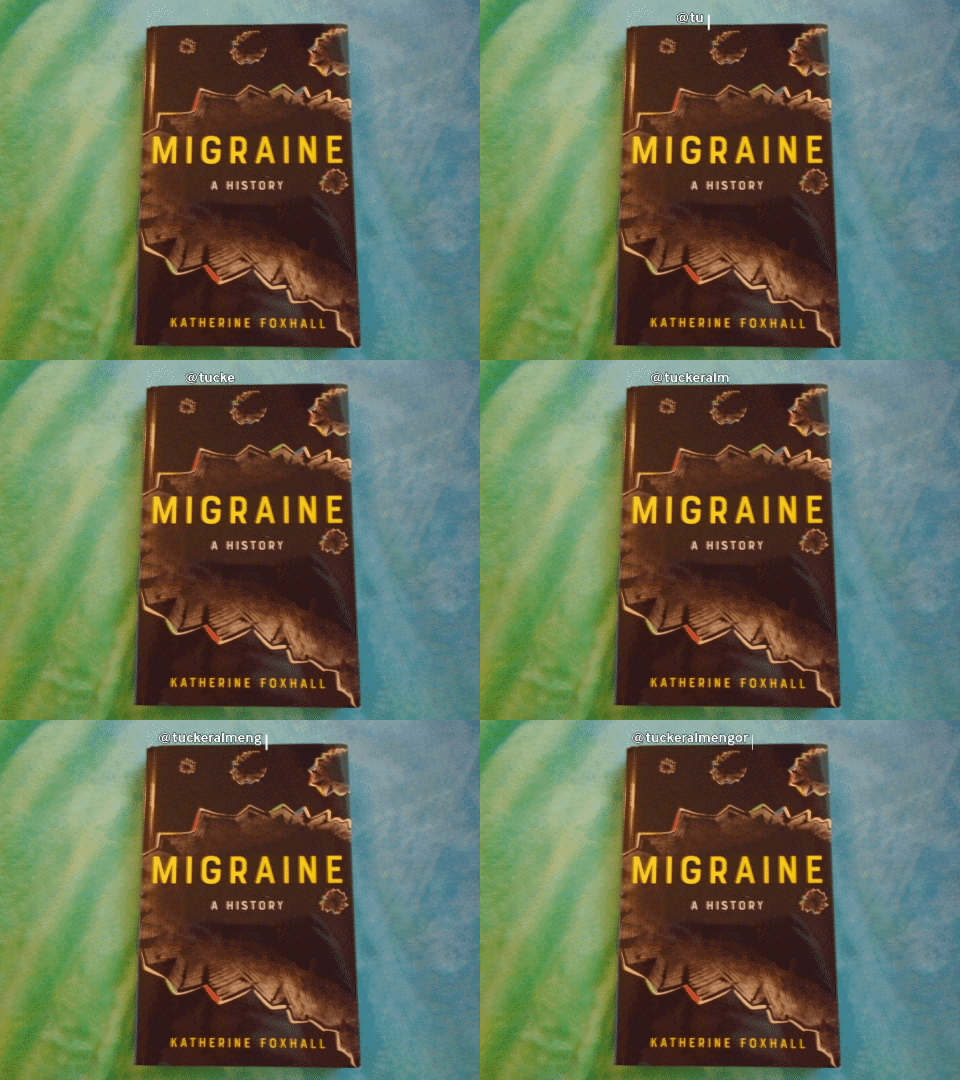
A cultural, social, and medical history of migraine. For centuries, people have talked of a powerful bodily disorder called migraine, which currently affects about a billion people around the world. Yet until now, the rich history of this condition has barely been told. In Migraine , award-winning historian Katherine Foxhall reveals the ideas and methods that ordinary people and medical professionals have used to describe, explain, and treat migraine since the Middle Ages. Touching on classical theories of humoral disturbance and medieval bloodletting, Foxhall also describes early modern herbal remedies, the emergence of neurology, and evolving practices of therapeutic experimentation. Throughout the book, Foxhall persuasively argues that our current knowledge of migraine's neurobiology is founded on a centuries-long social, cultural, and medical history. This history, she demonstrates, continues to profoundly shape our knowledge of this complicated disease, our attitudes toward people who have migraine, and the sometimes drastic measures that we take to address pain. Migraine is an intimate look at how cultural attitudes and therapeutic practices have changed radically in response to medical and pharmaceutical developments. Foxhall draws on a wealth of previously unexamined sources, including medieval manuscripts, early-modern recipe books, professional medical journals, hospital case notes, newspaper advertisements, private diaries, consultation letters, artworks, poetry, and YouTube videos. Deeply researched and beautifully written, this fascinating and accessible study of one of our most common, disabling—and yet often dismissed—disorders will appeal to physicians, historians, scholars in medical humanities, and people living with migraine alike.
I've read a number of medical histories and this was the most readable. As a migraine sufferer, I was the most engaged with this, but some of the histories I've read in the past have been difficult going. Despite this, the average migraine sufferer likely isn't going to pick up Foxhall's book, but for the curious reader it holds many wonders about an illness known in some ways for multiple millennia. Katherine Foxhall uses a feminist approach to give voice and witness to the experience of migraine (perhaps part of the reason the book is readable). I learned so much and it has given me so many insights to help make sense of the world with chronic migraine. I highly recommend "Migraine: A History."
If you want a very in-depth look at how migraines have been portrayed in the medical literature and case reports dating from ancient times to the present, this book is for you. I got a bit bogged down sometimes with so much detail, but I found the sections on more recent history very interesting.
I was asked to review this text book by the Nursing Times Journal
What was it like?
The cover intrigued me, I always felt it was black when a migraine came on or maybe it was a darkened room. I found this a topic that is talked about a lot, many people suffer from this, but I had not come across such a comprehensive and concise book written about this. The artwork on page 87 sums it up perfectly. This book explores so many theories from Wolff in the late 40s describing this as an inability to adapt to situations in life which I would say was stress and emotions, today, to the 1880s where people who were cultured suffered from neurasthenia yet the poorer classes suffered from epilepsy? But that was how people thought and thank fully we in society have moved on.
I found the various sections fascinating and how theorists and culture have changed and moved on- it is a book to pick up and read certain sections at a time.
The highlights:
It is a well set out book which although some readers may find a large read like this daunting the author writes well and it is easy to read. I encourage readers to read this in sections it is fascinating.
I particularly like the artwork within the book as I could identify with this as now an occasional migraine sufferer.
Strengths & weaknesses:
The author explores this subject in depth and as predicted gender very much comes into the history as does culture through the ages and the fact until neurology came into being a lot of this was just theory because it was such a difficult subject to unravel and as the author(social and medical historian) states we have come a long way and research and treatment can be bettered. The notes from each chapter are useful for reference and further reading and this has been well researched with pages of references showing just how much this author researched this subject.
Who should read it?
This should be on the student nurse and doctor reading list and any clinician caring for patients as this is important to understand migraines and the journey along the way – we are still learning.
I listened to the Audible version narrated by Robin J. Sitten, whose reading I enjoyed. Before buying the audiobook, I suggest you listen to the sample, because the narrator reads this more like a science textbook—which I prefer when I must pay attention to the reading. Unlike Audible hard science books, this book has no references or illustrations that can be printed out prior to reading. I’m up on physiology and have read several medically-oriented books about migraine.
Migraine is a prevalent neurological condition that’s underfunded, underdiagnosed, and under-treated—due to gender-based historical prejudice, cultural metaphors, and sexist stereotypes. In the medieval to early modern periods, migraine was taken seriously as a legitimate disease, but in the 18th century, there began a perceptible de-legitimization of migraine—first by association with miscellaneous nervous disorders, and then gradually skewing toward sensitivity, femininity, and weakness.
To this day, there is no cure. Some patients still must take opioids to manage severe migraine symptoms. There are medications that reduce symptoms of migraine attacks, but these medications don’t work for everyone. Although migraine has widespread social and economic impacts, in 2017 the National Institutes of Health allocated $51 million to smallpox—a disease eradicated in 1980—but only $19 million to migraine. To find out why this type of situation is allowed to continue, I recommend this book, “Migraine: a History.” If you are not a migraineur and/or if you prefer history-lite, you might look at other books before purchasing.
The history of how migraines have been perceived throughout (mostly but not exclusively European) history and how that has affected how both the migraines and the people with migraines were treated. Migraines may be caused by an imbalance in the body’s humours, by hysterical mental states, by excess blood (requiring phlebotomy), by vasodilation and constriction or, most recently, by a neurological disorder. Actually, even today, the exact causes elude the medical and scientific professions. They may prove to be different in different individuals or for different kinds of migraines.
The author has spent quite a long time on older beliefs and cures and somewhat less on the more recent updates and new understandings. It is interesting to hear what happened if you got migraines before modern medicine became available, but as a migraineur myself, I’m heartily glad I was born in the age of relatively mature science and of the NHS. I find the ongoing story of the thought processes that underly the current science quite fascinating. I was also quite taken with the descriptions and images that people have come up with over time to try to put over their aura experiences to those who do not have them and how well (or not) that has sometimes gone down with their contemporaries.
This book might be an academically successful book, but I picked it up expecting something interesting and readable. It's so incredibly boring and difficult to read, although the second half is definitely better than the beginning. The use of old English and 4-5 interchangeable names for migraine was annoying. The author seems to blame a large part of the pain and suffering on male medical figures of the past and present. She uplifts recent artists' visual representations then trashes an earlier attempt by a well-known doctor. She lambasts male doctors of the past by name. But then when she's highlighting artwork at the end she doesn't even name the artists? I'm assuming there's a confidentiality concern, but the author never explains. Save yourself the trouble and look for a book about migraine somewhere else.
This was a great book and very interesting from a historical perspective. I listened to it on Audible and found it very compelling. She makes a strong case for the need for more attention on this disease and better science digging into it that isn't so subjective to assumptions about women. The only downside of this book is that is has very little in it that can help you actually *treat* your migraines, but it's not meant to, really.
Foxhall’s ‘Migraine’ is a comprehensive and insightful history of migraine and it’s treatment. It’s also not the most enjoyable read. The separate chapters don’t really build a sense of momentum or through line in the study of migraine.
This an impressive book, but if less pop science and more expanded academic paper. Thoughtful, worth reading, but you will have to push through some.
I read the first chapter and this is not what I am looking for....and this is dry. Sometimes you hear an interview or read a blurb- think THIS is the book....and then when you grab it...it is NOT the book. :D