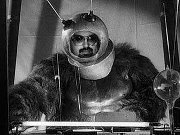
Whitstable - 1971. Peter Cushing, grief-stricken over the loss of his wife and soul-mate, is walking along a beach near his home. A little boy approaches him, taking him to be the famous vampire-hunter Van Helsing from the Hammer films, begs for his expert help...
Leytonstone - 1906. Young Alfred Hitchcock is taken by his father to visit the local police station. There he suddenly finds himself, inexplicably, locked up for a crime he knows nothing about - the catalyst for a series of events that will scar, and create, the world's leading Master of Terror...
Netherwood - 1947. Best-selling black magic novelist Dennis Wheatley finds himself summoned mysteriously to the aid of Aleister Crowley - mystic, reprobate, The Great Beast 666, and dubbed by the press ‘The Wickedest Man in the World’ - to help combat a force of genuine evil...
The Dark Masters Trilogy (2018) by Stephen Volk, containing the following novellas:
Whitstable - 1971 (2013): The first of the three fictional novellas featuring real people stars Peter Cushing, days after losing his beloved wife to emphysema in 1971. While sitting on the beach near his home in Whitstable, Cushing is approached by a boy who thinks Cushing IS Van Helsing, vampire fighter and nemesis of Dracula. And the boy believes he is being preyed on by a vampire -- his stepfather.
The truth is just as horrible. Cushing begins by trying to shirk responsibility, and then tries getting the authorities to help out. But in the end, the actor has to discover how to face Evil himself, as himself -- though the art of acting does come in handy.
It's a marvelous, sympathetic character study in which the metaphor of vampirism is explored sensitively through one of the real-world evils that it can be a metaphor for. Despite the grim and mournful subject matter, Volk injects appropriate humour throughout -- especially when it comes to people mixing Cushing up with his oft-time co-star Christopher Lee, or to only recognizing him from cameos on current comedy TV shows. Highly recommended.
Leytonstone - 1906 (2015): Alfred Hitchcock's anecdote about his father having him put in jail for a night as a young boy in order to teach him to be good is the spark for this meditation on childhood fears and the peculiar character of the world's greatest thriller and suspense director. As he notes in his afterword, Volk alters the real nature of Hitchcock's family to make him an only child, doted upon by his mother and worried about by his father, who decides on the police visit.
Needless to say, the police visit does not yield the expected results. Volk examines the roots of fear here in childhood trauma, while also having what seems to be a good time coming up with precursors for many of Hitchcock's most famous film scenes. His Boy Hitchcock isn't entirely sympathetic, but he is certainly sympathetically drawn when it comes to his motivations and fears. Highly recommended.
Netherwood - 1947 (2018): In the last year of his life, 'The World's Wickedest Man,' Aleister Crowley, summons England's most popular post-war horror novelist -- that would be Dennis Wheatley -- to a peculiar hotel in Netherstone. Why? Because Crowley believes a recent apprentice has gained enough magical power to conquer the world -- and, more importantly to Crowley, who lost a daughter at a young age, to fully claim that power the apprentice will sacrifice his own infant daughter.
This really is a great work, straddling reality and the supernatural without ever conclusively establishing that Crowley's fears are "real." One of the things that links the two men is a concern with permanence -- as a philosopher and thinker for Crowley, as a novelist for Wheatley. The third-person narrative focuses on Wheatley's thoughts and reactions, leaving Crowley to be imagined throughout from the outside by Wheatley. This choice generates suspense (is Crowley really on the level or is he just 'aving a laugh?).
But this narrative POV also allows the reader to judge Wheatley as he's judging Crowley -- and equivocating in that judgment. This seems fitting because one's assessment of Crowley relies a lot on just how much one believes in what he supposedly did, and how much one believes HE believed in what he supposedly did. It all makes for a fascinating fictional trip through the lives of two people who are increasingly forgotten as the decades slip by. Highly recommended.
“Life must go on, yes, but in the end—after the end—life was not important, just pictures on a screen, absorbing for as long as they lasted, causing us to weep and laugh, perhaps, but when the images are gone we step out blinking into the light.” - Whitstable
This beautiful edition contains three very different stories. You can resonate with them all in their own way. There is Whitstable which will pull at your heart strings, Leytonstone which will give you the creeps and Netherwood which will leave you baffled.
Whitstable - 1971. Peter Cushing, grief-stricken over the loss of his wife and soul-mate, is walking along a beach near his home. A little boy approaches him, taking him to be the famous vampire-hunter Van Helsing from the Hammer films and begs him for his help.
Leytonstone - 1906. Young Alfred Hitchcock is taken by his father to visit the local police station. There he is suddenly locked up for a crime he is not aware of. This being the catalyst for a series of events that will scar and shape the infamous master of horror as we know him today.
Netherwood - 1947. Black magic novelist Dennis Wheatley has been summoned to the aid of Aleister Crowley. The mystic who is well known for being the evilest man alive needs Dennis’s help with a much greater evil.
What I love about these stories is that they include people we know through these events which are told via the creative storytelling of Stephen Volk.
I really enjoyed each of these stories but my favourite would have to be Whitstable 🖤
Although I already own a third of this collection ("Whitstable") I just knew that this book would be an unmissable purchase, and I am glad to write that my assumption was correct.
This is a collection of novellas, wrapped up in a rather splendid hardback courtesy of PS Publishing with gorgeous design and art from Pedro Marques, that highlight three persons whom shaped Volk's love of genre, from crime to horror.
The aforementioned "Whitstable" focuses on an ailing Peter Cushing, spending his reclusive days in a seaside town, mourning forever the death of his beloved wife.
"Whitstable" is an altogether more whimsical tale; an Edwardian coming-of-age fable, starring a ten year-old Alfred Hitchcock. Gave me the occasional belly laughs it must be said, and a welcome break from the seriousness of the previous story along with the finale, the longest and darkest story "Netherwood" when Dennis Wheatley at the height of his fame is summoned by the disease-riddled Aleister Crowley for a task to save the world...
More famous for his film and TV writing, this collection is just proof that Volk is equally adept at writing prose; a superb triptych of stories that any fan of either of the above characters should read, even if you know very little of the other two.
This is a review of the final story in the Dark Masters Trilogy, Netherwood. I have reviewed the two previous stories, Whitstable and Leytonstone, under their own headings. Dennis Wheatley is summoned to Netherwood, in Hastings, the retirement home in which Aleister Crowley, self-proclaimed ‘wickedest man in the world’, is seeing out his final years. The two have met before when Wheatley was researching for The Devil Rides Out. They aren't friends; in fact, Wheatley actively dislikes Crowley, but the summons suggests desperate help is needed, and Wheatley's curiosity gets the better of him. Crowley needs help stopping an acolyte of his from becoming too powerful now that he has been discovered to be even more rotten than Crowley himself. Or is that what Crowley needs? This is a marked improvement on Leytonstone, and Volk even drops in mentions of two of my favourite writers, Gerald Kersh and Patrick Hamilton, in a vain effort to get me onside, but I'm wise to his tricks. This one does have its moments, but not quite enough, I'm afraid.
An utterly fantastic trilogy of novellas by Stephen Volk (who might easily claim to be a 'Dark Master' himself). The weakest of the three is almost certainly 'Leytonstone', featuring a young Alfred Hitchcock, but the fact that this is still an engaging and thrilling read gives you some idea of the quality of the others. 'Whitstable' provides a touching and detailed vignette from the later life of Peter Cushing, but it's 'Netherwood' that closes things off in true 'Dark Master' style, as Aleister Crowley and Dennis Wheatley conspire to do a final good deed in the life of the Great Beast. Exciting, beautifully written and surprisingly moving.
'The Dark Masters' is a triptych of novellas, each of them seamlessly blending fact and fiction in their portraits of three 'dark masters' from the worlds of horror: Peter Cushing, Alfred Hitchcock and Aleister Crowley. The novellas may depict imaginary episodes in the lives of these characters, but the author's knowledge of each of them is so deep and intimate that it is not enough to say the he wears his learning lightly: whereas a lesser writer would tell a story with grafted on biographical details, Volk seems to inhabit his characters and reveals who they are to his readers from the inside out. The three tales lead off in different directions, as befits the contrasting personalities of the three men, and each one allows the author to explore different aspects of the human condition. In tone, pitch, turns of phrase and delicacy of expression, the prose is near perfect.
'Whitstable' explores the personal grief of Peter Cushing following the loss of his wife, and is written with deep tenderness and poignancy, as well as as dark humour when the gentlemanly widower meets a young boy who may or may not be in danger from a vampire. This is a beautifully written study of bereavement and the idea of whether human or supernatural monsters are worse.
'Leytonstone' is a study of a young Alfred Hitchcock, offering a fictionalised account of a real-life incident that happened to him at the age of six, written from the perspective of his later film career but at the same time capturing vividly the sensory world of young boys, their imagination, capacity for cruelty, and the particular sights and sounds of England in the early 1900s.
'Netherwood' is the longest of the three novellas but is set in 1947, midway between the others in time, and concerns an encounter between Dennis Wheatley and Aleister Crowley. As with the preceding tales this is brilliantly evocative of its time and place, and is a superbly-crafted portrayal of 'the wickedest man in the world' as seen through the eyes of another master of the dark arts who was equally guilty of leading a life of duplicity on many levels. As with 'Whitstable', the delicate line between the psychological and the supernatural is handled with great subtlety, keeping the reader in suspense throughout as to the true nature of what is occurring.
Okay, you could argue this is not a horror book. Why? Well, it's 3 fictional stories inspired by 4 real characters. Peter Cushing. Alfred Hitchcock. Dennis Wheatley and Alistair Crowley. However, as these are all Dark Masters I think this book in relevant to our genre.
The first story 'Whitstable' is set in the seventies where Peter Cushing, in the minds of grief, bumps into a kid who recognizes him as Van Helsing from the Hammer movies and wants his to help to destroy a vampire.
The second story concerns Alfred Hitchcock's childhood but the third story is the one which really interested me.
Occult fiction writer Dennis Wheatley is summoned to the deathbed of Alistair Crowley. I'll say no more but as a concepts that's a compelling one.
The writing is excellent and the characters well researched. Stephen Volk has form as a screen writer (Ghostwatch and Ken Russel's Gothic are among his credits.) but his prose is strong and vivid. I'd recommend this book to anyone with an interest in horror cinema.
After reading the final story where Dennis Wheatley meets Crowley I was moved to read Wheatley's 'The Haunting of Toby Jugg.'