A young WWI soldier's unauthorized visit home has dire consequences in a haunting story reimagined in miniature tableaux. About one hundred years ago, the whole world went to war. The war was supposed to last months. It lasted years. It is Christmastime, 1914, and World War I rages. A young French soldier named Pierre had quietly left his regiment to visit his family for two days, and when he returned, he was imprisoned. Now he faces execution for desertion, and as he waits in isolation, he meditates on big questions: the nature of patriotism, the horrors of war, the joys of friendship, the love of family, and how even in times of danger, there is a whole world inside every one of us. And how sometimes that world is the only refuge. Its publication coinciding with the centennial of the signing of the Treaty of Versailles, this moving and sparely narrated story, based on true events, is reenacted in fascinating miniature scenes that convey the emotional complexity of the tale. Notes from the creators explore the innovative process and their personal connection to the story.
Pierre-Jacques Ober was born in a military family but broke with family tradition in his preference for philosophy over war. He lives with his wife, Australian photographer Jules Ober, in the rain forest of Australia.
«In time of war, you cannot be a good son and a good soldier at the same time.»
Warning! Questa è una storia raccontata attraverso splendide riprese fotografiche di un set in miniatura. Natale 1914. La Grande Guerra infuria in Europa. Un giovane francese si è arruolato per senso del dovere e dell’onore. È un buon soldato, ma vuole anche essere un buon figlio. Decide quindi di abbandonare il suo reparto per andare a trascorrere il Natale con sua madre. Scoprirà, suo malgrado, che, in tempo di guerra, non si può essere un buon figlio e un buon soldato allo stesso tempo... «War is never the answer. War only create misery and only just create the roots for the next war to come. So war is to be avoided. At all costs.» (1)
The Good Son is probably the most unusual book I've reviewed. It is a World War I story about one small soldier's experience and although it's a picture book for older readers, the recommended is age 14+. And it isn't exactly illustrated in the traditional sense - each page is photographed using customized painted miniature figures, more sophisticated versions of the kind toy solders so many kids played with, and all of them are set in detailed landscapes, creating powerfully effective tableaus.
Written one hundred years after the end of WWI, the tale opens, in slightly blurred black and white photos, long after the war is over. It was a war that was supposed to be over by the first Christmas, but instead went on for years, while people suffered and kept going into battle.
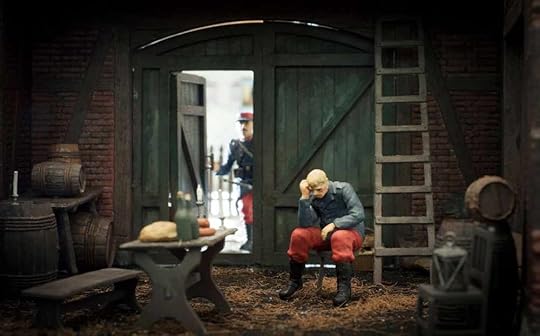
The story shifts then to color photos of Pierre, a young French solder, sitting alone, locked in a barn. Pierre is facing execution for desertion, having gone AWOL for two days to spend Christmas with his widowed mother and not wanting her to be alone. Left by himself in the barn, Pierre has time to think about why he enlisted, about loyalty, about the horrors of war, and about what had been his hopes and dreams for his life after the war.
Believing the propaganda and wanting to make his mother proud, Pierre had, like so many men, signed up to fight once war was declared in 1914. As the war drags on, and more and more men are killed, Pierre realizes that war is terrible, a point that is made over and over. But, Pierre was a good soldier, even receiving a commendation for capturing six German soldiers, albeit, soldiers who are tired of war and just want to be out of it - feelings Pierre shares with them.
Readers learn a lot about Pierre as he sits in the barn awaiting his fate. His friend Gilbert, who once saved Pierre's life, brings him in food, wine, and company. But even Pierre's good behavior and commendation don't help him when his colonel sentences him to be shot for desertion the next morning:
As the war drags on, and morale sinks among the other soldiers, the colonel had decided to make an example of Pierre.
So, no, Pierre doesn't not survive the war but his story is sure to remain with sensitive readers long after they close this book (this is not a spoiler).
The Good Son is probably one of the most effective anti-war books I've ever read. Pierre's story is told in one or two short lyrical sentences on each page, with accompanying photos that move the tale along, revealing the pointlessness and the unfairness of war. Readers will find themselves asking questions about how propaganda is used to motivate people, especially young people, about patriotism, and about how does a good son, a good soldier end up in front of a firing squad? All this makes The Good Son is a very interesting and unusual philosophical look at war.
An compelling point that this book makes is that war is fought by little solders, young men like Pierre, and that these soldiers are at the mercy not only of the military, but also the politicians who decide to go to war, a point the is driven home through the metaphorical use of little toy soldiers, making Pierre's story all the more poignant. And I think that the little toy soldiers have a much more profound impact on the reader that conventional illustrations would have had.
You may have a hard time getting your teens into this picture book, but I believe that once they begin to think and explore its pages, The Good Son will really resonate with them. After all, some of them may be the future's little soldiers.
Back matter includes A Note from the Author and photographs and an explanation on The Process by which The Good Son was created. You can also find would some photographs of how each tableau was created on the author's Instagram page.
Parents and teachers can also find factual information giving context for The Good Son HERE
The Good Son will be available in the US on May 14, 2019.
This book is recommended for readers age 14+ This book was sent to me by the publisher, Candlewick Studio
Description: A young WWI soldier's unauthorized visit home has dire consequences in a haunting story reimagined in miniature tableaux.
Ack - too many feels and not enough words. The illustration style of this book using minatures is hauntingly disturbing - remarkably it doesn't lessen the horrors of war. Fantastic use of colour and sparse text create emotionally charged scenes. At times eerie and heart achingly poignant.
it is stated that, "About one hundred years ago, the whole world went to war" and Pierre-Jacques Ober has captured one lad's story - that of Pierre who simply went home for Christmas and was subsequently imprisoned for desertion. Wars are fought by soldiers, soldiers like Pierre who are at the mercy of politicians. Ober illustrates just how propaganda was used during the war.
There is no happy ending here, however, there is empathy. A most powerful and visually riveting tale.
An early review copy I will cherish. Lovely illustrations combined with easy text to tell the story of the effects of war, in this story World War I.
It is Christmas and Pierre, a young French soldier longs for home, for his mother and a visit that will warm his heart against the cold, cold fields of death.
Pierre is tired and slips away, wanting only a few days with his family. Alas, he returns, and it doing so he is imprisoned and doomed for execution.
This is an incredible book. Beautiful, unique miniature medal like soldiers illustrate the tale of war and the loneliness of longing for stability and home.
Artistically, this one would gain 4 or 5 stars--looking at it objectively without considering feelings or emotions. Subjectively, I can't give it above 2 stars because I wish I could unread it.
First sentence: About one hundred years ago, the whole world went to war. The war was supposed to last months. It lasted years.
Premise/plot: The Good Son is set in France during the first world war. Pierre is a French soldier. Pierre wanting to be a good son decided to go home and visit his mother for Christmas--without permission. It was just two days. But those two days may just cost him his life. For in being a good son, his being a good soldier was called into question. As he awaits his fate he writes a letter home to his mother.
My thoughts: Don't be fooled by the format of this one. It may look like a picture book--its shape and size--but if ideas carried weight this one would weigh a ton. It is impossible to judge a book like The Good Son.
On one hand, it's visually wonderful. It is told in miniature and stars VINTAGE TOY SOLDIERS. The book is illustrated with PHOTOGRAPHS. Artistically one can't help celebrating its mastery. I'd be surprised if this one didn't earn STARS and ACCLAIM by critics.
It isn't just the art. The story is technically brilliant as well. I'm currently reading Les Miserables by Victor Hugo. If anyone knows how to slip in philosophy and BIG IDEAS into a fictional story it's Hugo. Ober makes a good, strong effort in The Good Son. Does war have a point? Is there such a thing as a good or just war? Is all war evil? What is it all for? What price does war cost us as humans? As I mentioned earlier, if ideas have weight, this one would weigh several hundred pounds.
On the other hand, The Good Son makes Jude the Obscure look like a bright, cheery, pep-you-up read. Or perhaps compare it to ANIMAL FARM. For being just 104 pages in length it packs in enough sorrow and despair for one hundred books. This book is bleak, dismal, dark, depressing. It packs a philosophical punch or two. But is it a punch readers can withstand?
Artistically, this one would gain 4 or 5 stars--looking at it objectively without considering feelings or emotions. Subjectively, I can't give it above 2 stars because I wish I could unread it because it is BLEAKITY-BLEAK.
I received this hardcover book through the LibraryThing Early Reviewer's program.
This is a picture book for children, but don't assume it's about rainbows and happy endings. It's not. This book is intense. It is honest. It is bleak. Without a drop of red, it depicts the horrible nature of war. This is a book that might really bother some kids (and parents), but I see this as a book to inspire some hard but necessary discussions.
Without even considering the content, the The Good Son is an artistic masterpiece. It is fully illustrated through the use of toy soldiers, elaborate sets, and brilliant use of perspective. The effect is stunning. The use of toy props doesn't cheapen the message in the slightest. On the contrary, the pages look eerily realistic at times. I think kids will really connect to the scenes because there ARE toys being used--which again, might be bothersome for some, but that is something to be worked through.
The text is minimal but effective. This book would be quick to read, but so much is happening in many scenes, I found myself lingering on each. The set up for the book is stark: a young French soldier named Pierre went AWOL for two days over Christmas to visit his mother, and upon his return, he is imprisoned and sentenced to death. He is to be made an example of to prevent further desertions. Pierre reflects on his time as a soldier and what he has learned about his German enemies as he awaits dawn and his execution. Again: this is not a book with a happy ending. That's the nature of life, and of war--especially the Great War.
Some people might argue that the very premise makes this a horrible book for kids. I strongly disagree. There's a great Madeleine L’Engle quote: “You have to write the book that wants to be written. And if the book will be too difficult for grown-ups, then you write it for children.” Children aren't oblivious. They see and experience a lot. Teaching them that war is glorious and that heroes can't be killed does not do them favors in the end. This book uses toy soldiers to get on the same level as kids, and respects their ability to understand what unfolds.
Une magnifique histoire de l'Histoire, touchante et criante de réalisme. Les illustrations originales à partir de figurines donnent une grande profondeur au texte et un style vintage très adapté au sujet. Une pépite !
This is a beautifully executed book using the photographic imagery of miniature figures to depict the scenes of war - battles, marching groups of soldiers - from the story that is being told. The time is 1914 at Christmastime and the setting is France.
These scenes evoke the scale and scope of war. The large groups of men involved. The battles and the destruction caused from them. The soldier didn't anticipate the reality of the bloody war he later experienced. It haunted him.
The conflicted mind and emotions of a soldier have him in a situation of desertion at time of war. The question in my mind is "Did he actually leave without permission resulting in desertion?" or "Did he not return in the prescribed amount of time allotted?" or "Was it simply a misunderstanding?" Each answer evokes a different thought process and emotional impact as to the story.
Is this a children's book? I don't think so. It is intended for the age 14 middle-school age child and upwards, and it could readily give opportunity to discuss the realities of war; but I think this discussion more suited for the upper limit of the intended audience plus a few years. The pictures do depict the impact of war on individuals in the civilian as well as military community.
I enjoyed the artistry of staging the miniatures and the photography. The backstory of the photographic production of this book is fabulous and shows the intricacies of this type of work so beautifully executed.
I liked the desire of the soldier to be with family. I disliked the imprisonment and promise of execution - whether by error or truly justified. For a children's book this is a bit much - even the intended audience.
DISCLOSURE: I received a complimentary copy to facilitate this review. Opinions are mine, alone and are freely given
Understated is the best short description for this beautiful book. The author based it on stories his maternal grandfather told him as he was growing up. Those, coupled with his fascination with realistic miniatures, became the fuel for this book. The amazing illustrations, coupled with brief lines of text below the images, tell the story of Pierre, a young French soldier near Christmas time during WW I. Having just his mother for family, he takes the risk of temporarily deserting his post for two days to be with her. When he returns, despite his record and willingness to keep fighting, he is sentenced to die. There are several simple and not so simple messages in the story. There's the importance of family, the value of friendship, the fact that people fighting each other often have more in common that they realize, and most important, that war is horrible and dehumanizing. While the messages may be lost on some juvenile readers, more will get the various messages. Hopefully, they will be changed for the better.
There is absolutely no doubt that war is hell. Should there be any doubt in anyone's mind, this book makes that even more clear. Relying on photographs of carefully created miniatures of beautiful landscapes and war-torn fields, the creators of this book tell the story of one soldier's experiences during WWI. As often happens, Pierre is caught up in the blushes of patriotism and patriotic duty and joins the French army, eager to do his part. Like most everyone, he expects the war to end quickly, certainly by Christmas. But it doesn't, and he leaves his fellow troops to visit his mother, returning after a two-day visit. As he awaits his execution, he ponders several important questions about patriotism, loyalty, family, and duty. It is clear that the war has not been kind to Pierre, and it is just as clear that the war will be won or lost by the little men, the little soldiers, like him. This is certainly not a book for children, but it is a powerful reminder that war is not for the fainthearted. The scenes in which he ends up hanging out with some German soldiers, considered his enemies, and sharing some food and drink, reveal that they have quite a lot in common with each other. The line between line and death and that between what makes someone a good son or a good soldier seems to be very uncertain, and I appreciate the philosophical questions raised here. This is an unforgettable book, and each page is simply stunning in detail and emotional impact.
The Good Son is the story of a soldier in WWI told through miniature displays. This may appear to be a children’s picture book, but it’s really well suited for an adult audience. The artistry of the miniatures, the lighting and photography, and the poignant story come together to create a beautiful book. The creators explain that they allowed the miniatures to tell the story instead of bending them to the wills of the writers. Their delicacy and attention to detail show on every page. At first glance, these images look like photographs of actual soldiers.
This is the type of book that is perfect to share with both my eleven-year-old son as well as my husband. Many thanks to LibraryThing and Candlewick Press for the advance copy.
I was actually really surprised at how much I enjoyed this book. When I received it from a publisher, I wasn’t entirely sure it would be something I enjoyed reading. I do really enjoy history and have read quite about World War I & II, but I wasn’t sure about the “told in miniature”. The photographs are actually really amazing and the short story that goes along with them was equally interesting. At the book of the book the author explains his family’s history with the military and wars, as well as what gave him the idea to create these images and this book. Turned out to be very interesting.
Thank you to the publisher, Candlewick Press, for sending me a review copy of this book.
This is a unique treasure. It's a short story done so tightly that it could double as a picture book (it's not). The story arc is as unique as the presentation. Ober is the son of military people. He also likes miniatures. So he wrapped a story around miniatures. Set in World War I, Pierre enlisted, went to war, was traumatized by war, deserted for a short time, returned, was court marshaled, then sentenced to death. His prison is a barn for most of the story and we understand a deeper meaning when he writes home to his mother.
... but again, it's told from stills of miniatures posed and created to compliment the story and vice versa. It is evocative and emotional. Certainly character driven, but also historical and shows a side of soldier PTSD as well as some of the events that did take place during WWI.
Completely captivating. I literally want Ober to create more of these whether they're based on wars or history or something else entirely. It was a moving experience.
This is an unusual book and something of an artpiece. It is the story of a French soldier in the first world war in 1914 who made the mistake of going home for Christmas. The story is very short and simple but it packs quite a punch. This is primarily told through photographs taken of miniature soldiers and others, and the creation of the miniature scenes and the way they were photographed is the true highlight of this book. After the story there are some pages illustrating and explaining part of the process. This is a book I will return to.
I received a copy of this book in exchange for a review from the Librarything early reviewers program.
There are many excellent fiction books that bring to life the horrors of war and tell the stories of the brave men and women who fought in them. The Good Son is one of the best picture books I have read on the subject of war and does a superb job of telling the story of one brave young soldier.
In 1914 the world went to war. A war that should have lasted months lasted years. One such young man who went to fight a war that he did not start was Pierre. Like everyone else, he had been told that the war would be over by Christmas but when December came around there was no end in sight. Good-hearted Pierre was close to his mother and so headed home for two days to spend Christmas with her. When he returned to hie regiment he was imprisoned and charged with desertion and was sentenced to death - high command deciding to make an example out of his actions to ensure that other soldiers would not follow in his footsteps. And so it would be, that a young man torn between being a good son and a good soldier who fought for his country would have his life taken at the hands of his own regiment.
The Good Son is a moving and powerful story based on an actual event. It is such a heart-breaking and harrowing read and you immediately feel for the situation that these young solders find themselves in. Persuaded by propaganda to fight for a cause bigger than their own and their actions to be controlled by those in high command who sit far away from the battlefields. You feel for Pierre - a young man who is lost and confused, trying to fight for his country, trying to make his mother proud, caught up in something much bigger than he can comprehend, and whose life is ultimately valued as worthless even by those men that he serves.
Due to its content this book will not be suitable for all children, but those who do get to read it are in for something rather special. It perfectly portrays one young soldier’s experience of war. From signing up to leaving family behind. Marching through scenic countryside before finally reaching the brutal battlefields where loss of life meant little. It captures the horrific consequences of war, where for the young men fighting it a win still felt like a terrible loss. Soldiers - tired of fighting, tired of marching, tired of carrying equipment and who would rather be captured than fight anymore. This was the reality of war.
The book is beautifully presented in hardback, the pages are thick and I can best describe it as a work of art. The artwork within was created using miniature figures, staged scenery and natural lighting, and the end result is stunning. Each scene has been intricately created down to the most minute detail and then photographed to create the most beautiful pictures. The story is told in very limited text, pages having just a single sentence or phrase to move the narrative along - this is more than enough. It means that the eyes of the reader are kept firmly on the pictures as we are drawn into their world and share their experiences.
Heart-breaking, harrowing and emotionally charged. This is a very special book that will deeply move any reader that has the opportunity to experience it.
I've read both fiction and non-fiction books about war, some recently about World War I, the war called "The Great War" and the one supposed to last only a few months. This new story created by Pierre-Jacques Ober with illustrations by Jules Ober, his wife, and Felicity Coonan is told mostly in first person by the good son Pierre, one who wished to fight for his country (France), one who gave his life for his country, but not in the way you may first think. Ober tells us that this story is of a war "fought by little men, like Pierre. In the afterword, he shares his family's French military tradition but turned to philosophy instead. Although he grew up hearing their stories and played his own war games with little soldiers, he did not become a soldier. The photographs that tell Pierre's story include staged miniatures of soldiers and some country people set in various backdrops, like fields of snow or flowers, through windows, in marching formation. It appears that some digital overlays are made, like what appears to be a French call to arms. Back matter photos, some way to see just how tiny the figures are (one is below). The ability to show expressions in both body and face is impressive. The story's timing revolves around the time of that first Christmas, one written about in other books, the ceasefire for the one Holy Day. Pierre has gone home for two days to see his mother at Christmas to be "the good son", without permission. He returned, "to remain a good soldier". An especially poignant scene at first has Pierre telling of them marching all over the countryside, saying "It was beautiful." and showing fields with red flowers. A few pages later, they meet the enemy for the first time, also in a field showing a few of those flowers, but this time with bodies lying on the ground. Pierre says, "It was terrible." The message to those who may have experiences of war or have read books and stories will not be new, but the pictures here in this particular story show some of the worst a battlefield can be, some of the feelings felt by Pierre and others who want to do right, yet don't understand being "caught up in a big mess". I wonder how many who are fighting today would agree? Thanks to Candlewick Press for the copy!
So, to be clear, despite what the ranking would suggest, this isn't a masterpiece of WWI literature (I mean, it's classified under JF). Still, I'm giving it a rare 5/5, as there's absolutely nothing I could suggest to improve it. It certainly treads over familiar ground in the genre, but apart from that? Yeah.
The main claim to fame is that the story is told almost entirely through miniatures, with bits of text that drive the story forward. Nor is it told chronologically, as it centres on a French trooper, Pierre, as he waits to be executed for desertion. Christmas, 1914 has come and gone, he slipped away for a few days, but that's enough to warrant execution. After all the promises that the war would be over by Christmas, and with said war not over, morale is plummetting, hence why Pierre needs to be made an example of. Thus, he uses his last night talking with his friend and a lieutenant, writes a final letter to his mother. Interspaced with all of this are various events - enlistment, initial patriotism, carnage of the battlefield, meeting German soldiers and realizing they're just ordinary people, comradeship, winter settling in, etc. Like I said, the book isn't doing anything new, but what it does, it does very well. That, and the miniatures, despite being, well, miniatures, actually lend a great sense of humanity to the piece. In part because of how they're arranged in various scenes, in part because of the writing. For instance, the line (paraphrased), "they called it the Great War, but it was little soldiers who won it."
During the Great War, a young French soldier desserts his post to spend Christmas Eve and Day with his mother. When he returns to his post, he is arrested and executed as an example to others of the severe penalty for desertion.
Told largely in full-page photographs by Ober’s wife, Jules Ober, Ober’s sparse text tells the chilling story of this unfortunate French soldier, based on true events. The text is calm and direct, with not a word too many. The plastic miniatures were purchased in many places and the miniature sets were built and dioramas set up by Felicity Coonan. Natural lighting was used to photograph the striking dioramas, creating a stunning effect of reality. Altogether, they make for one powerful political statement – what is the purpose for war? The French soldier had encountered some Germans and learned that they were trying to return home, that they were as tired of fighting as he was. Instead, they surrendered themselves to the French soldier, who was awarded a medal for bringing them in. It is this decorated soldier that is being used as an example.
Reading aloud this picture book (more of a short story) would make an outstanding opening activity for a middle grade or high school study of World War I.
by Pierre-Jacques Ober (Author), Jules Ober (Illustrator), Felicity Coonan (Illustrator)
The Good Son is the story of a young world war I soldier, Pierre. Pierre is locked up in a barn because he abandoned his unit for 2 days in Christmas. He left his unit and then returned. Desertion, unfortunately has a severe penalty. Pierre is sentenced to die. Yes, this story does not have a happy ending. Part of the story is told in Pierre's voice, as he writes a letter to his mother. He writes to say goodbye. He explains to her that he deserted his unit so that he could visit her for two days in Christmas. The young man missed his mother, the warmth of his home being tired from the horrors of the long war. A war that was meant to end by first Christmas, but had dragged on for many years. A heartbreaking and sad tale, The Good Son is illustrated in photographs. The unique miniature soldiers against miniature backdrops captured through the lens are absolutely beautiful. The story telling is fresh and unique. The depth and perception captured on camera evokes emotion as you read through young Pierre's fate. Visually riveting, evocative and emotionally strong, The Good Son is a must read!
This book is amazing. A powerful and poignant story based on a real event, that tells the sad story of a young soldier in the France in the first WW who signs up because he is a good son and wants to make his mother proud. He is told he will be home by Christmas, which of course does not happen, so, as a good son, he goes home for Christmas and returns to his troop two days later. He is charged with desertion and faces execution. Told in simple prose and with a letter to his mother at the end to bring tears to your eyes, this books highlights the futility of war and the anguish caused. The Obers put the spotlight on the individuals within an army as puppets in a bigger political game.
The illustrative techniques are exceptional with old toy soldiers set up in a series of scaled landscapes and dioramas and photographed to depict each part of the story. The concluding pages provide information on the story and the techniques which is fascinating. Catch a glimpse on the publisher's site at https://www.penguinrandomhouse.com/bo... Shortlisted for the 2020 CBCA Book of the Year: Picture Book award.
One of the reviews from another I read stated if this book was weighed by emotion, it would weight over 100 pounds. I tend to agree whole heartedly. I would say I also have never encountered a book quite like this, yet, it will remain in my memory forever.
Using the art of photography and miniatures, a whole scene is recreated surrounding World War I, and it indeed contains a theme so deep and meaningful, it strikes to the very heart of small disagreements all the way to what leads to wars.
In a time where at every time there is strife, disagreement, sometimes outright hatred, this book, while at first I thought maybe too juvenile for the high school population, now realize it is adult enough and probably more adult-theme than for most adults.
This is a must pick-up and a must talk about - very heavy with emotion and theme, definitely a forewarning, but worth every turn, look, and examination of the art used by this French author and Australian artists.
This is such a really interesting way to illustrate a book, by using miniature figurines. Hence, I am very grateful, that the author, a Pierre-Jacques Ober, originally from France, to whom made his home in Australia, wanted to share some of his nation’s history, with Aussie Kids. Hence, the reason this book, was created. Basically, the story is about French solider, fighting in W.W.I, narrating all the good and bad things about the war in France, through the eyes of a young man called Pierre, to whom is locked in a farm barn, after deserting is army unit. So, now what is his fate, for such a crime, who just got tried of fighting a war, they said for only be a few months, but instead dragged on for 5 long years, for France?
Such a sad story, that all Children need to know the truth about the War, not just here in Australia, but what it meant for other nations. And, this book, is a great one to do this.
While this book is a quick story from WWI, the power of the story coupled with the excellent photography make it a book worth having on your shelf. The authors have created scenes with miniature figures and settings that are astoundingly realistic, especially with the photography techniques used. While this could be considered a book for children, I would only recommend it for more mature young minds, considering the nature of the story itself. We adults can learn from the story also. I have shared this book with my adult sons who both love history, and it is going on my shelf to share one day with my infant grandson.
**I received a free copy of this book from LibraryThing's Early Reviewers program in return for an honest review.**
This picture book is recommended by the publisher to teen readers, and that is because of the heavy emotional content. The text is spare, but the story of what happens to Pierre, a young man who deserted his company for a couple of days during WWI in order to visit his mother for Christmas, hit me like a punch in the gut. This book drives home the sadness, violence, and pain caused by war, and the sacrifices made by military men and women and their families.
The remarkable thing about this book is its illustration style. Every picture has been created using miniatures, which are arranged in scenes and then photographed. Each spread is perfectly constructed and many of the images themselves express a bittersweet and poignant outlook. I especially love the scenes in which miniatures have been used to create newspaper photographs covering the war, and the ones where Pierre imagines an impossible future he will never have the chance to live out.
This book is very upsetting, and it's not something I'd recommend to all readers. I could not have read this as a kid, and even as an adult, it's weighing on me a bit after reading it just twice. But it is a powerful picture book that provides a framework for grappling with some really difficult issues, and I'm not sorry I read it.
This little book is so astounding that I immediately read it again a few minutes after finishing it. I had to wait a few minutes for the reread in order to collect myself. The Good Son will gut punch you and not even be sorry about it. These are the horrors of war. Visually, this is one of the most beautiful books I have ever read. It is told through photographs of models and miniatures. These little soldiers tell the story of a big war. And it is unforgettable and unforgivable.
So we marched all over the countryside. It was beautiful.
While this is a children's story it is particularly bleak story, as one would expect from a WWI tale.
I'll start with the aesthetics - it is wonderfully created, designed and photographed. The story is told via the photography of miniatures. You may be thinking how could this possibly have any impact, but the use of different lighting and the way that the photos have been composed draws the readers eye in.
The words add another level to the images, slowly unfolding the story of Pierre and his experience over the first Christmas of WWI in 1914. Fair warning, this isn't a happily ever after story, but it highlights the joy that can be found even amongst the pain and suffering.
Incredibly ambitious, and it delivers. Trying to illustrate an emotional story with static figures, especially static, pre-made figures, is incredibly difficult. It's largely the skill of the photographer that these toy soldiers have any life at all. The story itself is simple but poignant: Pierre wants to be both a good son and a good soldier. It may not be possible to be both, and trying may make him neither.
A simple and intimate story about the madness of the First World War told in few words made strong by the sometimes surprisingly expressive accompanying images such as [no spoiler here, don't worry] After-battle scene: "We won. It was terrible." It can be read in minutes, and the strongest impact is in the final two sentences.
The storyline is too thin, very sad but simple. I did like the way that that that the soldiers were portrayed. It does make a strong anti war statement.
I received a finished copy of this book as a win from LibraryThing from the publishers in exchange for a fair book review. My thoughts and feelings in this review are totally my own.