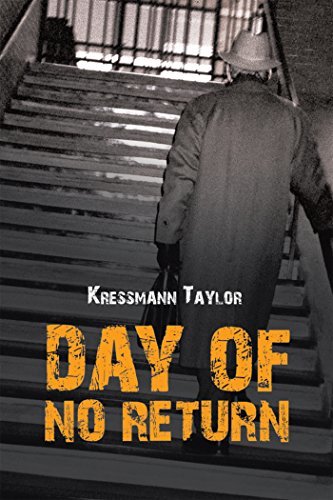
Kathrine Kressmann Taylor’s Address Unknown was a revelation to me last summer, and I have been eagerly anticipating Day of No Return since. This novel was originally published as Until That Day by Kressmann Taylor, though its reception was disrupted by the attack on Pearl Harbor and the US entering the war.
Unlike Address Unknown, an epistolary novel about business partners, Day of No Return is a bildungsroman about a young man training for the priesthood in 1930s Germany. Based on the true story of Leopold Bernhard, the novel shares his life story through the pen of Kressmann Taylor, who wrote the novel under strict conditions of Bernhard’s anonymity. He came to the United States fleeing persecution. His own Gary, IN congregation threatened his life when he made clear his positions on the invasion of Poland, so he was moved by the FBI to a different congregation in the Northeast, where he met Kressmann Taylor. Karl Hoffman is the fictional name of Bernhard’s character.
The novel considers the Lutheran Church in Germany affected by the rise of Hitler through Karl’s eyes as a seminary student. Nazism is presented as a religion counter to Christianity. An emphasis on the blood-based nature of the state religion is held up against the Lutheran liturgy, and the narrative harnesses the liturgy for storytelling to great effect. The moment when Karl witnesses a “German Christian” (Nazi-affiliated) priest denying communion to congregants with Jewish blood gave me chills.
Karl and his father, a priest (based not on Bernhard’s real father but on his priest in Germany), become involved with the Confessing Church, and Martin Niemöller is a memorable character in the narrative. Though Niemöller’s 1946 poem “First they came…” is not in the narrative, of course, the same line of thought is argued; Niemöller’s influence must have been strong on Bernhard’s thought.
There is so much fascinating detail in this eyewitness account of the Lutherans who resisted Nazism with their theology and their lives. Though Karl remains a student in Berlin in the novel, Bernhard also went to Switzerland and studied under Emil Brunner and Karl Barth. His political theology and Christology are delightfully Barthian--this would make an excellent source for a seminary paper. Chapter 8 alone should be included in political theology sourcebooks. In my avid reading of religious fiction, I have not yet encountered a novel that was so powerfully a work of political theology. (And now I am wishing that some powerful novelist takes into hand the story of St Óscar Romero….)
I highly recommend Day of No Return to anyone curious about the Confessing Church or the Lutheran Church in Germany in the 1930s. The narrative is so tight you could bounce a Pfennig off it. It struck an even deeper chord in me than Address Unknown, perhaps due to its length and my affection for coming-of-age novels, but certainly because it speaks hard but beautiful truths about Christianity in the face of disgusting ideologies and state persecution.
In its republished version as Day of No Return, this book includes a draft of Bernhard’s autobiography and his curriculum vitae. Many details were changed to protect Bernhard’s family in Germany during the war. They visited Bernhard in the US but decided to return to Germany, living a different city that “had nothing to bomb.” They died in the bombing of Dresden.
-----
“But the one thing [the Nazis] were attacking did not lie in an organization. There was a look in men’s eyes--but you could not arrest them for that. There was hope in patient faces--but how are you to prove that hope is treason? There were words sounding in the air, commands from an unseen Leader, and against them the Nazis’ countercommands rang futilely down the wind. And the words were: ‘Thou shalt have no other Gods before Me.’”
“It is a truism that the wider world a man feels himself a part of, the less likely he is to be seduced by notions of the superiority of some narrow group. Conversely, the walls that shut us in with your pride and our degradation turned Germany into a hothouse in whose soil the myth of Aryan supremacy flourished sadly.”
“‘There isn’t any way to protect yourself from the truth, except to like it,’ he told me.”
“‘You believe in salvation by the blood of Christ and I believe in salvation by the strong red stream that flows in all Aryans….You and I, Karl,’ he shouted, ‘you and I--and who would have thought it? We shall both be saved by blood!’”
“If the voice of their brother’s blood cried out to them from the ground, there were many who answered in the stony words of Cain: ‘Am I my brother’s keeper?’”
“Will the folds of the swastika hide forever the Crucifix, the symbol of our salvation?”
“The centuries-old prayers, the poetry of the creeds, the chants so many times reiterated sounded like words adrift in the midst of the martial display around us, and in the singing of the Kyrie there was a sound that was almost sobbing. Lord, have mercy upon us. Christ, have mercy upon us. Lord, have mercy upon us.”
“‘The old Jewish superstitions which disfigure our [Christian] faith must be lopped off and with them must go the Jews who are responsible for them.’ …. ‘There won’t be any Christianity when those fellows get through lopping it off,’ muttered Juhann to me under his breath.”
“And I wondered, looking with fear toward the future, how much longer we could call ourselves Christians who sat by and watched the waters of life refused to the thirsty.”
“It was startling to realize that these people and hundreds like them made their correct appearances at church, yet were completely ignorant that the Church was fighting for its very life and that on the other hand a rival religion had arisen, preaching a harsh and cruel paganism and that their very sons were walking the streets shouting its bombastic shibboleths.”
“Violence will breed counterviolence. The Nazis preach courage but have not yet learned that courage and brutality aren’t synonymous. You can’t blame your own crowd for reacting violently when they’ve been pricked too far.”
“‘We have only one savior and he is Adolf Hitler,’ the Baron told me over and over again. ‘He is saving the people now, and it is the people’s duty to worship him. Why should we allow anyone to teach them that they have a different Saviour?’” [sic]
“No man can ask more of his life than to use it for something greater than himself. The fruit from the seed we are sowing may not ripen in our time. But we can trust the outcome without question. The truth is never defeated.”
“We are exiles in our familiar place. How shall we sing the Lord’s song in this strange land?”
“The truth of God is not destroyed. It stands secure against violence and against the defeats of time.”
“How great a hope is ours and how great a responsibility, if in the days to come we are to stand before the world, a people who love the Lord our God with all our hearts and our neighbors as ourselves.”