

What do you think?
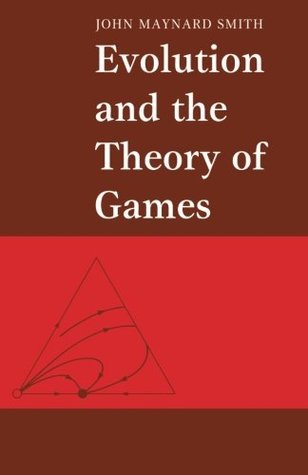
Evolution and the Theory of Games
Professor John Maynard Smith has written an account of a new way of thinking about evolution which has been developed in the last ten years. The theory of games, first developed to analyse economic behaviour, is modified so that it can be applied to evolving populations. John Maynard Smith's concept of an evolutionarily stable strategy is relevant whenever the best thing for an animal or plant to do depends on what others are doing. The theory leads to testable predictions about the evolution of behaviour, of sex and genetic systems, and of growth and life history patterns. This book contains the first full account of the theory, and of the data relevant to it.
The account is aimed an senior undergraduate and graduate students, teachers and research workers in animal behaviour, population genetics and evolutionary biology. the book will also be of interest to mathematicians and game theorists. the mathematics has been largely confined to appendices so that the main text may be easily followed by biologists.
By applying game theory to the problems of population biology, the author has succeeded in inventing new and interesting ways of looking at populations and has developed a theory leading to testable predictions.
The account is aimed an senior undergraduate and graduate students, teachers and research workers in animal behaviour, population genetics and evolutionary biology. the book will also be of interest to mathematicians and game theorists. the mathematics has been largely confined to appendices so that the main text may be easily followed by biologists.
By applying game theory to the problems of population biology, the author has succeeded in inventing new and interesting ways of looking at populations and has developed a theory leading to testable predictions.
234 pages, Paperback
First published October 21, 1982
About the author
John Maynard Smith
41 books84 followersJohn Maynard Smith FRS was a British theoretical and mathematical evolutionary biologist and geneticist. Originally an aeronautical engineer during the Second World War, he took a second degree in genetics under the well-known biologist J. B. S. Haldane
Ratings & Reviews
Friends & Following
Create a free account to discover what your friends think of this book!
Community Reviews
Displaying 1 - 5 of 5 reviews
June 27, 2007
This is a founding work of evolutionary game theory. It
introduces the evolutionarily stable strategy (ESS) --
namely, the game-theoretic strategy which, if played,
cannot be invaded by any rival strategy. Maynard Smith
used this to answer lots of questions in a very
mathematically tidy way -- among the most interesting
questions being, "Why are there approximately as many men
as women?" If the game-theoretic payoff is defined as the
expected number of grandchildren, then half-and-half is
uninvadable by any other ratio. The book is filled with
little discoveries like this, and it's explained
throughout by a master scientific writer; JMS learned from
J.B.S. Haldane, whose "The Causes of Evolution" brought us
the Mendelian-Darwinian synthesis.
introduces the evolutionarily stable strategy (ESS) --
namely, the game-theoretic strategy which, if played,
cannot be invaded by any rival strategy. Maynard Smith
used this to answer lots of questions in a very
mathematically tidy way -- among the most interesting
questions being, "Why are there approximately as many men
as women?" If the game-theoretic payoff is defined as the
expected number of grandchildren, then half-and-half is
uninvadable by any other ratio. The book is filled with
little discoveries like this, and it's explained
throughout by a master scientific writer; JMS learned from
J.B.S. Haldane, whose "The Causes of Evolution" brought us
the Mendelian-Darwinian synthesis.

October 29, 2017
Interesting primer for people that want to understand the principle of the evolutionary stable strategy (ESS) and how game theory can be used in evolutionary biology in general. Somewhat math heavy and probably not for general consumption

December 7, 2019
I read this book in-depth the first chapters while more browsing trough the later half. It is very well written; very accessible. I was fascinated by the idea of applying these type of approaches, in a general way, to understand human behaviour better. Coupling with an understanding of the complexity and that societies are emergent phenomenon i.e. cultural evolution one realizes that actually applying this type of approaches to human behaviour is challenging. I still believe it is a super cool project which I hope to pursue further in the future. For an economist with a background in game theory, I really think it was a great starter for reading things like Wilson's Darwins Cathedral, and Henrich's Secret of Our Success. You get some actual grasp of evolutionary dynamics and equilibriums. I am not sure if anyone has incorporated the actual argument of stable coexistence of different phenotypes in human society and that this might be an integral part of our evolution. I think Bowles&Gintis has some work slightly along these lines discussing how pro-socialness can survive. Further, in "Who we are and how we got here" David Henrich discusses the really deep roots of caste systems in Ethiopia. Could this arise from Smithian evolution? Perhaps this point is a bit controversial, or perhaps the mixing rate for humans is not such that this does occur. I really don't know, but I am as fascinated by the idea now as I was picking up the book. If anyone reading my review knows of applications to human behaviour or evolution, please let me know.

Want to Read
November 10, 2008gonna read it for presenting that leaflet for the "special topics in physics"...
all the ideas and concepts of it seem confusing and intresting...:)
all the ideas and concepts of it seem confusing and intresting...:)
Currently Reading
August 6, 2019Շատ հետաքրքիր գիրք
Displaying 1 - 5 of 5 reviews