Inspired by her Italian grandparents' immigration story, Donna DiGiuseppe studied Humanities and Italian history at UC Berkeley and in Venice, Italy. Tracing her roots to a hilltop village in Abruzzo, Donna toured Italy from Milan to Palermo to rediscover a piece of Italian history. Donna fell in love with Sofonisba Anguissola when she held Sofonisba's 1559 "Holy Family." Donna has been inside Sofonisba's childhood home and has laid flowers at her gravesite. Her debut novel LADY IN ERMINE: THE STORY OF A WOMAN WHO PAINTED THE RENAISSANCE reconstructs Sofonisba's fascinating life from Donna's extensive travels. What Dianne Hales, author of MONA LISA A LIFE DISCOVERED, calls, "A vivid portrait of a talented woman who defied the conventions of her times," LADY IN ERMINE is a story of historic achievement born of one woman's perseverance and determination to fulfill her passion. A gallery of Sofonisba's work is available at donna's website sofonisba.net
What does a CV/resume from the 1500s look like? Well if you are Sofonisba Anguissola, it looks like this:
This book, along with the artwork of Sofonisba Anguissola, have impacted me deeply and, I think, permanently. In a time when women were not allowed to be educated, not allowed to paint, and not allowed to do anything that tied them to the wider world, there existed a girl who would break so many rules and leave her mark upon the world.
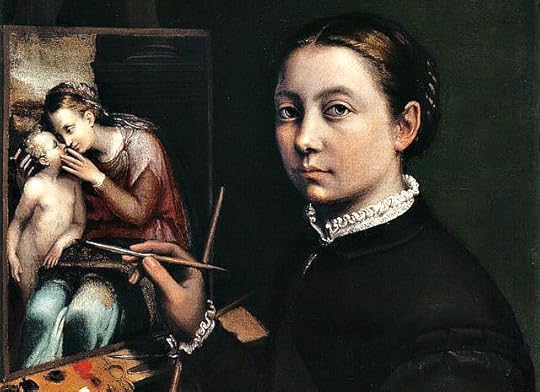
The above painting by Sofonisba Anguissola was sent to Michelangelo, in the hopes he would give her some pointers. In contrast to paintings of women at this time, and for hundreds of years to come, Anguissola painted herself as serious, capable, passionate, and driven. Michelangelo indeed thought her talented. He challenged her to paint a weeping boy and gave her some notes on painting techniques. She was of course rejected often and ridiculed for being a female who dared to paint, but eventually Anguissola was appointed a court portraitist in Spain for Philip II and Elisabeth of Valois (de' Medici). Some of her paintings were attributed to men, including the one she did of King Philip himself, an injustice that was not corrected until the 1990s! Just decades ago, museums finally displayed her paintings under the correct name of the artist, Sofonisba Anguissola.
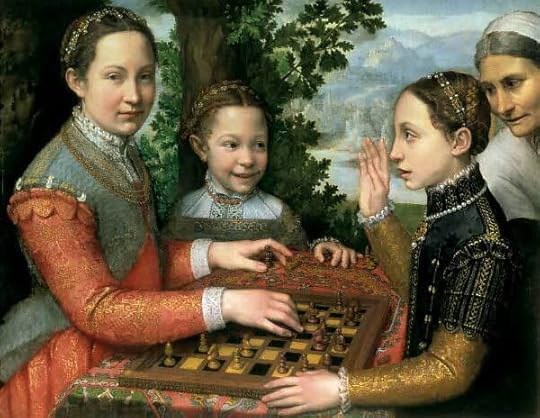
Weirdly enough, I came first across an Anguissola painting while playing Civ 6. I was playing as Hammurabi (my very favorite character) and while collecting art, I ended up with this painting of *women* playing chess. It said, "Anguissola," and incorrectly reported that it was from the 1800s., even though it was painted in the 1500s.
After seeing the Chess painting, I wanted to know who Anguissola was and I HAD to own a print of this painting, as well as the self portrait she sent to Michelangelo. Finding out that Civ 6 had mislabeled it, and that in fact it was women playing chess in the 1500s and not the 1800s, I grew more curious still. I had to know what artist painted women as objects possessing intellect and curiosity and not as mere sex objects. Discovering that Anguissola was a woman, that she exploded the glass ceiling by painting at a time when it was absolutely not allowed, made me so curious about her. I found this book and looked at her works of art as I read about her life. Anguissola's father was a tireless champion of her painting. He suffered insults but did not care. He got her a painting tutor, unthinkable to get a female a painting instructor. It just...was....not...done.
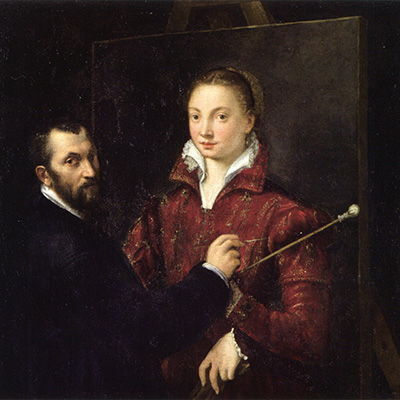
In addition to being revolutionary for simply painting as a woman, Sofonisba Anguissola was an extremely progressive painter. Adding to what I already mentioned about how she portrayed women differently, she also was an out of the box type of thinker and it reflected in her art. Pictured below is a painting that blew the minds of humans back in the 1500s. Anguissola painted her instructor, painting her. This is an easy concept for us to understand in 2021. However, back in the 1500s, people were like, "Wait a minute! Are you telling me that the person who painted this is the very person who is sitting in the chair? She painted her instructor painting her? How is this even possible?" To them, it seemed like a magic trick. It was so inventive!
In her life at Court, Sofonisba Anguissola became a close friend and confidant of the Queen, who died young in childbirth. She helped raise the royal daughters and taught them how to paint. I don't want to say too much more about her life, because it's a far better experience to just cuddle up with this book and a laptop, so that you can look at each work of art as it's discussed. There were so many aspects to this book that seemed exaggerated or made up. How could a woman in the 1500s accomplish this much and be this close in proximity to the leaders of countries? And yet, I looked it all up and verified the information I was reading, and, if anything, DiGiuseppe unplayed so much of it. I cannot recommend this book highly enough. Thank you DiGiuseppe for bringing to life this incredibly important and immensely talented artist.
One last note, if you want to be extremely disappointed in humanity, feel free to look up a WaPo article/ art review from 1995 in which Paul Richard, self important art critic, played down the importance of finally giving Anguissola her due and compared her unfavorably to Cezanne, who lived hundreds of years after Anguissola, centuries in which techniques had been tested and developed. I like Cezanne, but I encourage you to look at his artwork side by side with Anguissola, who painted hundred of years before he did. Her work definitely holds its own. In my estimation, it's far better in every way except for use of color. The sexism and arrogance that dripped from every paragraph of this article made me feel really sad because Anguissola's works waited 400 years to be correctly attributed to her, a fact that made me feel a a profound sense of joy and relief upon learning it, and Paul Richard simply dismissed her, as so many had during her time and in the more than 400 years since. What a shame that he was the voice of The Washington Post's art page.
A good insight into the life and times of one of the few, probably the only, female Renaissance artists to achieve recognition. Most of the story is fiction with some factual reference to actual historical events that took place in Italy and the Spanish court. The author emulates the florid, verbose style of courtly greeting and conversation that the ruling class used at the time; she does a good job describing Sofi's early isolation at court and her loveless first marriage to Fabrizio who fortunately for her died at sea. What's was lacking in the novel was some idea of Sofi's artistic process and her development as an artist - we are told that she wants all her paintings to reflect the soul of her subjects and she's always seeking 'invenzione' or inspiration but there's little detail on her unique skills.
There are some interesting asides that appealed to me: she is advised that at court “You must learn a thing or two about court culture, Sofonisba, so that you can protect yourself and your reputation. First, never contradict your betters. Avoid possessing any unflattering information about them unless you can utilize it. And don’t explain yourself to your inferiors. When your image is secure, your freedom will be too". Also I laughed when she came across the Bishop of Burgos' servant was delighting his master with a heavy session of fellatio! This review was written by Shawn Callon, author of The Diplomatic Spy.
If you were a girl of artistic inclinations, born in Renaissance Italy to a progressive Humanist father who believed that you were possessed of a mind as well as a soul and therefore worthy of a tutor to teach you how to paint, you would have been lucky.
But you still would have had societal obstacles to overcome. The first was modesty. A woman could not properly sign her own paintings, let alone accept payment for them. And she should not expect for her work to be viewed in any public setting. Clerics believed that “a lady should keep her hands pure for prayer.”
This was the world into which Sofonisba Anguissola is born in 1535, in Cremona,. Yet her talent was such that her work was compared to Leonardo da Vinci’s, and Michelangelo corresponded with her (and even replicated one of her drawings in a work of his own.), so how was she to ignore her gift? Sofonisba’s ambition sprang as well from her fervent desire to restore honor to her family.
This ambition crystalizes on the day that Prince Phillip of Spain (which ruled parts of Italy at the time) locks eyes with her as he parades through town on horseback. The feeling that she can see into his soul solidifies into a determination to paint Phillip’s portrait one day. Her chances to do that increase when she is invited to become a lady in waiting for now-King Phillip II’s third wife, Isabel of Valois. The Spanish Court already has a court painter, but Isabel is interested in painting lessons from her talented lady, whom she eventually asks to paint her portrait. Phillip’s tepid response to the portrait leaves Sofonisba feeling he’s unlikely to ever request a portrait of himself.
Other ladies in waiting, envious of Isabel’s favor for her friend Sofi, and intrigue involving the Cardinal of Bourgos, challenge a vulnerable young woman on her own and make Sofonisba yearn to return home, but she remembers her duty to her father to bring honor to the family and carries on. Gradually, other members of the court—Princess Juana, Don John of Austria, the Duke of Parma, and Don Carlos—ask to have their portraits painted. Stylistically, Sofonisba experiments with various paint thicknesses and new lighting techniques, but her focus is always her subject’s face in her attempt to depict al vero, the truth. Elaborately detailed clothing and props provide the context and narrative for the portraits.
When Isabel dies in childbirth, Sofonisba cares for the queen’s surviving daughters. Two magnificent paintings spring from this time. Finally, she paints King Phillip’s portrait. “The greatest honor for a portraitist is to paint the king’s portrait, but the greatest task is to reveal the sitter’s soul.” Depicting Phillip in prayer, she accomplishes both goals. And years later, one of Isabel’s granddaughters sits for the exquisite Lady in Ermine.
In mid-life, Sofonisba leaves the Spanish Court, with wealth and honor. Her life continues to be dynamic: she marries—twice—and continues striving to improve her painting. She ponders, “What woman gets such freedom of choice in how to life her life?” She lives into her nineties, serving as a link between 15th c. Renaissance masters like Michelangelo and 17th c. Flemish artists such as Reubens and Van Dyke.
It’s no exaggeration to say that Sofonisba Anguissola lived an epic life. Author Donna di Giuseppe, a historian, has somehow synthesized the many characters in this epic story and the complex goings-on of 16th c. Europe to create a fascinating and immersive novel about a monumental artist.
I have within the last few years discovered female artists of the Italian Renaissance and found this story fascinating. From having a father who encouraged all his daughters in their education and artistic ventures, to her 12 years at the Spanish Court, to her drive to paint in her own style and complete her masterpiece, this book covered her life from a young girl until her death. Well worth the read.
This book was such a pleasant surprise. Our book club enjoyed the descriptive and detailed writing of the renaissance period. Sofonisba was truly a intriguing person. An excellent book! A must to read!
This novel is such a find! It’s an easy and fun way to learn about a part of European history almost 500 years ago that is rich in historical significance. My daughter (16) and I both read the novel taking turns. We learned about Renaissance period art and monarchic figures and politics without the drudgery of reading a historical review of the facts. It was nice giving WWII a rest! Sofi, an Italian portrait painter and main protagonist (1532-1625), brings the Renaissance to life by taking you into her adventures as painter tutor and confidante of Spanish Queen Elizabeth of Valois. Sofi tries to break into the European male dominated art scene with political savvy and determination. The book has Jane Austin themes - a strong female protagonist whose ambitions are challenged by societal expectations that limit her romantic and financial freedom. I’m not a royal family groupie and don’t read Hola (the Spanish equivalent of Hello magazine), but I really enjoyed reading up on royal drama through this book. Donna Di Giuseppe has a way of making you feel like you are getting the inside scoop of what’s happening inside those castles by learning about Sofi’s story inside the Spanish court at a time when King Phillip II was building Madrid and France and Spain were fighting over Italian territory and artistic treasures. Despite the seriousness of the cover, this is a light and entertaining read with tongue in cheek humor.
A good insight into the life and times of one of the few, probably the only, female Renaissance artists to achieve recognition. Most of the story is fiction with some factual reference to actual historical events that took place in Italy and the Spanish court. The author emulates the florid, verbose style of courtly greeting and conversation that the ruling class used at the time; she does a good job describing Sofi's early isolation at court and her loveless first marriage to Fabrizio who fortunately for her died at sea. What's was lacking in the novel was some idea of Sofi's artistic process and her development as an artist - we are told that she wants all her paintings to reflect the soul of her subjects and she's always seeking 'invenzione' or inspiration but there's little detail on her unique skills.
There are some interesting asides that appealed to me: she is advised that at court “You must learn a thing or two about court culture, Sofonisba, so that you can protect yourself and your reputation. First, never contradict your betters. Avoid possessing any unflattering information about them unless you can utilize it. And don’t explain yourself to your inferiors. When your image is secure, your freedom will be too".
Also I laughed when she came across the Bishop of Burgos' servant was delighting his master with a heavy session of fellatio!
I had never heard of Sofonisba Anguissola and I feel so sorry that I never had. This book led me to look for her work and read about her life at the Spanish court. This woman who painted in a world where painting in women was not only rare but even considered to be “immoral” as it took them away from their more pious pursuits. Her hundreds of paintings are either lost or worse not attributed to her. Her mastery over portraits where she brought out the soul of the sitter for the viewer is something to marvel at after nearly 5 centuries. It is amazing what she achieved in the 1600s with her steadfast passion for art. This book takes the reader through her life as a young girl recruited as a lady in waiting to the Queen of Spain who she soon befriends with her honest nature and forthright personality. Her art and her dreams for her art takes the reader through her life long journey from the court to her ill-fated cruel marriage in Sicily to her widowhood and final days married to the love of her life. All through she draws and paints relentlessly and as she explains to young Rubens near the end of her life, she kept a copy of most of her work for herself. I found that it took almost 400 years to correct the wrong and identify many of her surviving paintings as hers. What will surely win any reader’s heart is what a progressive man Sofinisba’s father was. She and all her sisters were trained in art and he dreamt of her shining in the light of her talent in a world of artists who were men. Such men over centuries are also rare. Strongly suggest read this book (it reads a bit dry at times though) and look for Sofinsba’s art and marvel at how she broke the glass ceiling when no woman was perhaps aware such a ceiling existed.
WOW....had not expected to fall in love with this book. It was our book club pick for July. When seeing the title I almost skipped it, but being the obedient person I am I decided I had to read it. I am so glad I did!!! I have not read a book in a while that captured my attention and was a book I did not want to put down. I would have to say I don’t know much about history during that time so found that very intriguing as well. The author did a wonderful job of describing the characters and their environment and transported you back in time. She kept me coming back to see what might harm next. Don’t let the title or the picture sway you from reading this. I have recommended this book to everyone. Sit back and enjoy, you will not be disappointed.
Sofonisba Anguissola grew up in mid 16th century Cremona. Unusually for the time, she was trained as an artist and showed a precocious talent for portraiture. She was invited by the Spanish court to become a lady-in-waiting to Elizabeth of Valois, the third wife of Philip II. Many of her portraits still survive but, sadly, many were burned in a fire in Madrid. And, like many woman painters, over the years many of her paintings have been attributed to male artists. The book is definitely worth reading because the artist is such an interesting character and the author clearly did a lot of research. The writing, however, is quite lacking the subtlety and coherence of Sofonisba’s paintings.
An overall pretty entertaining fictional look at Anguissola's life. Of course, many of her thoughts and feelings are imagined. The author also uses those story telling techniques of presenting villains and conflicts which may or may not have happened to Anguissola. But there is no doubt that as a female painter in her time, there were many challenges she would have had to overcome.
I was absorbed by the story. At times I was angry on her behalf and I was very affected by Anguissola's death. I think using the historical fiction model as opposed to a straight biography might be a better vehicle to get people interested in this extra-ordinary woman's life.
I'm an art history lover and I fell in love with Sofonisba. This is a great story of the perseverance and dedication of a woman who wasn't supposed to be someone. The author's admiration painted her in such context that I found so much of myself in Sofonisba. How the world could forget the woman Michelangelo copied is beyond me. Side note, I highly recommend following up with the author's Pictorial companion, I used the pictorial to study Sofonisba's pieces from her perspective. I found it fascinating to have the art work next to me as I read the book and studied the pieces as Sofonisba goes through her creative process.
This was a fascinating story of an Italian female painter in the mid 1500's. The culture at that time dictated that a women should get married and give her husband an heir. Sofonisba Anguissola is called into service as a lady in waiting for the third wife of King Philip II. The story shows how she pursues her dream of painting portraits against the culture that women are not as talented as a man and have no ability to control their own life without the help of a man. I couldn't put it down. If you like historical fiction you will love this.
This is a beautifully researched and highly insightful book. It tells the story of a female artist's search for personal and artistic identity in a time when it was not a woman's place to do so. It is a true story told with historical accuracy that also references details in Sofonisba Anguissola's paintings to create a compelling and thought provoking narrative about her life, art and the time in which she lived.
Such a wonderful book! I could not put it down! I have purchased it for many of my family members and close friends as gifts! Truly an inspiring story demonstrating the ability to rise above all odds to pursue goals and aspirations! Lesson to all of us not to let anything stand in the way of what we want to achieve in life! Barring unforeseen circumstances, we are in control of our destiny! Donna's eloquent style of writing is truly outstanding!
It was a wonder of excellent research and a fascinating story with warmth and sensibility. I felt like I knew her. She and all of the characters were so well drawn in fullness.
Such an insight producing piece of work! The author’s Labor in researching this project is impressive. I gained much insight into renaissance atmosphere as it pertained To women.
Ms. Diguiseppe beautifully weaves the history of Sofonisba & the history period with fiction to bring the characters to life. Sofonisba was a very talented, determined artist in a time when few woman succeeded. The book reflects meticulous research and is a fun read.
Learned so much about the psyche of a painter either male or female but the struggle for a female painter in that age was beyond comprehension! Beautifully written.
I had never heard of this spectacular artist and woman, Sofonisba Anguissola (1532 – 1625). I have read (and listened to) Susan Vreeland's The Passion of Artemisia at least 5 times. Now I suspect I should return to that book once again to see what context Susan Vreeland gave about earlier female artists. Answer: Vreeland kept the focus directly on Artemisia Gentileschi (1593-1654) and did not mention other female artists. It is sad that she did not mention Sofonisba (Sofi) Anguissola who preceded her. In addition to these two female painters, more attention is now being paid to other female painters during the Renaissance.
DiGiuseppe brings Sofi to life as a court painter who is constantly missing her birth family of sisters, one brother, and parents she left behind. Very striking is how Sofi observes King Philip II mourning his fourth and final wife and then realizes that he is primarily devoting himself to prayer. She realizes that she did not give herself time and permission to mourn her own losses because of her dedication to her art. The book gives ample coverage to Sofi's paintings, her growth as an artist and struggles to reach the respect she so well deserved. It also builds an understanding of her as a woman from adolescence to old age. The version of the book I bought did not have the cover with the Lady in Ermine on the cover; I saw it among a series of her paintings and was struck by how modern this particular portrait was in how the subject was depicted in her bearing and how the elegant ermine cloak frames her face and body.
I don't remember why I bought this book with a 2019 copyright. It might have been because a local book club chose Laura Morelli's (2020) The Night Portrait: A Novel of World War II and Da Vinci's Italy but I read DiGiuseppe's book first. I was puzzled why Morelli's book focused on Da Vinci's "Lady With an Ermine" portrait of Cecilia Gallerani, mistress to Ludovico Sforza, and did not mention the painting in the title. I suspect it was because of DiGiuseppe's title and earlier publication date. The painting is so central to Morelli's book that she was granted permission to reproduce it throughout the book as a marker for each major section of the book. And the painting also figures in the Nazi's confiscation of masterpieces during World War II and the recovery of many of these masterpieces to be returned to the museums, families, etc., from whom they had been stolen.
Da Vinci's "Lady With an Ermine" is actually holding an Ermine, a white coated animal akin to the weasel but whose fur was reserved for nobility and often just royalty. The Night Portrait makes much of the multiple metaphors that the ermine could stand for: purity, nobility (and ties to the Sforza family), and also protection for a pregnant woman (Cecilia was pregnant with Sforza's child at the time).
My reading these two new books and the earlier book, The Passion of Artemisia (c. 2002), led me to return to reading Paul Strathern's The Medici and to re-reading his book "The Artist, the Philosopher, and the Warrior: The Intersecting Lives of Da Vinci, Machiavelli, and Borgia and the World They Shaped." Hidden within these books are not just the male artists and their male benefactors but also the female benefactors. They do not contain anything I remember about female artists. Patronage included not just those who sponsored works of art but the people whose portraits were requested, as with Sforza's commissioning of the portrait of Cecilia Gallerani.
And reading all of these things led me into other areas in which women's roles have been ignored but are now coming to life. (Two of these are the illumination of manuscripts and musical compositions.)
A terrific biographical novel about a female Renaissance painter, Sofonisba Anguissola, born in Italy in 1549. Thanks to author Donna Digiuseppe for bringing forth a female artist from history that helps refute the claim that there were no great female artists prior to the modern era, as suggested by scholars including Linda Nochlin who wrote a controversial essay in 1971 “Why Have There Been No Great Women Artists?” Nochlin’s main argument was that the lack of ‘great’ female artists, stemmed from the fact that women weren’t allowed to attend art school and receive training in how to paint the nude body. Though true, it’s not the main reason; the problem ran far deeper. Great women artists weren’t recognized due to the male-dominated profession of painting, beginning in the 14th century Europe that suppressed their talent, undermined their work and often credited their works to men. It continued for decades and expanded to include art critics, scholars and male artists. It continues today as evidenced with Sofonisba Anguissola—one of her paintings, Portrait of Catalina Micaela of Spain, 1577-79 (also the cover of the book), a portrait of King Philip II’s daughter, a gorgeous and remarkably modern work is attributed in the museum where it hangs, as a work by Alonso Sanchez Coello, the main court painter of Phillip II. It’s part of the Glasgow Museum collection in Scotland. It’s not the first time Anguissola’s work has been attributed to a male artist. Another is Queen Elisabeth of Valois (1605), which is credited to Juan Pantoja de la Cruz, another painter within King Phillip’s court who worked with Coello.
Back to the book—it’s an engaging, riveting read written as an historical novel. Digiuseppe chose Anguissola as she wanted to write about a woman whose accomplishments impacted history (p 364). The more that the story of Anguissola is discovered and shared, the more potential she has to do just that. Anguissola was a remarkable woman, not only a significant artist, but a woman of strength and character who made many sacrifices for her artistic talent and drive. The story is drawn from historical documents and from the works by Anguissola and those that inspired her. They’re listed by title at the back of the book. Also included is a list of historical figures at the beginning. All this makes for a terrific read. I learned not only about this remarkable artist, but court life and key players during Phillip II, King of Spain’s reign (1556 - 1598).