Jump to ratings and reviews
Rate this book

People in the Room

Rate this book

A young woman in Buenos Aires spies three women in the house opposite her family’s home. Intrigued, she begins to watch them. She imagines them as accomplices to an unknown crime, as troubled spinsters contemplating suicide, or as players in an affair with dark and mysterious consequences.

Lange’s imaginative excesses and almost hallucinatory images make this uncanny exploration of desire, domestic space, voyeurism and female isolation a twentieth-century masterpiece. Too long viewed as Borges’s muse, Lange is today recognised in the Spanish-speaking world as a great writer and is here translated into English for the first time, to be read alongside Virginia Woolf, Clarice Lispector and Marguerite Duras.

176 pages, Kindle Edition

First published January 1, 1950

49 people are currently reading
3102 people want to read

About the author

Norah Lange

19 books27 followers
Norah Lange fue una narradora y poetisa argentina de vanguardia, vinculada primero al Grupo Martín Fierro, especialmente con Jorge Luis Borges y luego al Grupo Proa de Leopoldo Marechal. Destacada por haber roto en Argentina el canon de que las mujeres no debían escribir prosa.

Hija del noruego Gunnar Lange y la irlandesa Berta Erfjord fue la cuarta de seis hijos. Llamativa por su condición de pelirroja, se destacaba por su audacia para irrumpir en ámbitos hasta entonces reservados a los varones.

Se le supone un amor juvenil con Jorge Luis Borges, quien prologó su primer libro La calle de la tarde (1925) y de Leopoldo Marechal que la inmortalizó en Adán Buenosayres como Solveig Amundsen.

En 1937 escribió su libro en prosa Cuadernos de Infancia, que mereció el primer Premio Municipal y segundo Premio Nacional de Literatura, y en 1944 escribió Antes que muera, un libro de memorias, continuación de aquel.

En 1943 se casó con el escritor argentino Oliverio Girondo.

En 1958 recibió el Gran Premio de Honor y Medalla de Oro otorgado por la Sociedad Argentina de Escritores (SADE).

Ratings & Reviews

What do you think?
Rate this book

Friends & Following

Create a free account to discover what your friends think of this book!

Community Reviews

5 stars
94 (14%)
4 stars
215 (33%)
3 stars
200 (31%)
2 stars
94 (14%)
1 star
32 (5%)
Displaying 1 - 30 of 153 reviews
Profile Image for Gumble's Yard - Golden Reviewer.
2,216 reviews1,797 followers
April 24, 2019
But all of this I thought slowly; each word required a scene which was difficult to compose with their faces incomplete, the signs barely visible, the obscure parts of their voices unheard. Then I devoted myself only to watching them, because at that moment the one at a slight remove lit a cigarette ……. A while passed before the third also lit a cigarette. The second didn’t smoke . The drawing room to my house was already dark, and I only left the window to check the time ….. It would be easy to follow them I thought if their domestic routine was so slow and meticulous
And Other Stories is a small UK publisher which “publishes some of the best in contemporary writing, including many translations” and aims “to push people’s reading limits and help them discover authors of adventurous and inspiring writing”. They are set up as a not-for-profit Community Interest Company and operate on a subscriber model – with subscribers (of which they now have around 1000 in 40 countries) committing in advance to enable the publication of future books.

This was the first book to which I subscribed – and it is always pleasing to feel one has contributed, in a very small way, to facilitating a work of art.

Famously and admirably, And Other Stories were the only publisher to respond to Kamilia Shamsie (recent winner of the 2018 Women’s Prize)’s 2016 challenge to only publish books by women in 2018.

https://www.theguardian.com/books/201...

The book is by Norah Lange (who died in 1972, aged 67) was a member of the Buenos Aires literary establishment – she married the poet Oliverio Girondo in 1943 and was connected to writers such as Jorge Luis Borges, Pablo Neruda, and Federico García Lorca. Originally published in 1950 this is, shamefully, the first time it has been translated to English - although its belated publication nicely fits into And Other Stories 2018 aim.

The book has been admirably translated by Charlotte Whittle – and reads naturally and atmospherically.

The premise of the book is very simple – the execution complex and masterly.

The narrator is a seventeen year old girl living with her family in a house in what appears to be a prosperous Buenos Aires district, a house in which they lived for two years, years full of memories and anecdotes for her other family members but which for her is seen “only as a convenient place to keep watch on the other” and which for her would “always be …. a dimly lit drawing room looking out on to the street, with shadowy corners and three pale faces that appeared to be living at ease”

For at the start of the book, the narrator spots, initially illuminated by a lightning storm, three women (who she imagines to be around 30) sitting quietly and calmly in the street windows of the house opposite.

She immediately fixates on them, voyeuristically obsessed with their lives. She imagines their characters. circumstances and back stories. Her fixation is to the exclusion of almost all else: any conversations with her family are dominated in her thoughts by the three faces opposite – she is convinced that she is party to a great secret concerning them (in a way which makes the novel effectively an internal spy/ detective novel) – and when she eventually start to visit them her imaginings and the sense of mystery only become more pronounced.

The novel is claustrophobic – and the sense I had is of a girl on the verge of adulthood but still with the imagination of a child, who is chafing against the rapidly approaching restrictions of female domesticity of the era and takes refuge instead in her imagination – in the same way that Lange herself took refuge in the world of writing.

The book is episodic in nature – each chapter describing another period (normally a day) of the narrator’s imaginings – which often stem from or lead into her dreams.

And that I came to realise is how it would best be re-read: as a bedside book, to be absorbed and savoured on a quotidian basis to inspire my own imagination and dreams.
Profile Image for Eric Anderson.
716 reviews3,938 followers
August 15, 2018
This is the first novel by Norah Lange to be translated into English and it’s just been published by the wonderful independent press And Other Stories. It was written in Spanish and originally published in Argentina in 1950. In her day Lange was a celebrated member of the Argentine literary scene – especially the avant-garde Buenos Aires group of the 20s and 30s. Throughout her life she famously hosted many literary salons and associated with writers such as Jorge Luis Borges, Pablo Neruda and Federico Garcia Lorca. She was awarded a Grand Prize of Honor by the Argentine Society of Writers having published poetry, memoirs, nonfiction and novels. Yet, she’s barely known outside her native country for reasons which César Aira’s introduction to the book and James Reith’s recent article in the Guardian interestingly suggest. It’s thrilling to discover a novel like “People in the Room” because, although I studied avant-garde literature at university from Borges to Alain Robbe-Grillet to Tristan Tzara, there were few female writers of this era included on the course list outside of Gertrude Stein and Nathalie Sarraute. It’s somewhat alarming to think that Norah Lange was there all the time, but most North American and European readers had no access to her work.

As characteristic of the innovative art and writing from this time, “People in the Room” pushes the boundaries of character and narrative where we’re given few specific details about the protagonist and her situation. Instead the reader follows her labyrinthine train of thought as she voyeuristically observes three women in their thirties through a window across the street from where she lives. Her obsession with these neighbours leads to endless speculations about their potential status as criminals or tragic figures or secretive heroines. Curiously, though she makes tentative contact with the women, she doesn’t want to discover any actual facts about them – not even their names. It’s as if her observations can transform them into an endlessly tantalizing array of fictional characters of her own creation: “I knew, if I was patient, I could have their finished portraits just the way I liked finished portraits to be: for them to be missing something only I knew how to add”.

Read my full review of People in the Room by Norah Lange on LonesomeReader
Profile Image for Paul Fulcher.
Author 2 books1,967 followers
April 25, 2019
Everything, in their presence, acquired gravity, a sense of parting, of bitter oblivion, of mysterious, ineffable ways.

Deservedly longlisted for the 2019 Best Translated Book Award

Published in 2018 by the excellent small independent publisher And Other Stories, People in the Room was translated by Charlotte Whittle from Personas en la sala, the 1950 original from Argentinian author Norah Lange.
Lange is rather unfairly known more as the muse of Jorge Luis Borges but see the publisher's website for an interview with the translator and Words Without Borders for an introduction, also included in the printed book, from César Aira, setting the novel in the context of Lange's life and work.

This is a short but intense novel, beautifully written and translated, one that is best not consumed in one sitting but rather slowly supped and savoured.

The narrator, 17 years old in late adolescence, finds herself captivated by the sight of three sisters, aged around 30, who spend most of their day sitting in the drawing room of the house opposite:

At that moment - as if everything had been prepared for me to attend this meeting with my appointed destiny - I saw them for the first time, began to watch them, and, as I watched them, slowly examining their three faces in a row, one barely more elevated than the others, it seemed to me that I held - like the suit of clubs in a game of cards - the pale clover of their faces fanned out in my hand.

They were sitting in the drawing room, one of them slightly removed from the others. This detail always struck me. Whenever I saw them, two of them sat close together, the third at a slight distance.


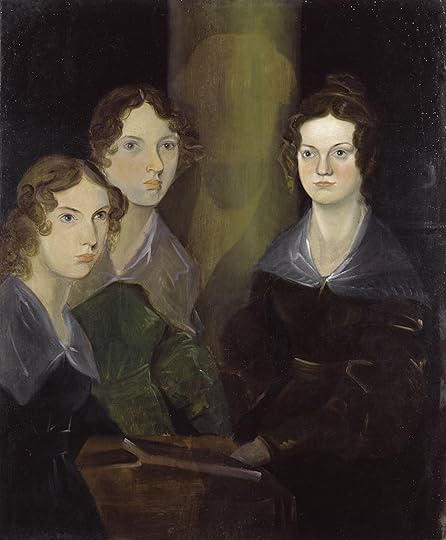
Lange's visual inspiration for this scene came from the well-known picture of the Brontë sisters painted by their brother Branwell (with its ghostly figure which has emerged over time from behind the sisters, widely believed to be a self-portrait of the artist, before he changed his mind and painted a pillar over it)

description

She at first merely observes them, speculating on who they might me and what secrets they might conceal. Later she becomes a regular visitor to their house, although even then she is more of an observer than a participant, feeding off small tidbits of conversation between them as fuel for her fevered speculations and posing them rather oblique questions.

While the narrator claims (referring to a question posed to one sister) that she is hoping any answer she gave might bring me closer to her past, explain her stubborn, unchanging evenings, the reader gets the impression that if she found out more concrete facts it would spoil her imaginings.

And as thoughts of the three sisters dominate her life, her own family realise that something is wrong, although they seem barely aware of the existence of the three women opposite:

She always has a book in her hand. Something she's seen outside. There must be some reason she no longer reads in her bedroom. She's changed. She hardly speaks to us anymore ...

Who they are, and why they sit day after day, largely in silence, is not disclosed in the novel. But there is one intriguing clue that was only to be resolved 42 years later:

I would picture them as three governesses, with little joy in their lives, who met to reminiscence about a house

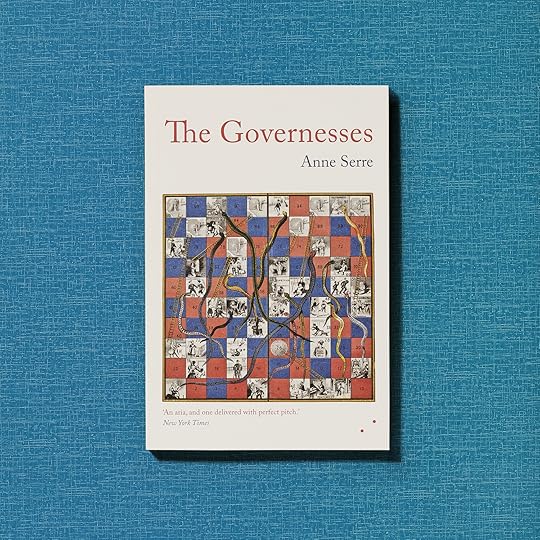
And from another longlisted book from this year's BTBA, we find that perhaps we do know the three women after all. Their story was told by Anne Serre in 1992, and translated into English in 2018 by Mark Hutchinson as The Governesses

description
Profile Image for Maria Hill AKA MH Books.
322 reviews135 followers
July 5, 2018
“Yes! Be quiet, because anything is possible once the horse is stopped: slit wrists, a nightgown damp from the heavy drops of their own tears, from the slow trickle of their blood; a delicate, belated haemophilia preventing them from turning over, soaking their hips, their bodies stuffed with sawdust beneath their glued on heads; their pink porcelain necks beneath their collars.“

This is my second book from my subscription to andotherstories.org but my first to read and review. Thus I am reviewing a little before the publication date. I must say I really enjoyed it BUT it will not be for everyone! So if you like the quote above please, please try this book. If not stay away as I picked this quote at random and its very typical. Consider yourself warned folks.

This is a story of a young seventeen-year-old girl who spies three faces of three sisters in the window across from her sitting room during a storm one night. She quickly becomes obsessed with them and their story. She loves them and wishes them dead. She does not know their name.

The reader quickly becomes lost in a shadowy world where you are not sure if the Sisters are real, partly real and partly imaginary or a total figment of the Protagonists imagination. Nobody in the story is named and prose and imagery are dense ( I read another piece of literary fiction, Crudo, to take a break from this at one point - seriously!).

Overall, I have to admit, that I cannot get multiple questions out of my mind. How much of this story is a commentary on the isolation of young women in early Argentina? How much of it is a homage to the Brontë sisters (the introduction says it was inspired by a picture of the three sisters and it definitely has some gothic undertones that remind me other their work)? Is the main protagonist mad and or a psychopath? She certainly claims that loving the older sister is responsible for her wishing the older sisters dead and she wishes her dead a lot. If the mark of good literary fiction is to drive you crazy with unanswered questions this one certainly fits the mark.

This is recommended to those who like dense poetic prose and who thought that Shirley Jackson’s The Haunting of Hill House had too much plot and tied up the ending too well.
Profile Image for Myriam V.
112 reviews74 followers
November 30, 2021
¡Qué belleza este libro!
¿Por qué tiene más lectores en inglés que en castellano? Hay una traducción reciente al inglés, aparentemente muy buena. Necesitamos una nueva edición en el idioma original.
Una chica va a cerrar la ventana una noche de tormenta y en el momento de la caída de un rayo ve su propio reflejo en el espejo. Luego es atraída por luz en la casa del frente, distingue tres mujeres sentadas en una sala y empieza a espiarlas.
Escrito en primera persona, ignoramos el nombre de la protagonista, solamente sabemos que tiene diecisiete años y que su obsesión es observar a las vecinas, saber si se vigilan o esperan algo, descubrir su secreto. Empieza un juego de identificaciones y ambigüedades, amor y odio, acercamientos y distanciamientos. El relato está lleno de presentimientos y dudas sobre oscuridades en las vidas de las vecinas que develan los deseos ocultos de la narradora y su propia transformación. Todo el tiempo ronda la idea de la muerte y a veces no sabemos qué es real y qué es fruto de sus fantasías, quizá porque todos tenemos algo de gótico en el Río de la Plata.
La prosa es exquisita, es un libro para disfrutar cada imagen y cada palabra, no para esperar la resolución de un enigma, no es un thriller, no es para gente ansiosa.
Para la creación de este libro, Norah Lange se inspiró en un retrato de las hermanas Brontë pintado por el hermano de ellas.
Profile Image for Anna.
2,128 reviews1,033 followers
November 19, 2018
I picked this paperback up from the new acquisitions shelf in the library and was intrigued by the central conceit of a young woman spying on three mysterious adult women. As it turns out, however, the introduction (read last, as ever) is correct to describe it as ‘not a novel to be read for pleasure’. It reminded me of 'The Yellow Wallpaper' by Charlotte Perkins Gilman. Both share a claustrophobic narrative in which a woman’s mind is stifled to the point that it unravels. In ‘People in the Room’ the narrator and the subjects of her obsession all remain unnamed. The former gazes in fascination across the street to see the latter through their window. The three mysterious sisters scarcely ever do anything or go anywhere, yet wholly consume the narrator’s imagination for no obvious reason. The narrator’s preoccupation with suicide and death, especially the death of the oldest sister, suggests that she is severely depressed. She attempts to befriend the sisters in a peculiar manner, one that is unsettling to the reader and likely alarming for the subjects of her fixation. She alternately considers them criminals, revenants, and tragedies. The intensity of her reactions to hypothetical incidents is indicative of her state of mind:

I remembered the new black dress I’d wanted to wear the first time I visited them, and felt touched to think that perhaps they missed me, and perhaps that very evening she’d say something that bore a likeness to my absence. Perhaps it would occur to her to send me a book. I thought of how awful it would be if they sent me a bouquet of flowers or a magazine. I felt capable of sending them back and begging them to forget we’d ever met, and, gradually, my resentment turned to tears, as I imagined myself in their drawing room, standing before the pale bouquet of their changing faces, shredding the flowers, tossing the magazine to the floor in fury.

“You ought to be ashamed, you ought to die of shame!… You ought to die!” I would add suddenly, as if the idea had only just occurred to me. “You ought to die!” I would cry. “So much talk of death, and you send me a magazine. As if you could await death while flipping through a magazine.”


The narrator constantly projects on the sisters. It seems likely that her obsession stems in part from a belief that their stasis prefigures her own future:

In fact, it was so often my fault that time and again I was seized by the idea that I too would gradually come to resemble those people who go about hiding something, sometimes even humbly, but almost always as if clinging to the small, proud consolation of saying to themselves over and over: “If only they knew...” Then I would gaze at my hands in my lap, as if someone had tossed them there, inert, like accessories to a crime, and to forget the sight, I would quickly unclasp them, start sewing something, polish a piece of furniture.


Flipping back through ‘People in the Room’ to find those quotes helped to crystallise my opinion of it: an accomplished and haunting insight into a character who lives entirely in her own mind; not an enjoyable reading experience.
Profile Image for Marie-Therese.
412 reviews214 followers
December 28, 2019
Beautifully written and fiercely compelling, Lange's brief novel is one of the most convincing evocations of late adolescent girlhood (its self-obsession, its mood swings, fearfulness, and expansive sense of drama, disquiet, and longing) that I've ever read.

On the night of a lightning storm, a nameless seventeen-year-old girl catches a glimpse of the faces of three women sitting in the drawing room in the house opposite her own. She develops an instant affinity for these faces, one that over the course of two months grows into an obsession. Working within a very narrow compass with almost no "action" or "plot" to speak of, Lange somehow manages to craft a novel that is suspenseful and hallucinatory, a kind of modern Gothic novel where the spookiness is all internal and psychological. The book ends with one of the most beautifully balanced virtuosic paragraphs I've yet encountered in Latin-American literature.

This is a treasure and I plan to seek the book out in its original Spanish very soon.
Profile Image for Yaprak.
525 reviews195 followers
July 14, 2025
Daha önce Çocukluk Defterleri romanını okuduğum, 1905 Arjantin doğumlu yazarı Norah Lange'in Salondaki Kişiler romanı karşı evdeki üç kişiyi incelemeye başlayan 17 yaşındaki anlatıcımızı konu ediyor. Yazarın 1905 doğumlu olduğunu bilerek belirttim aslında çünkü böylesine tekinsiz bir romanı 1950'de yayımlamasını ilginç buldum. Hoş Arjantin'den hep biraz tekinsiz yazarlar çıkıyor sanki :) Aklıma bu kitabı okurken hep bir başka Arjantinli kadın yazar Samantha Schweblin geldi. Onun Kurtarma Mesafesi romanındaki gibi tuhaf, neyin gerçek neyin hayal olduğu belli olmayan, oldukça depresif bir atmosfer var bu romanda da. Sonra merak edip araştırınca Schweblin'in de bir röportajında Norah Lange'i andığını gördüm. İspanyolca bilmiyorum o yüzden kötü de olsa röportajın çevirisini buraya da eklemek istedim.

"Hikâyelerinde, gerçek ile fantastik arasında Julio Cortázar’ın derslerini yeniden yazıyor gibi görünen kesişmeler var. ‘Boom’ kuşağının eski klasiklerine karşı nasıl bir konum alıyorsun?

Bizden önceki kuşağın bu büyük ‘boom’ elçilerini biraz unutmak istemesi çok doğal. Böyle şahsiyetlerden sonra nasıl yazılır ki? Ama şimdi bizim kuşağımız görünürlük kazanmaya başladıkça, onları yeniden sahiplenmemiz de doğal. Çünkü örneğin, benim için onlar yetişkinliğimdeki ilk okumalarımdı; ulusal ve Latin Amerikalı yazarların metinleriydi. Yüzyıllık Yalnızlık, Kent ve Köpekler, Tüm Yangınlar Ateştir gibi eserler kurucu metinlerdi ve sanırım ben bu yazarlara hayranlık duyarak edebiyata âşık oldum.

Ayrıca artık onların kadın çağdaşlarının da isimlerini anabiliyor olmamız beni çok mutlu ediyor: Silvina Ocampo, Sara Gallardo, María Luisa Bombal, Elena Garro, María Elena Walsh, Armonía Somers, Norah Lange gibi… Hepsi de çok yetenekli ve bir o kadar görmezden gelinmiş kadınlar."

Salondaki Kişiler'i anlatmak da anlamak da biraz zor aslında. Karşı evlerinde yaşayan üç kadını izleyen 17 yaşındaki anlatıcımızı dinliyoruz. Bu kadınlar sağ mı ölü mü, gerçek mi hayal mi anlamak pek mümkün değil. Biraz depresif ve karanlık bir roman desem yeri sanırım.İnceliğine güvenip tatil bavuluna eklemenizi önermem :) Ama karanlık atmosfere sahip romanlardan hoşlanan için de gizli kalmış romanlardan biri diye de eklemeliyim.
Profile Image for Neil.
1,007 reviews764 followers
June 24, 2018
Norah Lange (1905-1972) was an Argentine poet and novelist, a member of the Florida Group which included Oliverio Girondo (whom she married) and Jorge Luis Borges. People In The Room was originally published in 1950 but is only now available in English translation. The English version is published by And Other Stories, one of the UK’s small, independent publishers who support many works of translation.

This is a book it is impossible to read quickly. What I mean is that whilst it might be physically possible to rush through it, the writing style and the dream-like, hallucinatory images in the book make you slow down. It is a book about atmosphere as much as it is about plot. And the atmosphere is worth savouring and taking your time over. It is full of sentences like this one, picked almost at random as an example:

'I wanted to see her more clearly, to see how she looked when she said, "blue dress," beneath the overhead light.'

It is unsettling to read because it sometimes seems to refer back to events that haven't been recorded in the book. Or, and this is entirely possible, events that snuck by when the book had you temporarily hypnotised.

In essence, a young woman sees three other women in the house across the street and becomes obsessed with watching them. She imagines things for them (they are criminals, they want to die, they…) and her imaginings and actual events start to mingle in a confusing way. A strange man pays a visit that unsettles the women but the reasons for his visit are far from clear.

It all feels like a dream. Or perhaps nightmare is a better word.

In his introduction, Cesar Aira talks about the limitations placed on female writers in Lange’s time and place. He goes on to say:

'In the work of … Norah Lange … traditionally feminine subject matter is excavated so deeply that something entirely different emerges'

He is explaining that Lange works within the restrictions placed on female authors that limited them to subject matters such as home, children, marriage and family, but subverts that by delving deeply, so deeply that she uncovers something new, something outside the limitations that most other female authors accepted.

This might be a book that was first published almost 70 years ago, but it does not feel dated. It does feel unsettling, it does feel disorientating. It is an absorbing read and I think it probably needs at least two reads to get to grips with it at all. I will be returning to it at some point.
Profile Image for Gabril.
1,052 reviews258 followers
September 3, 2020
“Ci fu un lungo silenzio mentre la mia domanda in aria si riempiva di schegge, di aghi, di tutti i dolori scomodi e senza importanza, diventando sempre più grande e inutile.“

Surreale, onirico, magnetico.
Profile Image for Nathanimal.
200 reviews138 followers
December 3, 2019
I think some telepathy happened when I was reading this book. As I read it I kept thinking about the Brontë sisters, about the tiny books they made from scratch when they were kids, and, as adults, all their complicated needlework, and Charlotte’s fastidious botanical paintings. And I thought, in general, of the conditions under which women of that era were “kept” and I couldn’t help seeing these ornate items as a kind of prisoner art, all that attention exquisitely focused into a small, domestic object. Hysteria is a painted powder box.

Nothing happens in this busy little book. The narrator is a woman in a drawing room looking across the street at three other women in a drawing room. Jane Austen’s characters, who are also often in a drawing room, are so consumed with what people are like—is he a good man or a cheat? Are you all sense or sensibility? This book pushes that attention to its extremes. The narrator is creating these characters from almost nothing, they’re more a portrait of her own madness. It’s the most gothic thing I think I’ve ever read.

Speaking of portraits, as I read this an image kept floating through my mind, which towards the end I identified as the portrait of the three Brontë sisters, the one where Branwell famously painted himself out. It wasn’t until I’d finished the book that I went back and read the introduction* and discovered that the Brontë portrait had actually been the inspiration for the book! So, telepathy? It’s like she encoded the portrait into a novel for the reader to subliminally decipher. Neat trick.


* Tell me if you do this. I usually read the introduction of a book right up until the part where they start talking about the book itself. There’s nearly always a distinct transition from talking about the writer to talking about the book. When I’ve finished the book, then I go back and read the rest of the intro, if I’m interested enough to do that. I sometimes wish they’d break the intro in half and put the second half at the end.
Profile Image for Kirsty.
2,794 reviews189 followers
October 9, 2018
I purchased Argentinian author Norah Lange's novella, People in the Room, after randomly coming across it during a weekly browse of the Kindle store.  Much to my dismay, I have read very little Argentinian fiction, and would like to remedy this.  Lange's novel - which is, as far as I am aware, the only piece of her work currently available in English translation - sounded fascinating.

The introduction, written by Cesar Aira, is both insightful and interesting, despite the fact that it gave quite a lot of the story away.  I loved Lange's writing style and its translation into English felt fluid.  I loved the way in which almost all of the characters remained unnamed, and the element of obsession was so well handled. 

I found People in the Room to be unsettling and beguiling in equal measure. I’ve never read anything quite like it, and could feel the claustrophobia closing in as it went on.  The tension in the novel is almost palpable.  I'm not sure that I have ever read anything quite like People in the Room before, and it is certainly a book which will stay with me for a very long time.
Profile Image for Stacia.
1,035 reviews133 followers
April 5, 2020
I just couldn't connect with this one. While I can appreciate all the analysis & supposed merit of this work, it still doesn't mean I actually enjoyed or even liked this book. It felt like work to read it, to wade through her sentences. I didn't really care whether the situation was real or imagined to the protagonist; it was boring & repetitive... (& maybe that's part of the point the author was making). It's supposedly a gothic tale, a take on some of the rigid roles women were once consigned to, & more. Reading so many rave reviews & deep thoughts about it make me think I probably missed some spark, some great train of thought, some revelation, some feeling. I felt like I was crawling over clumsy sentences that went nowhere.

Ultimately, I found it boring & pointless. I couldn't even take pleasure in the writing itself because I didn't like her writing style.
Profile Image for June.
49 reviews27 followers
April 29, 2019
A good reminder that modernist prose always feels fresh. Written in 1950, the author expertly draws us into the mind of her young narrator -- a 17-year-old girl whose voyeuristic obsession with three unnamed female neighbors leads to a series of dark, hallucinatory musings. For lovers of atmosphere over plot. Wonderfully translated.
Profile Image for Bill Hsu.
1,001 reviews223 followers
May 24, 2021
This is all about the narrator's extended and elaborate concoctions. Lange spins impressive and obsessive passages like:
I know I couldn't allow myself to be mistaken, that I loved them, that I didn't mind not knowing their names as long as things went on just as before, and that if I had once felt a desire to see her dead, it was because I was fond of her, and when I was fond of people, I always imagined them dead.
Whew.

(3.5 stars)
Profile Image for Kamakana.
Author 2 books417 followers
November 14, 2021
if you like this review, i now have website: www.michaelkamakana.com

201011: not for everyone but definitely for me. haunting, hypnotic, harrowing. this reminds me, partly because of era in which it is set, of early use of motion picture technology. it was not self-evident that movies would tell stories, let alone in different manner than stage, with different focus than novels, for it is first that images 'moved' that fascinated. then tracking, zoom, close-up, dissolve, jump-cut etc became part of filmic grammar and stories were essentially different. images in silent movies told the story. images went from panorama, action, to closest psychological inspection. for me this is what this book does...

this is exactly the right medium for the story- slightly altered. this could be silent movie, with gestures, speech inferred, with repetition, significance implied or imagined, all from the voyeuristic perspective of the girl. who is passive spectator, who invests emotions without clarity, who never discovers who the women are, what has brought them to the room, what history binds them, who is the mysterious man, what are the letters... finally, not even knowing their names. and it is all a dreamlike, surreal project- her obsessive gaze- for she never shares this with her family, indeed seems paranoid anyone discovers her investigation...

questions multiply throughout this text, not simply who the women are or who the watcher is, but also structural. ‘nothing happens’ in plot ways but everything in thought ways. this is sort of a metaphysical thriller. there is consistent absence of identifying features- even the most banal description of the women is problematic for the watcher. do not know spanish so i do not know how lit is originally written, but it seems direct and uncomplicated, and perhaps that is the best language to tell this, a sort of language that is near as invisible, as transparent, as possible, for the most emotional declarations of love or hate or wishing them dead. and this is language deployed to give the (illusion) of objectivity, that i love so much about this book...
Profile Image for Jim.
2,425 reviews801 followers
June 20, 2019
Norah Lange's People in the Room is yet another reminder that Argentina has a national literature that is not only serious, but world-class. A striking Norwegian redhead, Lange was pursued by Jorge Luis Borges, but chose instead to marry the poet Oliverio Girondo, whom Borges considered an enemy.

With People in the Room (1950) we have a limited cast of characters, all female: There is the 17-year-old narrator who lives on an upper class street in the Buenos Aires suburb of Belgrano and there are the three sisters who live across the street from her. Consider them like the famous portrait of the Bronte sisters painted by their brother Branwell: Two sit side by side with the oldest, Charlotte, slightly off to the side at an angle. Except that neither the narrator nor the three sisters have names. The narrator doesn't know the sisters' names, and the sisters do not know the narrator's name.

The narrator becomes aware of the sisters because she could see them through her window, as they have no curtain hiding them from view. She becomes fascinated with them and eventually contrives a way to introduce herself at their home, where she becomes a frequent visitor. Their conversation is utterly banal, such as that a spider was seen in one of the bedrooms, or a particular item of clothing is stored in a bedroom trunk. The narrator is at one and the same time in love with the sisters and desirous of their death.

In fact, the level of non-specificity is high. The narrator is clearly obsessed, and the sisters are quiet, repressed, and bland. In fact, it doesn't seem to be very promising as a novel.

And yet, I found it fascinating.
Profile Image for peg.
341 reviews6 followers
April 14, 2019
Longlisted for the 2019 Best Translated Book Award, this recently translated book was written in 1950 by Argentinean writer Lange. It is one of those books filled with atmosphere and tension though not much actually happens.

The story is told by a 17 year old girl who becomes obsessed by her neighbors, 3 older women who sit in plain view in their front room night after night with the light on. The narrator spends many hours in her darkened room watching them, and soon we are not sure what is actually happening and what she is imagining, giving it sort of a gothic and ghostly atmosphere.

What there was of a plot really brought back memories of a summer in my early teens when I spent many hours watching next door neighbors and becoming quite obsessed with their activities, mainly because of the 2 older teenage boys who lived there with their family!
Profile Image for Stefano Cucinotta.
Author 5 books50 followers
November 10, 2020
A Buenos Aires una ragazza di 17 anni sviluppa un'ossessione per tre donne che vivono di fronte a lei e che non si spostano mai dal salotto di casa. Un breve romanzo difficile da definire: un'impressione quasi pittorica, piena di inquietudine e suggestioni. Le donne sono vive? Cosa vogliono davvero? È impossibile scrivere decine di pagine su un'immagine incorniciata da una finestra, ma la Lange compie il miracolo. Molto bello e decisamente autunnale, da leggere di fronte a un camino, con la nebbia fuori.
Per quelli che, guardando nelle case degli altri, immaginano intere vite.
Profile Image for Jaqueline Franco.
295 reviews28 followers
December 12, 2021
Como voy a salir de este dedalo de Espionaje?

Una novela muy peculiar, con una protagonista ( y testigo) que en una noche de tormenta, se acerca a la ventana para cerrarla, cuando de pronto, a la caída de un rayo, ve su reflejo en el espejo (es ahí que ella se siente ajena a sí misma), es en ese momento donde se percata de una luz encendida de la casa de enfrente, que enmarca a tres mujeres sentadas ante su mesa, con las cortinas descorridas. Aquí comienza una rutina de espionaje, desde su sala, todas las tardes; jugando con sus rostros, inventándose vidas para ellas, en su transitoria monotonía. Es una novela que juega en tres planos: fantasía, delirio y realidad.
No sé cómo explicar una novela en la cuál no ocurre nada, toda la narración es pasiva, y el cierre te hace cuestionarte si fue real!?
Una novela, de una escritora muy adelantada a su tiempo, y aquí lo deja claro. Me encantó.
Profile Image for Justine Kaufmann.
285 reviews121 followers
August 22, 2021
“Everything, in their presence, acquired gravity, a sense of parting, of bitter oblivion, of mysterious, ineffable ways.”

Norah Lange’s People in the Room is disorienting from the outset. Soon it will be clear that madness is afoot. But Lange doesn’t build up to some incident of insanity, she drops you in just before the storm strikes, when everything is serene, but tinged with an eerie foreboding of the turmoil to come.

Our protagonist and narrator, a 17-year-old girl, grows obsessed with three women. We are told they live across the way and sit there in front of the window, like a portrait. She sits there watching them all day. She runs into them at the post office. She visits their apartment. She listens to their conversations. She speculates about their pasts. She loves them. She wants them dead. Her whole world comes to revolve around these three women. BUT. Do they even exist? Or are these three women nothing but figments of her imagination?—be it out of boredom, out of madness, or simply out of the desire to create. And, if overtaken by the obsession to create, is her desire for her creations to die really just a desire to be rid of them, to be free?

Lange has excelled at creating prose unbearably claustrophobic, and she is able to acutely portray obsession—how quickly feelings of love and bewitchment turn into anxiety and acrimony. The idea behind this is so simple but genius, especially for its time. However, I do feel that the execution did not quite live up to my expectations (especially when held up to her contemporaries like Silvina Ocampo and Adolfo Bioy Casares). It would have been much more successful as a longer short story/ novella, shedding some of the repetition and waning moments of the book. But overall, another Argentine author I’m glad I read.


3.75 stars
86 reviews
February 22, 2019
This book is a great gift, and the translation is exquisite. Norah Lange is a writer of great daring and style. Each chapter is so contained that it could represent its own cycle of thought and emotion, always from the standpoint of the nameless narrator. What is known is minimal, and even that is full of doubt. One could read this and reasonably conclude that the narrator has invented the entire novel in her head, and that her much-loved counterparts, three women in a window, don't even exist. The style is as dense and powerful as Thomas Mann in Death in Venice, but with a much more experimental aspect. The feel is undeniably Argentine (don't ask me what that means), but one is also reminded of the poetry of Gabriella Mistral and Carlos Drummond de Andrade while reading this work. I can only imagine being a fly on the wall during a conversation between Norah Lange and Jorge Luis Borges, her dear friend. When I finished the first reading, I felt that the second time I should read the entire book aloud. This is great literature.
Profile Image for Zish.
108 reviews4 followers
May 30, 2018
I think I enjoyed this? I wanted to get to the point already, and it never quite did, which is a style of writing I’m still getting used to. It was an interesting look into the psychology of solitude. Very “Voyage around my room” by De Maistre.
Displaying 1 - 30 of 153 reviews

Can't find what you're looking for?

Get help and learn more about the design.