

What do you think?

التحرر
"كانت أولمبيا كراوفورد روبنشتاين تتحرك بعجلة في مطبخها في يوم مشمس من شمس مايو/أيار في المنزل الحجري الذي تشاركه مع عائلتها في شارع جاين في نيويورك، قرب الحي القديم لويست فيلاج. وقد أصبحت هذه المنطقة منذ زمن بعيد ضاحية راقية، بحيث تتواجد فيها المباني الأكثر عصرية مع حراس ومنازل حجرية قديمة جرى ترميمها. كانت أولمبيا تحضر الغداء لابنها ماكس البالغ من العمر خمس سنوات، والذي يفترض أن يوصله باص المدرسة خلال دقائق معدودة. انه في صف الحضانة في دالتون، ويوم الجمعة هو نصف يوم دراسي عنده. لذا، فهي تأخذه دوماً يوم الجمعة يوم عطلة لقضاء الوقت معه. ورغم أن لأولمبيا ثلاثة أولاد كبار من زواجها الأول، إلا أن ماكس كان ابنها الوحيد من زوجها هاري. جدّد هاري وأولمبيا المنزل قبل ستة أعوام حين كا
282 pages, Kindle Edition
First published January 1, 2006
About the author
Danielle Steel
782 books17.6k followersDanielle Steel has been hailed as one of the world's bestselling authors, with almost a billion copies of her novels sold. Her many international bestsellers include All That Glitters, Royal, Daddy's Girls, The Wedding Dress, The Numbers Game, Moral Compass, Spy, and other highly acclaimed novels. She is also the author of His Bright Light, the story of her son Nick Traina's life and death; A Gift of Hope, a memoir of her work with the homeless; Expect a Miracle, a book of her favorite quotations for inspiration and comfort; Pure Joy, about the dogs she and her family have loved; and the children's books Pretty Minnie in Paris and Pretty Minnie in Hollywood.
Facebook.com/DanielleSteelOfficial
Instagram: @officialdaniellesteel
Facebook.com/DanielleSteelOfficial
Instagram: @officialdaniellesteel
Ratings & Reviews
Friends & Following
Create a free account to discover what your friends think of this book!
Community Reviews
Displaying 1 - 30 of 424 reviews

December 26, 2016
I was having a lazy Boxing Day at home (we are normally on holidays at the beach, but this year it's not meant to be) while the kids were playing music, cricket, playing on their phones and with Teenage Mutant Ninja Turtles. They're used to their mum reading while they are having fun. I continued on with another current read but realised I needed something lighter, so I put that one down. I went straight to my two big bags full of Danielle Steel books - thank you Brenda for these!
This one did the trick. It was superficial with the right amount of reality; it wasn't taxing. It was light and fluffy, and I finished it my lazy afternoon. These novels usually are centred around privileged families, and this was no exception, but it did touch on more serious themes which I enjoyed. This was a coming out for twin girls, and their family. DS fans should like this one, as did I. What a nice afternoon of reading. Lazy mum! Love it.
This one did the trick. It was superficial with the right amount of reality; it wasn't taxing. It was light and fluffy, and I finished it my lazy afternoon. These novels usually are centred around privileged families, and this was no exception, but it did touch on more serious themes which I enjoyed. This was a coming out for twin girls, and their family. DS fans should like this one, as did I. What a nice afternoon of reading. Lazy mum! Love it.

December 12, 2019
3.5*
Easy, quick read that is entertaining. I actually really enjoyed this rather intense free read. Sometimes you just need a one-sitting read that does not require much time or thinking.
Easy, quick read that is entertaining. I actually really enjoyed this rather intense free read. Sometimes you just need a one-sitting read that does not require much time or thinking.

December 4, 2014
thank you for wasting my time, my money, and thank you so much for cutting off trees to publish this book .

May 20, 2009
I'd never read a Danielle Steel, and I wanted to try one. Now I know.
This book reads like she did some free writing in preparation for a novel, and then her publishers grabbed it, spell checked it, and shipped it off to bookstores. It's almost unreadable.
This book reads like she did some free writing in preparation for a novel, and then her publishers grabbed it, spell checked it, and shipped it off to bookstores. It's almost unreadable.

April 19, 2011
When I was in high school I never enjoyed partying with my friends even school parties. Not because I'm an outcast but because of the eyes that looking at you from top to bottom. I don't like it when people looking at me especially strangers and I don't like to mingle with the crowd. My prom experience? Well, it was a disaster, I don't know what to wear and I don't like what my mother suggested. It was the worst nightmare I ever had when I was in high school, stupid, that I nearly decided not to go with my friends.
Since I'm studying in a public school and our school have 56 to 60 sections with 60 students, everyone have to move to a larger place so our school rent a gymnasium served beverages and meals that were undesirable for the party, at least some enjoyed the night. Danielle Steel wrote something that was unexpected for a writer, it was like reading a short story with no sense of reading it or no higher intellectual lesson. It was like joining with the family having the disastrous weeks for the mother to prepare for her twin's coming-out party, a brother who have a secret, a Jew husband who don't like to attend and and ex-husband who blackmailed her.
I don't know what she have done to the book, I don't like the way she wrote. Sentences were mostly paraphrased from the other chapters and it was too short. Scenes were repetitive and conflicts of the story were replicates of her other novels. I don't know the big deal between reading her most read works and I think she have dedicated fans that she have the chance to stand from the New York Times bestseller list. It was an awful read and never to mention she published 3 books a year and they are very very short. She's a writer who writes for commercial purposes that forget the literary beauty of her writings. I still prefer her old novels.
Olympia Crawford Rubinstein, a lawyer specialized in civil rights and class action lawsuit, especially child discrimination. She have the most supportive family like Steel's other novel. She have a son, Charlie, who currently taking theology or something, identical twins, Virginia and Veronica who have different personalities, I mean a total opposite to each other and a younger son Max her only son to her second husband Harry, a Jewish and a lawyer.
They were perfect family, everyone have their own stories to tell and conflicts in life. Well, that was one of Steel's missing part, to introduce and develop each characters. She concentrate more to Olympia's mother-family disaster that it gets uglier and uglier in the end. It was predictable, once you read the first chapter you already know the ending it was like a fairy tail that end up garbage.
So what really happened? Her first husband Chauncey invited her daughter to attend the Arches, a coming-out ball and the day they will look for their soon to be husband. It was a strange thing and never heard of it. So she still have months to prepare herself and her family, some minor conflicts happened, her husband and Veronica don't like to attend but she don't have a choice but to keep reminding them and force them. It was like mom was getting crazy for my coming-out ball! I wish to stop reading the book in the middle of the story, but I can't.
Contains spoiler.
It was weird that the her second husband, who don't like to attend the party, just came out of the blue sitting in their table and happy. Okay, what happed to him? It was lack of development to that character. I know he's a Jew and he don't like discrimination but what happened to him before the party while she was busy doing father-mother stuff! This was superbly the most laziest novel I ever read at least the grandma is supportive then her son. The confession of her son was not a surprise almost of her books have that gay thing in the end.
This is superbly my worst book of the year and I don't like to make this thing happened again. But I'm not gonna stop from reading her works but I'm going to read in reverse. I should start with her early works. I don't like to harm fans here, but seriously this was a big disappointment for me. In the end, everyone learned acceptance and love that healed the old wound to everyone's heart.
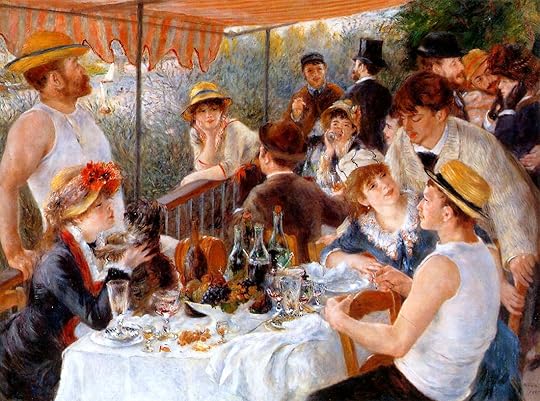
Luncheon of the Boating Party painted by Pierre-Auguste Renoir in 1881. I really like this painting and I can imagine myself drinking and partying with one of the painted man.
Rating - Coming Out by Danielle Steel, 1 Sweets and the best ball party ever celebrated or the worst! (This is the most disappointing book I ever read and I was hoping not to read another one, if I can only rate books with no stars. I don't like to mark this as not-to-read and please write better books soon. I'm still counting the days that I'll suffer reading your books. I still have a dozen here waiting.)
Challenges:
Book #71 for 2011
Book #43 for Off the Shelf!

Since I'm studying in a public school and our school have 56 to 60 sections with 60 students, everyone have to move to a larger place so our school rent a gymnasium served beverages and meals that were undesirable for the party, at least some enjoyed the night. Danielle Steel wrote something that was unexpected for a writer, it was like reading a short story with no sense of reading it or no higher intellectual lesson. It was like joining with the family having the disastrous weeks for the mother to prepare for her twin's coming-out party, a brother who have a secret, a Jew husband who don't like to attend and and ex-husband who blackmailed her.
I don't know what she have done to the book, I don't like the way she wrote. Sentences were mostly paraphrased from the other chapters and it was too short. Scenes were repetitive and conflicts of the story were replicates of her other novels. I don't know the big deal between reading her most read works and I think she have dedicated fans that she have the chance to stand from the New York Times bestseller list. It was an awful read and never to mention she published 3 books a year and they are very very short. She's a writer who writes for commercial purposes that forget the literary beauty of her writings. I still prefer her old novels.
Olympia Crawford Rubinstein, a lawyer specialized in civil rights and class action lawsuit, especially child discrimination. She have the most supportive family like Steel's other novel. She have a son, Charlie, who currently taking theology or something, identical twins, Virginia and Veronica who have different personalities, I mean a total opposite to each other and a younger son Max her only son to her second husband Harry, a Jewish and a lawyer.
They were perfect family, everyone have their own stories to tell and conflicts in life. Well, that was one of Steel's missing part, to introduce and develop each characters. She concentrate more to Olympia's mother-family disaster that it gets uglier and uglier in the end. It was predictable, once you read the first chapter you already know the ending it was like a fairy tail that end up garbage.
So what really happened? Her first husband Chauncey invited her daughter to attend the Arches, a coming-out ball and the day they will look for their soon to be husband. It was a strange thing and never heard of it. So she still have months to prepare herself and her family, some minor conflicts happened, her husband and Veronica don't like to attend but she don't have a choice but to keep reminding them and force them. It was like mom was getting crazy for my coming-out ball! I wish to stop reading the book in the middle of the story, but I can't.
Contains spoiler.
It was weird that the her second husband, who don't like to attend the party, just came out of the blue sitting in their table and happy. Okay, what happed to him? It was lack of development to that character. I know he's a Jew and he don't like discrimination but what happened to him before the party while she was busy doing father-mother stuff! This was superbly the most laziest novel I ever read at least the grandma is supportive then her son. The confession of her son was not a surprise almost of her books have that gay thing in the end.
This is superbly my worst book of the year and I don't like to make this thing happened again. But I'm not gonna stop from reading her works but I'm going to read in reverse. I should start with her early works. I don't like to harm fans here, but seriously this was a big disappointment for me. In the end, everyone learned acceptance and love that healed the old wound to everyone's heart.
Luncheon of the Boating Party painted by Pierre-Auguste Renoir in 1881. I really like this painting and I can imagine myself drinking and partying with one of the painted man.
Rating - Coming Out by Danielle Steel, 1 Sweets and the best ball party ever celebrated or the worst! (This is the most disappointing book I ever read and I was hoping not to read another one, if I can only rate books with no stars. I don't like to mark this as not-to-read and please write better books soon. I'm still counting the days that I'll suffer reading your books. I still have a dozen here waiting.)
Challenges:
Book #71 for 2011
Book #43 for Off the Shelf!

December 11, 2018
38. knjiga koju sam pročitala ove (2018.) godine je "Prvi ples" ("Coming out") od Danijele Stil. Jedna od boljih njenih knjiga u kojoj se na ne prevelikom broju stranica i sa ne previše likova zapetljava i raspetljava radnja i životne priče glavnih likova. Odlično je predstavljen ubrzani današnji tempo života žene koja ima karijeru i pokušava uspješno da odoli svim iskušenjima, zahtjevima privatnog i poslovnog života i svakodnevnim zavrzlamama... Djeca iz prvog braka i bivši muž, sadašnji muž i njihovo zajedničko dijete, divna svekrva oko koje treba brinuti, jer ima zdravstvenih problema zdravstveni problemi u najgorem mogućem momentu, pljuskavice, gripa, padovi i lomovi... I jedan debitantski bal na kojem trebaju prisustvovati kćerke bliznakinje iz prvog braka. A kada stignu pozivnice za bal ukućani imaju različite stavove o istom i tu počinje savremena porodična drama o principima, porodici i svim bitnim stavkama u životu. Da ne pravim spoilere, pročitajte, uživaćete.

September 6, 2014
Coming Out
التحرر
تدور أحداث هذه الرواية عن تلك العائلة الكبيرة , التي على الرغم من اختلاف أفرادها في الانتماءات والاتجاهات وربما الديانات أيضاً
إلا أنها تحافظ على تماسكها ومحبتها
وكأي فرقة موسيقية تحتاج إلى مايسترو يقودها , ويوجه أفرادها وآلاتها للحصول على الأداء السليم
كانت هذه العائلة الكبيرة تحتاج إلى المايسترو المتمثل في تلك المرأة الشابة , التي تأخذ على عاتقها مهمة العناية بكُل فرد من أفراد الأسرة , والعناية بهم جميعاً
وكأي أسرة بها مراهقين , كان عليها مراقبة سلوكهم والقلق بشأنهم
ومعرفة مشاكلهم ومواجهتها معهم
كان يجب عليها الصمود أمام مصائبهم التي تُفاجأ بها , مُدعين أنها رغبتهم وطريقتهم في التحرر والانتقال من مرحلة الطفولة إلى مرحلة النضج والشباب
أعجبتني شخصيتها جداً , حرصها على حفظ التوازن والنجاح في عملها ومنزلها وأسرتها
لا تجعل أياً منهما يؤثر على الآخر , تعمل دائماً لكي تحافظ على نجاحها فيهما معاً
بتفان وصبر
أكثر ما يثير غيظي هو أن نكون بصدد عمل يناقش فكرة هامة وجيدة ,لكنه لا يطرحها بالشكل المطلوب
ليس فقط ذلك !!
بل يتركها , وتنصب الأحداث على موضوع آخر ( تافه )
كان على الكاتبة مناقشة قضية التحرر في نطاق أوسع من ذلك
وليس في مشهدين فقط ( من خلال وشم المراهقة للفراشة على ظهرها وتحول الشاب إلى مثلي )
ليس فقط مناقشة الفكرة بهذه السطحية , لكنها ناقشت التحرر في التصرفات والأفعال فقط !!
رغم أن أهم ما يجب مناقشته , هو التحرر الفكري
وبشكل أوسع
ولكن أيضاً ناقشته في مشهدين فقط ( رفض الابنة وزوج الأم حضور الحفل لاختلافها مع مبادئهم )
هكذا تركت الكاتبة جوهر القصة
لتدور روايتها حول ذلك الحفل الصاخب والترتيب له
ليس جديداً أن يخذلك كاتب في أول قراءة له , دائماً ما يحدث هذا
لكن كما يحدث دائماً , لن أكون رأي خاص وحكم معين قبل أن أكرر التجربة مرة أخرى مع باقي روايات دانيال ستيل
التحرر
تدور أحداث هذه الرواية عن تلك العائلة الكبيرة , التي على الرغم من اختلاف أفرادها في الانتماءات والاتجاهات وربما الديانات أيضاً
إلا أنها تحافظ على تماسكها ومحبتها
وكأي فرقة موسيقية تحتاج إلى مايسترو يقودها , ويوجه أفرادها وآلاتها للحصول على الأداء السليم
كانت هذه العائلة الكبيرة تحتاج إلى المايسترو المتمثل في تلك المرأة الشابة , التي تأخذ على عاتقها مهمة العناية بكُل فرد من أفراد الأسرة , والعناية بهم جميعاً
وكأي أسرة بها مراهقين , كان عليها مراقبة سلوكهم والقلق بشأنهم
ومعرفة مشاكلهم ومواجهتها معهم
كان يجب عليها الصمود أمام مصائبهم التي تُفاجأ بها , مُدعين أنها رغبتهم وطريقتهم في التحرر والانتقال من مرحلة الطفولة إلى مرحلة النضج والشباب
أعجبتني شخصيتها جداً , حرصها على حفظ التوازن والنجاح في عملها ومنزلها وأسرتها
لا تجعل أياً منهما يؤثر على الآخر , تعمل دائماً لكي تحافظ على نجاحها فيهما معاً
بتفان وصبر
أكثر ما يثير غيظي هو أن نكون بصدد عمل يناقش فكرة هامة وجيدة ,لكنه لا يطرحها بالشكل المطلوب
ليس فقط ذلك !!
بل يتركها , وتنصب الأحداث على موضوع آخر ( تافه )
كان على الكاتبة مناقشة قضية التحرر في نطاق أوسع من ذلك
وليس في مشهدين فقط ( من خلال وشم المراهقة للفراشة على ظهرها وتحول الشاب إلى مثلي )
ليس فقط مناقشة الفكرة بهذه السطحية , لكنها ناقشت التحرر في التصرفات والأفعال فقط !!
رغم أن أهم ما يجب مناقشته , هو التحرر الفكري
وبشكل أوسع
ولكن أيضاً ناقشته في مشهدين فقط ( رفض الابنة وزوج الأم حضور الحفل لاختلافها مع مبادئهم )
هكذا تركت الكاتبة جوهر القصة
لتدور روايتها حول ذلك الحفل الصاخب والترتيب له
ليس جديداً أن يخذلك كاتب في أول قراءة له , دائماً ما يحدث هذا
لكن كما يحدث دائماً , لن أكون رأي خاص وحكم معين قبل أن أكرر التجربة مرة أخرى مع باقي روايات دانيال ستيل

October 24, 2012
Before you lambast me, this was a "stretch goal". Something WAAAAYYY outside my normal genre. This is an author I had always disregarded and bashed, but I figured I should read at least one of her books otherwise I'm being an uninformed hypocrite. I was going for the smut she's known for and apparently picked the exact wrong book because there was none. Then again, maybe it was the right one because I could judge it solely on it's writing merit.
And.... it was ok. It was 115 pages, so easily read in a couple hours. That was my first clue though. You can't get very in depth about anything in 115 pages. It was very shallow, nothing was fleshed out well. Neither the characters nor the plotline. Then again, it was a pretty weak plot with not a lot going on. What I mostly found subpar was her writing style. "First we went here, then we went there. He told me this. I ate that. We went to a party. The End." Blah.
It was a mildly interesting story with the beginnings of what could have been very heart warming and deeply empathized interactions between the characters. That's the only reason it gets 2 stars instead of one.
And.... it was ok. It was 115 pages, so easily read in a couple hours. That was my first clue though. You can't get very in depth about anything in 115 pages. It was very shallow, nothing was fleshed out well. Neither the characters nor the plotline. Then again, it was a pretty weak plot with not a lot going on. What I mostly found subpar was her writing style. "First we went here, then we went there. He told me this. I ate that. We went to a party. The End." Blah.
It was a mildly interesting story with the beginnings of what could have been very heart warming and deeply empathized interactions between the characters. That's the only reason it gets 2 stars instead of one.

July 15, 2008
I picked this book up purely because I had never read a Danelle Steel novel before. I figured that I should try considering she is a best selling novelist and this book looked harmless enough.
I must say that I was disappointed. It wasn't the language; I had expected it to have some. It also wasn't the topic that let me down, it was the writing style. I found something lacking. I had a hard time putting my finger on it at first, but I think it might be the way she "told" the story more than "showed" the story. A great amount of the character interpretation was done for the reader and some aspects of the main characters were over emphasized. Overall, I was disappointed.
Please do keep in mind that I know I might have picked up the worst book in Ms. Steel's collection. It also might have not been good representation of Ms. Steel's style or best work. So, I consider that, but this book was not very good.
I must say that I was disappointed. It wasn't the language; I had expected it to have some. It also wasn't the topic that let me down, it was the writing style. I found something lacking. I had a hard time putting my finger on it at first, but I think it might be the way she "told" the story more than "showed" the story. A great amount of the character interpretation was done for the reader and some aspects of the main characters were over emphasized. Overall, I was disappointed.
Please do keep in mind that I know I might have picked up the worst book in Ms. Steel's collection. It also might have not been good representation of Ms. Steel's style or best work. So, I consider that, but this book was not very good.

July 3, 2019
I finished another book but it was an audiobook and I listen to it on 1.75 speed (it was the fastest speed they went up to) I also started it before I went to bed and listened to it the whole time I did chores and cooked dinner. I was a good book. Danielle Steel is an author I read when I was in high school and I still really love her story telling. She weaves a great story. Usually there is a tragic scene and I was gearing up for some tragedy but this one didn't have one. I'm glad too because I wasn't sure I wanted to have a good cry :)
This is a story about a mother in the South who has twin girls and they are at the age where they are ready to go to a coming out ball(it's a catillion or a debutant ball of sorts) One twin is very excited and has thought of nothing more and the other twin is angry she has to go. The mother Olympia is divorced from their father and he is a man who lives off his inheritance money and has never worked a day in his life and is in the thick of the high society and what people will think. He's a mean nasty man and is spoiled and throws tanturms to get what he wants. He threw a royal tanturm when he found out Veronica was saying she wasn't going. Olympia was remarried to the sweetest man who happens to be Jewish and she became Jewish too. Her exhusband is racist and makes it known he thinks she is now beneath him for converting to Judism. The Catillion is upper white high society and Olympia's husband will not go and support an event where everyone cannot participate. The twin Veronica feels the same way Harry does.
This book is all about the catillion and the views on only upper class white girls can "come out." I stand with Veronica and Harry. The book touched on a very important topic but also hadvery touching moments (as Danielle Steel's books have a tendency to do) but there were many funny moments too that I loved. The son of Olympia and Harry is a little guy and some of his questions were so funny. I really enjoyed this book. I forget how much I love Danielle Steel. I recommend this to anyone who needs a good book to read and who just wants a good story line and not have to think to hard but enjoy the book all the same. This book is it. Great for a car trip or a plane ride.
This is a story about a mother in the South who has twin girls and they are at the age where they are ready to go to a coming out ball(it's a catillion or a debutant ball of sorts) One twin is very excited and has thought of nothing more and the other twin is angry she has to go. The mother Olympia is divorced from their father and he is a man who lives off his inheritance money and has never worked a day in his life and is in the thick of the high society and what people will think. He's a mean nasty man and is spoiled and throws tanturms to get what he wants. He threw a royal tanturm when he found out Veronica was saying she wasn't going. Olympia was remarried to the sweetest man who happens to be Jewish and she became Jewish too. Her exhusband is racist and makes it known he thinks she is now beneath him for converting to Judism. The Catillion is upper white high society and Olympia's husband will not go and support an event where everyone cannot participate. The twin Veronica feels the same way Harry does.
This book is all about the catillion and the views on only upper class white girls can "come out." I stand with Veronica and Harry. The book touched on a very important topic but also hadvery touching moments (as Danielle Steel's books have a tendency to do) but there were many funny moments too that I loved. The son of Olympia and Harry is a little guy and some of his questions were so funny. I really enjoyed this book. I forget how much I love Danielle Steel. I recommend this to anyone who needs a good book to read and who just wants a good story line and not have to think to hard but enjoy the book all the same. This book is it. Great for a car trip or a plane ride.

December 29, 2014
I’ll be honest; I’m not a Steel neophyte. Back in 1990 at the tender age of 17, I read Kaleidoscope and I remember enjoying it. However, the experience of reading a Danielle Steel novel at the wizened age of 41 was a less agreeable experience.
I pondered what I could possibly say in a review of Coming Out that hasn’t already been said in other reviews. Aside from the five star reviews that inexplicably appear on Goodreads (please contact me, if you think Coming Out is five stars, I have books recommendations that will BLOW YOUR FREAKING MIND!), I think most of the other reviewers have identified the significant flaws in Coming Out and in Steel’s writing style. So, in an effort to be a bit creative (I’m on holidays!), I’ll attempt to write a ‘review’ using Steel’s own writing style. Here goes!
Curtis cleared his throat. “I’d like to welcome the members of the Trash Book Club to our meeting. For our meeting this week, we decided to each read a novel by the prolific artist, Danielle Steel. We will provide a summary of our novel, and answer any questions. I’ll start. I read Coming Out, which was Steel’s 69th (snicker) novel and the second of three novels released in 2006. The story surrounds Olympia Crawford-Rubenstein, a nice rich white lady who has three children from a previous marriage and one precocious five-year-old with her current husband, a Jew. (If “Rubenstein” didn’t tip you off already.)
“Olympia’s (I can’t even say her name without giggling in my head) twin daughters (inexplicably dramatic opposites, Steel brazenly spitting in the face of all psychological twin studies) have been invited to a blue blood cotillion where they will “come out” to high society. In spite of the changed times, Olympia cherishes the memories of her own cotillion, and expects that the girls will be thrilled to experience this milestone in a young woman’s life.
Surprisingly, her daughter Veronica is opposed to the cotillion plan, and her twin sister Virginia is livid that her twin has to spoil everything. Olympia’s current husband, a Jew (yes, I meant to repeat that), agrees that a cotillion panders to Old-South discriminatory ideals, and supports Veronica’s protest. A war erupts in the Crawford/Rubenstein household. And without ruining the book for anyone, everyone is happy in the end. Questions?”
Curtis looked over at Kevin, who was politely raising his hand. Curtis looked with love and appreciation at Kevin, who was his closest friend and confidante, and had become accepted as a member of Curtis’s family. “Yes Kevin?”
Kevin smiled at his long-time friend and frequent travel companion, and smiled with love. While he and Curtis had not always agreed on everything, particularly when it came to Curtis’s loose morals, they always regarded each other with respect and admiration. “I won’t say anything yet about the book that I read. It’s not my turn. But I’m curious, did you find her writing style somewhat repetitive?”
Curtis looked with love and appreciation at Kevin, who was his closest friend and confidante, and had become accepted as a member of Curtis’s family. “Yes, Kevin. I did.”
Sarah quickly interjected. “I did too!” Sarah was a friend of both Curtis and Kevin, and she was affectionately referred to as their daughter. “I also frequently noticed her overuse of adverbs. I was quickly annoyed.”
“And always using extreme adverbs of frequency, as if something is ‘always’ or ‘never’,” Janna added. Janna was always noticing the small details. She never missed a book club, and always came with something tasty that she had prepared at home.
Elena nodded. Elena was a colleague of Curtis’s, and as she tossed her luscious auburn hair to the side, she unwittingly heightened the illusion that she was like a young Julianne Moore. “I noticed she makes comparisons to famous people to exemplify what characters looked like.”
Darlene gently cleared her throat. Curtis looked over at Darlene, who he had introduced to the book club because of her assertive, insightful, and often hilarious observations on life in general. He knew she would make a powerful addition to the book club. Darlene added, “I think she used hyperbole about a million times. It made me insane. I wanted to kill myself.”
“What’s funny,” Keri-Lee included, “was her random use of large words. She’s something of a random sesquipedalian.”
“I had to use the dictionary function on my kindle,” Curtis conceded. Curtis looked lovingly over the sea of white faces in front of him. He concluded, “Well it appears that Steel’s writing style is at least consistent.
“In summary, I was tempted to give the book one star. However, at 210 pages, this is one of Steel’s shortest novels, and for that tender mercy upon the reader, I give her an extra star. Next?”
I pondered what I could possibly say in a review of Coming Out that hasn’t already been said in other reviews. Aside from the five star reviews that inexplicably appear on Goodreads (please contact me, if you think Coming Out is five stars, I have books recommendations that will BLOW YOUR FREAKING MIND!), I think most of the other reviewers have identified the significant flaws in Coming Out and in Steel’s writing style. So, in an effort to be a bit creative (I’m on holidays!), I’ll attempt to write a ‘review’ using Steel’s own writing style. Here goes!
Curtis cleared his throat. “I’d like to welcome the members of the Trash Book Club to our meeting. For our meeting this week, we decided to each read a novel by the prolific artist, Danielle Steel. We will provide a summary of our novel, and answer any questions. I’ll start. I read Coming Out, which was Steel’s 69th (snicker) novel and the second of three novels released in 2006. The story surrounds Olympia Crawford-Rubenstein, a nice rich white lady who has three children from a previous marriage and one precocious five-year-old with her current husband, a Jew. (If “Rubenstein” didn’t tip you off already.)
“Olympia’s (I can’t even say her name without giggling in my head) twin daughters (inexplicably dramatic opposites, Steel brazenly spitting in the face of all psychological twin studies) have been invited to a blue blood cotillion where they will “come out” to high society. In spite of the changed times, Olympia cherishes the memories of her own cotillion, and expects that the girls will be thrilled to experience this milestone in a young woman’s life.
Surprisingly, her daughter Veronica is opposed to the cotillion plan, and her twin sister Virginia is livid that her twin has to spoil everything. Olympia’s current husband, a Jew (yes, I meant to repeat that), agrees that a cotillion panders to Old-South discriminatory ideals, and supports Veronica’s protest. A war erupts in the Crawford/Rubenstein household. And without ruining the book for anyone, everyone is happy in the end. Questions?”
Curtis looked over at Kevin, who was politely raising his hand. Curtis looked with love and appreciation at Kevin, who was his closest friend and confidante, and had become accepted as a member of Curtis’s family. “Yes Kevin?”
Kevin smiled at his long-time friend and frequent travel companion, and smiled with love. While he and Curtis had not always agreed on everything, particularly when it came to Curtis’s loose morals, they always regarded each other with respect and admiration. “I won’t say anything yet about the book that I read. It’s not my turn. But I’m curious, did you find her writing style somewhat repetitive?”
Curtis looked with love and appreciation at Kevin, who was his closest friend and confidante, and had become accepted as a member of Curtis’s family. “Yes, Kevin. I did.”
Sarah quickly interjected. “I did too!” Sarah was a friend of both Curtis and Kevin, and she was affectionately referred to as their daughter. “I also frequently noticed her overuse of adverbs. I was quickly annoyed.”
“And always using extreme adverbs of frequency, as if something is ‘always’ or ‘never’,” Janna added. Janna was always noticing the small details. She never missed a book club, and always came with something tasty that she had prepared at home.
Elena nodded. Elena was a colleague of Curtis’s, and as she tossed her luscious auburn hair to the side, she unwittingly heightened the illusion that she was like a young Julianne Moore. “I noticed she makes comparisons to famous people to exemplify what characters looked like.”
Darlene gently cleared her throat. Curtis looked over at Darlene, who he had introduced to the book club because of her assertive, insightful, and often hilarious observations on life in general. He knew she would make a powerful addition to the book club. Darlene added, “I think she used hyperbole about a million times. It made me insane. I wanted to kill myself.”
“What’s funny,” Keri-Lee included, “was her random use of large words. She’s something of a random sesquipedalian.”
“I had to use the dictionary function on my kindle,” Curtis conceded. Curtis looked lovingly over the sea of white faces in front of him. He concluded, “Well it appears that Steel’s writing style is at least consistent.
“In summary, I was tempted to give the book one star. However, at 210 pages, this is one of Steel’s shortest novels, and for that tender mercy upon the reader, I give her an extra star. Next?”

April 22, 2018
tw: anti Semitism, use of work in**an, racism
I wanted a little fluffy book that was short so I could finally catch up on my GR reading goal. I pulled this DS novel out of my DS basket (Yes, I have a Danielle Steel basket. Otherwise my mass collection would literally take up both my book shelves.) I've read this before but forgot the finer details and wanted to revisit. I've been going through my owned books and re-reading ones to see if they still hold up after so many years. I thought I was in for a light and fluffy book. I forgot that this was not the case and it didn't quite live up to what I remember it being.
This book, for being so short, talks about some pretty heavy topics such as archaic groups-like WASPS- and how they came off to others on the outside. Others being POC, Jews, etc. Coming Out also talks about racism very heartily (as one of the side characters is incredibly racist) and the treatment of Jewish people, especially during WW2.
In terms of characters, I admired Olympia for strongness. She had a crappy racist ex husband, teenaged twins, a little 5 (five) year old, a boy in college and a stubborn but lovable husband. She certainly had her hands full with all her kids and with her job as a lawyer advocating for abuse victims. I really wish her job was explored more. That is where DS really shines. Her characters are so utterly devoted to her jobs and that is something I love reading about. Olympia's job was barely mentioned. I understand that it wasn't the focal point of the plot but still. I don't think it would have hurt to have more of the job mentioned.
I think where one of my problems with this book was I wasn't sure how to feel about this coming out ball the twins were invited too. Back in the 50's, it was a time for women to "come out" to society-as they were cloistered somewhere- and find husbands. We viewed things through Olympia (in third person) so everything was all sunshines and rainbows. Her husband, Harry-also Jewish- was thoroughly against this ball due to its racist and sexist past.
So I'm conflicted. I know that what the ball used to stand for wasn't good but Olympia viewed it as a fun event. Maybe if the book was longer, my feelings could be better resolved. Things could have been hashed out more. We could have really explored more of the characters feelings on them. Harry was vehemently against it but him and Olympia barely talked about why. We were almost coerced into feeling bad for Olympia for having such a strong willed husband that made his stance on something that was against Olympia.
Overall, another fine DS novel, even though it has it's problems. It's nice and short so if you want to start reading her work, this novel wouldn't be a bad place to begin. You won't lose a lot of time reading it and you will get a feel for how DS writes.
I wanted a little fluffy book that was short so I could finally catch up on my GR reading goal. I pulled this DS novel out of my DS basket (Yes, I have a Danielle Steel basket. Otherwise my mass collection would literally take up both my book shelves.) I've read this before but forgot the finer details and wanted to revisit. I've been going through my owned books and re-reading ones to see if they still hold up after so many years. I thought I was in for a light and fluffy book. I forgot that this was not the case and it didn't quite live up to what I remember it being.
This book, for being so short, talks about some pretty heavy topics such as archaic groups-like WASPS- and how they came off to others on the outside. Others being POC, Jews, etc. Coming Out also talks about racism very heartily (as one of the side characters is incredibly racist) and the treatment of Jewish people, especially during WW2.
In terms of characters, I admired Olympia for strongness. She had a crappy racist ex husband, teenaged twins, a little 5 (five) year old, a boy in college and a stubborn but lovable husband. She certainly had her hands full with all her kids and with her job as a lawyer advocating for abuse victims. I really wish her job was explored more. That is where DS really shines. Her characters are so utterly devoted to her jobs and that is something I love reading about. Olympia's job was barely mentioned. I understand that it wasn't the focal point of the plot but still. I don't think it would have hurt to have more of the job mentioned.
I think where one of my problems with this book was I wasn't sure how to feel about this coming out ball the twins were invited too. Back in the 50's, it was a time for women to "come out" to society-as they were cloistered somewhere- and find husbands. We viewed things through Olympia (in third person) so everything was all sunshines and rainbows. Her husband, Harry-also Jewish- was thoroughly against this ball due to its racist and sexist past.
So I'm conflicted. I know that what the ball used to stand for wasn't good but Olympia viewed it as a fun event. Maybe if the book was longer, my feelings could be better resolved. Things could have been hashed out more. We could have really explored more of the characters feelings on them. Harry was vehemently against it but him and Olympia barely talked about why. We were almost coerced into feeling bad for Olympia for having such a strong willed husband that made his stance on something that was against Olympia.
Overall, another fine DS novel, even though it has it's problems. It's nice and short so if you want to start reading her work, this novel wouldn't be a bad place to begin. You won't lose a lot of time reading it and you will get a feel for how DS writes.
April 18, 2009
I picked this up as a book to read for the Eurostar trip; and I must say I was disappointed. While I expected a tumultuous voyage of emotions and fights, it was very... well, tame. It emphasised the positive points of each character too much, leaving nothing to the reader's own interpretation. While I am no stranger to easy reads, this book seemed to jump into my mind and kick out any of my own thoughts about the characters, replacing it with Steele's over explained points.
The ending seemed to fall flat too - it was a fairytale ending, and with all the complaints and woes in the book you wouldn't expect it to end so perfectly. It made me more than a little disgusted at the incredible exquisiteness of the life depicted and the unreality of it.
It isn't the worst book I've ever read, and if you skip some of the pages concerning how loving and giving the mother is to the daughter and everything else that could have easily been implied in a much simpler, subtle way, it can even be enjoyable - especially if you like happy endings. But if you want a book in which you can think, I would not recommend this one.
The ending seemed to fall flat too - it was a fairytale ending, and with all the complaints and woes in the book you wouldn't expect it to end so perfectly. It made me more than a little disgusted at the incredible exquisiteness of the life depicted and the unreality of it.
It isn't the worst book I've ever read, and if you skip some of the pages concerning how loving and giving the mother is to the daughter and everything else that could have easily been implied in a much simpler, subtle way, it can even be enjoyable - especially if you like happy endings. But if you want a book in which you can think, I would not recommend this one.

September 6, 2013
The people in this book are well educated middle upper class, or even "blue blooded". The young people go to Europe in summer and meet the rest of the family who holidays in St. Tropez, Monaco etc. etc.
An invitation for heroine Olympia's twin daughters to a coming out ball is the main issue in the book and becomes a huge family problem. Not the most serious situation for a family to deal with since coming out balls is a rather old fashioned upper class affair; even if the twins are from a previous marriage and father/step father highly disagree about the matter. As do the twins themselves. Neither is choice of ivy league university and which one of the divorced parents (who can both very well afford it) should pay the tuition, the toughest problem for a family to handle. Apart from the background of the older Jewish members of the family and some of the young people's struggle in finding their place in life and modern society, the family seems privileged and blessed in every way.
What makes the book readable in spite of the nearly non-existing storyline, is Danielle Steel's unique talent as a writer. She has the ability to create entertainment from the "thinnest" material and make the characters come amazingly alive.
I quite enjoyed this book. Far from first class reading, but ok when you simply need to relax with something light and predictable.
An invitation for heroine Olympia's twin daughters to a coming out ball is the main issue in the book and becomes a huge family problem. Not the most serious situation for a family to deal with since coming out balls is a rather old fashioned upper class affair; even if the twins are from a previous marriage and father/step father highly disagree about the matter. As do the twins themselves. Neither is choice of ivy league university and which one of the divorced parents (who can both very well afford it) should pay the tuition, the toughest problem for a family to handle. Apart from the background of the older Jewish members of the family and some of the young people's struggle in finding their place in life and modern society, the family seems privileged and blessed in every way.
What makes the book readable in spite of the nearly non-existing storyline, is Danielle Steel's unique talent as a writer. She has the ability to create entertainment from the "thinnest" material and make the characters come amazingly alive.
I quite enjoyed this book. Far from first class reading, but ok when you simply need to relax with something light and predictable.

September 6, 2023
A light-hearted and quick read from Steel about family turmoil and an archaic, blue-blooded debutante ball. I enjoyed this and I feel as if it was used partially for Steel to share some of her liberal political views, which is always good from a writer. Despite being from a privileged background herself, I think she tries to show her readers that she is open-minded and cares about deeper issues that wouldn't normally affect her. Whether this is all a façade or not is up to the reader I guess.

January 17, 2023
A very different story.

January 14, 2014
This rich, white, privileged lady named Olympia wants her two daughters to participate in a coming out ball that is only open to other rich, white, privileged people. Her Jewish husband is the voice of reason and flat out refuses to attend. But, Olympia won't give up, especially when a Jewish person and a black person tell her it's ok for her to support the racist function.
The basic premise of this book is interesting, how society is constantly changing and what was once commonplace (exclusion based on religion & race) is now questioned and old established traditions ultimately must change or they will not survive. This book, however, does not address any of those issues. This book focuses on a ridiculously controlling female character at the center of the story, who we are told is a fantastic lawyer and mother, but we are never shown any examples of either. I mean, you really want to shout at the lady for the first 3/4 of the book "YOUR SON IS GAY!!!" Because she is just so self centered she can't see it.
The big climax of the book is when the 18 year old daughter has the audacity to get a tattoo which breaks her mother's fragile little heart and makes her - it literally says this - want to die. Ink on her daughters back makes her want to die. For some reason when her son finally comes out of the closet, though, she is accepting & understanding. Which completely goes against everything we've learned about her character up to that point.
This is a quick, easy (but mind numbingly frustrating) read told entirely from the mom's perspective. The things she is in crisis over - sick kids, tattoos, blue hair, dresses... Are ridiculous pompous rich people problems. I couldn't identify with this book, but i do hope Danielle Steele is not as arrogant and out if touch as this book is. Keywords: mindless, offensive, fluff
The basic premise of this book is interesting, how society is constantly changing and what was once commonplace (exclusion based on religion & race) is now questioned and old established traditions ultimately must change or they will not survive. This book, however, does not address any of those issues. This book focuses on a ridiculously controlling female character at the center of the story, who we are told is a fantastic lawyer and mother, but we are never shown any examples of either. I mean, you really want to shout at the lady for the first 3/4 of the book "YOUR SON IS GAY!!!" Because she is just so self centered she can't see it.
The big climax of the book is when the 18 year old daughter has the audacity to get a tattoo which breaks her mother's fragile little heart and makes her - it literally says this - want to die. Ink on her daughters back makes her want to die. For some reason when her son finally comes out of the closet, though, she is accepting & understanding. Which completely goes against everything we've learned about her character up to that point.
This is a quick, easy (but mind numbingly frustrating) read told entirely from the mom's perspective. The things she is in crisis over - sick kids, tattoos, blue hair, dresses... Are ridiculous pompous rich people problems. I couldn't identify with this book, but i do hope Danielle Steele is not as arrogant and out if touch as this book is. Keywords: mindless, offensive, fluff

July 24, 2015
Late review.
When I purchased this book, I remember getting excited to read it coz' it's like a fairy tale theme. But upon reading, halfway through, it fell flat on me coz' the daughters were all tight ass. Story was good, but the characters annoyed me.
When I purchased this book, I remember getting excited to read it coz' it's like a fairy tale theme. But upon reading, halfway through, it fell flat on me coz' the daughters were all tight ass. Story was good, but the characters annoyed me.

May 31, 2023
Nous suivons Olympia, une femme mariée à un homme de confession juive en Amérique. Le bal mondain approche, ses deux filles jumelles sont conviées. Nous découvrons les préparations de cet événement tant attendu par Olympia.
C'est une histoire très simple et sans prise de tête. Mon avis est plutot neutre vis a vis de ce roman.
C'est une histoire très simple et sans prise de tête. Mon avis est plutot neutre vis a vis de ce roman.
May 27, 2019
In the novel, Coming Out, an invitation to the elite debutante cotillion called 'The Arches' arrived for Olympia's twin daughters, Veronica and Ginny. Then tradition unravels...chaos results....magic happens!
Each in their own way, they had all come out that night.
Each in their own way, they had all come out that night.
April 15, 2021
Sadly predictable

January 28, 2022
Alot of family drama.... quick, fun read
December 29, 2022
I enjoyed reading this. I'm so thankful my bookpal purchased it for me.

August 19, 2026
⭐️⭐️ 2 Stars
My first Danielle Steel book, and I think I’ve learned that this just isn’t really my genre right now. Coming Out was much more of a family drama than what I’ve been in the mood for lately.
There were some interesting family dynamics, especially with Olympia being stuck in the middle of her husband, her ex-husband and her kids. I also liked the meaning behind the title and how “coming out” ended up having more than one meaning.
For me, the story was a little slow at times, and I just didn’t connect with the characters enough to really get invested. There wasn’t quite enough happening to keep me hooked.
The ending brought everything together nicely, but honestly, by that point I was ready to be done.
I’m glad I finally gave Danielle Steel a try, but I think I’m going to stick with my thrillers, horror and romantasy for now. Never say never though — I might try another one someday!
My first Danielle Steel book, and I think I’ve learned that this just isn’t really my genre right now. Coming Out was much more of a family drama than what I’ve been in the mood for lately.
There were some interesting family dynamics, especially with Olympia being stuck in the middle of her husband, her ex-husband and her kids. I also liked the meaning behind the title and how “coming out” ended up having more than one meaning.
For me, the story was a little slow at times, and I just didn’t connect with the characters enough to really get invested. There wasn’t quite enough happening to keep me hooked.
The ending brought everything together nicely, but honestly, by that point I was ready to be done.
I’m glad I finally gave Danielle Steel a try, but I think I’m going to stick with my thrillers, horror and romantasy for now. Never say never though — I might try another one someday!

September 25, 2024
mid asf book bro, 2.5 stars.

March 24, 2021
Nothing special as a story.
Just useful English listening for me.
Just useful English listening for me.

March 14, 2022
Where do I begin with this one?
When you approach writing with the sole intent to make as much money and make sure your book makes it to the top of the charts, and you write fluff like this, of course, you can guarantee success. Danielle Steel is what you would call a working writer. She concocts stories based on a “crisis!” and never deviates from that. True, not all of her stories follow the same formula. But for the most part, it’s really an often tread path of hers.
The issue is that while crises form the backbone of everyday life, DS telegraphs it as though this were a 30-minute sitcom and she was blowing into a bullhorn. The catalyst here is an invitation to a ball. But this is not just a ball. Not just any ball. Nay, nay. Perish the thought!
This is the Pemberly Ball to end all balls, the one where the New Yorkers from the Gilded Age meet in order to secure bidders for their trophy daughters, and thus maintain the line. We get introduced to Olympia Crawford Rubinstein, a prosecutor working on child abuse crimes (although we aren't privy to her work life). She receives news of this event, and all is great until she discloses it to her kids and current husband Harry, who is a massive stick in the mud throughout the novel.
Harry and their younger daughter Veronica firmly state they are not going because this is the type of event that stands against their beliefs. On the other hand, Virginia wants to go. Charles broods, and we don't quite know what his own stance is. Then the ex-husband (who is involved in O’s life much more than he should) appears and he berates O, withholds tuition, and all but kidnaps his other daughter Virginia out of spite. Lastly, Frieda, Olivia’s MIL, sees a chance to finally go to a party decked to the nines after she survived the Holocaust. [Side note: I'm assuming this story takes place either in the late 90s or early 00s because at this point, Holocaust survivors are hard to come by.]
The time that DS spends on this one plot point is excessive. I’m not saying the party couldn’t be the event to all events but DS treats this with not much thought inasmuch as her characteristic superficial description. Ergo, it’s a wonder how the ball basically hijacks the entire book and nothing else matters. Every other tangential storyline gets shunted off-screen only to converge at the end.
This is a cardboard story. The worst of it is the telling. DS never lets you in on her characters' minds. It’s all gloss and superficial veneer. Scenes that could have had bite are glossed over with one or two paragraphs. She misses multiple chances to make her own small social commentary while never turning it into a sermon. Intriguing is when DS introduces an African American character formidably named Margaret Washington and then proceeds to do nothing with her. The inclusion points at checking a box, and leaving it checked.
In better hands, I would have bought the debutante ball story. You would get credible characters and character development instead of these insufferable cartoons. It’s almost as if DS took the premise of Pride & Prejudice, focused on the opening paragraph but eliminate the wealthy bachelor, and voila—we have a poorly written novel with no involvement, dramatic tension, and no climactic scene, nothing.
I don’t hate these types of novels but wow. At one point add plot points. Take risks. Make your people believable. DS seems to be content to present a tableau but not delve too deep into its material. She seems partial to the Holocaust but blind to African Americans, LGBTQ+ issues, women’s issues, and basically anyone who is not upper-crust white and Jewish. There were instances when it seemed from her own writing she clearly lives in a bubble of privilege.
I’ve got a few more DS novels. I’ll check to see what they can offer.
When you approach writing with the sole intent to make as much money and make sure your book makes it to the top of the charts, and you write fluff like this, of course, you can guarantee success. Danielle Steel is what you would call a working writer. She concocts stories based on a “crisis!” and never deviates from that. True, not all of her stories follow the same formula. But for the most part, it’s really an often tread path of hers.
The issue is that while crises form the backbone of everyday life, DS telegraphs it as though this were a 30-minute sitcom and she was blowing into a bullhorn. The catalyst here is an invitation to a ball. But this is not just a ball. Not just any ball. Nay, nay. Perish the thought!
This is the Pemberly Ball to end all balls, the one where the New Yorkers from the Gilded Age meet in order to secure bidders for their trophy daughters, and thus maintain the line. We get introduced to Olympia Crawford Rubinstein, a prosecutor working on child abuse crimes (although we aren't privy to her work life). She receives news of this event, and all is great until she discloses it to her kids and current husband Harry, who is a massive stick in the mud throughout the novel.
Harry and their younger daughter Veronica firmly state they are not going because this is the type of event that stands against their beliefs. On the other hand, Virginia wants to go. Charles broods, and we don't quite know what his own stance is. Then the ex-husband (who is involved in O’s life much more than he should) appears and he berates O, withholds tuition, and all but kidnaps his other daughter Virginia out of spite. Lastly, Frieda, Olivia’s MIL, sees a chance to finally go to a party decked to the nines after she survived the Holocaust. [Side note: I'm assuming this story takes place either in the late 90s or early 00s because at this point, Holocaust survivors are hard to come by.]
The time that DS spends on this one plot point is excessive. I’m not saying the party couldn’t be the event to all events but DS treats this with not much thought inasmuch as her characteristic superficial description. Ergo, it’s a wonder how the ball basically hijacks the entire book and nothing else matters. Every other tangential storyline gets shunted off-screen only to converge at the end.
This is a cardboard story. The worst of it is the telling. DS never lets you in on her characters' minds. It’s all gloss and superficial veneer. Scenes that could have had bite are glossed over with one or two paragraphs. She misses multiple chances to make her own small social commentary while never turning it into a sermon. Intriguing is when DS introduces an African American character formidably named Margaret Washington and then proceeds to do nothing with her. The inclusion points at checking a box, and leaving it checked.
In better hands, I would have bought the debutante ball story. You would get credible characters and character development instead of these insufferable cartoons. It’s almost as if DS took the premise of Pride & Prejudice, focused on the opening paragraph but eliminate the wealthy bachelor, and voila—we have a poorly written novel with no involvement, dramatic tension, and no climactic scene, nothing.
I don’t hate these types of novels but wow. At one point add plot points. Take risks. Make your people believable. DS seems to be content to present a tableau but not delve too deep into its material. She seems partial to the Holocaust but blind to African Americans, LGBTQ+ issues, women’s issues, and basically anyone who is not upper-crust white and Jewish. There were instances when it seemed from her own writing she clearly lives in a bubble of privilege.
I’ve got a few more DS novels. I’ll check to see what they can offer.

August 28, 2018
I found Coming Out by Danielle Steel at a local store that typically does not sell books. It was on sale, probably cheaper than it should have been yet it was in excellent shape! I always wanted to read something by Danielle Steel but never seemed to remember to pick up a book by her whenever I was out looking, so I decided to purchase this book.
This book was made in 2006, but it felt more along the lines of the 80s or 90s due to some of the comments within the book. There never seems to be a strict date of when this book is set, but some of the opinions don't seem to be that of 2006 (or maybe my hometown was just way more open at that time). The comments about how bad tattoos are seem to date this book more than intended too, seeing as it is 2018 and tattoos seem to be everywhere and widely accepted. If anything, that would be my biggest con for this book! It dates itself with the opinions within!
I did really enjoy this book - it was a light, dramatic read that I could easily put down and pick it back up. The story follows a rich, upper class family as they intend to go to an exclusive ball in New York. The twin daughters are on opposing sides (one wants to go, the other doesn't and decides to rebel), the Mother wants to go, the step Father doesn't, and so on and so forth. There is some romantic drama, some family drama, some "rich" drama, and it all seems to work well within the story.
That being said, this book is hit and miss - if you don't mind reading about privileged rich people with silly problems, it's a good read! I didn't mind that they complained about simple yet silly things, in fact I found it to be fluffy and funny at times. It felt like a soap opera I would watch on T.V. back in high school. The soap opera side is what kept me hooked, to be brutally honest. The drama was over the top, the reactions were big, and it felt like the perfect, stormy day read.
The book is relatively short and moves at a good pace to keep you interested. That is what also kept me interested in this book. I didn't think that the book felt too long or too short. To me, the book was the perfect length. I also really liked that the title of the book has multiple meanings in the book! Tied in with that title, the ending took me by surprise! The ending did seem to suddenly stop, but Danielle tied in one of the small plot points to finish this book up.
Overall, I think this book was cute and is a nice, soft read. It is in it's own little niche, so reader beware!!
Three out of five stars!
This book was made in 2006, but it felt more along the lines of the 80s or 90s due to some of the comments within the book. There never seems to be a strict date of when this book is set, but some of the opinions don't seem to be that of 2006 (or maybe my hometown was just way more open at that time). The comments about how bad tattoos are seem to date this book more than intended too, seeing as it is 2018 and tattoos seem to be everywhere and widely accepted. If anything, that would be my biggest con for this book! It dates itself with the opinions within!
I did really enjoy this book - it was a light, dramatic read that I could easily put down and pick it back up. The story follows a rich, upper class family as they intend to go to an exclusive ball in New York. The twin daughters are on opposing sides (one wants to go, the other doesn't and decides to rebel), the Mother wants to go, the step Father doesn't, and so on and so forth. There is some romantic drama, some family drama, some "rich" drama, and it all seems to work well within the story.
That being said, this book is hit and miss - if you don't mind reading about privileged rich people with silly problems, it's a good read! I didn't mind that they complained about simple yet silly things, in fact I found it to be fluffy and funny at times. It felt like a soap opera I would watch on T.V. back in high school. The soap opera side is what kept me hooked, to be brutally honest. The drama was over the top, the reactions were big, and it felt like the perfect, stormy day read.
The book is relatively short and moves at a good pace to keep you interested. That is what also kept me interested in this book. I didn't think that the book felt too long or too short. To me, the book was the perfect length. I also really liked that the title of the book has multiple meanings in the book! Tied in with that title, the ending took me by surprise! The ending did seem to suddenly stop, but Danielle tied in one of the small plot points to finish this book up.
Overall, I think this book was cute and is a nice, soft read. It is in it's own little niche, so reader beware!!
Three out of five stars!

May 16, 2016
إنها المرة الرابعة التّى أقرأ فيها لدانيال ستيل ،والمرة الثانية التّى تصدمني فيها بعمل ليس له قيمه .
فبعدما صُدِمت برواية الملاك الحارس كانت هذه الرواية هي القشة التّى قصمت ظهر البعير .
لا أظن نفسي سأقرأ لها على الأقل الأن ،وما حدث فى هذه الرواية كان هو أنها الرواية الثانية التّى لم أحتمل قرائتها بالرغم من صغرها ،فقرأت النهاية والتّى كانت تافهة على الفور ،لم أقرأ سوى بضع صفحات ثم مللت الرواية والسرد المُطول الذي بلا فائدة ،وغاية الرواية التى لم تكتمل .أود فقط الصراخ بوجه دانيال لأقول لها حباً بالله اتركي الرواية فى رأسك أولاً حتى تختمر فكرتها وتكتمل ثم أمسكى بقلمك ،أصبحت عبارة الأكثر مبيعاً على لوائح النيويورك تايمز بالنسبة لي كالجحيم ،ولكنها أخبرتنى أننا لسنا الشعب الوحيد الذي انحدرت ثقافته .
العنوان :"التحرر" ،كل شخصية في الرواية مُمسكَة بقيد ما فجأت هذه الحفلة لتحرره ،فالابن الشاذ اعترف بشذوذه والفتاتان تحررتا أيضاً ولم أهتم مما كان التحرر.
القصة :حفلة تسمى التحرر كانت تُستخدم في السابق لأصطياد العرسان لكنها أصبحت الان مجرد حفلة تميزية تدعو فقط اصحاب الطبقة الراقية ،لا دعاوى لأمريكيين من أصل افريقى ولا دعاوي ليهود ،وهذا اثار غضب فيرونيكا فرفضت الذهاب للحفل ،فغضب والدها تشونسى وهدد "SHIT "
النقد: "الرواية كلها طين هنقد ايه ولا ايه" ولكن بشكل عام ،لم تترك دانيال للرواية الفرصه لتتبلور في ذنها فتركت قلمها يكتب بلا هدف.
لا أظنها أيضاً راجعتها قبل نشرها .
النقد المُكَرر في كل روايات دانيال ،اللغة، ضعيفة للغاية يكثر بها كان وكانوا وكانت
فبعدما صُدِمت برواية الملاك الحارس كانت هذه الرواية هي القشة التّى قصمت ظهر البعير .
لا أظن نفسي سأقرأ لها على الأقل الأن ،وما حدث فى هذه الرواية كان هو أنها الرواية الثانية التّى لم أحتمل قرائتها بالرغم من صغرها ،فقرأت النهاية والتّى كانت تافهة على الفور ،لم أقرأ سوى بضع صفحات ثم مللت الرواية والسرد المُطول الذي بلا فائدة ،وغاية الرواية التى لم تكتمل .أود فقط الصراخ بوجه دانيال لأقول لها حباً بالله اتركي الرواية فى رأسك أولاً حتى تختمر فكرتها وتكتمل ثم أمسكى بقلمك ،أصبحت عبارة الأكثر مبيعاً على لوائح النيويورك تايمز بالنسبة لي كالجحيم ،ولكنها أخبرتنى أننا لسنا الشعب الوحيد الذي انحدرت ثقافته .
العنوان :"التحرر" ،كل شخصية في الرواية مُمسكَة بقيد ما فجأت هذه الحفلة لتحرره ،فالابن الشاذ اعترف بشذوذه والفتاتان تحررتا أيضاً ولم أهتم مما كان التحرر.
القصة :حفلة تسمى التحرر كانت تُستخدم في السابق لأصطياد العرسان لكنها أصبحت الان مجرد حفلة تميزية تدعو فقط اصحاب الطبقة الراقية ،لا دعاوى لأمريكيين من أصل افريقى ولا دعاوي ليهود ،وهذا اثار غضب فيرونيكا فرفضت الذهاب للحفل ،فغضب والدها تشونسى وهدد "SHIT "
النقد: "الرواية كلها طين هنقد ايه ولا ايه" ولكن بشكل عام ،لم تترك دانيال للرواية الفرصه لتتبلور في ذنها فتركت قلمها يكتب بلا هدف.
لا أظنها أيضاً راجعتها قبل نشرها .
النقد المُكَرر في كل روايات دانيال ،اللغة، ضعيفة للغاية يكثر بها كان وكانوا وكانت
This entire review has been hidden because of spoilers.
August 18, 2009
Truly, this book is not good. It is written from the perspective of Olympia, the mother of 4. Her twin girls are invited to attend a coming out gala with New York's upper society. Everything in the book has to do with preparing for the ball and the struggles of getting everyone there. (Seriously, was this an important enough topic to write a book about?) Oh and it deals with the 'political' struggles of organizations that do not include all demographics, teenagers who get tattoos, and being gay... Actually, I should not say it deals with them. It mentions these ideas, but skims over the top, never actually making them an issue. I have read a couple of other Danielle Steel books that were actually enjoyable, but this one was just a joke.
I listened to this book on CD while on a road trip. I just kept listening waiting for something important to happen or at least to have a decent romance scene that would guiltily catch my interest - but nothing.
I listened to this book on CD while on a road trip. I just kept listening waiting for something important to happen or at least to have a decent romance scene that would guiltily catch my interest - but nothing.
Displaying 1 - 30 of 424 reviews