

What do you think?

Max Ernst
Max Ernst
96 pages, Paperback
First published April 1, 1975
Ratings & Reviews
Friends & Following
Create a free account to discover what your friends think of this book!
Community Reviews
Displaying 1 - 12 of 12 reviews

September 18, 2016

The Eye of Silence
Max Ernst: Beyond Painting. Ninety pages of artistic dynamite with an extended essay by art historian Ulrich Bischoff. Part of the Taschen series with dozens of pages filled with Max Ernst art, the majority in color, this volume offers a solid foundation for anyone interested in the artist’s life and work. Below are a number of direct quotes from the essay along with my comments:
“Max Ernst, who grew up in a petty bourgeois home in the Rhineland experienced art and culture either as an occupation for affluent citizens on Sundays and holidays, or as the dry object of investigation in the hands of art history professors.” ----------- His stuffy home in a small German town was simply the outermost shell, and a thin shell at that; what is critically important is how, even at a young age, Max Ernst possessed an imagination on fire with vision and a boundless sense of freedom, as in, for example, "Oedipus Rex, 1922."

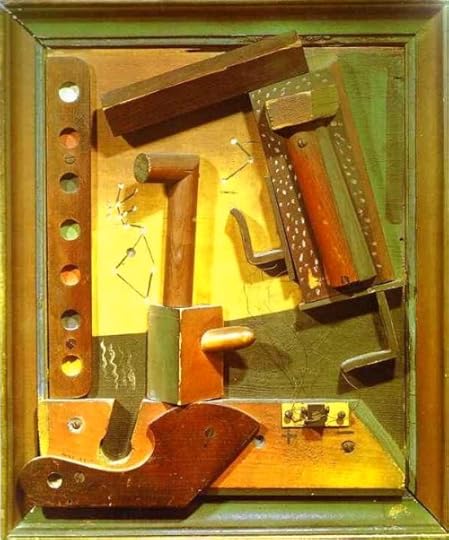
“Ernst’s main means of escape was to make use of objects having little to do with art and to employ an absolutely new technique.” ---------- That’s “objects having little to do with art” from a coarse, conventional perspective, that is, objects men and women stuck in lackluster, petty categories would never remotely consider as part of art. However, for one of the most dynamic creators of the 20th century, everything he came in contact with, large and small, no matter how mundane or commonplace, as if base metal in an alchemist’s laboratory, could be worked and transformed into artistic gold. Case in Point: "Fruit of a Long Experience."
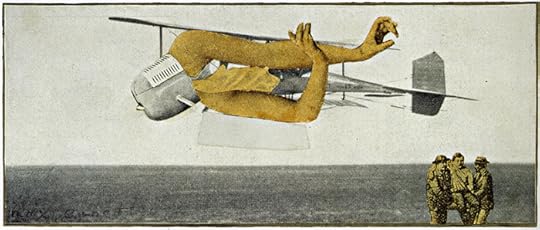
“The young student was interested in obscure fields of study and had a predilection for all kinds of strange, offbeat topics. His attempt to break away, which was mainly made possible by his use of chance and the unconscious, was a successful one.” --------- Ha! “Offbeat” and “strange” are relative terms. For an artistic imagination on fire, working within the confines of any approach blocking off the power of chance, accident, unforeseen possibilities or the bizarre is judged as so much stuffy prattle. Below; "The Murdering Airplane"
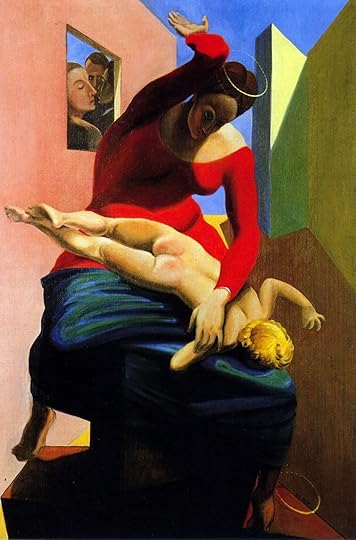
“Like a magician, Max Ernst the artist transformed whatever he touched, whether sacred or profane.” ---------- I couldn’t imagine an artist having more disregard for his own tradition and culture, even when that tradition and culture touches on elements of the sacred, than his painting “Young Virgin Spanking the Infant Jesus In Front of Three Witnesses.”
“Throughout the whole of Max Ernst’s works, hands play an important part. For the deaf, they are the main means of communication and since his father was a teacher of the deaf, Max Ernst was confronted with sign language from an early age.” ---------- How about that – watching his father teach sign language made a profound impact on young Max. Such attention to the delicacy of hand and fingers can be seen in his “At the First Clear Word.”

“His search for a technical means of avoiding a direct application of paint runs through his entire work, as do his efforts to carry out the picture itself and its subject with elements non-related to art. . . . In “Paris Dream” he used a wire comb to scrape two-thirds of a circle into the final surface of beige-grey paint, revealing a layer of blue below.” ---------- What I particularly enjoy about this painting is the contrast between the bold colors set out in a checkerboard grid across three mountains and the pale lightness of the upper half, the circle (actually many circles within circles) having echoes of an astrologer’s symbol for sun.

“The methods Max Ernst developed to stay “beyond” the classical way of painting taught at art schools have had an enormous influence on international art: collage, assemblage, montage, grattage, and decalcomania are techniques which he either developed himself or made us of in such a way that they soon became acceptable to both art schools and society alike.” ---------- The mark of a great artist is to leave the field you work in expanded and renewed. By my eye, the two works below are examples of the profound influence Max Ernst has had on the visual arts: “Europe after the Rain II” and “Capricorn.” Capricorn has a special appeal since Max appears with his honey!


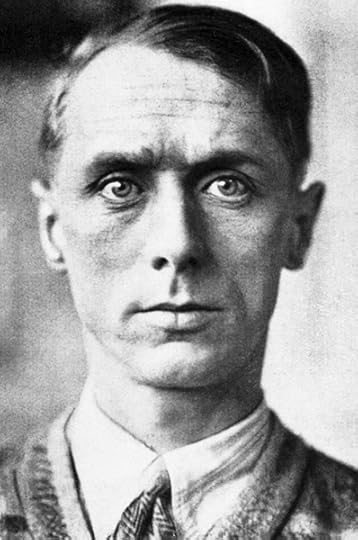
Photo of the Artist as a Young Man -- Max Ernst (1891-1976)

December 11, 2022
I love Max Ernst's work. Not all of them, but a lot. Especially the landscapes. Frottage and grattage baby

February 4, 2015
Max Ernst was a leading artist in the Dada and Surrealist movements. I had just finished his "novel in collage", Une semaine de bont�� and wanted more information about him. This book, in the Taschen series of short books about major artists, gives an overview of the evolution of his art, with reproductions of his most important works -- the book is about half text, half photos. I hadn't realized how many techniques used today -- some that I learned in grade school art class -- were either invented or greatly developed by Ernst, such as collage, frottage, grattage, dripping, etc. -- basically, much of his art was an attempt to avoid the idea of painting as the deliberately preplanned application of paint to canvas. According to the book, this was partly in reaction to the philistine concept of art as "high culture", and partly tied in with his interest, common to the Dada and Surrealist artists, in the unconscious mind and revealing the unconscious through seemingly automatic or chance processes. (I'll be looking into the library's three books on Dada; they don't have anything on surrealism (in literature or art) that isn't specifically on or by Salvador Dali.)

July 13, 2011
Returning to this 10 years later — and I have more of an understanding of what Ernst is doing. The text is still a bit turgid for my taste, but the reproductions are nicely done.
For me - with my very limited understanding here - much of the dada and surrealist work I've seen... simply strikes me as somehow immature -- psychologically, emotionally... I'm not sure what the right word is. It also seems to me to be dated. It's not holding up well. It may just be my ignorance or lack of sympathy or something... Or maybe it's just Ernst doesn't sit well with me. I like Hans Arp's work enormously... but the thought of an 80+ year old Ernst painting those funny futuristic bugs -- like a video game player -- doesn't quite fit for me...
Perhaps it is this: Surrealists and Dadaists were mostly very consciousvof being "modern". But "Art cannot be modern; art is eternal", as Schiele often said.
For me - with my very limited understanding here - much of the dada and surrealist work I've seen... simply strikes me as somehow immature -- psychologically, emotionally... I'm not sure what the right word is. It also seems to me to be dated. It's not holding up well. It may just be my ignorance or lack of sympathy or something... Or maybe it's just Ernst doesn't sit well with me. I like Hans Arp's work enormously... but the thought of an 80+ year old Ernst painting those funny futuristic bugs -- like a video game player -- doesn't quite fit for me...
Perhaps it is this: Surrealists and Dadaists were mostly very consciousvof being "modern". But "Art cannot be modern; art is eternal", as Schiele often said.

November 11, 2011
Another great entry in Taschen's Basic Art series. Max Ernst was an amazing artist, and this slim volume does a great job of introducing the man, his life, and a great selection of photographic reproductions of his work. While the reproductions are necessarily small, they are still high-quality and full of wonder. For the price, this is probably about the best introduction to this great artist that you're likely to find.

December 9, 2018
I own a few Taschen books, and from what I’ve seen I really like the format they go for. Different authors for different artists, so this could vary. This one is what I was looking for. I feel like I should make a disclaimer that any rating I give a book about art (or a book of poetry, for that matter) is in the end arbitrary to a certain degree. In the case of poetry, (a) it can produce such conflicted feelings, (b) it can obviously be very good from a technical point of view and not produce any kind of visceral response in me, or (c) it can be awful from a technical point of view and produce a positive response in me. Something that speaks so much more to the subconscious mind than the conscious is hard to explain, let alone measure. All of the above goes for art for me, too. But books ABOUT art are different entirely, I suppose. I’m still not sure what I’m looking for in books about artists or their work. I know it when I read it.
This wasn’t one I knew right away and felt blown away by, but it accomplishes some things I appreciate. It includes biographical material on Ernst that is helpful in approaching his work. It also discusses some of the artists and movements that he associated with and moved within (the obvious as well as the not as obvious). Insight into Ernst’s involvement in the development of collage, frottage, and grattage as techniques that would become staples was interesting, as was some of the “close readings” of certain paintings. The latter segues into the more interesting parts of the book. I have responded strongly to Max Ernst since seeing Marlene (Woman and Child - the first of his paintings I saw). The author of this little book succeeds in conveying a lot of Ernst’s symbolism, the mythology he developed (and that at different points in its development), and the things/movements/artists/biographical details he was drawing from. He succeeds in conveying all of this without trying to explain away anything entirely. Because, frankly, I don’t want to know exactly what Marlene (Woman and Child) is supposed to mean. Nor The Entire City. Nor the Eye of Silence. Nor The Horde. Nor The Robing of the Bride, and so on. I feel like so much of my life lately has been focused on mystery - its pursuit, its beauty, its pervasiveness, the clear signs of it spelling secrets out to me through the visible universe. But mystery’s pursuit is its beauty (and fun). As much as I want answers, I also think I probably would experience something worse than the death of every other human on earth if I was given the answers. The answers aren’t the point, and they rob us of something. So I guess that’s me going around my elbow to say, I love that this author gave enough answers without giving The Answers.
Max Ernst’s body of work, his paintings and sculptures, are clearly inspired by a weird and amazing pattern beyond him. I want the mystery to be sustained, and this short introduction to him and his major works allows for that. Aside from this ideal balance, the other high point of the book doesn’t need much explanation. It is filled to the brim with color images of Ernst’s best and most enigmatic paintings and sculptures. So many art books give you a few color pictures at the centerfold and otherwise save money on black & whites. Not this book. It might be short, but it is packed with gorgeous, glossy, often full-page if not full spreads, of amazing art that has defined much more of the art world than the Dada and Surrealism movements it’s often associated with - and more mediums than might be obvious at first glance. My guess is Bunuel owes more to Ernst than Salvador Dali. Who knows what kind of freaky music his work has inspired. If we’re honest, there’s probably some new form of art we don’t even have a name for that his work has inspired.
This wasn’t one I knew right away and felt blown away by, but it accomplishes some things I appreciate. It includes biographical material on Ernst that is helpful in approaching his work. It also discusses some of the artists and movements that he associated with and moved within (the obvious as well as the not as obvious). Insight into Ernst’s involvement in the development of collage, frottage, and grattage as techniques that would become staples was interesting, as was some of the “close readings” of certain paintings. The latter segues into the more interesting parts of the book. I have responded strongly to Max Ernst since seeing Marlene (Woman and Child - the first of his paintings I saw). The author of this little book succeeds in conveying a lot of Ernst’s symbolism, the mythology he developed (and that at different points in its development), and the things/movements/artists/biographical details he was drawing from. He succeeds in conveying all of this without trying to explain away anything entirely. Because, frankly, I don’t want to know exactly what Marlene (Woman and Child) is supposed to mean. Nor The Entire City. Nor the Eye of Silence. Nor The Horde. Nor The Robing of the Bride, and so on. I feel like so much of my life lately has been focused on mystery - its pursuit, its beauty, its pervasiveness, the clear signs of it spelling secrets out to me through the visible universe. But mystery’s pursuit is its beauty (and fun). As much as I want answers, I also think I probably would experience something worse than the death of every other human on earth if I was given the answers. The answers aren’t the point, and they rob us of something. So I guess that’s me going around my elbow to say, I love that this author gave enough answers without giving The Answers.
Max Ernst’s body of work, his paintings and sculptures, are clearly inspired by a weird and amazing pattern beyond him. I want the mystery to be sustained, and this short introduction to him and his major works allows for that. Aside from this ideal balance, the other high point of the book doesn’t need much explanation. It is filled to the brim with color images of Ernst’s best and most enigmatic paintings and sculptures. So many art books give you a few color pictures at the centerfold and otherwise save money on black & whites. Not this book. It might be short, but it is packed with gorgeous, glossy, often full-page if not full spreads, of amazing art that has defined much more of the art world than the Dada and Surrealism movements it’s often associated with - and more mediums than might be obvious at first glance. My guess is Bunuel owes more to Ernst than Salvador Dali. Who knows what kind of freaky music his work has inspired. If we’re honest, there’s probably some new form of art we don’t even have a name for that his work has inspired.

October 15, 2012
I understand the explanations given for Max's art and they might be valid but it kind of take away some of the mystery if it is explained in detail and I think some of it might be totally wrong. Nevertheless the book is good to read and I think the man came to great art through experiments and only achieved great art at the end of his life.

April 26, 2026
I used to like Ernst a lot when I was young. I liked the collage books best, but some of the paintings in this old paperback are pretty fun too. The reproductions are not brilliant - apart from the colour, some of them are not even very sharply photographed, e.g. 'Fascinating cypress'. But overall it gives a decent, if not very generous, sample of Ernst's styles as a painter.
I note that several of the reviews on this page are for a different book, published by Taschen and containing more paintings and a different text. My 'review' is about the book illustrated, a cheapo $5 Ballantine publication from 1975, before Taschen existed I believe, with 37 paintings (including only one of the several thumbnailed in other reviews, namely the one of Mary spanking Jesus - in my copy the colours are much less vivid than in the thumbnail). Just for information...
I note that several of the reviews on this page are for a different book, published by Taschen and containing more paintings and a different text. My 'review' is about the book illustrated, a cheapo $5 Ballantine publication from 1975, before Taschen existed I believe, with 37 paintings (including only one of the several thumbnailed in other reviews, namely the one of Mary spanking Jesus - in my copy the colours are much less vivid than in the thumbnail). Just for information...

Read
November 13, 2024Following my recent trip and my gorging on 20th century art, I am planning to read and absorb a lot more about this art that captures my attention. Just love it all
This book a mix of narrative and images is a perfect compliment to my learning
This book a mix of narrative and images is a perfect compliment to my learning

August 4, 2011
I have the English Version

September 15, 2016
There's no information about any of the images in here, simply the images, and any fan of Max Ernst will surely not care due to the vast collection of stunning artwork, page after page.
June 13, 2023
I love the art a lot I was so stoked when i found this at a thrift store
Displaying 1 - 12 of 12 reviews