Jump to ratings and reviews
Rate this book

Quartier Perdu

Rate this book
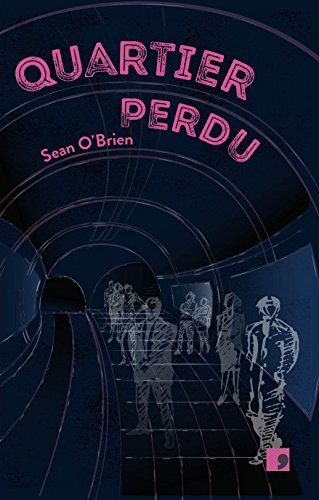
Sheltering from an air raid in an empty underground station, a young woman encounters a strangely out-of-place vessel passing along the platform...

A librarian cataloguing the manuscripts of a recently deceased horror writer notices one particular box, relating to his most mystical work, has disappeared...

A young academic takes up residency in the former home of an obscure, Dutch poet in order to better understand the strange rumours surrounding his demise...

Sean O’Brien’s stories are all lit with the unmistakable hue of the Victorian gothic: from the rantings of a deranged psychiatric patient, to the apparition of demons swarming into a remote, rural railway station; solemn oaths are broken and need atoning for; minor transgressions are met with outlandish curses. Often we join O’Brien’s protagonists attempting to take time out from their troubles, but removing themselves from their normal lives only lets the supernatural in, and before they know it personal demons find very literal ones to conspire with.

224 pages, Kindle Edition

First published October 3, 2014

31 people want to read

About the author

Sean O'Brien

132 books17 followers
Sean O'Brien is a British poet, critic and playwright. Prizes he has won include the Eric Gregory Award (1979), the Somerset Maugham Award (1984), the Cholmondeley Award (1988), the Forward Poetry Prize (1995, 2001 and 2007) and the T. S. Eliot Prize (2007). He is one of only four poets (the others being Ted Hughes, John Burnside and Jason Allen-Paisant) to have won both the T. S. Eliot Prize and the Forward Poetry Prize for the same collection of poems (The Drowned Book).
Born in London, England, O'Brien grew up in Hull, and was educated at Hymers College and Selwyn College, Cambridge. He has lived since 1990 in Newcastle upon Tyne, where he teaches at the university. He was the Weidenfeld Visiting Professor at St. Anne's College, Oxford, for 2016–17.

Ratings & Reviews

What do you think?
Rate this book

Friends & Following

Create a free account to discover what your friends think of this book!

Community Reviews

5 stars
2 (14%)
4 stars
6 (42%)
3 stars
5 (35%)
2 stars
0 (0%)
1 star
1 (7%)
Displaying 1 - 5 of 5 reviews
Profile Image for Bill Hsu.
991 reviews221 followers
September 21, 2022
A mostly enjoyable collection, despite uneven moments. (More like 3.5 stars.)

There's a gothic sensibility in many of the stories, updated to more contemporary, mostly English, backdrops. The writing is mostly clean and well-crafted. I'm guessing that, as a practicing poet, O'Brien knows to steer clear of overwrought and supposedly "poetic" flourishes.

The mostly English characters are skillfully sketched. They deal with stressful situations and loss in nicely evoked dark (mostly) English landscapes, with often unexpected outcomes. For example, the main character in "Change for Low Rixham" is an addict on a troubling and uncertain Aickman-esque train journey. In a few pages, the tale goes through several surprising changes in direction, leaving its inner Aickman behind. The premise could be quite ridiculous. But O'Brien refuses to spell out the details, and I was laughing with him at the end. Similarly, I sense nods to Aickman in the beautifully inconclusive "The Good Stuff", complete with a femme fatale that A. might have admired. "Story Time" is intense, cryptic and dream-like. I'm not sure about the ending, but it will stay with me for awhile.

O'Brien shows some range over the collection. The opening of "Ex Libris" approaches slapstick, though it slightly overstays its welcome. "A Cold Spot" has more than a whiff of M.R. James; then we have this repartee, with the two main female characters (Leah and Steph) alternately flirting with and taunting the narrator (Christopher, not identified explicitly). The women have just discovered the titular "cold spot" in the narrator's house:
"It's a cold spot, according to my aunt."
"So what does it do?" Steph asked.
"I don't think it does anything. I think it's just there."
"It's dead creepy. Perhaps you'll have to protect us."
"Perhaps he won't have his shirt on," said Leah. "And perhaps our clothes will be revealingly torn and we'll have to climb up an iron ladder through the flames to safety."
"But one of us will fall. And will he catch her? You never know. What do you think, Christopher?" said Steph.

The ending is actually quite touching.

So an enjoyable collection, despite a few (ahem) cold spots, of which "A Cold Spot" isn't one. But one should not expect all the t's to be crossed etc etc.

Revisiting some old favorites 9/22; all hold up pretty well.
Profile Image for Merl Fluin.
Author 6 books59 followers
August 5, 2020
42 SHORT STORIES IN 42 DAYS*

DAY 27: During An Air-Raid
A lot of strong images, but for me they didn't add up to much: the ending was too pat, and the writing clunked.

*The rules:
– Read one short story a day, every day for six weeks
– Read no more than one story by the same author within any 14-day period
– Deliberately include authors I wouldn't usually read
– Review each story in one sentence or less

Any fresh reading suggestions/recommendations will be gratefully received 📚
Profile Image for Jackie Law.
876 reviews
December 12, 2018
Quartier Perdu, by Sean O’Brien, is a collection of eighteen short stories. Many play on the suppressed fears of academics and writers – their desire for acclaim and to build a creative legacy. From within the rich, dark undercurrents much humour percolates. The author touches lightly on jealousies and ego yet gets to the heart of a quiet desperation. Those who regard themselves as successful bask in the company of:

“others wearing a thin blanket of carefully nursed resentment at their unsuccess”

The themes are vivid, often surreal. There is violence in association.

The collection opens with a story about an unbalanced relationship. Set in London during the Second World War, two young women employed by the BBC are vying for the attention of a colleague. In an attempt to gain the upper hand Vicky declares she has had enough and is going home, expecting Ray to accompany her. She ends up leaving alone. Unsure of her bearings she gets caught up in an air raid. Escaping underground she meets a ferryman. Their journey is cathartic.

The Sea-God is set in a remote, Greek bay at the end of the holiday season. A creative writing tutor has completed his contractual obligations and is enjoying a few days holiday. He is aware that, after close to twenty years, his star is on the wane.

“he and the public had begun to grow bored with his work, but readers of thrillers were a loyal bunch and would not wholly desert him for a while yet. After all, they had worked their way into their fifties with his books reliably to hand every summer. Why change now?”

Finding a journal in a drawer by his bedside he starts to translate the German text. His dreams become more vivid; his hosts pay him more attention. When a storm blows in he finds himself trapped in what many would regard as an idyll. He struggles to understand if what is happening to him can be real.

Several of the stories rely on drug taking to blur the edges between fear and reality. These drugs may be recreational, sinister, or administered by medical practitioners. There are those claiming to want to help. The protagonists struggle to retain control of their own minds and to convince others of their right to agency despite observed behaviour.

The legacy of dead writers is shown to be deeply personal and affecting. Quartier Perdu sees a young academic drawn into the dark world of the writer she has chosen to study for her PhD. Revenant explores the impact on a writer who believes he was the subject of another’s famous work.

Libraries feature in several of the stories. In The Good Stuff an academic is tasked with going through the meticulously maintained back catalogue of a recently deceased, prolific and popular author – one he does not regard as of much literary merit – to judge what should be bid for by his university. He discovers a sinister deal, one that could have ongoing consequences which would be hard to explain.

Ex Libris is a delicious dig at critics. A wealthy author takes exception to published views on his work and seeks vengeance.

Keeping Count is another tale of revenge. A self satisfied, aging poet agrees to be Master of Ceremonies at the interment of a supposed friend’s ashes.

“Of course, there was really nobody else to fill the role. He had gravitas, and he could still speak in sentences.”

As he muses on his plan to bed the widow he comes to realise that she has her own agenda.

A Green Shade is a wonderful satire on the modernisation of institutions of tertiary education. A new Head of Department, Todd, is using concerns over Health and Safety to cancel the long-standing tradition of an annual play. A retiring professor – whose Chair in Renaissance Studies will not be replaced – plans a swansong with the help of other discarded staff members who understand the true value of education.

“Todd’s Mission Vision, or whatever he was calling it, was of a merger with Media and Communications. ‘Let’s make English useful again!’ was his motto.”

An ancient play is resurrected and performed literally.

The final story, The Aspen Grove, introduces a writer in retirement who has settled in a quiet English backwater where he is trying to write a novel no one is pushing him for.

“People knew he wrote. He was said to have been working on a book for some years. Faced with his impermeable politeness on the topic, people had given up telling him that if they too had time on their hands like him they would also write books.”

Observing the habits of the locals living around him he misunderstands what actions are acceptable and suffers the consequences.

The writing in this collection is witty and at times piercing but always compelling. By blurring the edges of what may be defined as an individual’s reality, many ideas and their impact are touched upon. Carefully crafted to tell a story with penetrating understatement, this was an entertaining if occasionally sardonic read.
Profile Image for Ross Jeffery.
Author 28 books362 followers
May 9, 2019
Comma Press has done it again. I recently reviewed The Book of Tbilisi, a collection of short tales detailing the history of the Georgian capital. Quartier Perdu and Other Stories is, you guessed it, another gripping collection of short stories. This time, all the stories are written by a single author. Sean O’Brien does it all. Not only does he write stories, but poems, novels and plays which have won him a number of awards, including the T.S. Eliot Prize and the E.M. Forster Award. Quartier Perdu and Other Stories is his second collection of short stories. Unlike The Book of Tbilisi, the tales in O’Brien’s collection aren’t connected by one setting in particular. Instead, they’re connected by subtle snippets and mismatched clues. It’s a rollercoaster of a collection. Make sure you’re strapped in.

‘You are born out of nothing. The world lies all before you, issuing its invitation to the voyage on this blue evening.’ (“Lovely”)
Quartier Perdu is immediately enticing, opening with a story about a woman who gets caught up in a bombing. The next tale is about a town which has more cats than people. O’Brien’s collection is divided into three parts. Not only is each part different, but the stories inside each part are not exactly similar either. Some rely more on description while others are fuelled by dialogue. The tales switch between first, second and third-person. “Story Time” is structured like a diary and the titular story “Quartier Perdu” is written as a collection of letters. While each story is unique in its own way, Quartier Perdu has a creepy thread running throughout. Reminiscent of Edgar Allen Poe, O’Brien appears to echo Gothic tropes throughout his collection. On the whole, he echoes them well.

‘It was as if Susie was already sitting in some other place, a kind of future, confident that soon the desired visitor would arrive and stay, and the redundant one would be gone.’ (During an Air-Raid)
One of O’Brien’s greatest feats throughout the collection is his character descriptions. Although we don’t stay with any of the characters for long, they are crafted as carefully as the protagonists of a novel would be. It’s almost a shame that they only exist within the limited scope of short stories. Take Caterina, ‘the nineteen-year-old daughter from the restaurant next door, tanned to cinnamon in her tiny red shorts, moving effortlessly among all the glances that followed her’ (“The Sea-God”) or Mrs Yorke who ‘had the faint stylised hesitation found among those who are never entirely sober’ (“The Good Stuff”). O’Brien makes use of details which could simultaneously pass us by and reveal critical elements of a character’s personality.

‘Now, I thought, now it might happen: since boyhood I had always wanted to be inside a story, and it seemed as if this could be it, the opening page of a narrative that turned out to be true.’ (“To See How Far It Is”)
It’s hard to choose a favourite from a collection where every story possesses its own sense of humour or mystery. However, one that particularly strikes me is “Lovely”. Written in second person, “Lovely” details an evening stroll and a date in a coastal town. Not many authors are brave enough to write a story in second-person. I suppose that’s why “Lovely” is my favourite; I appreciate O’Brien’s risk. For a few pages, you become the protagonist. An entire story is dedicated to you.

‘Surely, you might think, the outcome simply could not be predicted. There was nothing inevitable here. I can quite see why it is necessary to think so. But you would be wrong.’ (“Certain Measures”)
As with any collection of short stories, especially one of this length, some stories are not as memorable as others. When writers compile a short story collection instead of a novel, there is a reason for their choice. If I were to give one piece of advice before picking up this book, it’d be to not power through the collection as you would a novel. O’Brien is talented enough to have produced a collection in which each story stands alone. There is no need to devour the stories in one sitting. Keep this book on your bedside table and dabble in and out.

‘Leah was found two days later, washed up on a mudbank in the mouth of the Haven, fully clothed except for her shoes and with no marks of deliberate injury.’ (“A Cold Spot”)
If you’re currently between books and not sure whether you fancy reading romance, crime or fantasy, Quartier Perdu is the collection for you. If you’re not in the mood to invest in an entire book’s worth of characters and storylines, open up to a random page and start with one story. If you just feel like reading well-written, cleverly plotted and gripping fiction, O’Brien is a great place to start. So far, Comma Press has not disappointed with its short story collections. When’s the next one?
This entire review has been hidden because of spoilers.
Profile Image for Isabelle.
Author 18 books79 followers
February 16, 2019
I'd love to give more but the proofreading issues really bothered me! Also some stories were much stronger than others.
Great to read contemporary gothic though
Displaying 1 - 5 of 5 reviews

Can't find what you're looking for?

Get help and learn more about the design.