“I can’t fit the pattern together yet. But something horrible is going on here, and there’s no telling what might happen if what we have just discovered became known.” — Philo Vance to John F.X. Markham, District Attorney
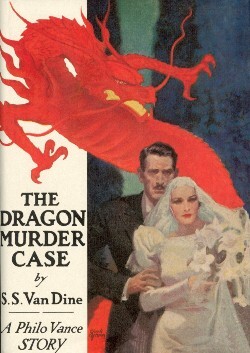
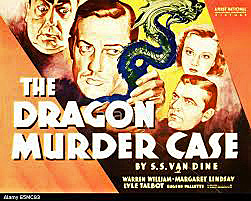
Perhaps just shy of the locked room murder puzzle masterpiece that is The Kennel Murder Case, culturally influential art critic Willard Huntington Wright’s (S.S. Van Dine) seventh Golden Age mystery featuring the dapper and borderline insufferably knowledgable amateur detective, Philo Vance, is an absolute blast in all respects. Those who’ve seen the early film adaptations with William Powell, and can picture him in their mind while reading, have a bit of an advantage, I’d say. Meticulously plotted and incredibly literate as always, Wright seems to be having great fun with a plot where the murder — if there is one — may have supernatural undertones.
During a party at a century-old estate, a man has gone missing after diving into the Dragon Pool — a mysterious body of water bathed in legends of a real dragon spirit living within the pool and guarding it. Markham and the erudite Vance are together when a frustrated Sergeant Heath, tired of questioning numerous party attendees who all seem to have a motive for a murder as yet unconfirmed — no body can be found; the man simply vanished in the pool, and never came up — asks for help. Intrigued, Vance accompanies Marham to the estate and finds the atmosphere more tied to the past than the present — and eerily so. Vance immediately realizes that body or no body, something at the Stamm estate is very wrong. The mysterious Dragon Pool is drained, but there is no body, despite it being impossible for the missing man to have escaped from the pool unseen by any of the guests! In a manner of speaking, Van Dine’s The Dragon Murder Case then becomes a locked-room mystery. Confusing everything, when the man’s body is finally discovered, in a mysterious place of caves and Indian legends, he has strange, talon-like markings on him. Even Vance isn’t sure yet what to make of it all:
“That’s a strange place, Markham. It’s full of infinite possibilities—with its distorted traditions, its old superstitions, its stagnant air of a dead and buried age, its insanity and decadence, and its folklore and demonology. Such a place produces strange quirks of the mind: even casual visitors are caught in its corroding atmosphere. Such an atmosphere generates and begets black and incredible crimes. You have seen, in the last two days, how every one with whom we talked was poisoned by these subtle and sinister influences.”
The death of Sanford Montague will not be the only fatality as Vance, Markham and Heath attempt to get to the bottom of things, without diving into the pool of the supernatural. Is the eldest Stamm female, who claims to have seen the great dragon, delusional, or is there truly something otherworldly at play here? Markham thinks not, but Heath is beginning to wonder — and becoming a bit uneasy about it. Though the analytical Vance feels there has to be a solution, his familiarity with rare fish and ancient aquatic life, and his nearly encyclopedic knowledge concerning dragons and their presence in mythology all over the world — Vance knows about pretty much everything — appears to Markham’s irritation, to have him sitting on the fence about the murders. At one point in the case, Vance even takes time out to inform Markham of dragon lore encompassing the globe. It goes on for page after page, like an info dump, yet Wright was such a terrific writer, that to skip over it is to miss some truly fascinating information.
What becomes clear, as Vance finally sees a glimmer of light at the end of the tunnel, is that The Dragon Murder Case will require something beyond the tried and true methods of detection. Vance comments on such when Heath admits to Markham that he isn’t sure how to handle the case, and rather than be miffed, Markham sympathizes with his Sergeant. That’s when Vance concurs:
“The usual methods are futile. The roots of these two crimes go down much deeper than that. The murders are diabolical—in more than one sense; and they are closely related, in some strange way, to all the sinister factors which go to make up this household and its influences…”
There’s some knowledge Wright doesn’t share with the reader, involving a trip into town by Vance where the high-brow detective figures it out, that might have a few purists shouting about fair play and all that, but with a Golden Age mystery from one if its true masters being so much fun, who cares? Wright’s sublime literate mysteries featuring the dapper Vance eventually gave way to the hardboiled detective, but nothing this good, nor as much fun, ever really goes out of fashion. Rediscover how much fun mysteries from another time and place can be by picking up The Dragon Murder Case. You’ll understand then, why they call it the Golden Age.