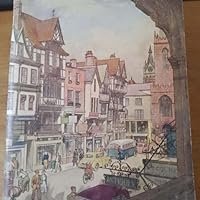
Twin sisters and best friends Debbie and Doria Darke face the possibility of separation when they discover only one scholarship is available at the London ballet school where they wish to study.
Fraternal twin sisters Doria and Deborah Darke - the former a shy, insecure brunette; the latter an extroverted, confident blonde - both love ballet in this engaging novel from prolific British children's author Mabel Esther Allan. When the two go up to London to audition for scholarship spots at the celebrated Lingereaux Ballet School in Bloomsbury Square, both girls are offered a place, but only Debbie is given a scholarship. Dorrie is devastated, and her unhappiness is compounded when the girls' parents decide that Debbie will not be permitted to attend either. Willing enough to have both girls move two-hundred miles from home in order to pursue their training, Mr. and Mrs. Darke draw the line at the idea of Debbie going off on her own. Angry and rebellious, Debbie says terribly hurtful things, putting great strain on the sisters' relationship. Then Dorrie is offered a scholarship after all, when another pupil must withdraw from the school, and the 'ballet twins' head to London. All is not well however, and Dorrie struggles with her insecurity, and her feeling that she will always come second to her more popular, talented sister. She also mourns the loss of her once close friendship with Debbie. Can things be put right between them, and will Dorrie ever step out of Debbie's shadow...?
Originally published in 1967 under the name 'Jean Estoril,' a pseudonym that Allan used for much of her ballet fiction, including her series about Drina the Ballerina, We Danced in Bloomsbury Square is the third ballet-focused novel I have read from this author, following upon her The Ballet Family and The Ballet Family Again. I enjoyed it a great deal, although perhaps not as much as those other two. Dorrie is the narrator here, and we therefore see everything from her perspective. As a result, it's difficult not to think of Debbie as a bit of a selfish monster, although Allan resists the temptation to turn her into a villain. There certainly is a certain shallowness and insensitivity to her, but the episode in which demonstrates that she is also capable of deep and sincere love for her sister. On another note altogether, I thought the very brief mentions of race in the story were quite interesting, given the date of publication. One of Aunt Eileen's boarders is a young black man from Jamaica, and she comments at one point that it would be un-Christian to object to "coloured students" in her house. It is my understanding that many boarding houses in London did discriminate based on race during this period, so Aunt Eileen's remark felt like a direct authorial response to the issue. Dorrie herself mentions the sole black student at the Lingereaux school in a positive way, although she also reflects that it would be difficult for the girl to fit in with any ballet company, revealing the almost exclusively white nature of the dance form at that time.
These were very brief moments in the book, and although they are certainly of interest to me as a scholar who tries to situate the historical children's literature that I read in its contemporaneous cultural milieu, the chief focus of the book was Dorrie's journey toward a better understanding of herself and of her sister. Like so many of Allan's books, it offers a sensitive depiction of a young person's complicated relations with family, friends, and school. Recommended to anyone who enjoys ballet fiction and/or stories of twins for middle-grade readers.
Wonderful story about the Darke twins who go to London to study ballet, and how their rivalry threatens to destroy their relationship. I think this is my favorite of all Mable Esther Allan's books (I own at least 25 of them but she wrote dozens - my set of Drina books disappeared when I moved in 1999 and I was too annoyed to replace them), and I highly recommend it to anyone who likes twin books, sister books, ballet books and/or books set in London.
I loved this book! The main character Doria (Dorrie) wants to be a ballet dancer more than anything but isn't confident in herself as her twin, Debbie is. But over the course of the story she become more self-confident in her dancing with the help of her new friends that she meets in school in London and the teachers there as well. I'd recommend this book to anyone who likes ballet and stories having main characters that change for the better!
My favorite books by Jean Estoril are her 'Drina" books but her other books are quite good too. I like her sweet and somewhat dated style, they are basically the perfect English school girl stories. I never did ballet but I have always been obsessed with it and I enjoy the window into that life that reading a Jean Estoril book gives me.
I seriously dug this book. Didn't even know it existed until CLM gave it a rave here on Goodreads. Estoril's prose reminds me of Roald Dahl at his most contemplative (especially Danny, The Champion of the World. So well written and engaging...I'm on to the Drina books, now. Hopefully, they will give me incentive to drop some lbs. and take ballet class, like I've always wanted.
I loved the Drina books as a kid so I thought I'd give this a try. It was hard to find and relatively expensive.
Frankly, it was not a strong book. Everything is told from the 1st person POV of a 13 year old aspiring ballet dancer. The only problem is that her twin is better than her, and gets the only scholarship to a famous ballet school. From there she has to struggle with issues of confidence and envy of her sister. While I didn't like the sister from the portrayal, this was somewhat because of the narrator's over-sensitivity, however understandable it would be (I would have reacted much the same way).
This also results in other mishaps and misinterpretations that border on the absurd. Nevertheless, I'm glad to have read it and recaptured some of the feelings I had reading Drina as a child.
This book is also known as the Ballet Twins it's not a different book but as it had been some time since I had read it I enjoyed the tale ( told by Dorie) of the twin sisters who both get a scholarship to the Lingeraux Ballet School if you have read the Drina ballet books then you will know who that is. They are from Birkenhead ( they say Cheshire, Merseyside now) and there is a fight in Dorie's mind as she feels that she is the underdog, and not there through choice but as an afterthought. We see their story through this first term at the school and as far as I am aware there are no other books in this series. For confident readers of ten plus.
This entire review has been hidden because of spoilers.
a good story about handling complicated feelings around growing up. as a kid, i felt like i was always in my sister’s shadow, and this book helped me realize how to come into my own and handle being the less confident sibling. i read it over and over, and even as an adult i still have read it a few times.
An old favorite. Twins Dorrie and Debbie Darke discover ballet and are determined to make it their career. But, in this story told from Dorrie's point of view, it isn't always easy, and it puts a strain on their relationship. Recommended.
Re-read January 2016, and LOVED it! I love the narration; the twins are only 13 at the time of the book but the story is being told by a much older Dorrie so you have a very mature voice there.
My sister and I, identical twins, read this book when we were still in elementary school and we both adored it and have copies of it on our shelves today. I gave it two years ago to my own daughter to read, and she cherished it, too. I identified very strongly with the main character, a girl named Doria ("Dorrie") Darke, who is in love with the ballet and wants to be wonderful but is plagued with self-doubt, some fear, and jealousy of her twin, who is a more physically gifted dancer and arrogant besides. The book takes place in England and is quite a well-written and compelling story that I think many young girls (and even grown women) today would love.
While there was nothing particularly standout about this book, I found myself coming back to it again and again because it was a fun and pleasant read.