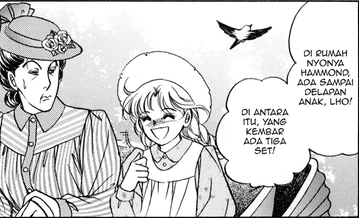
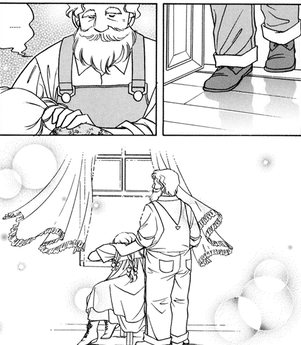
I did not realise just how impossibly difficult it would be to successfully locate any reasonably priced copies of Yumiko Igarashi's manga Anne of Green Gables series (which is called 赤毛のアン or Akage no Anne in its original Japanese, translates as Red-Haired Anne in English and looks like it stops with Anne of the Island). And in fact, I could not find any English language translations whatsoever anywhere (even though they are all listed on the Goodreads database) but have decided to try Anne et la maison aux pignons verts (the French edition of the first AOGG manga book, and which I managed to locate on ABE Books at a not too outrageous price). And with Anne et la maison aux pignons verts basically showing the story of Anne of Green Gables from when Anne Shirley first arrives in PEI until she is after the fiasco with the currant wine head of her class with regard to academics (but no, Anne et la maison aux pignons verts does not have Anne saving Minnie Mae Barry's life and thus also no Mrs. Barry realising that Anne did not deliberately cause her daughter Diana to get drunk and I also am not sure if the French language editions of Yumiko Igarashi's manga Anne of Green Gables were even continued past Anne et la maison aux pignons verts), yes, my personal reaction has been one of very major and pronounced conflictedness (and as such only a very grudging and low three star rating for Anne et la maison aux pignons verts and actually more akin to two and a half stars). Sure, from a textual point of departure, I have as a fan of Lucy Maud Montgomery and of the entire Anne of Green Gables series very much appreciated just how delightfully loyal, how very close contents and thematics wise the featured text of Anne et la maison aux pignons verts (which was translated by Odilon Grevet from Yumiko Igarashi's original Japanese) actually is to what Lucy Maud Montgomery actually and specifically writes about in Anne of Green Gables (and that without the accompanying artwork, without the manga component, my rating of Anne et la maison aux pignons verts could likely even be five stars, as nothing essential is textually missing and what is missing is not really all that necessary anyway except to provide some narrative padding and extra description so to speak).
But no, I am not really all that much a manga fan, and while certain elements I do readily enough (even though with a bit of aesthetic cringing) accept because I know they are standard manga tradition (like how for example all of the children and teenagers in Anne et la maison aux pignons verts have these huge eyes and that Gilbert Blythe's visual manga attractiveness is a bit girly and effeminate), there are two very specific illustrative scenarios of what I would definitely call visual strangeness and not really being accurate with regard to the actual text (both for Anne et la maison aux pignons verts and also for what L.M. Montgomery originally wrote in Anne of Green Gables). For one, why does Yumiko Igarashi draw Thomas Lynde (Rachel Lynde's husband) as looking not like the laid back, placid and easy going small time Prince Edward Island farmer of Anne of Green Gables but instead as appearing sinister and shifty, as looking more like a banker with nefarious secrets/interests, as almost physically resembling some kind of organised crime boss? It makes no aesthetic sense whatsoever, it makes me shake my head and it also makes the Thomas Lynde of Anne et la maison aux pignons verts appear visually, illustratively problematic and potentially threatening when there is absolutely NO threats and dangers at all emanating from him printed words wise. And for two, why does Anne Shirley's teacher Mr. Phillip have to be depicted so horrifically like a monster in Anne et la maison aux pignons verts? For while Mr. Phillips certainly is a stickler and does not really either like or understand Anne Shirley and her imaginative temperament, how Yumiko Igarashi depicts him like some kind of all encompassing villainous horror story is more than a bit overly exaggerated on a visual level (and that this just like with the Thomas Lynde depictions do not really visually mesh with the textual presentation in Anne et la maison aux pignons verts).
Thus and combined with my annoyance at the reading from back to front set-up of Anne et la maison aux pignons verts and that the tiny font size is really hard on my ageing eyes, sorry, but for me, Yumiko Igarashi's manga illustrations are just not my aesthetic thing, and while encountering a manga version of Anne of Green Gables in French has been interesting, it has also only been only very slightly enjoyable.
And just to say (finally, I promise) that I have now also read the English translation of 赤毛のアン, of Akage no Anne, and that yes indeed, my reading reaction Red Haired Anne Vol. 1 (which I was able to read for free online in its entirety and which naturally corresponds to Anne of Green Green Gables) is basically exactly what I have been feeling regarding this here French edition, regarding Anne et la maison aux pignons verts, namely that Red Haired Anne Vol. 1 is nicely loyal to L.M. Montgomery's contents and themes for Anne of Green Gables but that Yumiko Igarashi's manga artwork just does not really work for me personally.