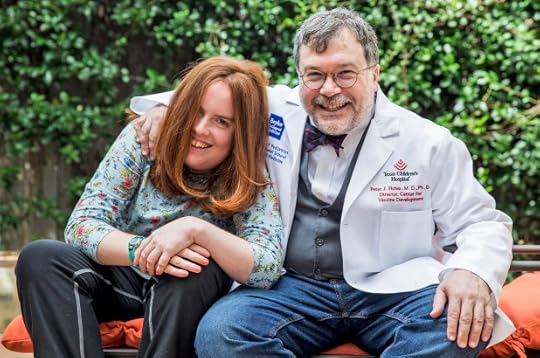
In 1994, Peter J. Hotez's nineteen-month-old daughter, Rachel, was diagnosed with autism. Dr. Hotez, a pediatrician-scientist who develops vaccines for neglected tropical diseases affecting the world's poorest people, became troubled by the decades-long rise of the influential anti-vaccine community and their inescapable narrative around childhood vaccines and autism. The alleged link between the two was first espoused in a fraudulent scientific paper, long since retracted, but the story shows no signs of letting up. As a result, we've seen deadly and disabling outbreaks of vaccine-preventable diseases around the country, and Texas, where Hotez lives, is at particular risk.
In Vaccines Did Not Cause Rachel's Autism, Hotez draws on his experiences as a pediatrician, vaccine scientist, and father of an autistic child. Outlining the arguments on both sides of the debate, he examines the science that refutes the concerns of the anti-vaccine movement, debunks current conspiracy theories alleging a cover-up by the CDC, and critiques the scientific community's failure to effectively communicate the facts about vaccines and autism to the general public, all while sharing his very personal story of raising a now-adult daughter with autism.
A uniquely authoritative account, this important bookpersuasively provides evidence for the genetic basis of autism and illustrates how the neurodevelopmental pathways of autism are under way before birth. Dr. Hotez reminds readers of the many victories of vaccines over disease while warning about the growing dangers of the anti-vaccine movement, especially in the United States and Europe. A former US Science Envoy for the Department of State, he also explains what's at stake if the movement continues to gain ground. Opening with a foreword by leading medical ethicist Arthur L. Caplan, this book is a must-read for parent groups, child advocates, teachers, health-care providers, government policymakers, health and science policy experts, and anyone caring for a family member or friend with autism.
"When Peter Hotez--an erudite, highly trained scientist who is a true hero for his work in saving the world's poor and downtrodden--shares his knowledge and clinical insights along with his parental experience, when his beliefs in the value of what he does are put to the test of a life guiding his own child's challenges, then you must pay attention. You should. This book brings to an end the link between autism and vaccination."--from the foreword by Arthur L. Caplan, NYU School of Medicine
Peter J. Hotez is an American scientist, pediatrician, and advocate in the fields of global health, vaccinology, and neglected tropical disease control. He serves as founding dean and chief of the Baylor College of Medicine National School of Tropical Medicine in the Department of pediatrics and holds the Texas Children's Hospital Endowed Chair in Tropical Pediatrics.
I'm glad Dr. Peter Hotez is pushing back on the anti-vaxxers. There aren't a lot of qualified people doing so.
The book covers his training as a physician and scientist, the rise and risk of the anti-vaccine movement, and personal stories about his beloved Rachel.
The writing could be smoother. The real strength is in the information: the complete lack of evidence to support the claim that vaccinations as a cause of autism, brain changes in ASD children begin before birth, the risk of an unvaccinated portion of the population, to name a few. Lots of solid information and worth reading for Rachel's story.
Dr. Peter Hotez with his daughter Rachel from New York Post
It's good to finally have a work that shows someone who has a family member with autism AND deals with vaccines.
Vaccines do not cause autism.
I would have appreciated hearing more from Ann about raising Rachel, especially since the burden of childcare and dealing with Rachel's autism fell on her. It would have been good to hear from Rachel too, but then she may have opted out of putting her point of view in the book and that's okay.
It was helpful showing how Rachel progressed and how she behaved along with the input from Ann who had noticed something was different with Rachel before the diagnosis of autism. Showing the struggles, battles, heartache, and the good was helpful in showing that those on the autism spectrum and their families have to deal and cope with behaviors from their loved ones without a lot of support especially as an autistic child becomes an adult. It was also helpful to show an autistic girl because autism in girls has increased in the last few decades. Having a face to put to the diagnosis rather than a meaningless phrase of paper will help many see the humanity of those with autism rather than a impersonal diagnosis.
It's genetic and has about a 1000 genes that affect the development of autism with only 65 genes currently identified. The genes that cause autism affect development in the womb, not caused by vaccines. Autistic behaviors start before certain vaccines are given, ones falsely accused of "causing" autism. People are born with autism, not infected with it. Those with autism are usually born with a larger head (macrocephaly), don't bond or don't bond well with parents, cry easily and can't be consoled as babies, start overdeveloping their brains starting at 6 months, may regress in development milestones or be slow to meet them and are usually diagnosed between 18-24 months.
We don't provide enough services and support for those with autism and families that have an autistic family member. Vaccines are safe. Let's put more effort into developing and funding support and services for those on the autism spectrum and their loved ones. That's what we really need more of.
I 100% agree with the author’s conclusions and I appreciate the fact that this is written from the perspective of a vaccine scientist who also has an autistic daughter but man, this is an awful book. (And frankly, once I understood that his daughter was autistic and got the gist of what that looks like for her and how hard it is to parent her, I skimmed everything else about her. It’s too much information.)
It reads like a very long term paper; many of the sections actually sound like (and possibly are) abstracts directly copied from studies. Consequently, it isn’t understandable to the average reader or parent, like me. Lots of medical jargon and acronyms, not all of which is explained. Example: “As part of the evaluation she underwent an EEG (electroencephalogram) that revealed an interesting finding of some right-sided temporal lobe spike discharges, for which she received tegretol for a time, possibly with some improvement (p.46.” Huh? What does any of that mean? Why is that interesting? What is the medicine? What did it do? What improvement? No clue. Never explained. That’s just one of many such instances throughout the book.
So unfortunate. A book like this is definitely needed to refute the anti-vaccination arguments floating around but it needs to be done in a way that is more accessible to the layperson.
I really wanted to like this book because Dr. Hotez is a really great scientist and speaker, and it’s important for this subject to be discussed. This book unfortunately does not do that effectively. It is incredibly rambling, name drops abound (both people and places), and poor Rachel is made to seem like this horrible chore that her brilliant parents were saddled with. Maybe it improves later in the book, since I only made it halfway before giving up, but the first half is a very big disappointment. I think there are different accounts of both vaccine success stories and those from autistic people themselves which would probably be more informative and better told. I’ll keep my eye out for them.
Even as someone who has settled the vaccine "controversy" in my mind years ago, I was rattled when a well-meaning family member asked if I'd considered that my son might have autism. Given some of his ambivalent social behavior and his penchants for measuring objects and lining them up, and since he'd had a fainting episode following a vaccine at age 2, could he be experiencing long-term adverse effects? I wasn't nearly as bothered by the possibility of neurodiversity as I was by the idea that his vaccination status increased his risk. I responded with a feeble, "well, links between autism and vaccines have been debunked," which was met with, "not anymore. Now that so-and-so is in charge, we're finally getting some good research." So to ease my flustered mind, I looked for a book. Scientific explanations for why autism CAN'T be brought on by a vaccination are clearly elucidated. The myths of the MMR vaccine, alum and thimerosal are thoroughly reviewed and kicked to the curb. I even learned that the close spacing of vaccines has been studied and found to have NO effect on the onset of autism (and it was a pretty elegant study). The link between vaccines and autism is one of the most thoroughly studied myths that has no scientific basis, and funding for autism research should not exhume that corpse. Instead, we should be using funding to further what is known about what DOES cause autism. I learned about the past decade's new research explaining that autism is a genetic or epigenetic condition with up to a thousand contributing genes, and it is associated with biological markers that can be measured in utero and at six months of age. I appreciated that Dr. Hotez explained that sometimes injuries and deaths happen as a result of vaccination, and under what conditions these tragedies happen, and that they are never to be confused with an onset of autism. So I am again satisfied that I did right by my kids in vaccinating them. Oh, and one more thing. After reading about Dr. Hotez' childhood hanging out with his microscope, examining slide after slide of stagnant pond water, I'm pretty sure my son's eccentric behavior is more in line with the author of this book than that of his daughter (who sounds endearing and infuriating all at once)
This is a MUST read for so many people (scientists, medical health professionals, public and global health workers, parents, etc etc). Dr. Hotez very clearly outlines the history of the anti-vaccine movement, along with the most current research proving unequivocally there is NO link between vaccines and autism. It is such a good read because he goes into detail about his own daughter, Rachel, who has autism along with many other mental health diagnoses. The book ends with talking points, great ways to stimulate the conversation and show there is no good evidence between autism and vaccines. And furthermore, how it is becoming a public health crisis that vaccine coverage is dropping to a dangerously low level.
I am surrounded by conspiracy theorists: at home, at work, online or offline. I live with family members who think 5G caused Covid, that eating only meat will cure any cancer, and may or may not believe that time was rewritten by Jesuits to erase Russia as the heartland of the world. The day I started reading this book, I was already pulling citations out (see below) for extended family members on Facebook still spouting the idea that "we just don't have the research yet" to know whether or not vaccines are connected to autism (and all that literally the day before the Tylenol farce fml 🙃🙃).
This year kick-started my much belated science education (which I dodged as much as I could as a kid absorbed with languages and drawing), and while the learning itself has been top-notch, best-thing-I've-ever-done level of informative, the *reason* for that education is absolutely draining. Now that I'm several books into the history of vaccines and how viruses work, I talk about it basically all the time, and on that front there has been some hopeful movement in the right direction from those in my family who have to hear it. Please read this book. Please share it with everyone you know. Follow accounts that share factual, evidence-based posts on vaccines and viruses on whatever social media you use and reshare that information widely. I was completely able to escape any of this information growing up, and so, apparently, did most of America. We need to know how important vaccines are to saving lives, preventing devastating illnesses, and hearing from the actual evidence we have over decades showing their efficacy and safety, rather than from the anti-vax crew who are determined to shoestring a couple of half-baked ideas together in time for their next lawsuit. It's only gotten worse since this book was published: there were a few mentions in here of RFK Jr and even Trump that showed where the trend was going, and God do I wish the trend had reversed a long time ago. It's such an uphill battle we have, but one of the most important battles we can possibly be involved in.
Studies mentioned in this book for quick reference:
-2002, in the New England Journal of Medicine, a Danish study of over 500,000 children who received the MMR vaccine, reported only 700 children with ASD (Autism Spectrum Disorder). There was no difference in the rate of children diagnosed with ASD in the group of 500,000 who got the vaccine compared with a control group of 96,648 children who were not vaccinated--i.e., autism was the same in both groups, so the vaccine did not cause autism, nor did it increase cases of autism. There was also no jump in additional diagnoses of ASD when the vaccine was introduced, again proving that the vaccine did not cause or increase ASD in the population.
-2003, the same Danish group also looked at thimerosal in vaccines and any connection to autism, and found no difference in rates of ASD diagnoses in groups that received thimerosal containing vaccines and groups that received vaccines without thimerosal.
-2004, in the Lancet, a study at the London School of Hygiene and Tropical Medicine looked at around 1,300 kids with ASD against a control of 4,500 kids without ASD and found was no association with ASD and MMR vaccination.
-2006, scientists & pediatricians from McGill University & Montreal Children's Hospital also found no connection between measles, vaccination, and autism.
-2008, California Department of Developmental Services showed that removing the anti-bacterial thimerosal from vaccines did not result in a decrease of ASD diagnoses. Thimerosal is better known as Merthiolate! You've been using it for years! The reason people thought thimerosal was unsafe was because thimerosal's proper name is ethylmercury, which does not accumulate in the body, but in the fifties and most significantly in 1968, a Japanese chemical plant was releasing methylmercury (a different form than ethylmercury) into a bay that was fished for seafood. Methylmercury is not broken down and accumulates in the body, and the most common way it is ingested is through seafood. When large enough amounts have accumulated in a mother, congenital defects arise in her offspring, causing neurological damage and motor disturbances. It's called Minamata Disease. The scare came from confusing how the two types of mercury work in the body. Yet, if thimerosal was causing neurological damage, removing it from vaccines should have showed a decrease in ASD, but there has been no change.
-2014, University of Sydney, Australia, reviewed 10 published studies in a meta-analysis. Altogether, those 10 studies covered 1.2 million children, two studies that looked specifically at MMR vaccination, two on cumulative mercury dosage, and one on thimerosal exposure, and none found any link to ASD.
-2015, the Lewin Group and Drexel University Autism Institute in Philadelphia looked at 95,727 children. In families with an autistic child, there is a higher likelihood that subsequent children will have autism. The group of children included 1,000 with autism and another 1,929 children who had an older sibling with autism. The data showed that the MMR vaccine was not connected to autism, even in those children who had an older sibling with ASD where there was heightened 'risk' of ASD.
-2015, a Japanese study on 189 children with ASD against 200 controls without ASD found no difference in vaccination between the groups and that the MMR "did not elevate the risk of ASD onset in this Japanese population," and that "therefore, there is no need to avoid these vaccinations due to concern of inducing ASD." They also found no connection between thimerosal and autism.
-2015, a group from the Infant Primate Research Laboratory in Seattle and a group from the Department of Psychiatry of the University of Texas Southwestern Medical Academy of Sciences performed animal experiments, giving rhesus monkeys vaccines containing thimerosal following the schedule recommended for children in the 1990s and in 2008. No difference in behavior was seen, and post mortem autopsies of their brains found "no neuronal cellular or protein changes in the cerebellum, hippocampus, or amygdala"--i.e., no structural changes in the brain were found.
On the other side, research into autism specifically is highlighting structural changes and differences in the brain that begin in utero. There are gene malfunctions or deletions, resulting in different or "disorganized" structures in the prefrontal cortex and temporal lobes of the brain. At 6 to 12 months of age, a child with these disarranged structures experiences something called cortical surface expansion, where the brain suddenly begins to grow. At 18 to 24 months, the time period when most parents notice delays or sudden regression, the brain is actually growing, called 'brain volume overgrowth'.
These structural differences cannot be caused by any possible vaccination. Parents see the sudden expression of a cascade of events that began up to a year before and don't know what's going on. That timing unfortunately coincides with vaccination schedules, hence the heavy focus on MMR vaccines, which are often administered in the same window of time that brain overgrowth is finally showing symptoms. But those symptoms will arise regardless.
Research has been done and continues to be done. We know vaccines aren't causing or exacerbating autism. People who continue to claim a connection or that we don't have enough data to see if there is a connection, are either not looking or are lying intentionally.
Full disclosure: I have met Dr. Hotez, had him sign my copy of his book and have attended as many of his lectures here in Houston as possible.
While I found his book echoes many of the points he makes in his talks---the sections about his daughter, Rachel, were heart-wrenching. Those anecdotes should be enough to convince skeptics that Dr. Hotez would never lightly dismiss their own struggles with children with special needs. A loving father such as Dr. Hotez would never pursue medical research that might in any way have harmed his daughter---yet, some will still believe this might be so. It's hard to imagine that anyone would think this way, but then again, there are some people very strong in their opposition to vaccinations.
Part of the problem might be that Dr. Hotez’s writing wasn't willing to sensationalize claims about the harms that non-vaccination can incur---unlike many on the other side of this argument. And the other problem is that the medical community has not figured out how to talk to the general public. Having worked in medical video production, it was always an ongoing issue as to how to present patient education to have people understand and take ownership of their own health. So, one of the main issues that I read in other reviews about Dr. Hotez's communication style is one that is wrestled with every day in patient education circles.
I thought Dr. Hotez's points were well-made and his description of his family's challenges was also very poignant. I do wish he might have gone into more of the viewpoint of those of us who have worked in the TX Med Center. When I worked at MD Anderson, it was unthinkable to be the one that might infect a cancer patient at the nadir of their chemotherapy regimen when their immunity was the lowest. When I transferred over to the UT Medical school, I met organ transplant patients were also extremely vulnerable to infections. Therefore, while there is no medical procedure (including vaccinations) that does not have potential side effects---those risks were well-worth taking, just to be reassured that the most vulnerable patients around us every day would not be harmed.
Then when I worked around an ER--vaccination became more of self-defense as there was no way to know what might be coming through the door as far as infections. In an ER, there will always be the possibility of being exposed to diseases for which no vaccines exist---so just lessening the possibility of vaccine-preventable diseases by being current on our immunization schedules made working there easier.
Yet, I've never been able to convince my vaccine-hesitant friends based on my experiences and unfortunately, Dr. Hotez's book which is a mixture of heartfelt family struggles combined with vaccine science might not either. But it's an important first step on the long journey ahead to start the conversation and change public health.
I have an adolescent son with autism, and I believe without a doubt that vaccines have nothing to do with autism. I'd been waiting for Dr Hotez' book to make an appearance at our local library and when it finally arrived, I grabbed it. His writing is a bit dry; it's obvious he's used to writing for academia, and more than once I had to Google some medical/scientific terms, but I appreciated his facts and his talking points re: the reasons people cite for believing that vaccines cause autism. Unfortunately I suspect that the book will not change the minds of anyone who has committed to the idea that vaccines cause autism, but hopefully it will become a source of information for people who are wondering what to believe.
It was at the end of the book when I fully realized that Dr Hotez absolutely gets what this issue is costing families with autism: "the absence of support services for adults with ASD is one of the reasons I became angry with the anti-vaccine lobby. They deplete a lot of oxygen from the room to the point where elected leaders...could easily lose track of what families with ASD children really need- special services in school and after school, job placements and programs for adults- in order to focus on vaccines. I partly blame the anti-vaccine movement in America for why there are so few resources for adults and children with ASD......as it stands now, regarding Rachel, Ann and I are largely on our own". As he told the story of his daughter and his family, I found myself so often nodding my head, thinking, that's exactly what it's like, especially when young adults with ASD age out of the public school system. Dr. Hotez and I both live in Texas, and my own son has been on what is called an "interest list" for medicaid-waiver services since 2009. The resources are few, and stretched. I have personally witnessed how the vaccine "controversy" has taken over autism related issues to the point where, like Dr. Hotez, our family realized that we were pretty much on our own. It is unfortunate, because autism interest groups could be a potent force for real, meaningful change especially as children with autism become adults with autism and need job coaching, help with finding housing, navigating through the complexities of what passes for a safety net in this state and country, and so much else.
I really enjoyed reading this book. Peter Hotez found a great balance between personal experience and hard scientific facts. It is amazing how extremely polarised this topic is and to be honest I understand why parents are so scared to give their children vaccines. If I would not understand much about science and would constantly be confronted by apparent negative outcomes of vaccines I would also be hesitant to inject this "poison" into my own child. I also got that impression from him whilst reading the book.
The main reason why I give this book 5 stars is because he managed to simplify the issue and the hard facts for anyone to understand. I really salute him for taking the time to write this book and push for the message that there is no scientifically proven link between vaccines and autism.
Furthermore he didn't just talk about the negatives but also about solutions that can help this epidemic of false information spreading. I recommend this book to anyone who is generally interested in the history of vaccines and especially to couples looking into having children or parents facing the decision of vaccinating their children.
This book was less convincing than I hoped it would be. Only 2 chapters have valuable information (chapter 9 and the last one), and the rest of it relates back to those chapters just saying “anti vax is bad because of what I will say/have said” but didn’t get to the meat of the issue until later. It was pretty repetitive, mostly chastising everyone for the movement but less evidence itself. I recommend those 2 chapters to skeptics, but that’s it. Pick it up at the library, and definitely don’t listen to the audio!
This was clearly written and explained a lot. I already believe that children should be vaccinated against diseases, but perhaps this will help undecided parents or guardians decide that not vaccinating their children endangers the children's health and the health of those around them. The facts are there, in this book and elsewhere.
This was also an interesting look at a sort of autism that is said to be more common in girls than boys. And, when the girls grow up, women. Dr. Hotez' daughter Rachel was diagnosed as having a pervasive developmental disability as a toddler, and has intellectual disabilities, but after some time of having a speech delay, she became highly verbal. Rachel has great trouble with math, though.
Rachel would run away and hide from her parents when she was little. Of course this alarmed her parents. The account about how she'd run away and hide under racks of clothes in department stores seems like it would be a way to cope with sensory overload. At least for a respite from having a crowd of people around, hiding in the ladies' room also seems like a way to cope, though not a productive one.
Dr. Hotez is clear about how hard it was for him and his wife Ann to raise Rachel, and how they worry about whether she'll ever be able to hold down a job as of the time of his writing. This book was published in 2018. Rachel was 24 or 25 then. I believe that more time should be devoted to giving parents respite, and helping autistic individuals find jobs, and having a support network for parents and their autistic children, including the adult children. Those autistic children do grow up.
I liked that concept of "science tikkun," spun off of the "tikkun olam" concept of healing the world. Although Dr. Hotez says that there are reasons that scientists don't necessarily have much interaction with the general public, he believes that having more dialogue between reputable scientists and the general public would be very educational for the public.
This book is very well written with plentiful sources and addresses why the author, a scientist (who develops vaccines) and a pediatrician, belives that vaccines (especially MMR) do not cause autism. Part of what makes his writing worthwhile is that not only does he develop vaccines but his daughter is autistic. It is brief and to the point and gives you a good detailed explanation why autism is not caused by vaccines.
Great easy to read informative book. It explains the argument for vaccination well and why there is no link between vaccines and autism, but also gives good information on the causes of autism as well. A persuasive book by a truly committed doctor with a personal interest. It has given me a good place to start to reason with my patients who are anti-vax. I wish Dr Hires and his incredible family all the best.
Lots of great information. I did not know most of the concerns and arguments against vaccinations until reading this book juxtaposed with the scientific evidence that refuted each concern. When we know definitively the cause and cure of autism, this book will seem really ridiculously. Aside from the book itself, narration by PJ Ochlan was hard to get through. Robot reading is bad and I’d say that Ochlan reads a bit better than that.
Very nice recap for a lay audience of the relevant literature showing there is no link between vaccines and autism. I appreciated learning about his personal experiences as a father of a child with autism. Will be using this book as a teaching tool in my college microbiology classes.
The best chapter was the one on the scientific findings of what does cause autism (not vaccines) and how the structure of autistic brains develop. I was less interested in the biographical details.
Excellent book, as an autistic person who is a staunch believer in vaccines, it's a really good read to just humanise the whole situation with enough science/ studies to back it up without being boring. Is it a tiny little bit preachy? Yes. Does this author have the right to be? Also yes. VACCINATE YOUR CHILDREN PEOPLE!
Listened to this book of history of disease, science of vaccines, explanation and theory of autism causes and call to action for both parents making vaccine decisions, law makers debating policy and scientists researching to know the facts and speak the truth unashamedly. There were times it felt repetitive, and yet I really appreciated the personal view of a parent living the autism life.
I especially appreciated the last few chapters which simply summarize the issues and include talking points for healthcare providers
Peter Hotez is a pediatrician, a vaccine scientist specializing in neglected tropical diseases, neglected mainly because they affect mostly very poor people, and the father of an autistic daughter.
It's the intersection between his specialization in vaccines, and the fact that he has an autistic daughter, that has given him perhaps more public attention than he really enjoys. Well, that, and that fact that is not shy about speaking up about the absolute nonsense that is the anti-vaccine movement.
It's important to realize that the modern anti-vaccine movement started in 1998, when Andrew Wakefield, who was then a British physician, and twelve colleagues published a paper in the Lancet, purporting to prove that the MMR (measles, mumps, rubella) vaccine caused autism in children. This was a startling and alarming conclusion, and new epidemiological studies were conducted--and no one could replicate the results. It was known that Wakefield's "study" only involved twelve patients. What wasn't initially known is that he was paid by attorneys undertaking lawsuits against vaccine manufacturers, that he and his team had conducted invasive procedures on the children without obtaining ethical clearance, and lied about their results. Eventually, due to journalistic investigation rather than the procedures the Lancet should have had in place, all of this came out, and the Lancet had to take the unusual step of fully retracting the paper. In addition, in 2010, which personally I find to be an appalling delay, Andrew Wakefield was struck off the UK medical register, losing his right to practice medicine.
He moved to Texas, which is where Peter Hotez ultimately moved with his family, in the furtherance of his goal of conducting well-funded research on developing vaccines for more of those neglected tropical diseases than his previous positions had made possible.
Hotez also, over the course of his work in developing vaccines, and his life as the father of an autistic daughter, became increasingly outspoken on the false connection between vaccines and autism, working hard to make clear how completely wrong-headed this is. Although autism is typically diagnosed in early childhood, around the time many vaccines are given, based on autism symptoms first manifesting then, the changes in brain structure are detectable much earlier, even in utero. In addition, every time the anti-vaccine movement identifies a different aspect of vaccines that in their view is obviously the cause (this time for sure!) of autism, subsequent studies find no such connection, and even when that aspect can be and is removed, as in the removal of thimerosol, a preservative, from most vaccines, the rate of new cases of autism doesn't decline.
Hotez lays all this out in clear, understandable, accessible terms, and with the passion of a dedicated professional. He also discusses his autistic daughter, her symptoms and experiences, and how he and his family have been personally targeted because he is, in the eyes of some of the anti-vaccine movement, Evil, because he has an autistic daughter, and yet not only advocates for vaccination, but conducts research to develop new vaccines.
This is a clear, readable, informative, passionate book. Recommended.
This is one of those frustrating books where the people who it's actually targeting won't read it, and those who do read it probably already know most of the information. That said, I did learn some new interesting information about the history and development of vaccines, and the causes of autism.
However, a lot of the book focuses on the author's own life and that of his daughter, Rachel. Obviously I knew to expect this, but I didn't realise it would make up such a large majority of the book. I was also hoping for some discussion on how to reach people who are already so entrenched in the anti-vaccine ideology - as so much of the current pushback against anti-vaxxers is simply quoting facts and figures at them, which clearly isn't working - but unfortunately there was only a brief section on this in the epilogue.
Also, I sometimes found the way the author talked about Rachel, and about autism in general, a little uncomfortable, particularly when he mentioned he was hoping for a cure for autism. The idea of a cure is something that is primarily pushed by non-autistic people, while autistic people themselves generally oppose it. The reason many are against a cure is because they do not see autism as inherently bad, and most of the problems they experience are the result of society not understanding or ignoring the differing needs of autistic people. Also, being autistic is so intrinsically tied up with one's identity and personality, that to "cure" someone of autism would fundamentally change them as a person. What we need instead is better support for autistic people and their families, not a cure for autism, and I was disappointed to see a cure being advocated for here.
Overall the book has some good information on the science of vaccines and autism, though there are large sections that are more autobiographical. I feel like the scientific parts of the book could have been more in depth, but I understand the author probably wanted to keep it accessible to non-science readers as well.
This is an important book, and I commend Dr. Hotez for his courage in sharing his family’s struggles with a disabled child (now an adult) to spread the word that vaccines are safe. Vaccines save lives. Vaccines do not cause autism. The latest measles outbreak in WA shows how dangerous the anti-vaccine movement is, how pervasive, and we need more strong, credible voices filling the silent void where anti-vaccination people make a lot of noise. What’s made abundantly clear in Dr. Hotez’s book is how difficult it is for families living with ASD, and how the energy and money spent refuting the false vaccine claim has taken away from ways to help people.
All that said, I was disappointed by the writing and editing of this book. I did not care for the writing style, despite the interesting history of vaccines and compelling family story, and I wanted to hear more from Ann and Rachel.
This book has three main themes - Dr. Hotez's and his wife's struggles raising an autistic child, Hotez's career in fighting pediatric infectious diseases and the science refuting an autism-vaccine connection.
His account of his daughter's upbringing is what brings the book to life, along with the reminder that physicians and researchers working with vaccines often have parental concerns of their own and a personal stake in assuring that their children are healthy and protected from dangerous infectious diseases.
The writing could have been a little smoother in transitioning between topics and I did not find the autobiographical details all that interesting, but overall this is a very worthwhile read.
This book was not meant for me, because I believe in vaccines and science. This book is good for the people who are on the fence, or questioning.
I heard the author on a podcast and he was eloquent and interesting and I immediately ordered his book. The book goes into the details of vaccines (without going too over your head), the travesty of the Wakefield faux-science that started this whole debacle and how vaccines do not cause autism according to all the scientific research.
Why this book is different is because the author has an adult daughter who is autistic. He is also a vaccine scientist and a doctor. So he comes to the conversation with the science, the experience and background.
As Dr. Hotez says at the beginning, this book is very different than books by Mnookin or Offit. For sure a personal take - although some personal details and thoughts seem disconnected -- with science sprinkled throughout.
An important addition to Mnookin and Offit, as it seems the personal stories on the anti-vaccine side are lacking compared to those on the pro-vaccine side. That said, readers looking for a more academic evaluation of the topic will probably be disappointed (as this doesn't appear to be the goal of Hotez's book) and should look to The Panic Virus first, with this as a good companion to that piece.
I thought the book was very good but I got it on audible and the narrator was HORRIBLE. It was extremely difficult to listen to but I persisted because I really wanted the information. Now that I’m finished though, I’m not sure I could carry out an educated conversation about vaccines and autism. It was dense with information and I’m not sure if I didn’t retain it well because of the horrible voice or if it was too science-y for me. Overall I understood everything he said and I think he more than proved his point.
This book has important information: Anti-vaccine beliefs (and they are beliefs -- not science) are damaging families. Autism is an important problem, too, but it is unrelated. Now, we should start talking about how to help people build creative, fulfilling and safe lives for everyone, including people for whom it will never be easy.
I hope that expecting parents and parents of young children will read this book and make an informative decision about whether or not to vaccinate their children.