Portraits and texts recover lost queer history: the lives of people who didn't conform to gender norms, from the fifteenth through the twentieth centuries.
"A serious--and seriously successful--queer history recovery project." --Publishers Weekly
Katherina Hetzeldorfer, tried "for a crime that didn't have a name" (same sex sexual relations) and sentenced to death by drowning in 1477; Charles aka Mary Hamilton, publicly whipped for impersonating a man in eighteenth-century England; Clara, aka "Big Ben," over whom two jealous women fought in 1926 New York: these are just three of the lives that the artist Ria Brodell has reclaimed for queer history in Butch Heroes. Brodell offers a series of twenty-eight portraits of forgotten but heroic figures, each accompanied by a brief biographical note. They are individuals whose gender presentation was more masculine than feminine, who did not want to enter into heterosexual marriage, and who often faced dire punishment for being themselves.
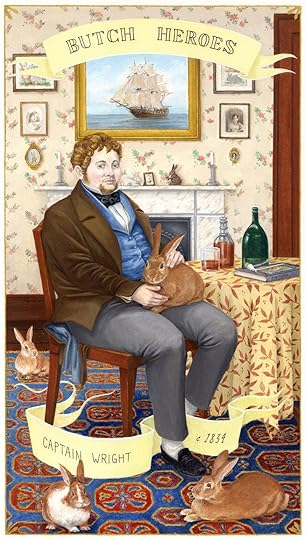
Brodell's detailed and witty paintings are modeled on Catholic holy cards, slyly subverting a religious template. The portraits and the texts offer intriguing hints of lost lives: cats lounge in the background of domestic settings; one of the figures is said to have been employed variously as "a prophet, a soldier, or a textile worker"; another casually holds a lit cigarette. Brodell did extensive research for each portrait, piecing together a life from historical accounts, maps, journals, paintings, drawings, and photographs, finding the heroic in the forgotten.
I had incredibly mixed feelings about this one. Just some quick notes -
Most of the people profiled (though not everyone) clearly intended to live as men and not as masculine women, or any other ways "butch" is commonly interpreted, so IMO the title is very misleading. (Was this a publisher decision?? The author is a nonbinary transmasculine person.) There are certainly butch transmasculine people, but that is not how most people will read the title IMO. "Butch" is also a very Anglo-Western term and the book didn't reflect on that at all, even when it would have been highly relevant.
The author's pronoun choices were sometimes confusing. I was lukewarm about the art. Sometimes the text did not match the art; most notably about the polyamorous triad, out of whom only two people were depicted. I also felt very eh about how the book handled ethnicity, in general.
On the other hand, the book introduced me to MANY historical gender-nonconforming people I had previously been unaware of, and I've read an amount of queer histories. So I'd recommend reading it primarily for the citations and the author's work on actually finding out about the people depicted. _______ Source of the book: Lawrence Public Library
Ughhh I genuinely don't know how to rate this book. On the one hand, the people profiled are important and shouldn't be lost to cishet history... On the other hand, I want to shake the artist/author by the lapels and go, "Your erratic use of pronouns is irresponsible, and you should be ashamed of the fact that you only cite white authors about indigenous people. You could have done so much better with, like, a minimum of effort, AAAAUGH." So I have very different star ratings, based on whether the person reading the review is queer or not
(and this isn't even TOUCHING the fact that they're all smushed under the Butch umbrella when some of those profiled would be more accurately described as trans men)
in conclusion this book is a land of contrasts, I guess

I wasn't sure what to expect with this book but I really found myself enjoying it. It's a beautiful book with art and short recounts of historical figures who butch or trans or whatever other labels that were outside of the vocabulary of a historical moment where they lived were queerly gendered. This is a book I'm really glad to have on my bookshelf
A beautiful and important book, the kind of book you want to own and come back to look at again and again. The paintings are incredible and I loved the stories/biographical information that accompanied them. Of course I would love it if the information was more expansive, but I'm certain this is due to a lack of information rather than a lack of trying. I love learning about queer history and it's amazing just to know these people existed and hear about the lives they led.
4 stars because the portraits are gorgeous and the history is important. The pronouns in this book are chaotic at best, and I'm frustrated by some of the labeling for figures who described themselves as being men. Obviously writing queer history is challenging, but I think some of the profiles could have been handled with a little more tact. Still, a cool concept for a series of art pieces, and I learned a lot about people who I had never read about before!
Butch Heroes combines fine art and a kind of LGBTQIAA archaeology. Artist Ria Brodell sifted through historical documents to find the stories of individuals who, — to paraphrase Brodell — while apparently assigned female at birth, chose a gender presentation that was more masculine than feminine, and had documented relationships with women. Each individual is portrayed with a portrait in the style of a Catholic holy card, and each portrait is accompanied by a brief biography. A bibliography at the back of the book records the sources Brodell used to compile the biography; they attempted to find original sources from the time, such as newspaper articles or personal journal entries, whenever possible.
The result is a fascinating and tantalizing glimpse at complicated lives, and a powerful reminder that gender nonconformity and diverse sexual orientations are not confined to the modern age. Because individuals in the past did not have had terms and concepts for themselves such as “lesbian,” “transgender,” “genderqueer,” “nonbinary,” or indeed “butch,” there is often reluctance on the part of historians to treat people like those portrayed in this book as part of our shared queer history. However, this reluctance can lead to the erasure of non-conforming lives like those celebrated herein. We don’t know how any of these people would identify, were they alive today, but we can look to their stories and recognize the shared threads.
i love this book and needed this book. it profiles about 30 people throughout history, all of whom were assigned female at birth, had relationships with women, and had a masculine gender presentation (there's no way to know how they would have identified in modern terminology). each page-long profile is accompanied by a beautiful painting of that person in the style of a holy card.
i didn't know about any of these people before reading this book, and probably would never have known about them had i not read it. although there isn't a ton of information available about them, it's a comfort just to know that they lived. it's a comfort just to know that we have always lived.
I only wish that some entries were more expansive. Without doing research of my own, I don't know if it's due to lack of reference texts or just a choice by the author. The graphics are beautiful and the bios are very interesting. Definitely worth the read.
I received a complimentary copy after the book was published and then misplaced it. Now having found and read it, I urge y'all to do the same. It's a moving and accessible historical reclamation of queer lives through art.
I think this was an interesting read but the author could have done so much more. I think a longer and more thorough introduction would be helpful to discuss the history of the word butch and it’s use here.
though we may never truly know these people’s stories in this book and how they would have identified, i’m happy it exists, im elated someone tried to save these stories that might have been lost to history. the preservation of queer history fills my heart with joy.
Amazing paintings and important details about the lives of people who are mostly unknown. This short book is a little gem glittering in the dust of history....
Such a beautiful book, with exquisitely told accounts of women throughout history and the world who lived and died as men. These stories need to be shared.
Beneath this monochromatic cover lies a rich history celebrating people whose presentation align more to the masculine side of the spectrum and each is accorded a full page illustration that contains all the colour and expression of art, done in the style of the Catholic holy cards the author grew up with. The portraits, both painted and written, often have an intimate focus on home and their lives in society. The one thing with this book though was that I did have to take it in bursts because some ( a good portion) of the stories were harrowing which is reflective of our history.
Of the portraits in the book I may have chosen the below one for my review display because A) Bunnies! or B) it was the only feckin one that would work but there are a ton more that really are worth checking out too!
Descriptions and illustrations/paintings of the various women/men.
The most interesting aspect was how far back the people lived in time. And how they were treated, sometimes bad (as in - killed) or met with not so much resistance. I would say there was more bad than good, and that it seemed that the American Indian tribes treated these people better. Overall though, I found it interesting that - while western societies tried to condemn the acts... they seemed unclear on how to proceed.
Overall, I found this much more intriguing than I originally thought it might be... what did I think it might be?: I thought it would be more recent. I thought it would include pedantic statements vs letting the stories stand on their own. Neither of this happened.
Would be interesting to see even more of these stories/biographies but I am sure history likes to sweep those who don’t conform- under the rug and out of sight. The search must have been tough to find the ones in the book.
This book (which is not as old as the cover would indicate, being published this year) is a book of short (one page) biographies of people in history who these days we'd probably see as transgender or as butch lesbians. It's really interesting! I learned about a lot of people I'd never heard of before and I'm definitely going to look into some of the books in the bibliography. Also, each biography is accompanied by a painting, and the paintings are lovely, and the people in them mostly look pretty handsome and badass. It's great! I'm so glad I found it.
A collection of those who came before. A testament to the fact that we have always been around and have most often been persecuted. Brodell’s paintings, in the style of catholic saint cards, seem simple, but are deeply affecting, giving faces and context to women, men, and those in between who dared to live differently. I often imagine what person I would have been had I lived in another era; Butch Heroes made me feel the water entering my lungs.
Despite the (mostly) brutal deaths these people endured, I found this book strangely encouraging and heartwarming. It's really cool to see all the different ways LGBT people have carved their own rebellious paths across history and geography. I loved the Catholic saint painting style too.
Draws attention to butch and transmasculine people of the past. I agree with others that they didn't handle pronouns or transition in the best way. They should have taken more care to add more Black representation to this book.
Excellent. Very quick read, but with a solid bibliography section to facilitate further research if desired. I appreciate that I had not known about many of these people before.
I loved reading this book. Another great resource for introducing us to historical gender non-confirming people and how they lived their lives and who they loved. I want to note that not all of the people are from the US or the UK which was fantastic.
This is a very short book with very short biographies of different people who presented butch or male. In the introduction the author notes how there was very little resources on these people and how sometimes they had to read in between lines, or newspaper articles to find out their stories or the names they have chosen to go by. In one of the stories, a butch women was identified only because her name came up during a murder scene where two women were fighting over her and someone described her as someone who looks like a man or is wearing men's clothing (can't find the exact wording right now because I've returned the book to the library.) But it just shows how the author had to dig so deep to find anything to hold on to.
It's worth mentioning the title is a little misleading and I was slightly sad about that only because I was expecting something different. The author mentions that they chose butch because it not only represents a masculine presenting woman but that was a word commonly known to people and that it also meant being strong, brave and resilient. But even so, some of the people in this book very clearly identified as men as they not only presented as masculine but had their names changed and lived their lives as men. It is very hard to determine in fact how they would have identified as words were quite limited back then but also there is barely any resource for us to factually know that, but in a few of the stories it did seem that they identified as male and went by he/him. Maybe the use of gender non-conforming would have been more fitting? I don't know. But there are some butch representation in here as well.
The art style, though not my favorite is very suitable for the time period in which these people lived and what we commonly see in museums when looking at art during those periods and I loved it so much because of that! I hate that we never get to see such representations in museums as if these people never existed and I really hope we do. Not only in modern art spaces or in modern art styles but something that looks and feels like what Ria Brodell has drawn.
I don't expect the research that went into this book was easy, nor getting the artwork as close to reality as they can but I definitely wanted more and I hope there can be more stories to share in the future from more countries across the world. I do at some point want to own my own copy to have this as a resource readily available.
An enjoyable, necessary book for all those interested in our history. The art is well done and lends a sense of emotion to the stories of these butch heroes, both for those who experienced violence during or after their life and for those who lived quite comfortable lives. It is an excellent brief introduction to gender non-conforming lesbians of the past, providing an opportunity for those interested to look deeper into their lives and perhaps others who haven't been recorded here. However, the switching pronoun use creates considerable lack of clarity and detracts from the quality of the writing. Furthermore, the use of contemporary terms (e.g., 'cisgender') in the book, despite the introduction arguing it is inappropriate to apply modern labels to historic figures was confusing. I think it would be a stronger book if the author chose either an ahistoric or a historic approach and followed through, rather than this jumbled mixture of both. Ultimately, I do recommend it.