John Donne was an English poet, preacher and a major representative of the metaphysical poets of the period. His works are notable for their realistic and sensual style and include sonnets, love poetry, religious poems, Latin translations, epigrams, elegies, songs, satires and sermons. His poetry is noted for its vibrancy of language and inventiveness of metaphor, especially as compared to that of his contemporaries.
Despite his great education and poetic talents, he lived in poverty for several years, relying heavily on wealthy friends. In 1615 he became an Anglican priest and, in 1621, was appointed the Dean of St Paul's Cathedral in London.
“Morte, não te orgulhes, embora alguns te chamem poderosa e temível, pois tal não és: aqueles que tu pensas ter derrubado não morrem, pobre morte, nem ainda me podes matar. Do descanso e sono, que são apenas a tua imagem, muitos prazeres surgem, e mais hão-de chegar, e os nossos melhores homens depressa te seguem no repouso dos seus ossos, na liberdade das almas. Escrava do destino, do acaso, dos reis e homens desesperados, com o veneno, a guerra e a doença tu habitas; se a dormideira ou a magia também nos adormecem e melhor que o teu golpe, porque te enches de orgulho? Depois de um sono que é curto, a vigília é eterna, e não mais há-de a morte existir. Tu, morte, morrerás."
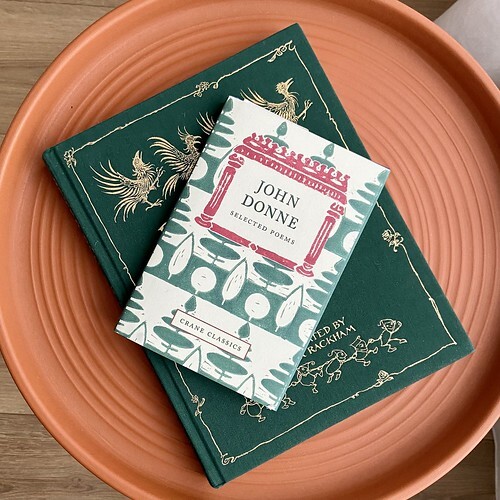
I rather enjoyed this little volume of poetry. This was my first attempt at reading John Donne, and I found the somewhat archaic language/spelling a little difficult to parse, so I'll probably follow up by reading the same poems in translation. The edition I have is pretty and very well made, high quality, so I liked it too.
"Twice or thrice had I loved thee, Before I knew thy face or name; So in a voice, so in a shapeless flame, Angels affect us oft, and worshipped be; Still when, to where thou wert, I came, Some lovely glorious nothing I did see. But since my soul, whose child love is, Takes limbs of flesh, and else could nothing do, More subtle than the parent is Love must not be, but take a body too; And therefore what thou wert, and who, I bid love ask, and now That it assume thy body, I allow, And fix itself in thy lip, eye, and brow.
Whilst thus to ballast love, I thought, And so more steadily to have gone, With wares which would sink admiration, I saw, I had love's pinnace overfraught; Every thy hair for love to work upon Is much too much, some fitter must be sought; For, nor in nothing, nor in things Extreme, and scatt'ring bright, can love inhere; Then, as an angel, face and wings Of air, not pure as it, yet pure, doth wear, So thy love may be my love's sphere; Just such disparity As is 'twixt air and angel's purity, 'Twixt women's love, and men's, will ever be."
Air and Angels
***
Este é o primeiro poema de John Donne que figura no livro editado pela Relógio d'Água (tradução de Maria de Lourdes Guimarães e Fernando Guimarães), e não resisti à tentação de o evidenciar face aos demais belos poemas que li neste livro. Já antes tinha encontrado a versão de Jorge Sousa Braga (no livro "Sombras Brancas", ed. Língua Morta) e tinha-me cativado pela sua imensa beleza: digo, sem exageros, que foi mesmo o poema responsável pelo interesse que acabaria por nutrir por John Donne porque, no meu caso, às vezes só preciso mesmo de um breve pretexto para querer mergulhar na obra de um autor, e ler o poema "certo", no momento "certo" pode ser o suficiente para inflamar este meu coração.
Mas são outros os poemas que se destacaram nesta leitura e para os quais não queria deixar de chamar a atenção: The Dream, A Fever, The Legacy, The Prohibition, A Valediction: Of Weeping e os seis sonetos sacros (globalmente considerados, mas com destaque para o "What if this present were the world's last night?") trouxeram-me o mesmo grau de deleite...
I mainly fell asleep listening to this. Very Shakespearean. Did not really understand much. Had to listen closely.
I think I chose to listen to his poetry because I recall that Caro was studying this era of poetry in Surprised by Oxford.
And then…
BAM!
I listened to nearly 3 full hours of his poetry without understanding most of it, and then at the very end, here comes Sonnet X, “Death Be Not Proud”, and deep, deep, deep within the recesses of my memory I remember this studying/memorizing this poem and even remember a few lines of it!
I have no idea who taught me or what class I learnt this poem in, but it was deep within my brain! I cannot express to you my excitement, that at the very end, with only 12 minutes left of this audiobook of seemingly obscure poetry, I stumbled upon something I remembered! What a thrill.
Then, as icing on the cake, one of the next poems was Holy Sonnet XIV, or “batter my heart, three person’d God” which contains the line “bend / Your force to break, blow, burn, and make me new” which is the title of the E. Lily Yu book that I read and loved last year.
Talk about saving the best for last! What a reward.
I have adored John Donne since high school and I was so pleased to listen to these. I aim to read a poem a day; its a bit erratic so far as goals go, but better than no poetry, right?
so 4 stars for the poetry.
I am not sure that the choice of narrator was quite right; he sounds like the gayest man on earth and Donne was pretty much the exact opposite right? Frederick Davidson. But his real name was David Case.
oh wow - now that’s a story - smoker - of course, gay [ha!] early audio reader; had - I want to call them voice names not pennames - a different one for each audio imprint. Is that genius? it might be… but died of throat cancer unable to make a sound.
It is not always easy to judge what Donne’s attitude to Petrarchan convention was. He appears to accept them in the Expiration and Song: Sweetest love, yet in others he is clearly mocking.
Teach me to hear mermaids singing,/ And find/ What wind/ Serves to advance an honest mind. -Song.
I am two fools, I know,/ For loving, and for saying so/ In whining poetry;// And I, which was two fools, do so grow three;/ Who are a little wise, the best fool is. -The triple fool.
And that this place may thoroughly be thought/ True paradise, I have the serpent brought. -Twicknam Garden.
Oh, to vex me, contraries meet in one:/ Inconstancy unnaturally hath begot/ A constant habit; that when I would not/ I change in vows, and in devotion. Holy sonnets 19.
John Donne is the quintessential metaphysical poet.
He is a poet I have been aware of as long as I've been alive.
I've read a lot of his poems but with great poets, you never know if you've read enough, and so, I decided to pick up a copy of his selected poems and was treated to some of the holiest, and horniest, poems of all time.
See, the thing with older poetry, especially 19th century and older, is that a lotta people think they're austere and boring. With Donne, yes, they are austere but never, ever boring. Donne plays with words in a way that only a true poet, true in the sense of taste, passion and education, can.
Reading these poems was not only fun but made me feel closer to God and my girlfriend.
I'm not the gratest poetry fan out their but I really enjoy Donnes style. Some of the poems I read are hilarious. And hey, I read it and understood what it says. That's a win given how old this work is