The Quarry Wood, although published well before Sunset Song, inhabits a similar world; the progress of its heroine could almost be the alternative story of a Chris Guthrie who did go to university. Compassionate and humorous, the grace and style of Shepherd's prose is heightened by a superb ear for the vigorous language of the north-east. The Weatherhouse, Shepherd's masterpiece, is an even more substantial achievement which belongs to the great line of Scottish fiction dealing with the complex interactions of small communities, and especially the community of women - a touching and hilarious network of mothers, daughters, spinsters and widows. It is also a striking meditation on the nature of truth, the power of human longing and the mystery of being. The third and final novel, A Pass in the Grampians, describes Jenny Kilgour's coming of age as she has to choose between the kindly harshness of her grandfather's life on a remote hill farm, and the vulgar and glorious energy of Bella Cassie, a local girl who left the community to pursue success as a singer, and has now returned to scandalise them all. The Living Mountain is a lyrical testament in praise of the Cairngorms.It is a work deeply rooted in Shepherd's knowledge of the natural world, and a poetic and philosophical meditation on our longing for high and holy places. This is the first omnibus edition of Shepherd's prose works- her sensitivity and powers of observation raise her work far above the status of regional literature and into the front rank of Scottish writing.
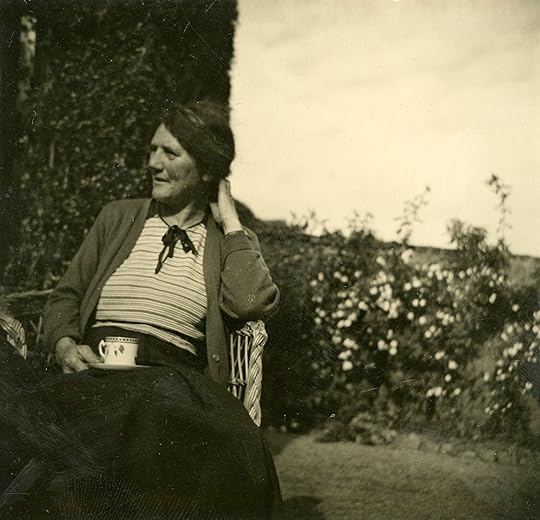
Nan (Anna) Shepherd was a Scottish novelist and poet. She was an early Scottish Modernist writer, who wrote three standalone novels set in small, fictional, communities in North Scotland. The Scottish landscape and weather played a major role in her novels and were the focus of her poetry. Shepherd also wrote one non-fiction book on hill walking, based on her experiences walking in the Cairngorms. An enthusiastic gardener and hill-walker, she made many visits to the Cairngorms with students and friends. She also travelled further afield - to Norway, France, Italy, Greece and South Africa. Shepherd was a lecturer of English at the Aberdeen College of Education for most of her working life.
"Knowing another is endless. The thing to be known grows with the knowing."
Listen.
Sleet blattered against the ploughman's side as he followed the team; or, standing in a blink of sun, he saw the striding showers cross the corner of the field like sheeted ghosts.
"to blatter" - a Scottish word meaning to strike repeatedly and noisily, or to move with a clatter. Lovely.
The alliteration in this sentence is perfectly pitched too, and has an almost onomatopoeic quality which I find, for some reason, rather moving. I would describe it as a perfect sentence.
"“My lassie wunna ging like Maggie Findlater, terrible goodwillie to yer face an’ despisin’ the hale rick-ma-tick o’ her fowk ahin their backs.” “Maggie!” said Stoddart. “Maggie’s nae that ill.” “A muckle easy-osy lump,” snorted Mrs. Ironside. “If she’d keep her mou’ shut an’ her feet in she’d be a’ richt. She taks a gweed grip o’ the grun’ yet an’ a grand mou’fu’ o’ her words for a’ her finery."
Sometimes you may need the glossary at the back, or the internet. But the sound here is key, the feel of it. These are the voices of women long forgotten, long past. Women with a complex and rich life, full of adversity and love and violence and poverty.
"Touch is the most intimate sense of all. The whole sensitive skin is played upon, the whole body, braced, resistant, poised, relaxed, answers to the thrust of forces incomparably stronger than itself. Cold spring water stings the palate, the throat tingles unbearably; cold air smacks the back of the mouth, the lungs cackle. Wind blows a nostril in, one breathes on one side only, the cheek is flattened against the gum, the breath comes gaspingly, as in a fish taken from water – man is not in his element in air that moves at this velocity. Frost stiffens the muscles of the chin, mist is clammy on the cheek, after rain I run my hand through juniper or birches for the joy of the wet drops trickling over the palm, or walk through long heather to feel the wetness on my naked legs."
This is Nan talking about her walks in the mountains, about her love for and life in, the Cairngorms. There is a welcome lack of romanticism here, I think, and certainly no new-age Gaia nonsense. This is A Good Thing.
"This changing of focus in the eye, moving the eye itself when looking at things that do not move, deepens ones sense of outer reality... By so simple a matter, too, as altering the position of one‘s head, a different kind of world may be made to appear. Lay the head down, or better still, face away from what you look at, and bend with straddled legs till you see the world upside down. How new it has become... Details are no longer part of a grouping in a picture of which I am the focal point, the focal point is everywhere. Nothing has reference to me, the looker."
Again, this is Nan talking to us directly - there is a philosophical engagement throughout her work which I found stimulating.
"At the turn of July there was already a hint of autumn. The skies were heavy grey...Soon, the barley was russet. An antrin elm-leaf yellowed. Birds gathered; suddenly on a still day a tree would heave and reeshle with their movement, a flock dart out and swoop, to settle black and serried on the telegraph wires; and after a little rise again in a flock and disappear within the tree."
"Antrin". "Reeshle". "Serried".
"Strange stagnant world — he hated its complacency. Standing there on the ridge, dimly aware of miles of dark and silent land, Garry felt a sort of scorn for its quietude: earth, and men made from earth, dumb, graceless, burdened as itself. This place is dead he thought."
Something else I liked from the novels.
"It is, as with all creation, matter impregnated with mind: but the resultant issue is a living spirit, a glow in the consciousness, that perishes when the glow is dead. It is something snatched from non-being, that shadow that creeps in on us continuously and can be held off a continuous creative act. So, simply, to look on anything such as a mountain, with the love that penetrates to its essence, is to widen the domain of being in the vastness of non-being."
See now, that is the sort of "spirituality" I can get behind...
Anyway, I think you get the point. She is an incredible writer and you should read her. I found each of these novels deeply moving, and just a joy to read. Plus any of you interested in the subaltern, in the buried voices of (in particular) women, then these are stories you should read.
I decided to write my PhD project about Nan Shepherd so I had to like her ouevre :D
I didn't read the entire book as I had already read the majority to of these. But "A Pass in the Grampians" is only available in this Grampian Quartet, so...
"A Pass in the Grampians" is a story about a close-knit rural community in Scotland between Aberdeenshire and the Cairngorms. Live goes on as it always has for centuries, but the arrival of Bella Cassidy, former member of this community and now famous extravagant singer, is wrecking havoc and chaos. With her disdain for their traditions, Bella will not only disrupt the peaceful lives of young Jenny, who is both mountain girl and interested in exploring the world, but also Bella's own life. Secrets will be uncovered, lives will change.
I very much enjoyed this story and the serene descriptions of nature infusing people and their feelings. Again, absolutely beautiful.
Five Stars
I also loved the "Quarry Wood", a beautiful beautiful feminist coming-of-age story, I adore "The Living Mountain" not only from a literary perspective but from my own experience as a hiker in the Cairngorms and I liked the "Weatherhouse" and that the boundary between female functionality and madness are not always clear.
If you can deal with this pondering, nature-infused, Zen-like style of writing, pick it up!
I was a bit of a failure as a reader for this volume. I already knew (and had reviewed) the last book of this quartet (The Living Mountain) separately. I think it unique and unforgettable. But I'm not going to write about that again here, or my feeling that it should be available on its own and without the intermediaries that always beset it in every version I have seen -- namely uninspired introductions or commentaries.
No, I picked up this compendium in order to read the other three novels. Nan Shepherd originally set out to be a novelist, I believe (she also worked as an English teacher) but after these three she stopped. I don't know why. She demonstrated the ability, the quickness of eye, the turn of phrase, the passion for her characters. But she hadn't reached whatever her great novel might have been. Her life's achievement was The Living Mountain, not a novel at all but a non-fiction study of a mountain, a sort of love-poem in prose.
But each of the three novels here has much to commend it, while not fully achieving its aims (in my limited view). I feel I didn't read well, though I'm not sure why. In all but the last novel (A Pass in the Grampians), I kept muddling the characters and having to turn back or soldier on carrying my unresolved muddle with me. I should have slowed down and gone back to the start but I didn't feel that degree of commitment. This was at least as much my own fault as the author's.
However, I did -- very much -- enjoy the settings. Some of the natural description is wonderful, as is some of the characterisation. Most of all I liked the way she incorporates natural and localised speech. The novel is not written in Scots, like its contemporary masterpiece Sunset Song, but its characters speak a colorful blend of idiomatic Scots and English. I heard phrases and expressions I don't know at all, though I live in Scotland myself. I thought many of them simply wonderful. I need no convincing that people really were talking like this at this time. The books are almost like recordings from a century or so ago.
Here, for example, is a granny expressing a disparaging opinion of Francie's disastrous marriage in The Weatherhouse. Her relish is unmistakable: "He was fond of fish before he fried the scrubber," she says of his choice. When Theresa brings in tea and pancakes, she says, 'There, you don't get the like of that at Knapperley. It's aye the same thing with Bawbie, a stovie or a sup kail.' To which the lad, Garry, says, 'A soo's snoot stewed on Sunday and on Monday a stewed soo's snoot.'
Later, Francie himself unburdens about his undemonstrative wife:
"Warmed by the whisky, heartened by honest song, he began to talk of what sat closest to his own bosom: what but Bell his wife and her incomprehensible trick of not sitting close, of holding off. 'He doesn't seek to kiss me, I canna do with that kind o' sotter,' she had proclaimed abroad. A libel on a man. 'A blazin' lee,' shouted Francie. 'Doesna seek to kiss her. Doesna indeed.' For what but that had he waited twenty years, to be thwarted in the end by a woman's caprice: a woman who had the impudence to say 'Fingers off the beef you canna buy' to her own lawful spouse. 'But she'll be kissed this very night,' he shouted. He banged the table and swaggered home at last in glee. His habitual sheepish good-humour had turned to a more flaming quality. A man greatly resolved. // 'He needs all his legs,' said Miss Barbara."
Now there's an observation I am reserving for future use: "He needs all his legs...."
I had occasion in a recent review to reference Isaiah Berlin's famous fox and hedgehog analogy (the fox knows many things, the hedgehog only one) and I find it serviceable here again. Nan Shepherd is the hedgehog's hedgehog: she knows one thing and she knows it well--that "thing" is the Scottish Highlands. She has burrowed deeply into the land and its moods, into the people and their habits and customs, and she writes with unconcealed delight and love about all of it. I don't think I would give five stars to any of the quartet of books gathered here in one binding (though the editors say The Weatherhouse is her masterpiece, I fancied A Pass in the Grampians the most), but the cumulative effect is impressive, magisterial. It was the American naturalist and writer Aldo Leopold who charged us with the importance of "thinking like a mountain" in our musings on ecology and sustainability, and while neither of those terms appear in these collected works of Shepherd's, I'd defy anyone to find a better example of what that looks like in practice than what she depicts in The Living Mountain and what she displays in the other, fictional works. As she puts it, "simply to look on anything, such as a mountain, with the love that penetrates to its essence, is to widen the domain of being in the vastness of non-being. Man has no other reason for his existence."