Joseph Rudyard Kipling was a journalist, short-story writer, poet, and novelist.
Kipling's works of fiction include The Jungle Book (1894), Kim (1901), and many short stories, including The Man Who Would Be King (1888). His poems include Mandalay (1890), Gunga Din (1890), The Gods of the Copybook Headings (1919), The White Man's Burden (1899), and If— (1910). He is regarded as a major innovator in the art of the short story; his children's books are classics of children's literature; and one critic described his work as exhibiting "a versatile and luminous narrative gift".
Kipling was one of the most popular writers in the United Kingdom, in both prose and verse, in the late 19th and early 20th centuries. Henry James said: "Kipling strikes me personally as the most complete man of genius (as distinct from fine intelligence) that I have ever known." In 1907, at the age of 41, he was awarded the Nobel Prize in Literature, making him the first English-language writer to receive the prize, and its youngest recipient to date. He was also sounded out for the British Poet Laureateship and on several occasions for a knighthood, both of which he declined.
Awarded the Nobel Prize in Literature in 1907 "in consideration of the power of observation, originality of imagination, virility of ideas and remarkable talent for narration which characterize the creations of this world-famous author."
Kipling kept writing until the early 1930s, but at a slower pace and with much less success than before. On the night of 12 January 1936, Kipling suffered a haemorrhage in his small intestine. He underwent surgery, but died less than a week later on 18 January 1936 at the age of 70 of a perforated duodenal ulcer. Kipling's death had in fact previously been incorrectly announced in a magazine, to which he wrote, "I've just read that I am dead. Don't forget to delete me from your list of subscribers."
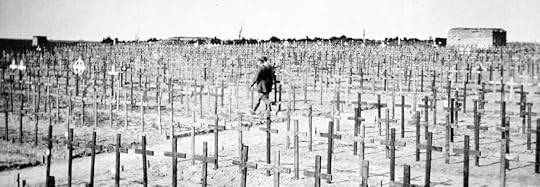
All she saw was a merciless sea of black crosses, bearing little strips of stamped tin at all angles across their faces.
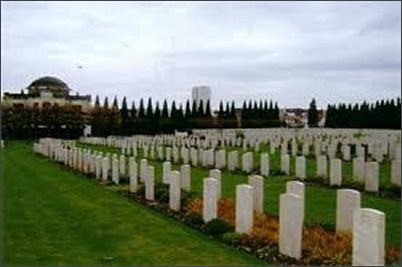
When listening to music or watching a film moved him to tears, my husband at times jested that with aging, one might grow more sensitive and emotional, and so tears might come more frequently and easily. My husband was a wise and perceptive man. After reading Julian Barnes essay Kipling’s France, which casts a light on Rudyard Kipling’s profound attachment to France, a bond sealed with blood after the loss of his son John at the Battle of Loos in 1915, I listened to The Gardener (which can be read here) , a tale on the Great War written by Kipling while travelling through France in Spring 1925 after visiting the war cemetery of Rouen for the War Graves Commission. And sobbed.
In this subtly crafted and gripping story on love and bereavement a woman sees herself impelled to go through ‘an inevitable series of unprofitable emotions’ – in silence. Surprisingly, in some sense this succinct story, by just touching briefly on the life of one single woman but intertwined with Kipling’s personal tragedy, came across as a more powerful and memorable rendition on the way war can wreak havoc on an individual’s life than some lengthy novels I read on the Great War – leaving me humble and shaken, reading this like looking at a heart torn out and shredded to pieces.
If listening, I would recommend to skip Neil Gaiman’s introduction and return to it after listening to the story itself (which starts at 6’40’’), both to allow yourself the pleasure of interpreting the story for yourself and in order not to hear disclosed the penultimate , quite poignant paragraph of the story, a sentence which refuses to leave me.
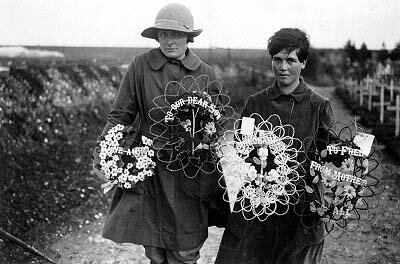
Always someone's father. always someone's child.
"Have you news of my boy Jack?" Not this tide. "When d'you think that he'll come back?" Not with this wind blowing, and this tide. "Has any one else had word of him?" Not this tide. For what is sunk will hardly swim, Not with this wind blowing, and this tide. "Oh, dear, what comfort can I find?" None this tide, Nor any tide, Except he did not shame his kind - Not even with that wind blowing, and that tide. Then hold your head up all the more, This tide, And every tide; Because he was the son you bore, And gave to that wind blowing and that tide. (Rudyard Kipling, 1916)
It would be quite an understatement to say that human beings behave mysteriously, for the way we act and conduct ourselves, is at times beyond comprehension. We have made great advancements in our understanding of nature and the universe so much so that we are about to take off beyond the realms of our perceived world, but when it comes to comprehending human emotions, we still found ourselves staring into an abyss. How we project ourselves in front of others and how we actually behave are unsurprisingly poles apart, in between these lies a dynamic area of constant flux wherein we keep churning conventions as per our convenience, as and when we require. So, our personality keeps on transforming with our perceived requirements of the world we live in.
We are social animals so we have to live as per the need of our society. We have devised morals, ethics, laws- said, unsaid both, rituals, cultures, and dogmas over the years as we have evolved. All of us have dark secrets of ours, which we keep in the deep recess of our heart, wherefrom it would not be possible for ‘others’ to get even a hint about those murky and concealed secrets of our existence. However, it is not as easy as it might sound at the outset, for we have to constantly work upon it to keep those inconspicuous details sealed in our hearts. Sometimes we have to devise some other disguised things and necessities for safeguarding our ultimate secret, for our entire existence may depend upon it, an inauthentic existence which we have created out of references and dogmas in the eyes of others but which is very dear to us since it becomes our identity in our society. There arises a rift between our personal and public life, as people are not what seems to be in their public space.
Our story is about Helen Turrell, who has such a dark and cataclysmic mystery, related to her nephew, Michael, sealed deep in the cervices of her memory. There is a strange phenomenon about human beings, they tend to forget things about which lie to themselves over the years so that it becomes their newly ‘metamorphosized’ truth. The story starts with a comically unfortunate incident that engulfs the brother of Helen, leaving her to raise his child. The child grows up into a young, robust gentleman- Michael- having a promising career lying ahead of him. But as he is about to grab that hard-earned, resplendent opportunity, he gets enlisted for the Great War.
War, as we know, is one of the necessary evils devised by humankind over the years of evolution. We see that our history has been ravaged with many examples of these bloody events and we have glorified most of those as our prized possessions through our history of pride and culture. It is one of the most discussed but barely understood vagaries of humanity. But one thing could be said about war with audacity and authority, that it creates havoc and inundates lives in various forms for whatever reasons it might be fought. Here also we see no exception as Michael loses his life to the lust of power and dominance of humanity for which the Great War is fought. It robs Helen of her world, for she has only her nephew to live with. However, she behaves in a very cold manner when she has been informed about her great loss mentioning missing always means dead.
What follows is a searing account of grief and loss wherein a woman is forced to live through bereavement with a heart, heavy with the weight of a deeply concealed secret, perhaps which does not allow her to express her grief for the secret is too precious to be revealed at any cost. Her world stands still in a sort of bottleneck while the rest of the world moves forward but it fails to touch upon her heart lying deep below the safety net of that inconspicuous secret. She receives an intimation about the new abode of her nephew- Hagenzeele Third Military Cemetery which she decides to visit to finally meet Michael in a space that is private and totally their own, to once again feel the emotions of love and grief through their common but unshared secret.
The author presents the story in a very objective and detached way as we do not see overwhelming emotions. The prose is complex and dense wherein the sentences are framed with carefully chosen adjectives to convey the moods and emotions of the characters as they would have behaved themselves in such situations. The reader has to be attentive throughout the prose to not miss the emotions of the characters. Though the story is just ten pages long, it may surpass even some of the novellas in its scope as the author has been able to infuse so much in such a short tale.
The main theme of the story is how we should behave in the light of religion as the author had been heavily influenced by Christianity. We tend to behave differently in our internal and social personas, in a sense, we, in fact, lie to keep our secrets intact. Though our religious morality teaches us differently i.e. to be honest to our inner and outer realities but is a man strong enough to live up to those standards since we behave as per our survival instinct and conduct ourselves according to it. The author even infuses a character- Mrs. Scarsworth- to make Helen realize that we should always be true to ourselves and even gives her a hint from the afterlife but does it make Helen change her mind and embrace her secret in the light of the world or not, well there could be multiple interpretations of the story.
We the human beings as enigmatic as anything could be. We have multiple selves which one is true which one is not who can tell since we behave as our needs prevail. Shouldn’t we need to behave as per ethics and morals or we could change them as and when we need to overcome the obstacles of our existence. And what about truth well, everyone has his own version. And our secrets well, tricky one but we have to survive at whatever cost without being condemned so secrets may be kept hidden even that means trodding the paths forbidden.
I read just one book-Jungle Book- by the author and that too in my school days so though I remember the parts of the story but I hardly remember anything about the impressions by its prose or narrative, hence in a sense, it’s the first story by the author for me. Although the political inclination of Kipling has always been controversial especially in the context of India, mainly because of his support of Colonel Dyer who was responsible for the Jallianwala Bagh massacre, but the narrative gifts of the author are obvious and unparalleled, he could be read for his sense of observation and outstanding ability to use words.
I was amazed by how much Kipling packed into this complex, subtle and devastating story -- and most of all, how well he captured the experiences of love and grief over time. The story centers on a single woman who adopts her brother's infant orphan (or, really, half-orphan) who grows to manhood during the prosecution of The Great War, known today as World War I.
Most profound to me in this story were Kipling's sensitive portrayals of the inner movements of grief, and the painful interactions not only between the grieving and the non-grieving, but even between two people who are each grieving separately for their own loved one. Layered into this, Kipling drew strongly on several levels on Christian and Biblical symbolism, and brilliantly managed an ambiguous ending with a subversive twist.
In commenting on her excellent and moving review, Ilse encouraged me to delve a little deeper into the religious symbolism. Since it involves so many plot points, I've put the rest of the review behind a spoiler wall.
READ THIS STORY BEFORE READING THIS REVIEW!! IT’S PERFECT!! It’s a super quick read, JUST DO IT!!
Despite the fact that I knew that the boy was her son the entire time, THE. ENDING. STILL. GOT. ME. I never cry because of stories. This one. This got me. I got the goosebumps and the tears.
The person who recommended it to me told me it was similar to a short story I’d written, which, upon finishing it, I’m honored by. The person asked me about Jesus being portrayed as a gardener in the Bible but I couldn’t remember the reference. Now I understand why he asked 🥲 All that’s left for me to decide is if the man was actually her son’s spirit (because he was the one she was looking for in the graves but he was alive) or if it was actually Jesus. I’ve always loved the story of Mary being approached by Jesus outside of his tomb, it’s such a story of hope. And even though this one isn’t, it’s a story about closure. Except that now I’m just thinking about how he probably never knew he was her sonnnnn. Or maybe…he did??
I’m definitely going to recommend this to my students and see if they catch the significance of the boy’s conversation with her about calling her “Mummy.”
What a brilliant little story! Somebody said it right, it takes more artistic calibre to write short stories. Kipling injected so much of silent sorrow into this book. Beautiful! Also, am I the only one who found the ending particularly intriguing and mysterious?
Thanks to my friend, Amapola, for recommending Rudyard Kipling's The Gardener, which I really enjoy! 💖😘 I admit that when I first read this short story, my mind had a different take about the young man and his aunt. I was not able to find this short story in my collection of his works but I was able to view it online, which also had in-depth analysis which made me read it again to see what they were suggesting. I found out that Kipling's son, John died in World War 1 and about Kipling's commission for the soldiers' graves. I had been trying to think of another author's letters to read in the near future and I decided on reading Kiplings, I think his letters will be an interesting insight to his thoughts and views of the world, thankfully my collection has them.
"The Burden Rudyard Kipling ONE grief on me is laid Each day of every year, Wherein no soul can aid, Whereof no soul can hear: Whereto no end is seen Except to grieve again— Ah, Mary Magdalene, Where is there greater pain? To dream on dear disgrace Each hour of every day— To bring no honest face To aught I do or say: To lie from morn till e’en— To know my lies are vain— Ah, Mary Magdalene, Where can be greater pain?
To watch my steadfast fear Attend my every way Each day of every year— Each hour of every day To burn, and chill between— To quake and rage again— Ah, Mary Magdalene, Where shall be greater pain?
One grave to me was given— To guard till Judgment Day— But God looked down from Heaven And rolled the Stone away! One day of all my years— One hour of that one day— His Angel saw my tears And rolled the Stone away! "
This short story is about an aunt/mother and her nephew/son whose life is cut short because of his death.
After a second read and reading the analysis, also the following poem, "The Burden" I see that Michael was her illegitimate son, at the end the gardener knowing that her nephew was her son, could be taken that he said son in knowing the truth or just another phrase for son, but it is hinted during the story that he is indeed hers. The stigma was very different than today's standard about being illegitimate and it must have been truly painful not to be able to profess the truth and declare it to all. It seemed that if her community guessed the truth they were quite kind.
Just a devastating look at grief. “All she saw was a merciless sea of black crosses, bearing little strips of stamped tin at all angles across their faces. She could distinguish no order or arrangement in their mass; nothing but a waist-high wilderness as of weeds stricken dead, rushing at her” is utterly chilling and really stopped me for a second. The Great War, as well as the literature around it, still carries this unbelievable weight compared to most other conflicts for me. I think largely because of these images of matching crosses and gravestones, where men and boys lie united in death, not separated in presentation by rank or class, remaining where they passed. The context of Kipling’s own war grief is the final blow this story gives, especially when paired to how the true grief of the poem reviews itself in the end.
I think he perfectly achieves what he sets out to do.
I'm very confused. The Gardener by Rudyard Kipling is a short story that has received some high praise from people like Neil Gaiman. And... I don't completely understand why. I've just finished reading it and I have to say that I found it way too compact - so much so that it didn't really touched me emotionally. Yes, it's a story about family bonds and loss, but I felt like it all went so fast that I didn't manage to create any attachments to it. The only part that actually spoke to me was Helen's reaction to her nephew's death. Here's a tiny bit of it:
"She was standing still and the world was going forward."
All baffled I read a bit more about the interpretation of the story. It is supposed to have a strong Christian symbolism, which went completely over my head. Neil Gaiman says that re-reading the story will offer you new layers that you haven't seen before, plus he talks about an unreliable narrator... I can't see any of it.
The only thing that made me appreciate the story more, from my post-reading research, was learning about how Kipling's son had died in a war and his body was not identified before Kipling's own death. Kipling started to collaborate with The Imperial War Graves Commission, who "dealt with burying and commemorating First World War dead and missing soldiers". Having this piece of information, the story might indeed come across differently. Then I can perhaps even appreciate the symbolism of the gardener. People say it was supposed to be a metaphor for Jesus. Fair enough. What if - besides that - it was also Kipling himself, helping all the people going through the same grief to find their way?
I think I'd like to re-read the story at some point to see if my view of it changed. But for the moment, I wasn't as mesmerized as I expected to be.
I read this because someone I admire wrote on Twitter that it was the greatest story - along with Dubliners - to come out of Britain (or was it more ambitiously to be written in English?) In either case, it is neither and it doesn't matter. It is moving and quite unexpected in places, for Kipling; its ending is intriguing and it helped me remember a few days ago on Armistice Day my brothers and sisters who fought and died, alongside readings of Ted Hughe's 'Six Young Men', which I turn to every year at this time, and 'Rain' by Edward Thomas.
The Kipling society has a very good page on the story's critical heritage, complete with sometimes competing interpretations, if you're interested.
The plot of the story "The Gardener" by Rudyard Kipling is connected with the events of Kipling's life. On September 27, 1915, his eighteen-year-old son was killed in a battle near Loo.
Later he visited the cemetery and talked with the gardeners. After that he began writing the story.
the first (of many) short stories that i had to read for my british literature class. it portrays how people dealt with mourning and grief by making it distant and intangible (?) just not to feel the despair of the great loss the world war one has caused. which obviously meant living in a lie. however, there is still sympathy left, as the hopeful note of the last sentence hints. world war one works are one of my favourites and i can't wait to read more of them!
Burvīgs un ļoti skumjš stāsts. Īsā stāstā Kiplings pamanījies ielikt pamatīgu traģēdiju un pārsteigt lasītāju. Klausījos šo ar Nīla Geimena priekšvārdu. Tas palīdzēja labāk izprast, bet atņēma daļu pārsteiguma.
Incredibly profound. Definitely one of my favorite short stories ever. Read it after hearing it referenced on the Brothers Zahl podcast. It won't make sense until the last paragraph. Regardless of what you make of Kipling, this is a truly beautiful story.
11 pages is hardly a book... But for a moment of pause and reflection on Remembrance Day, I defy you to read this and not tear up at the end. Deeply moving.
9/10 - Fits an incredible amount into a tiny work. Sorrow, innocence, delusion and tragedy amongst very vivid imagery. A worthy remembrance day reminder.