Very detailed account of this less mentioned period in Russian history. Was written in such a way that it was academic but not boring. The tone made it accessible for everyone regardless of their prior knowledge. I thoroughly enjoyed it and learned alot, of which I'll quote below:
p21 defeat in crimean war initiated the great reforms that abolished serfdom, created zemstvos, rudiments of the rule of law, modernized the army.
p21 witte, architect of russian industrialization, russia was a latecomer, therefore the state would need to play a large role in stimulating the process.
p22 by 1914, russian empire was the 5th industrial power in the world.
p28 lenin stated that human initiative, not general economic forces, would be the decisive factor in political fate of russia.
p29 bolshevik means majoritarians. menshevik means minoritarians.
p29 lenin increasingly made bolsheviks into movement with distinct ideological thrust.
p31 russo japanese war caused by expansionist policies in far east.
p35 slavophile theme of 1840s, "for the people, opinions. for the tsar, authority"
p37 nicholas II decision to follow Wittes advice of the ukazi instead of mirksys legislature, would be the most criticized of his reign.
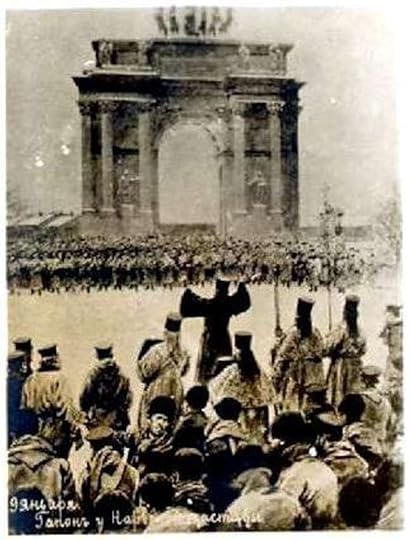
p47 bloody sunday had a lawlessness and mass violence on a scale unknown since the time of troubles early in the 17th century. witte played role.
p50 statute of 1881, referred to as the real constitution, of the empire, demolished the absense of a legal order in russia.
p53 trubeskoi "the renewal of russia should be based on trust"
p62 first "soviet" organization appeared in mid may of 1905, ivanovo voznesensk
p111 newspaper controlled by mensheviks called nachalo, trotsky called for permanent revolution, an idea originally from A. Helfound who was his mentor.
p112 lenin said the proletariat must establish an alliance with peasanty to stage a successful revolution.
p115 heavy large scale industry was more prevalent in spb than moscow. moscows industry was clothing, textile, food, whose workers were not as likely to revolt due to unsophisticated methods.
p126 tsar nicolas ii believed terror must be met by terror
p130 witte was known to have mood swings and depression
p133 newspapers in 1906 hired responsible sitting editors whose only job was to answer police calls and accept punishment
p137 duma elections in 1906 were first real election in russia. voter turnout was 30-40 percent
p157 black earth regions of central russia had most highly developed serfdom prior to 1861.
p178 stolypin was compared to bismark in germany.
p179 tsarist govt had men only from bureacracy, therefore did not command trust in society.
p187 stolypin tie symbolized the ruthlessness of the regime with its court executions
p194 stolypin believed the peasants lacked a civic spirit and were not full citizens, they affected mentality of russia.
p195 the land IS russia.
p229 tsar nicolas II held stubborn to old principles, none of russias changes and progress altered his worldview.
p231 witte said everyone in russia is radical, and i am the most radical of all.