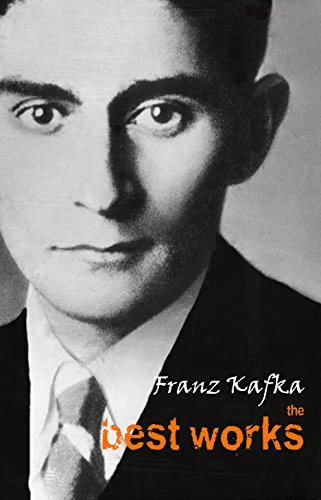
This ebook compiles Franz Kafka's greatest writings, including novels, novellas, short stories and parables such as "Amerika", "The Trial", "The Metamorphosis", "The Castle", "In the Penal Colony", "A Hunger Artist" and "The Great Wall of China". This edition has been professionally formatted and contains several tables of contents. The first table of contents (at the very beginning of the ebook) lists the titles of all novels included in this volume. By clicking on one of those titles you will be redirected to the beginning of that work, where you'll find a new TOC that lists all the chapters and sub-chapters of that specific work.
Franz Kafka was a German-speaking writer from Prague whose work became one of the foundations of modern literature, even though he published only a small part of his writing during his lifetime. Born into a middle-class Jewish family in Prague, then part of the Austro-Hungarian Empire, Kafka grew up amid German, Czech, and Jewish cultural influences that shaped his sense of displacement and linguistic precision. His difficult relationship with his authoritarian father left a lasting mark, fostering feelings of guilt, anxiety, and inadequacy that became central themes in his fiction and personal writings. Kafka studied law at the German University in Prague, earning a doctorate in 1906. He chose law for practical reasons rather than personal inclination, a compromise that troubled him throughout his life. After university, he worked for several insurance institutions, most notably the Workers Accident Insurance Institute for the Kingdom of Bohemia. His duties included assessing industrial accidents and drafting legal reports, work he carried out competently and responsibly. Nevertheless, Kafka regarded his professional life as an obstacle to his true vocation, and most of his writing was done at night or during periods of illness and leave. Kafka began publishing short prose pieces in his early adulthood, later collected in volumes such as Contemplation and A Country Doctor. These works attracted little attention at the time but already displayed the hallmarks of his mature style, including precise language, emotional restraint, and the application of calm logic to deeply unsettling situations. His major novels The Trial, The Castle, and Amerika were left unfinished and unpublished during his lifetime. They depict protagonists trapped within opaque systems of authority, facing accusations, rules, or hierarchies that remain unexplained and unreachable. Themes of alienation, guilt, bureaucracy, law, and punishment run throughout Kafka’s work. His characters often respond to absurd or terrifying circumstances with obedience or resignation, reflecting his own conflicted relationship with authority and obligation. Kafka’s prose avoids overt symbolism, yet his narratives function as powerful metaphors through structure, repetition, and tone. Ordinary environments gradually become nightmarish without losing their internal coherence. Kafka’s personal life was marked by emotional conflict, chronic self-doubt, and recurring illness. He formed intense but troubled romantic relationships, including engagements that he repeatedly broke off, fearing that marriage would interfere with his writing. His extensive correspondence and diaries reveal a relentless self-critic, deeply concerned with morality, spirituality, and the demands of artistic integrity. In his later years, Kafka’s health deteriorated due to tuberculosis, forcing him to withdraw from work and spend long periods in sanatoriums. Despite his illness, he continued writing when possible. He died young, leaving behind a large body of unpublished manuscripts. Before his death, he instructed his close friend Max Brod to destroy all of his remaining work. Brod ignored this request and instead edited and published Kafka’s novels, stories, and diaries, ensuring his posthumous reputation. The publication of Kafka’s work after his death established him as one of the most influential writers of the twentieth century. The term Kafkaesque entered common usage to describe situations marked by oppressive bureaucracy, absurd logic, and existential anxiety. His writing has been interpreted through existential, religious, psychological, and political perspectives, though Kafka himself resisted definitive meanings. His enduring power lies in his ability to articulate modern anxiety with clarity and restraint.
These are my own interpretation when reading the stories. What are your thoughts?
1. Unhappiness "Unglücklichsein": The narrator was so lonely and miserable that he started talking to a ghost child. He was lonely that he felt happy instead of scared to the apparition. He then argued with the ghost as if he was fighting with his own thoughts. He left the room and had a random conversation with his neighbor about not stealing his ghost otherwise their relationship will be over. He went on saying I'm tired and need to sleep. Weird story, is this about a man with psychosis due to intense isolation?
2. The Judgement "Das Urteil": A story about Georg writing a letter to his jaundiced friend that "ran" to Russia. Talked about how his friend never visit him and his family anymore, should he tell his friend that he is getting engaged? Georg contemplated on his father's condition since his mother died.. He tells his father about him writing the letter to his old friend. The father was suddenly angry to Georg and cursed to death by drowning- Georg did end up killed himself by jumping off a bridge. I don't understand this bizarre tale, why is something simple turned into a complicated short story. I suppose those characters symbolized something personal to Kafka in real life?
3. Before The Law (a parable): I think the man from the country is typical human being, The Law is heaven, the gatekeeper is .. well the heaven's gate keeper. So the man is trying to understand and chase after Heaven. That he doesn't really live his life, just chasing after heaven and do nothing. He asked and asked the gatekeeper, trying to learn all about heaven until he is old and dying. In the end he does not understand anything.
“Here no one else can gain entry, since this entrance was assigned only to you. I’m going now to close it.” Does this mean, heaven doesn't exist and it the end death is just.. death. So live your lives, don't waste it on trying to chase The Law.
4. The Metamorphosis (a novella): Comments separately
5. A Report to An Academy "Ein Bericht für eine Akademie": I think this is about someone with minor ethnic heritage trying to fit into the dominant culture of a society. To fit in and look normal. "I repeat: there was no attraction for me in imitating human beings; I imitated them because I needed a way out, and for no other reason."
6. Jackals and Arabs: Allegory of Jewish-Arab relations, Kafka "caricaturing the concept of the Chosen People who appear as intolerant of the Arab culture as the Arab culture is of them." or existentialist theme https://www.essayfox.com/jackals-and-...
Not all stories are that great or interesting to read - I prefer the novels, the short stories are some how not that appealing and you really need to push yourself through especially the repetitive
This review covers only The Castle, one of the works in this anthology.
Franz Kafka lived in Germany in the end of the 19th and the beginning of the 20th centuries He is most well-known for his work The Metamorphosis, in which the protagonist grotesquely wakes up one day as a giant cockroach. The work of this review (The Castle) was started and left unfinished in 1922, two years before Kafka’s death in 1924. It was only published posthumously in 1926 – against Kafka’s expressed wishes in his will.
It tells the story of the main character, known only tersely as K., who arrives in a village in Germany and claims to be a “land surveyor.” However, he cannot get approval to work in this role unless certified by the village’s central authority, named Klamm, dwelling in a Castle. The villagers keep pushing him towards the Castle, but despite the necessity of authorization, he is unable to get an audience. (Anyone who has dealt with governmental or corporate bureaucracies can certainly relate.) His assistants get jobs there, his girlfriend gets an audience there after cheating on K., but K. can never attain his goal. The story ends abruptly, without a climax or a denoument, and the reader is left to imagine the rest of the tale.
Scholars have long pondered the symbolism that Kafka intended. Of course, we will never know for sure. Could it be humanity’s never-ending yet unattained attempt at salvation and at finding God/heaven on earth? Could it just be the futility and meaninglessness of life? Could it be about the facelessness of modern governmental bureaucracies? Though not a professional literary scholar, I suggest that we need to see this work in the scope of the European intellectual landscape after World War I. This landscape held a bevy of alienated individuals who saw through human attempts of self-betterment, only to destroy each other horrifically on battlefields. They were disillusioned with everything – God, progress, labor, idealism, Marxism, democracy, indeed with all of life.
In this sense, we can view Kafka in The Castle as a proto-existentialist. After Kafka, Sartre and Camus wrote elegantly about the absurdity of life. Some might find books like this hopeless. I certainly had my frustrations while reading it of its pointlessness. Still, such existentialist dilemmas certainly fit with Kafka’s disposition and historical moment. If he can write a classic about suddenly turning into a cockroach, why not write a story without an ending?
This edition is sort of the literary equivalent of a greatest hits collection. It includes what are usually considered the best short stories as well as "Metamophosis" and the unfinished novels. The text has obviously been scanned from a hard copy, and consequently the quality is somewhat mixed. The text of "The Trial," for example, is pretty clean, while the text for "The Castle" is riddled with uncorrected typos. In most cases, it's easy to figure out what the word should be, so it is more of a nuisance than a deterrence to understanding. Because of that I gave this edition four stars. I can't speak to the quality of the translations in regards to their fidelity to the originals, but the versions included are quite readable. Personally, I prefer the short stories to the novels. For anyone interested in getting to know Kafka and his work, this is a very good selection and at a great price, if you don't mind the occasional typo.
I bought this book so I could read Kafka's short story, Metamorphosis. I'm not fond of short stories as a rule, but this one was pretty amazing. A salesman living with, and supporting, his parents and sister wakes up one morning as a big bug. There are so many facets to this story, so many metaphors wrapped up in this "situation" that the family accepts matter of factly. They have questions to be sure but none of them are of a serious nature. I highly recommend Metamorphosis. I plan to read more of his work.
I was very impressed with "The trial" so I decided to read this book. Between the novels and tales I cannot choose which one I like the most. All of them have its particularities. What I can say is that "Amerika" is a pretty good work, unfortunately it is not completed. "The hunger artist" affected me a little maybe because I was influenced by the fact Kafka worked in this writing prior of his death, while he was suffering laryngeal tuberculosis. "The castle" is the last one in my list, I found it very dramatic but absurd and infuriating, which is what characterized Kafka's work.
I love Kafka's writing style, and the potential for unsettling horror in his stories, but this was not a bingeable collection. I found that after a while, all of the frustratingly (but intentionally) useless characters and situations started to blend together. My favourites are still "In the Penal Colony" and "Metamorphosis" - the two stories I read before this collection - but I did also enjoy "The Burrow". 3.5