What do you think?
Rate this book


427 pages, Hardcover
First published January 1, 1995


There are few, if any, other instances in recorded history where we have the conversations of leading figures as they complete one era, come to terms with it, and prepare their strategy for the next. It is as though these men were lifted out of history at a crucial turning point—from the age of conventional weapons to the nuclear era — placed within a timeless container and told to discuss their past and future as the recorders roll.- Jeremy Bernstein
"it says that you are supposed to receive the Nobel Prize for 1944." The excitement that struck the ten detainees at this moment is hard to describe in a few words. Hahn did not believe it at first. In the beginning he turned away all the offers of congratulations. But gradually we broke through, with Heisenberg in the lead, who congratulated him heartily on the 6200 pounds.

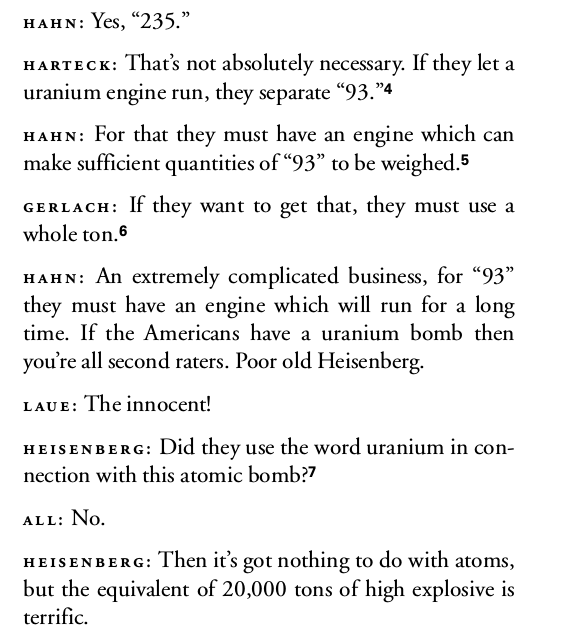
reading this lecture, I am once again struck by the intellectual thinness of this group. Here are ten German nuclear scientists — nine if one does not count von Laue — who are supposed to be the cream of the crop, the intellectual elite, of German nuclear physics, men who had been working on these questions for several years. And look at the discussion it produced.
To see what I have in mind, let us entertain the following fantasy. Suppose the tables had been turned and ten of the best Allied scientists had been interned in Göttingen when a hypothetical German atomic bomb went off. Whom shall we include? Fermi, Bethe, Feynman, Serber, Wigner, von Neumann, Oppenheimer, Peierls, Ulam, Teller, Bohr, Frisch, Weisskopf... What would the technical conversation have been like? No doubt there would have been disagreements and some fumbling. But like this? The question answers itself.