
What do you think?
Rate this book


Édition enrichie (Introdution, notes, annexes, chronologie et bibliographie)
Lorsqu’il commence à écrire les Rêveries à l’automne 1776, Rousseau est un vieil homme proche de la mort, presque pauvre, célèbre dans toute l’Europe et pourtant assuré que l’espèce humaine le rejette. Il continue cependant d’écrire et les Rêveries sont à ses yeux la suite des Confessions. Mais il ne s’agit plus désormais de raconter sa vie ni de s’expliquer aux autres pour dévoiler sa vraie nature. Dans une solitude propice à l’introspection, si des souvenirs épars remontent maintenant à sa mémoire, c’est pour lui-même qu’il les consigne en même temps qu’il cherche à se mieux connaître et réfléchir plus largement sur les ressorts de notre esprit humain.
Mais ces méditations sont aussi des promenades où la rêverie devient expansion de l’être, où le contact avec la nature est source de bonheur dans la pure conscience d’exister. Une nouvelle manière d’écrire s’inaugure donc, un libre parcours sans effort que la ligne mélodieuse d’une prose souvent poétique rend admirablement sensible. Ces Rêveries que Rousseau nous laisse lorsqu’il meurt à Ermenonville en juillet 1778, il se peut ainsi qu’elles ne nous soient pas adressées : elles nous sont en tout cas destinées.
Edition de Michèle Crogiez.
178 pages, Kindle Edition
First published January 1, 1782


Reduced to my own self, it is true that I feed on my own substance.And while the writing is not bad, he repeats his points to the point of tedium, and takes so long in saying it, that I fell asleep reading a few of them.
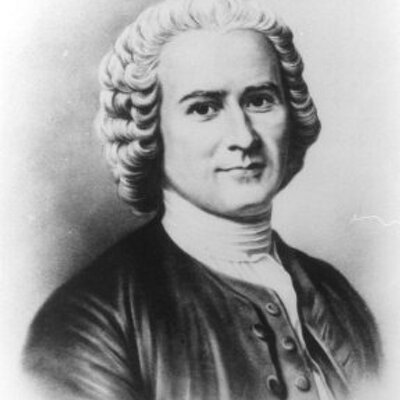
These hours of solitude and meditation are the only time of the day when I am completely myself, without distraction or hindrance, and when I can truly say that I am what nature intended me to be. (Second Walk)
For, although I am perhaps the only person in the world to whom destiny has decreed that he should live in this way, I cannot believe that I am the only person to have such a natural inclination for it, although I have so far not come across it in anyone else. (Fifth Walk)
__________
All the judgements of men are henceforth of no significance to me . . . (Seventh Walk)
I am a hundred times happier on my own than I could ever be living with them . . . and whatever they may do, my contemporaries will never mean anything to me. (First Walk)
Montaigne's playfulness here, evoking the movement of his thoughts and his own wanderings, points to a third link between his Essays and Rousseau’s Reveries: they are both texts written ‘on the go’. In his chapter ‘On Three Kinds of Social Intercourse’, he describes how, in his library, ’sometimes my mind wanders off, at others I walk to and fro, noting down and dictating these whims of mine’; and in his chapter ‘On Some Lines of Virgil’, Montaigne describes how sometimes he thinks best while he is on the move:But what displeases me about my soul is that she usually gives birth quite unexpectedly, when I am least on the lookout for them, to her profoundest, her maddest ravings [rêveries] which please me most. Then they quickly vanish away because, then and there, I have nothing to jot them down on; it happens when I am on my horse or at table or in bed—especially on my horse, the seat of my widest musings.
Perhaps the last and potentially most far-reaching thing that Montaigne’s Essays and Rousseau’s Reveries have in common is that both texts attempt to portray the twists and turns of each writer’s mind. Like Montaigne before him, Rousseau forges has identity through a process of spontaneous mental combustion, through the accumulation of thoughts and memories: like the Essays, the Reveries paint the portrait of a thinking man as he thinks.
My task is the same as that of Montaigne, but my aim is the exact opposite of his: for he wrote his essays entirely for others, whearas I am writing my reveries entirely for myself.


