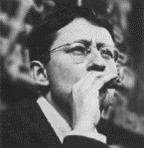
Amadeo Bordiga (1899-1970) was an Italian Marxist theoretician, who played a major role in the ideological development of the post-1917 Socialist revolution. He is well known as one of the last Comintern members to criticize Stalin to his face and live to tell the tale, most notably referred to as "the gravedigger of the revolution" during a 1926 party conference. In Dialogue with Stalin, Bordiga carefully dissects the economic state of the USSR under Stalin, and lays forward the capitalist nature of the USSR.
Amadeo Bordiga was an Italian Marxist, a contributor to Communist theory, the founder of the Communist Party of Italy, a leader of the Communist International and, after World War II, leading figure of the International Communist Party.
Written in 1952 this essay is one of the last to be written with the goal of proving the capitalist nature of the USSR, it is also the weakest of them I have read.
This is partly because its scope is the most narrow and superficial, rather than look at Soviet society and economics as a whole it is just a direct response to a book published by Stalin `Economic Problems of Socialism in the USSR` so it mainly concerns itself with picking apart the passages in the book.
Bordiga says at the beginning we should read between Stalin's lines, to get at the true meaning of his work. If we do the same to Bordiga's argument an interesting pattern emerges. Another reason for the weakness and limits of this work is that Bordiga does not actually disprove of much of how the soviet society developed. He openly defends Lenin and spends most of the work trying to distinguish between the economies of the two, despite most of the capitalist features already present. The best Bordiga can do is claim that Lenin was aiming at building state capitalism, whereas Stalin has merely built industrialism.
He also explicitly endorses the terror and the closest we get to criticism of Lenin is a brief remark of a time when Lenin committed the great sin of disagreeing with Bordiga at a Comintern meeting.
To be honest there are passages were Bordiga seems to have no real issue with Stalin's economic system, and is mainly incensed by the misuse of his beloved Marxian language and terminology. This makes sense as Bordiga was very much a believer in stageism and so while a book accusing the soviet union of capitalism in red clothing seems damning, to Bordiga the development of capitalism in Russia and Central Asia is a fine and necessary thing, if only Stalin were more honest.
"Once again, it remains true: Russian “economic policy” has certainly developed the material productive forces, has indeed expanded the world market, but within the capitalist forms of production. It does indeed represent a useful historical tool: no less than the industrial invasion at the expense of the starving Scots and Irish or the Wild West Indians, but it cannot loosen the relentless grip of the contradictions of capitalism, which very well potentiates the forces of society, but which for that must debilitate and subjugate the workers' association."
The work also has issues with tone, parts, especially the beginning are extremely purple and full of points that end in obscure classical references, other times he makes a point and then fails to elaborate it. There are also entire sections that serve no real purpose in regards to the argument but give Bordiga a chance to praise without qualification Marx and Engels, the praise is so all encompassing it reminded me of the odes to comrade Stalin that the soviet press and art world had to keep making to escape the hand of the secret police.
Read Berkman instead, or if you must have a Marxist Pannekoek.
A substantive and highly informed critique of Stalin’s 1951 treatise ‘Economic Problems of Socialism in the USSR’, and its theoretical rationalisations and justifications of the course taken by Soviet economic development; in particular taking to task Stalin’s claim that socialism has been realised, i.e. lower stage communism.
There are many choice quote that can be extracted from the text - for example, the shallowness of smuggling in ‘state industrialism under the socialist banner’, and palming it off as if it represented a socialist advance; how Soviet industrialisation represents a similar process of primitive accumulation (although I believe the German translates closer to ‘original accumulation’) as described by Marx in Capital; Bordiga even goes so far as to say that in much of the undeveloped world a certain glorification of the productive forces is ‘necessary.’
But what Bordiga is absolutely not prepared to accept is that this is socialist or a socialist process. He characterises the Soviet economy as state capitalist.
Therefore Stalin is spreading falsehoods, undermining Marxist theory, and twisting basic Marxist postulates beyond recognition.
For Bordiga, among the heights of Stalin’s theoretical barbarism is his acknowledgment that the law of value operates under socialism, in direct contradiction to Marx.
To quote Bordiga: ‘As for Stalin, he fabricates a theory - precisely: theories are invented, laws discovered - and in defiance of father Marx says: certain economic appearances of socialism obey usually to the law of exchange (law of value).’
For other Marxists like Raya Dunayevskaya, this acceptance (made as early as 1943 by some Soviet economists) that the law of value operated in the USSR she took as a face value admission that the regime was state capitalist.
Some passages from Bordiga’s work are worth quoting at length, illustrating his Marxist erudition and analysis:
‘Even if we only stick to the analysis of the domestic economy, the Russian economy in reality makes use of all laws of capitalism. How can it increase the production of goods not meant for consumption, without proletarianising humans? Where shall it take the humans from? The course is that of primitive accumulation, and mostly the means are as horrible as those that are depicted in “Capital”…’
‘Just in the dimension in which the process of the beginning accumulation of capital takes places… will it be revolutionary and spin the wheel of history forward. But this is not a socialist, but a capitalist process. In this big part of the globe, the glorification of the development of productive forces is necessary. Stalin correctly says, that this is not his credit, but that of the economic laws, which enforces these “policies” upon him. His entire undertaking is made up of fraudulent labelling…’
Bordiga has the nice habit of quoting Marx and Engels to prove what they did not say. In Anti-Dühring Engels said society will take control of the means of production. Therefore, when the Soviets use the word “nation” instead, they are paraphrasing something Engels did not say. The Communist Manifesto and the Principles of Communism use the word nation in the exact way the Stalinists did. But, ‘no’, says Bordiga: ‘they must have been paraphrasing Anti-Dühring specifically, look the distortions, how terrible they are!’ A tiger has stripes, therefore if it has stripes, it is a tiger. Or rather: A lion does not have stripes, therefore nothing has stripes. Bordiga doing doing the level 1000 logics. When Bordiga is not cherry-picking quotes or spewing logical fallacies, he makes his stuff well nigh unreadable. Bordiga starts with a soliloquy to historical determinism. Why does he disagree with Stalin? Stalin doesn’t follow the Marxian programme. Fair enough. Bordiga believes that every programme is more important than a dozen steps in real movement. This is one of the points on which Bordiga consistently says the opposite of Marx. Marx believed the programme of the Manifesto soon grew outdated. Bordiga believed it is an icon. Many Trotskyites believe in two great historical forces. Material reality and Stalin. Bordiga agrees. But his dualism is material reality and the programme. Furthermore, Bordiga proves his points by asserting them. Industrialisation makes workers poorer because, uuh? Trust me bro, that’s the way it is man. This way Bordiga ‘proves’ that commodity production mean capitalism. Lenin said capitalism was the system of commodity production. That is, the system where commodity production was dominant. The products command the producers. This Bordiga points out. To prove that not just means of production but also means of consumption have to be taken by “society”? It’s not clear. Bordiga was an awful writer. But he seems to go direct against the statement of the Manifesto that “All that we want to do away with is the miserable character of this appropriation”. Bordiga does not see the relevance of the only relevant section he quotes, instead he ‘disproves’ the Communist Manifesto by declaring all systems with commodity exchange capitalism, even though Marx and Engels distinguished this from the previous burgher and petit-bourgeois production which also had commodity exchange. Even serfs partook in this. So did the Romans and other slave economies. There is more than enough other stuff to unpack. But I am tired of such tripe.
Muitas analogias, muitas referências a clássicos, tudo para dizer "Isto, segundo a semântica, e considerando que eu acho que ele está a citar esta obra e nenhuma outra em específico poque ele é um labrego e labregos não lêem, está errado. Eu sou muito inteligente".
“Commodity production, including private property, is neither "natural" nor, as the bourgeois claims, permanent and eternal. The late appearance of commodity production and its existence on the sidelines of other modes of production serve Marx to show that commodity production, after it has become universal, just after the spread of the capitalist production system, must go down with it. It would take too long if we wanted to cite the Marxist passages directed against Proudhon, Lassalle, Rodbertus and many others, denouncing any attempt to reconcile commodity production with the socialist emancipation of the proletariat… For us, every system of commodity production in the modern world, a world of associated labour, that is the aggregation of workers in production plants, is defined as capitalist economy.”