
Jump to ratings and reviews
Rate this book

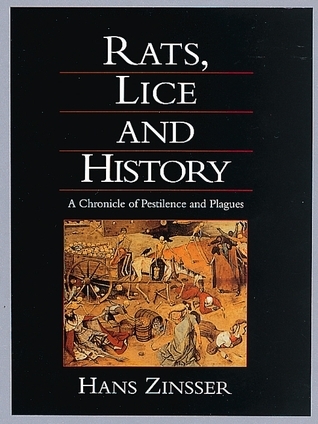
Rats, Lice, and History: A Chronicle of Pestilence and Plagues

Rate this book
The classic chronicle of the impact disease and plagues have had on history and society over the past half-millennium. Intriguingly fascinating and entertaining reading for anyone who is interested in how society copes with catastrophe and pain. Relevant today in face of the worldwide medical calamity of AIDS. Continuously in print since its first publication in 1934, with over 75 printings.

301 pages, Hardcover

First published January 1, 1935

106 people are currently reading
2719 people want to read

About the author

Hans Zinsser

33 books8 followers

Ratings & Reviews

What do you think?
Rate this book

Friends & Following

Create a free account to discover what your friends think of this book!

Community Reviews

5 stars
218 (37%)
4 stars
202 (34%)
3 stars
119 (20%)
2 stars
28 (4%)
1 star
12 (2%)
Displaying 1 - 30 of 84 reviews
Profile Image for Michael Perkins.
Author 6 books474 followers
August 9, 2022
Read Proust last year and in the process learned that his father, Dr. Adrien Proust, was a history making epidemiologist. He was a leading public health official in preventing cholera from entering France. Quite a story.


https://thelandofdesire.substack.com/...
Profile Image for Alexia.
195 reviews27 followers
March 24, 2015
I am absolutely stumped on how to review this book. I love medical histories, so when I saw this at a used bookstore I picked it up.

This book is about everything BUT typhus. Religion, history, mathematics, politics--if it's a subject completely unrelated to typhus it's most certainly in there. So I should just give it one star and move on with my life, right?

I wish it were that easy, because this book was hilarious. So off-topic, but the author is aware of how off-topic he is, "This, we promise, is the last serious digression from our main theme" (It is not)

At multiple points, he feels that so much extraneous matter is related to his subject that he just starts giving a list of random historical events with no explanation of their connection. The topic of typhus isn't truly brought up until page 212, and doesn't really start being addressed until page 229.
This, to me, is hilarious. I started this book in a serious mood, expecting to be informed about the progression and history of a serious disease. Instead, I was caught off guard by all this randomness and burst out laughing.

2 stars then? 5? 1? Let's go with 4. Sure! It's a star number I picked randomly, and that should fit considering the random nature of this book.
Profile Image for Nancy.
1,442 reviews49 followers
October 2, 2011
Rats, Lice and History is written in an entertaining conversational style with with enough scholarly flourishes that you'll want your computer by your side to look up words and translate all the French, German and Spanish quotes. (Generally the Greek and Latin are translated or explained.)

The author manages to weave in a wide range of historical musings along with up to date science (for the publication date of 1934). The description of how "new" diseases arise is as true for AIDS as for typhus.

I found my copy of the book at the University of Oregon Science library. I really enjoyed the physical book. The bookplate for Vandevelde inside the cover, the obituaries for Dr. Zinsser pasted into the front and back of the book,the worn cover, and the pencil underlines all connected me to others who had read this exact same physical book.

Profile Image for heptagrammaton.
463 reviews59 followers
May 10, 2025
Fascinating and often fun. Erudite. Charming. Packed with tangents and digressions to an almost comical degree – in a way that is ultimately enriching to the tone and stylistic appeal of the text. Rats, Lice and History is a systems-oriented insightful history of disease by one of the early 20th century's most pedagogically gifted bacteriologists, and a reminder that pandemic is never annihilated but only allayed by the force of knowledge, and collective action, and sheer material circumstance.

   Full of humour - with blood, and yet also with bile. (Elaboration to follow.)


But then a Grand Duke was murdered at Serajevo and everybody lost their heads [...] And God was on everyone’s side. And when we had all gone to war and the stage was set, typhus woke up again.

Not everyone realizes that typhus has at least as just a reason to claim that it “won the war” as any of the contending nations. Many a French barroom fight might have been avoided if this had been clearly understood.


    ∙    method(ology) is the message

Foregrounded in his focus are the relational dynamics between organisms and the broad evolutional trends of disease once it's established in a population. He rejects moralizing human-centric views in sly mockery, rejects privileging one species' view over another.
   This, I think, is the strongest point of Rats, Lice and History as a work with enduring didactic merit.

    ∙    the monopoly on violence will harvest your scalp

   Zinsser was a firm humanist and vocally derogatory of fascism. Yet his language is and his views are inevitably inflected by colonialism and white supremacy, in the subtle inherited ways that can seem innocuous should we choose to believe ourselves ahistoric beings.
   He relates the following anecdote: in the middle of typhus epidemic, he ran out of healthy lice for expirimental purposes and got a policeman to arrest a man of colour, apparently prodigiously lousy, so as to harvest his lice. The man is supposed to have been let out to go, quickly thereafter, freely, no harm done.
   The whole story is supposed to amuse, yet it may be difficult to feel amused if you are at all inclined to stop and consider how the experience of being stopped on the streets and detained, even if it be briefly, even if it be for the sake of science, even if it be for the sake of public health. We are never told if our lice donor was informed. We are never told if he consented. (We can reasonably imagine he could have hardly felt he had any choice.) We are never, strictly speaking, told to what extent our facilitating tool of the executive was informed of the purpose of this exercise, or if he, strictly speaking, gave a damn about ethics.
   Nor can we escape the racial undertone of. I will grant and believe it reasonable that Zinsser was not racist (insofar as that statement makes sense for his, but also any, time and place.) He keenly observes the historical and material circumstances of infestations, I wouldn't doubt he did not have any prescriptive lousiness/race connections in mind - but it matters who he chose to point out to the constable, and who he did not. It is doubtlessly relevant that for centuries skin colour and moral purity and physical cleanliness have been socially, linguistically (see lousiness/lousiness), institutionally conflated.
   It is a brief reminder of the long roads of ethics, of the flippant dehumanization that was (is) all too common an attitude in medicine and the natural sciences and the intersections of executive power and social prestige.
   We have ethics committees now. It's not good, but it's better.

    ∙    some notes on nomenclature (ICZN, hug me, I am scared)

Our understanding and handling of taxonomy has been fundamentally altered by being - thus a bunch of the space Zinsser dedicates to educated musings on the evolution of rats and lice, reliant as it is on morphologal comparison, has been rendered somewhat obsolete, though nevertheless fascinating. I am affixing this particular note, for the benefit of people like me, with very bare knowledge of zoology. (And because I looked it up and deeply regret it.)
   Today, Mus and Rattus are considered different genera — but literature of the 1930s was a chaotic mess; the brown rat is alternately classified as Mus rattus norvegicus, or Epimus rattus decumanus, or M. rattus decumanus (which Zinsser himself uses elsewhere) or R. norvegicus... I have been trawling through 80-years-old science trying to make sense of this. 0/10.
Profile Image for Printable Tire.
839 reviews135 followers
January 14, 2013
I salvaged an old paperback copy of this book from the library's garbage bin one day when I was walking around with a very bad cold. It seemed like an appropriate thing to read, as it had to deal with sickness and it was the kind of boring subject that is pleasant to read when one is stuck in bed and going nowhere.

It's a very strange, funny book- a shaggy dog with fleas.

The first several or so chapters are a defense for why a doctor should be able to write a work of literature. Dr. Zinsser calls science an art and goes on to quote much Gertude Stein in order to hold it up to ridicule.

The next quarter or even more is then dedicated to wars and disease and destruction from the dawn of civilization onward. It would be an almost unbearably boring and depressing list if Dr. Zinsser didn't have such a sardonic wit and charm to him. He is both cynical of humanity and full of deep humanity, and because of this and his style he is reminiscent of Kurt Vonnegut.

Dr. Zinsser wrote this book before World War II, and his thoughts on the buildup of that war are heartbreaking. He convincingly argues that most wars in history have had more fatalities due to disease than those caused on the battlefield, and that many famous battles and wars were dramatically changed due to the influence of diseases.

The next sections deal with lice, and mice and rats- and these are some of his funniest observations. Concerning the sex-life of the louse, Dr. Zinsser writes,

"Nature has provided that the nymph- that is, what may be called the high-school or flapper age of the louse- is not yet possessed of sexual organs. These do not appear until the fully adult form develops, and reproduction is thus postponed until a responsible age is reached. Adolescent Bohemianism, 'living oneself out,' 'self-expression,' and so forth, never get beyond the D.H. Lawrence stage among the younger set. How much physical hardship and moral confusion could be avoided if a similar arrangement among us could postpone sexual maturity until stimulated by an internal secretion from the fully established intellectual and moral convulsions of the brain! The loss of copy this would entail for Theodore Dreiser, William Faulkner, Ernest Hemingway, and others would be amply compensated for by gains in other directions." (134)

Again, writing about rats:

"Neither rat nor man has achieved social, commercial, or economic stability. This has been, either perfect or to some extent, achieved by ants and by bees, by some birds, and by some of the fishes in the sea. Man and the rat are merely, so far, the most successful animals of prey. They are utterly destructive of other forms of life. Neither of them is the slightest earthly use to any other species of living things. Bacteria nourish plans; plants nourish man and beast. Insects, in their well-organized societies, are destructive of one form of living creature, but helpful to another. Most other animals are content to lead peaceful and adjusted lives, rejoicing in vigor, grateful for this gift of living, and doing the minimum of injury to obtain the things they require. Man and the rat are utterly destructive. All that nature offers is taken for their own purposes, plant or beast." (154-155)

Finally, on page 173 of a 228-page book, Dr. Zinsser broaches the topic of typhus.

It is very clear (he even says it) that Dr. Zinsser was inspired by Tristram Shandy in writing his rambling, preambling "biography" of typhus, digging out interesting but unrelated topics when they interest him, burrowing around history for the first signs of its existence.

It's a bumpy but no less enjoyable ride for being so, and in its casual, layman's way seems ahead of its time. The only faults I had with it are there are sometimes no translations of long passages in another language (perhaps the average reading public knew more languages than I do back then) and it can be quite repetitive, though pleasantly repetitive, and the chronological order of events is totally bananas (Dr. Zinsser will talk about the Dark Ages and plague then go back and talk about diseases in ancient Greece.) Also, I'm not entirely sure what typhus is, or if it's even around anymore. But still, as a science book on a topic I usually show no interest in, it is a fascinating, intelligent, and well-written book.
Profile Image for James Henderson.
2,247 reviews159 followers
January 26, 2023
Zinsser's book, published in 1935, can be read as a modern adaptation of Laurence Sterne's The Life and Opinions of Tristam Shandy. It provides the reader with a picaresque description of how typhus outbreaks have influenced human history. In the days before antibiotics, he issued a challenge against germs that is still relevant today: "Infectious disease is one of the few genuine adventures left in the world." The lance is rusting in the chimney corner and the dragons are all dead. The war against those ferocious little fellow creatures, which lurk in dark corners and stalk us in the bodies of rats, mice, and all kinds of domestic animals; which fly and crawl with the insects, and which fly and crawl with the birds, is about the only sporting event that has not been negatively impacted by the relentless domestication of a once free-living human species.

Even though this book was written almost a century ago, it hasn't become any less interesting or funny. Hans Zinsser has created an eccentric view of history, rambling about rats, typhus, the Roman Empire, lice, and everything. You can't read it in one sitting, because you'll have to keep taking breaks to calm down from the experience. I liked the book because because I learned so much - this book is a classic microbiology textbook among other things. My favorite foonote was associated with a word I'd never heard -- it said, "If the reader does not know the meaning of this word, that is unfortunate." That gives you an inkling of what is in store for you if you choose to read this book.
Profile Image for Veronica.
260 reviews4 followers
March 29, 2020
I read this book in college in a course called Disease in History. I can’t help but think of the course and the book in the current pandemic. I keep thinking how could our governments worldwide not know what can happen when a disease with no immunity explodes. History tells us. It has been so clear to me from the start, that it is startling. My knowledge comes from education. Our leaders need to ask the experts not rely their gut feelings.
2 reviews
July 2, 2008
Contains the best footnote ever: "If the reader does not understand the meaning of this word, that is too bad"
Profile Image for Brian Clegg.
Author 165 books3,207 followers
August 25, 2017
This classic of popular science has just had a welcome reissue. I say popular science, but Hans Zinsser regularly claims his book is nothing of the sort, as 'we detest and have endeavoured to avoid [popular science]'. (The use of the royal 'we' is another of Zinsser's foibles.) Yet popular science it certainly is - his attempt to avoid the label seems to be because it was somewhat despised as a type of writing by academics in the 1930s when this book was written - and Zinsser wanted to make this more personal than popular science tended to be back then, hence his instance that the book was a 'biography' of the disease typhus.

Such is Zinsser's enthusiasm to underline this more arty, biographical approach, he spends the first couple of chapters not talking about typhus, but rather the range of the arts and sciences, their relationship and the point of biography. If you are interested in these topics (as I am) this is interesting and amusing (in part because of Zinsser's very obvious attempt to demonstrate his own breadth of interest and knowledge), if not what you'd expect in a book like this.

More surprisingly still, perhaps, it's not until chapter 13 that we really meet the disease typhus. Along the way, Zinsser teases us with little details, but then puts off the main topic as he dives into, for example, the natural history of the two main vectors of typhus, rats and lice. Finally, though, we do get a grounding in the nature of this unpleasant killer - as far as was possible, considering that a virus like typhus was too small to be seen under the microscopes of the day.

How you find this book will depend to an extent how you cope with Zinsser's whimsical and eccentric approach. I found the first 12 chapters more interesting than those on the disease itself (partly because of an aversion to things medical), but there's no doubt that his writing can still be amusing and interesting. You wouldn't read it as you might a modern equivalent to get the latest science - but you will certainly find out a lot about typhus and the conditions (including the wars and living conditions) that made it possible for it to exist and thrive in human hosts.
Profile Image for Neal Alexander.
Author 1 book41 followers
December 27, 2021
Typhus is a group of diseases which are transmitted by the bites of lice, fleas or mites. They flourish in conditions of poor hygiene, such as in war or prison. In early modern England “gaol fever” was a synonym for typhus and, for example, after the 1577 “Black Assize” court in Oxford, more than 300 people died of typhus, including the Lord Chief Baron of the Exchequer and the Lord High Sheriff.

The author, Zinsser, compares his book to Tristram Shandy in terms of the time it takes the protagonist to be born. Unfortunately, some of the preliminary material is just tiresome, such as musings about whether the book will ever be published and read, and footnoting the word “saprophyte” only to tell the reader that it’s “too bad” if they don’t know what it means. However, other preliminary material is worthwhile, in particular a kind of historiographical essay of what we can know (generally little) about historical epidemics, such as those we call the plagues of Athens (as told by Thucydides) and of Justinian.

Consistent with his trope of calling the book a biography, the author stresses that pathogens evolve to take advantage of changing environments of vectors (insects and mites) and of vertebrate hosts (humans, other mammals, and birds). Within this program it makes sense to include the description of syphilis as something which in time became relatively benign, at least compared to its gruesome morbidity when it was first known in late 15th century Europe.

On the other hand, such evolutionary ideas will be well known to potential readers, bearing in mind that it’s not intended as a popular science book (a genre which the author says he detests). So there might have been more value in the specific topic of typhus. But, unfortunately, cutting edge knowledge from the 1930s is not always helpful today, in fact it can be confusing.

In particular, Zinsser talks about the “murine type” and the “human type” of “true typhus” (as opposed to spotted fever rickettsiosis and Tsutsugamushi disease, the latter now usually being called scrub typhus). These murine and human types are now recognised as different diseases with different pathogen species and different vectors. The “human type” is what we now call louse-borne typhus or epidemic typhus, and its main transmission is between humans via the lice, as mentioned in the title of the book. Given that title, it may be surprising to read that “Typhus fever was born when the first infected rat flea fed upon a man”. (Here the protagonist is finally “born” over two thirds into the book, compared to about one third in the case of Tristram Shandy.) The idea is that the “birth” via the flea was a species jump from mouse to human. Whether or not such a jump ever occurred, we now recognise “murine typhus” or “endemic typhus” as a separate infection with its main cycle being between rats and fleas, and humans sometimes getting in the middle. The author talks about the typhus “virus” even though he previously said it was either a bacterium or protozoon: this is presumably just because “virus” was a more general term in the 1930s than it is now.

There are also some contemporary references which don’t stand the test of time, such as snide remarks about FD Roosevelt, and a contemporary New York city mayoral election. Finally, the author seems proud of himself to have caused someone to have been incarcerated for a night just so that a sympathetic policeman could harvest lice from him for the experimental use.
Profile Image for Nick Davies.
1,763 reviews61 followers
July 30, 2016
Very interesting content, but because of the writing style it was somewhat tough going. Nevertheless, this book represents a curious look at the history of infectious disease and public health. Some parts were unintentionally funny - the Philistines beating the Jewish in an ancient war by getting their Gods to strike the Jews down with a plague. But not a plague of pestilance or dysentry, oh no. Historians believe it was a epidemic of haemorrhoids.
Profile Image for Dina.
551 reviews49 followers
March 27, 2016
What an excellent book. Didn't expect to enjoy it so much. It's fascinating how human history including the destruction and creation of great civilizations was influenced by epidemics of infectious diseases. Its also fascinating how far back in history those diseases persisted in influencing the events in human history. Entertaining and fascinating read.
Profile Image for Jason.
326 reviews21 followers
February 22, 2023
Warfare has always been a part of human existence. So has disease. What if I were to tell you that the two are inextricably linked? That is the point that science historian Hans Zinsser attempts to prove in his semi-classic study Rats, Lice and History. While he makes a sweeping and somewhat superficial survey of Western civilization, he does have enough scientific credibility to prove his point.

This book does not get off to a great start. Although written in the 1930s, the author writes with a prose that resembles Victorian era essays using baroque sentences that meander on for a bit too long with elaborate detailing and excessive description. This isn’t necessarily a bad thing, I happen to like some 19th century literature, but it feels a little out of place in the context of this mid-modern text. The first two chapters also left me wondering where the book would be going since they had almost nothing to do with rats, lice, or history. The second chapter, in particular, was a rant against modernist styles in literature where the author makes it clear that he has no appreciation for the likes of T.S. Eliot, Gertrude Stein, or James Joyce.

Moving on from there, Zinsser gives a lengthy overview of trade practices, disease, and warfare as they occurred in ancient times. We hear about the usual Greeks, Romans, and Christians up through the Middle Ages to the voyages of Columbus. By this point in my life I’m getting a little bored of every history scholar writing as if the world outside of Europe didn’t exist before World War II, but I just have to accept that that is how history used to be studied. In any case, the author points out that the use of ships for trade and war did a lot to spread disease since stowaway rats carried infected fleas that regarded the sailors as nothing more than food. Yes, like it or not, people are food.

One of the strongest points of the book’s first half is that diseases often weakened and killed more soldiers than combat actually did. He even goes so far as to make the point that disease could have been a more decisive factor in fighting than military strategy, skill, or execution. Now that is an idea that should deflate the myth of the courageous warrior. The science of the matter is that having large groups of people, be they confined on boats or engaging in military campaigns, in close proximity to each other make it easy for fleas and lice to spread sicknesses throughout the population at a rapid pace. Soldiers returning home or mingling with the people they conquer spread the diseases into the civilian population and then we have epidemics like the Black Death. You have to admit the idea is plausible and with Zinsser’s background in biology, he uses his knowledge of entomology to support the point.

After about one hundred pages of what eventually sounds like a bunch of babbling about wars, the narrative really takes off as Zinsser examines historical writings to locate the first mention of typhus. There isn’t much in the historical record that corresponds with the modern understanding of typhus symptoms and its origins are murky at best, but he develops a theory, one that he admits is not strong, that typhus originated in Asia and was spread by sea merchants to Western Europe via Cyprus during the Renaissance.

From there, Zinsser takes a big leap into the subject of human-animal relationships with chapters describing lice, mice, rats, and fleas which, along with humans, form a pentangonal track for typhus to travel along. His opinion of lice is surprisingly sympathetic while his take on rats is not so hot. Lice, he claims, are actually neutral vectors that catch typhus from humans. When they reproduce, they pass the typhus on to their offspring which spread among the human population and spread the disease further amongst humans. Typhus actually kills the host lice so spreading the disease does not benefit them in any way. They are innocent vermin that just happened to get caught in the crossfire of a war between humans and a disease. Rats, on the other hand, are nothing but pests according to the author. He thinks they serve no purpose in the world other than to cause problems. They are, in fact, part of the food chain and being the scavengers that they are, their ecological function in the world is to clean up the messes left by other creature like us. That is why they thrive in places that are full of human-made garbage. Useless? I hardly think so. But regardless of what you believe, the truth is that mice carry the fleas that transmit typhus to rats and those fleas transmit typhus to humans. The humans transmit it to lice and the lice transmit it to other humans. It’s a grim way of looking at people, but we do have to be reminded from time to time that we are not the magnificent species we claim to be. We might actually be little more than a dangerous parasite if looked at from Planet Earth’s point of view. In any case, this portion of the book is fascinating and brilliant; you can really see Zinsser at his best in these passages.

The rest of the book is all about typhus and he gets around to pointing out how bad of a problem it was during World War I. This brings up an interesting dilemma. If this book was inspired by the aftermath of World War I, is it fair to say that the event overly influenced the author in his analysis and conclusions? Or did the post-war realities shine a light onto a previously unexplored matter of human history, medical science, and entomology? I can’t say for myself because I know absolutely nothing about typhus or the science of epidemics. But I can say this book made me look at humanity in a new light which is saying a lot considering the thousands of books I have read in my lifetime.

Since the 1930s, scientists have learned a lot about typhus and other illnesses so it is fair to assume that some of the information in this book is dated. But Rats, Lice and History poses a significant question about human nature and our history. If wars are the primary way in which diseases spread and become epidemics or pandemics, wouldn’t it make sense to fight less of them or even eliminate them altogether? I have no idea how we could accomplish that, but if that question is the biggest takeaway you can get from this book, then the message transcends any dated scientific ideas it may contain. I’d say that the way Hans Zinsser presented just enough evidence to make that question stick in my mind is reason enough for it to be worth reading, even almost one hundred years after its initial publication.
Profile Image for David.
311 reviews138 followers
April 9, 2011
Best biology book I ever read. Beautiful, ornate style that reminds me of Swift and Defoe. Fascinating details. Nero Wolf was caught reading it once when he was away from the Orchid rooms, which is a recommendation in itself. The idea of a disease as being like a single organism that spans space and time in a single body and has always been with us is irresistible. I keep up with developments in microbiology as a hobby, although I don't normally do hobbies which are usually associated with pastimes such as chess, knitting and cookery...
Profile Image for Lobo.
781 reviews99 followers
Read
August 11, 2025
Kiedy książka ma masę ciekawych informacji, ale autor jest dupkiem. Wszystko, co było przedstawianiem faktów historycznych - bardzo interesujące. Wszystkie subiektywne dygresje autora (czyli solidne 30% książki)? Droga przez mękę. Zinsser nie powinien wypowiadać się o modernizmie w sztuce, a najlepiej wszystkie swoje poglądy zatrzymać dla siebie, bardzo prywatnie, jak gloryfikacja Corteza (sic!). Zdecydowanie za mało szczurów.
57 reviews
March 1, 2026
I got this book for 50c at a book sale, and didn't realise it was about typhus until I started reading it, then typhus didn't actually come up until about 80% through the book but it was very funny and a lot of fun to read.
Profile Image for Kris Raah.
36 reviews2 followers
March 16, 2020
An appropriate book to read during our current virus crisis. And what else is there to do during my self inforced social distancing BUT READ READ READ
Profile Image for Rita.
1,706 reviews
April 5, 2020
c 1935
I have Pocket Book edition August 1945
"This is a wartime book...in compliance with the government's regulations for conserving paper..."

When Renee saw this little book on my bookshelves she was rather excited. Had read it long ago and wanted to get reacquainted.
Indeed he writes amusingly. A very personal style [except referring to himself as WE]. The technical details got a little too complicated for me, but his point that diseases have killed many more soldiers than guns is made very well. A lot of interesting historical examples.

He has respect for Russia and for Russian scientists.
235: "There are no words to record the dreadful sufferings of the Russian people from 1917 to 1921. We are concerned with TYPHUS ALONE. From the careful and conservative calculations of Tarassewitch, it is likely that, during these years, there were no less, and probably more, than 25 million cases of typhus in the territories controlled by the Soviet Republic, with from 2 1/2 to 3 million deaths."
210 "1566 - Vienna suffered the most severe typhus outbreak of its history. Ever since that time typhus has remained ENDEMIC in Hungary, the Balkan states, and the adjoining territories of Poland and Russia. These are still, at the present day, the HOME STATIONS from which modern European epidemics take origin."

229 "It is a curious and heartening fact that international cooperation in the prevention of epidemics placidly continues, however hostile or competitive other relationship may become. Now [1935] -- while the world is an armed camp of suspicion and hatred, and nations are doing their best to push each other out of world markets, to foment revolutions and steal each other's military secrets -- organized government agencies are exchanging information concerning epidemic diseases; bacteriologists, epidemiologists and health administrators are consulting each other and freely interchanging views, materials, and methods, from Russia to South America... It is perhaps not generally known that for several years, during the most turbulent period of the Russian Revolution, the **only** official relationship which existed between that unfortunate country and the rest of Europe consisted in the interchange of information bearing on the prevention of epidemic disease, arranged in cooperation by the Health Commission of the League of Nations and the Soviet government."
157 "From the point of view of all other living creatures, the [brown, now common] rat is an unmitigated nuisance and pest. There is nothing that can be said in its favor. It can live anywhere and eat anything. It burrows for itself when it has to, but when it can it takes over the habitations of other animals, such as rabbits, and kills them and their young. It climbs and it swims.
It carries diseases of man and animals -- plague, typhus, tichinella spiralis, rat-bite fever, infectious jaundice... Its destructiveness is almost unlimited...Man and the rat will always be pitted against each other as implacable enemies. And the rat's most potent weapons against mankind have been its perpetual maintenance of the infectious agents of plague and of typhus fever."
162 "Neither rat nor man has achieved social, commercial or economic stability. This has been achieved by ants and by bees, by some birds, and some fishes. Man and the rat are merely, so far, the most successful *animals of prey*. They are utterly destructive of other forms of life. Neither of them is of the slightest earthly use to any other species of living thing....Man and the rat are utterly destructive. All that nature offers is taken for their own purposes, plant or beast."
146 "The louse will never be completely exterminated, and there will always be occasions when it will spread widely to large sections of even the most sanitated populations. And as long as it exists, the possibility of typhus epidemics remains."
Profile Image for Melanie Chartoff.
Author 2 books29 followers
March 3, 2024
I’ve been continuously captivated by this insightful book on the origins of typhus by Hans Zinnser. It’s informative, shocking and quite funny in places. Considering it’s publishing date of 1935. It’s remarkably hip to human nature in 2024, just past the worst pandemic of my particular lifetime. How lucky we have been, due to the evolution of hygiene and the sharing of results between scientist of all countries to escape the scourges that killed so much of humanity, and won so many wars, and defeated so many brilliant leaders.
I highly recommend this book to non-scientists of all stripes.
Profile Image for Inder.
511 reviews81 followers
April 25, 2008
Thanks to Happyreader, I realized my review of this book is associated with a totally obscure and out-of-print edition. So that no one will ever actually see my review, and I can't easily compare mine with others'. Since I really, really love this book, I'm moving my review.
_____________________________

A must read for anyone interested in biology, or science, or language, or good writing, or life in general, this is one of my all-time favorites. After many non-sequitors about a variety of topics, the author finally gets around to explaining, in engaging, lucid detail, why human history is actually the history of bacterias, viruses, fleas, lice, and, yes, the occasional rat.

This is the precurser to "Guns, Germs, and Steel," but it's funnier. But beware, the first couple of chapters are very weird. Don't give up!

This book made me want to become an epidemiologist. It's still one of my back-up plans.
Profile Image for Hannelore.
77 reviews
December 18, 2017
As much as I dislike to give this book such a low rating, I feel that I must. While the book is actually very well written it meanders through multiple other topics before arriving at the self professed subject shortly after the 200th page. For a book the author calls a biography of Typhus it discusses everything from the difference between science and art to multiple other plagues and their effects on history before briefly introducing the reader to the subject for a short period that still wildly tangents. Thus the low rating.
Profile Image for Victor Sonkin.
Author 9 books324 followers
November 1, 2020
This is a very famous and much-lauded book; I was very anxious about finally reading it. Well, it does not deliver. Its beginning does not make any sense at all; it has not aged gracefully; the biological nature of typhus (which is actually the subject of the book) is left rather unclear; all that from a scientist who was a major figure in typhus studies, responsible for identifying one of its types! A necessary classic, yes, but that's it.
Profile Image for Joyce.
248 reviews2 followers
May 3, 2017
An unusual and fascinating read. Discovered this early edition amongst my husband's old finds from library sales. Written in an interesting style, lots of details, but not too scientific. Loved the Author's viewpoints on life written from a perspective just after World War I. Many of his observations would still be relevant today. Thank G for good sanitation and sanitation engineers!
243 reviews8 followers
August 23, 2013
Probably more interesting as a historical document about how scholars looked at disease and the world in the 1930s than as actual history, but the book remains influential in the field, as far as I can tell.
Profile Image for Zanna.
676 reviews1,101 followers
November 14, 2013
Taking disease as his spectacles for an analysis of the history of civilization, Zinsser's lively odyssey throws light on events and cultural tropes in a highly entertaining way. Deservedly a classic
Profile Image for kubby.
86 reviews14 followers
Want to read
October 17, 2015
got this on my table at the studio for when i need a break; picked it up at the hart library for a buck!
809 reviews10 followers
July 29, 2009
This is a very good and authoritative account of the spread of disease by a master historian of science. Originally published in the 1930s the book has a classic feel to the language and structure.
Profile Image for Preetam Chatterjee.
7,573 reviews388 followers
March 15, 2026
Mission 2026: Binge reviewing (and rereading on occasion) all previous Reads, I was too slothful to review, back when I read them.

Zinsser, himself an illustrious bacteriologist and medical researcher, approaches the history of disease with the wit of a storyteller and the authority of a scientist who has spent years confronting microbes under the microscope.

The result is a book that reads less like a dry academic study and more like a lively historical adventure in which rats, lice, and bacteria quietly shape the destinies of entire civilisations.

Beneath the playful title lies a deeply serious exploration of how epidemic diseases—especially typhus—have repeatedly altered the course of human history.

Zinsser begins by reminding the reader that the grand narratives of empire, war, and exploration often overlook a far more decisive force: infectious disease. Armies may march under brilliant generals, but their fate has frequently been determined by the microscopic organisms carried by vermin and parasites.

The humble louse, in particular, emerges as a strangely powerful historical actor, transmitting the deadly pathogen responsible for epidemic typhus. In crowded armies, refugee camps, and impoverished cities, lice thrived, and wherever they flourished, disease soon followed.

Zinsser shows how these outbreaks repeatedly disrupted military campaigns, decimated civilian populations, and reshaped political events. Reading these accounts, one begins to suspect that microbes have been as influential in world history as any emperor or conqueror.

What makes the book particularly delightful is Zinsser’s unmistakable personality.

He writes with dry humour, occasionally digressing into anecdote, satire, or literary reflection. At times he even pokes fun at his own profession, mocking the solemnity of scientific writing while simultaneously delivering serious medical insight.

This combination of erudition and wit transforms what might have been a grim subject into something unexpectedly engaging.

The narrative moves fluidly between biology and history, explaining the mechanisms of disease transmission while illustrating their consequences through dramatic historical episodes.

Zinsser’s central focus is typhus, a disease that once haunted Europe and much of the world before the development of modern hygiene and antibiotics.

Epidemics erupted whenever social conditions favoured the spread of lice—during wars, famines, and mass migrations. These outbreaks often proved more destructive than the battles themselves.

Zinsser demonstrates how military campaigns across centuries were derailed by disease, reminding readers that the true enemy of many armies was not the opposing force but the invisible pathogens spreading through their ranks.

Yet the book is more than a medical chronicle. It is also a reflection on humanity’s long and uneasy coexistence with microbes.

Zinsser repeatedly emphasises that civilisation's progress—urbanisation, trade, and mobility—has often created ideal conditions for the spread of infectious disease.

The very forces that expand human prosperity can also amplify vulnerability.
Reading ‘Rats, Lice, and History’ today produces a curious mixture of fascination and unease. The tone is frequently humorous, even mischievous, yet the underlying lesson is sobering.

Human history, Zinsser suggests, cannot be understood without acknowledging the silent influence of parasites and pathogens that have accompanied us for millennia.

Behind the grand drama of kings, revolutions, and empires lurks a far less glamorous but immensely powerful cast of characters: rats scurrying through city streets, lice clinging to human clothing, and bacteria multiplying invisibly within the bloodstream.

It is a reminder—both amusing and unsettling—that the fate of civilisations has often rested on creatures so small they can barely be seen.

Few scientific books manage the rare trick of being both intellectually rigorous and wildly entertaining, but ‘Rats, Lice, and History: A Chronicle of Pestilence and Plagues’ by Hans Zinsser is exactly that sort of curious hybrid.

Very informative and illuminating. Give it a try.
Profile Image for Ergative Absolutive.
672 reviews17 followers
December 26, 2024
This is a remarkable book -- not so much for its accomplishment of what it promises on the cover ('A bacteriologist's classic history of mankind's epic struggle to conquer the scourge of typhus'), but for 1) its insight into the world of medical science in 1934 (when it was written) and 2) the author's delightful rambling personality. We get very little actually about typhus, but quite a lot about the problems with biographers these days (too Freudian); the distinction between art and science with commentary about the silly modernists these days (especially Gertrude Stein); a fond, affectionate description of the life cycle of the louse; chapters upon chapters upon chapters of discussion of histroical epidemics that are not any of them typhus, with chapter headings saying things like, 'This, we promise, is the last serious digression from our main theme'; and then a few chapters later, which still is not yet about typhus, 'The need for this chapter will be apparent to those who have entered into the spirit of this biography'.

Accompanying these more light-hearted commentaries are digressions in which Zinsser makes his political view clear. He never loses an opportunity to comment on how bankers are parasites upon the worker; or, oddly, to criticise the New Deal, and he becomes remarkably eloquent on the horrors of war, and how it is diseases, rather than military strategy, that are often deciding factors.

One does not read this book to learn about typhus. There actually isn't all that much about typhus in it, and I'm sure a modern book of popular science (a genre which Zinsser despises, for which reason he gives very little information about what is known scientifically about the disease; how discoveries of its spread and action were made, or anything of that sort) would be much more effective in teaching the reader about the disease itself. But from the perspective of 2024, this 90-year-old book is a remarkable window into the personality of a passionate and peevish bacteriologist.
Displaying 1 - 30 of 84 reviews

Can't find what you're looking for?

Get help and learn more about the design.