Japan's "Great Recession" lasted from approximately 1992 - 2007 and finally provided the economics profession with the necessary background to understand what actually happened during the US recession of the 1930s. The discoveries made, however, are so far-reaching that a large portion of economics literature will have to be modified to accommodate another half to the macro economic spectrum of possibilities that conventional theorists have overlooked.
In particular, Japan's Great Recession showed that when faced with a massive fall in asset prices, companies typically jettison the conventional goal of profit maximization and move to minimize debt in order to restore their credit ratings. This shift in corporate priority, however, has huge theoretical as well as practical implications and opens up a whole new field of study. For example, the new insight can explain fully the precise mechanism of prolonged depression and liquidity trap which conventional economics - based on corporate profit maximization - has so far failed to offer as a convincing explanation.
The author developed the idea of yin and yang business cycles where the conventional world of profit maximization is the yang and the world of balance sheet recession, where companies are minimizing debt, is the yin. Once so divided, many varied theories developed in macro economics since the 1930s can be nicely categorized into a single comprehensive theory, i.e., the Holy Grail of macro economics
The policy implication of this new discovery is immense in that the conventional aversion to fiscal policy in favor of monetary policy will have to be completely reversed when the economy is in the yin phase.
The theoretical implications are also immense in the sense that the economics profession will no longer have to rely so much on various rigidities to explain recessions that have become the standard practice within the so-called New Keynesian economics of the last twenty years.
Commercial real estate made us really pale (in Japan). We lost 3 years worth of GDP. People were no more maximizing profits, but minimizing debt. (in the 1990 -2005 recession).
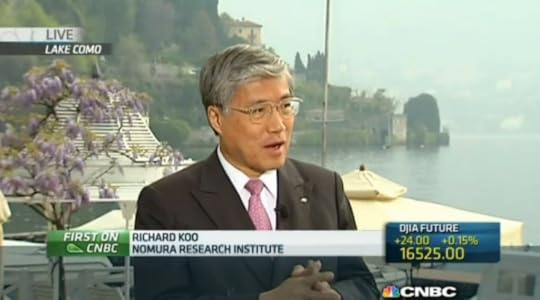
(Jan 21, 2015) As the ECB gathers for a meeting, many speculate on its next steps; some doubt the euro can be saved. Koo is very skeptical about this one single step: “buying debt”.
In a recent interview to the Portuguese newspaper Publico he made some interesting considerations:
(1) Europe is going through a phase like Japan had been in: recession. Buying debt by ECB; this impacts only in the markets, the real economy won’t be saved, says Koo.
(2) There should be solutions at governments’ level; like “government spending money”.
(3) The Maastricht treaty must be corrected; budget rules should change.
(4) The euro is a “magnificent experience” yet some changes must be made.
(5) Private savings should be channeled to buying debt. He believes there’s plenty of savings available both in Spain and Portugal.
(6) Koo is very critical about Germany: the first one who got into troubles; there’s a “great hole” in the German thought [namely that they would pay for high public deficits in Spain, Portugal or Greece].
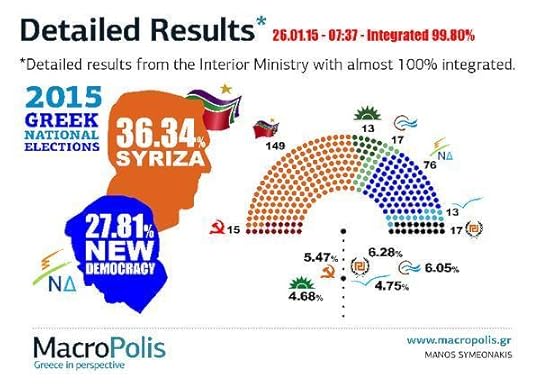
Well, as they [the ECB] gather, I’ve just read that next Monday Greece may have this kind of morning wake-up: under a communist rule, after Sunday elections*;... being third the Nazi-party. The article I just read adds this taxi-driver (called Christos) opinion: “every Greek likes the drachma”.
Things may get tougher for the Euro. But Germany‘s leader has already said : Europe can proceed without Greece; Merkel recently justified her view: “because Ireland and Portugal have recovered”.
Ah, Abe in Japan is trying to bring back inflation. We, here in Portugal, are “deflating”.
I have some doubts on this comparison Europe/Japan. ---
March 2025 update (the great bookshelf un-leveraging continues): Today I've removed all tags and pencil scribbles from this beautiful hardcover before placing it lovingly in the Oxfam box with a dozen or so of its shelfmates.
A lifetime ago, in 2014, I anonymously raised a cheeky question at the annual CFA conference to Sheila Bair, former Chair of the Fed and one of the heroes who saved capitalism once again by giving bankers several trillion dollars more. Sheila deflected my question about the salubrious, equalizing nature of asset and price deflation, but it was fun to see her cool exterior briefly flush at the heresy of such a question from such a body as ours.
Reading through The Holy Grail again, I'm more awake to the nuances of Koo's faith in supply-side econ, aka neoliberalism. While he refuses to apologize for his complicity in Reagan's giveaway to corpo raiders:
I supported Reagan because I believed that America's economic problems could not be solved by conventional macroeconomic policy, and instead required a substantial expansion of the nation's ability to supply goods and services. I still believe that the decision I made at that time was correct.
and fifty more pages in, throws in this neolib article of faith as though it were an aphorism:
Since the private sector is a more efficient user of funds than the government...
nevertheless, I realize now that Koo's thesis directly calls the entire neolib faith into question, hog ties it with logic, and beats it to death with the relentless repetition of fact (all while chanting, of course, this only applies to 'ordinary circumstances'). Huh.
I begin to suspect that Koo had converted over to the behavioralists, and perhaps he did. After all, he even (gently) mocks the sainted Milton Friedman for arrogantly denouncing the Fed presidents (10 out of 11) who dared to disagree with his assessment of the Great Depression. Koo remonstrates that Friedman held this view because it never occurred to him that demand for funds could turn negative; his focus on deposit-reserve and deposit-currency ratios to explain money growth assumes that borrowers are always there.
And yet, Koo then explicitly suggests that his concept of debt minimization preserves the sanctity of neoliberal dogma by freeing it from its reliance on gimmicks such as price and wage stickiness and rigidity to explain long-term recessions. If econs incorporated emojis into their canonical set of runes, that's one of many statements here that needs a lol at the end.
Original notes: I applaud Richard Koo. As the ranking economist of Nomura when he published this book, Koo joins a small club of professional economists published while in the corporate world rather than academia. Today, this kind of research would not see the light of day in book form, for better and worse. That's not to say I agree with everything Koo argues here, and I certainly disagree with his throaty but toothless defense of supply-side economics (aka neoliberalism).
Pointless aside: In 2000, I turned down an opportunity to work for Nomura in downtown Manhattan in the former World Financial Center, across the west side highway from the WTC). Not so much thinking about 9/11 but about how much more self-hating I could have been as a banking d-bag instead of an insurance d-bag. I'm quite happy with my 28 year-old self for taking the road less travelled-by.
As a 'Japan hand' in the first decade or so of my career, I am a student of Japan's political economy and particularly its successfully-engineered post-bubble deflation. Economists almost universally see Japan's policy response to its debt-fuelled feeding frenzy of the 80s, which resulted in over twenty years of declining prices and stable or zero wage growth, as a failure. Koo says, and I agree, that they are all insane.
Koo's hook in Holy Grail (a baffling choice for title until you realize this is a theory of everything) is his assertion that Japan's long recession, while impacted by the usual suspects of structural issues, culture, failed monetary policy, and poorly managed banking system [all true], had as the necessary factor what he calls a "balance sheet recession". By this he means that debt leverage was elevated to the point that it took three decades to unwind it to a meaningful degree. Instead of resuming debt-fuelled growth as soon as the market would support it (i.e. what neolibs worldwide demanded they do), Japanese companies and individuals continued paying off debt even when it didn't make rational* economic sense.
Koo needed about twelve pages to present his evidence, but then we wouldn't have a whole, weighty, and rather impressive-looking book. In support of his hypothesis, Koo presents data on corporations--even those zombies that were technically insolvent--continuing to pay off debt and repair balance sheets into the late 00's, even though interest rates were zero and money was free - which is at odds with economic theory* generally, and particularly with the rigid ideology of the structuralists of the LDP, who have dominated Japanese government since the end of WWII.
Overall, a good analysis and a load of data I had never seen before. Koo argues that Japan's "wasted" decade was anything but. The Japanese bureaucracy, for all of its stereotyped lack of imagination, largely ignored political and corporate demands and effectively engineered a soft, slow decline into shabby chic for the still-large middle class instead of the typical neolib bloodbath. The bureaucracy's aggressive monetary policy, while insufficient to pull Japan out of recession due to the drive to repair debt-laden balance sheets, did in fact keep the economy ticking, albeit on a slow decline.
If only Koo had stopped there... But to turn an article into a book without saying anything new, one must pad. And Koo pads on, assessing responses to other recessions. He bizarrely lists worker strikes as a primary issue rather than a symptom of larger ills, and oddly holds to the argument that the supply-side policies of Reagan and Thatcher administrations were the sufficient factors behind the emergence from stagflation of the US and UK economies - i.e. that trickle-down economics and Reagan's shifting of the tax burden from the wealthy to the poor and middle classes did the trick. Koo completely ignores Volcker's bold monetary experiment that crushed inflation. He parrots the capitalist lie that the private for-profit sector is a more efficient user of capital than the public, and of course cannot answer why private sector borrowing does not result in efficient or sensible allocation of resources, nor higher economic growth.
Will the U.S. be like Japan? Many fear the U.S. GDP will plateau, as Japan's has for over a decade. Interested in learning more about the Japanese episode, I picked up "The Holy Grail of Macro-Economics", by Richard Koo.
The book had much that I was looking for on Japan: about the conditions of their corporations, the levels of indebtedness, and the ways in which their government tried to deal with it.
In addition, it turned out to be a more ambitious book than I expected. Koo talks about the slow down of growth in Germany, and about the Great Depression of the 1930's, and he tries to tie these together to address some fundamental questions in economics.
Koo's thesis is that: Some recessions are special (they're "balance sheet recessions") and are marked by some fundamental behavioral changes because people go into "balance sheet repair mode" for a while. These changes in motivation and behavior, can make it seem as though certain laws of economics are temporarily suspended. For instance, monetary policy does not have its normal effect (e.g. even with rates at zero people could be unwilling to borrow) Fiscal policy can have an impact by spending wealth based on promises of repayment by future generations. He contends this it worked in Japan, and the stagnation that resulted was a good thing; otherwise the country would have seen some years of falling GDP and painful readjustments
Koo terms a balance-sheet recession as the "Yin" phase of an economy, and says it is marked by a drive to strengthen one's balance sheet even allowing possible profit opportunities to slip by (with "Yang" being the typical profit-maximization phase of an economy). He says: "in this phase, monetary policy is ineffective, because firms are all rushing to pay down debt, and private sector demand for funds is essentially non existent."
The notion of a business cycle characterized by over-indebtedness, ending in a crash, followed by deflation is not new. Monetarist Irving Fisher presented it in the 1930's. Among conventional economists, the monetarists advocate "printing" more money as a solution. However, Koo (primarily Keynesian) stresses the futility of monetary policy in the context of a credit-based economy. In such an economy, the central bank can inflate "narrow/core/high-powered money", but the broader credit money-alternatives can continue to deflate while borrowers remain in "balance-sheet repair" mode.
Monetarist economists stress the supply-side of money and credit, giving very little importance to the demand side. The simplified versions of the quantity theory of money assume that demand for money is stable. This works most of the time; however, when people are uncertain about the economic future, the demand for money and credit changes. Creating more money has little effect, because most of it is deployed into the safest asset and and does not "multiply" into business credit expansion. In this narrow area, Koo, the Keynesian would actually find agreement from von Mises who criticized the Quantity Theory of money for excessive focus on the supply of money, and for paying too little attention to demand, addressing it only indirectly via the "velocity of circulation".
Keynes propounded a situation called a "liquidity trap", where monetary policy is ineffective. While the phenomena that Koo describes is very similar, there are crucial differences. Koo says: "Keynes, ... had to argue that it was a decline in the marginal efficiency of capital that induced corporations to stop investing. But he never convincingly explained why the marginal efficiency of capital should suddenly fall."
I interpret this in the following way: Keynes suggested that an economy might face a shortage of investment, but did not explain how this could happen. The mistake Keynes was making is that he was proposing this as a general theory. The type of situation Keynes described can occur, but only in the special and rare case of a balance-sheet recession. In other words Keynes was wrong to think that what he saw was an intermittent "natural" occurrence in a free-economy; rather, it was caused by a large number of people shifting into "balance-sheet repair" mode in the aftermath of a bust in a credit-driven boom.
Be warned that Koo's solution is Keynesian. He wants governments to borrow to the hilt and is comfortable leaving twice or thrice our current debt to the next generation. If you're not willing to read through those types of recommendations don't pick up the book. I will say that Koo is a clear writer, so at least he does not hide his recommendations in obfuscation and throw an epistemological load on the reader. Though many Keynesians see their recommendations as part of a general theory, and would like to see an economic "fine tuning" czar, Koo's book gives it a different spin. If one thinks a mixed economy is legitimate, and if one thinks the government ought to redistribute wealth, then -- in that special case -- there are times when fiscal spending can accomplish the redistribution and can "work" in the sense this its advocates think it ought.
Koo tries to relegate Keynesian prescriptions to a special case, arguing that monetary means at better for regular "fine tuning" by our economic Gods! Of course, as some skeptic note: for Keynesians temporary means forever!
The free-market solution to balance sheet crises is intelligent private-sector driven liquidation and readjustment. If one does not believe in government redistribution, this is also the fair way. In the longer scheme of things, it is also the more efficient way, because the sharper readjustment morphs into a faster turn-around and because it does not build long-term "moral hazard' into the system.
Despite his faulty recommendations, I found Koo's book to be useful. I learnt about recent Japanese economic history. In addition, Koo is an articulate champion for his variant of Keynesianism and it is useful to understand his point of view if one is going to argue against it.
A wonderful review (2009), that I’m very proud of. It just turned out not to be correct. 🤷🏻♂️
(I have upgrade my review -- not because the book, as such, has improved -- it is basically an article masquerading as a book -- but only because the thesis has become a part of my mental furniture)
Good thesis -- mediocre book. Took an hour to browse it. Basically...
Unlike typical recessions, which (like 1990/91) are due to credit crunches, and which can be 'solved' by forcing liquidity into the banking system; the Japanese recession of 1990-2005, like the Great Depression of 1929-1932 are "balance-sheet recessions" -- meaning that a collapse in asset prices (when the bubble bursts) punches a big hole in the balance sheet (these assets are sitting on the asset side of the b.s., were bought with leverage, and used as collateral for further leveraging) -- which can only be 'solved' by deleveraging, that is, by paying down debt. And that takes years... and sometimes decades.
This is what we've got now.
The problem, then, is not liquidity -- or "getting credit flowing again!" -- as Obama and Summers think; the problem is simply solvency... financial institutions, households, govts world-wide... are all effectively bankrupt (that is, their assets are overwhelmed by debts, obligations, liabilities). In this circumstance, pumping in liquidity is useless -- since no one has the capacity to borrow -- there is no lack of supply (money), but rather a lack of demand (appetite). The only thing that will solve this is debt minimization. In Japan, it's taken 27 years (and counting)...
What the Fed is doing will simply stoke inflation.
This means, one needs to sell bonds, and trade dollars out at every opportunity for gold, silver, oil, agricultural commodities, and asia. The U.S. stock market will either fall for the next 10 years or, more likely, trade in a range between 7000 and 12000 while losing value continuously in real (inflation-adjusted) terms as the dollar falls. In the case of extreme inflation (100-200% per annum), the stock market could soar to 30,000 or more -- and STILL lose value in real terms.
There will be inflation and stagnant growth in the West for years to come. Whether it will be an inflationary stagnation or inflationary depression remains to be seen and will depend on many factors.
In the end, an economic theory is just as good as its basic assumptions. One of the core assumptions for almost all Economists is the belief that all corporations always try to maximize profits. Is that assumption always valid? No, argues Richard C. Koo, Nomura’s Chief Economist. A few times during a century, after a major asset bubble breaks, corporations change focus to debt minimization. It creates a huge impact on the economy and needed policy actions. This was the catalyst to The Great Depression and to the recent Japanese recession, according to Koo. He doesn’t hesitate to debate Bernanke, Keynes, Friedman, Krugman and others on this issue. Time will still tell who is right, but Koo’s case is extremely convincing. Even a long- term bottom-up value investor will find new use for macroeconomics with his arguments.
A balance sheet recession is a vicious circle. When an asset bubble breaks because of Monetary tightening, management are forced to save their insolvent companies by allocating all cash flow to debt repayment, independent of the borrowing rate. Few see it initially because it is not in management’s or bank’s interest to speak about it, and it’s usually hard to detect in aggregated numbers. During the Japanese recession, GDP growth was still doing fairly well and the annual deflation was never more than roughly 1 percent.
Koo’s innovation is a division of the state of the economy in two main phases: (1) The “normal” Yang (light) phase where the private sector is healthy, maximizing profits and where monetary actions from Central Banks are highly effective and (2) The Yin (shadow) phase where corporations struggle to repay debt, the demand for funds are essentially non-existent, and “the economy heads towards a contractionary equilibrium known as a depression.” In this phase, governments need to do the opposite of the private sector - they must borrow and spend. This is all about aggressive fiscal policy. Deficits and high public debt levels are of secondary importance. In a Eurozone balance sheet recession, the Maastricht 3% cap will be a devastating constraint. Koo’s Yin-Yang cycle of bubbles and balance sheet recessions is a true intellectual advance!
Koo also examines several other – even the more spectacular - suggested policy actions in the public debate including helicopter money, government purchases of bonds, capital injections in banks, etc. His conclusions are very value added.
Is Koo’s Balance Sheet Recession Theory just a modernized update to Irving Fisher’s Debt Deflation Theory? No, but there are similarities. “Debt Deflation” begins with a rapid fall in output prices whereas a “Balance Sheet Recession” starts with a major fall in asset prices, which is more common. Are we in a Balance Sheet Recession currently? “The subprime fiasco contains certain peculiarities that are not found in the past balance sheet recessions. For one, the problem originates with the household and banking sectors, rather than the corporate sector.” But the story doesn’t stop there. There are many commonalities with the situation in Japan during the last 20 years. Chapter 7, “Ongoing Bubbles and Balance Sheet Recessions,” was an exciting page-turner for me. That goes for the update in Chapter 8 too (I read the revised edition from 2009).
This book has really opened my eyes in many ways. Koo’s explanation for the different phases in his Yin-Yang circle is very logical and well written. Suddenly, it all fits together. And the crucial question regarding reflation/deflation in this secular trend is much easier to analyze. Without doubt, this will be a classic. Kudos for extremely useful graphs and tables. One minor nuisance is the extensive repetition of some of Koo’s more important arguments. This book is a high IRR investment for all market participants.
Richard Koo is famous for bringing the concept of balance sheet recession into the economics mainstream. His thoughts are important up to this date (January 2026), as he seems to be one of the few economists to make sense of what is going on in China. This book is a classic for students of history of economic thoughts and ideas given the relevance of the concept of “balance sheet recessions”, and given that the latest (definitive?) edition of the book dates from 2009, when there was a lot of optimism about Japan’s economic recovery which didn’t really materialize. The general public can probably get a better grasp of Koo’s ideas in more recent podcast interviews of him. He remains a relevant thinker. The appendix on the book on how to integrate money into mainstream economic models is essential for graduate students of economics. The reason I’m giving this book only 3 stars is because it has a big editing (or translation?) problem, and feels very repetitive at times. This is the typical book that can easily be a PowerPoint presentation for certain audiences -or, again, a podcast interview.
If you're into this kind of stuff, this book is a good read. If not, it would be as dry as a mouthful of crunchy October leaves from your backyard. Not dry like humor can be dry, because there is no humor involved (of course, why would there be?), but again, dry like a mouthful of crunchy October leaves.
I'm into this kind of stuff, and yet I give it only 2 stars--the "it was OK" rating, for which I have plenty of reasons, in addition to it's lack of flavor, style, or the presence of a creative editor. The reasons are listed below, but I still say it is a good read for me because I like disputing claims while reading them. But before I get into the reasons, let me first add the disclaimer that I'm a lightweight in these subjects compared to Koo, so I'm sure my arguments he could easily combat even if the book itself does not.
First reason, the book lacks the scope necessary to be considered an important contribution to the field of economics. The scope is limited because of a fixation on the term "balance sheet recession," but never is mentioned exactly how macro asset prices have fallen, how a state should prevent these prices from falling, if a state should prevent it, whether the problem is the climb of asset prices instead of the fall of asset prices, whether the problem is with accounting of asset values, whether asset prices should be rebooked to reflect current values following a bubble burst (suggesting the recessions are not caused by falling prices but by firms limiting capital transactions by holding onto their assets and thereby restricting the velocity of money). Further, the scope of the book is limited by the repeated idea that firms change behavior from profit maximizing to debt-minimizing, but this is the same thing entirely since debt cannot be minimized without earning the owners equity to pay it down which comes from maximizing profit, so behavior cannot be changed nearly as much as he claims it changes (and he doesn't offer any specifics about how corporate behavior changes exactly, other than the propensity to allocate more money to debt repayment instead of reinvestment or share distribution, therefore the standard theories of assuming corporations are profit maximizing which the book discards cannot be discarded or discounted whimsically). Especially missing from this book is a clear and detailed policy recommendation for the so-called balance sheet recessions. You must pay very close attention or you will miss the recommendation, which is either heavy fiscal stimulus or nationalization. Most of the book focuses on criticisms of monetary efforts, but at least one chapter focused on detailed policy recommendation would have gone a long way to improving the book. I could go on, but let's call that sufficient. The scope of the book is limited.
Second, the book undermines experts on the subject instead of consulting them. Speaking of policy recommendations, the book criticizes the very people who are making the same policy recommendations that this book makes, except those experts who are making those recommendations are doing it so much more clearly. It seems the author of this book has a personal vendetta against Krugman for Krugman's highly-published criticisms of the Japanese handling of the recession, and it comes out clearer than every in the final page of this book. It appears the author of this book fails to see Krugman for what he is, a political pundit who writes opinion articles in the NYT. Sometimes Krugman says things that are interesting and fun to read, and that is the reason he is writing in the NYT and not the Journal of Economics. Sure, Krugman has won the Nobel Prize for Economics, but that doesn't mean every thing he says is biblical. Therefore, a look at a book such as his most recent one will show that Krugman makes a strong case for fiscal stimulus spending in areas like local governments and government works projects--mirroring what Koo recomends. The only difference is, you need to read carefully to find the 2 or 3 mentions by Koo for his recommendations, Krugman bases his entire book on the argument. Another expert on the subject is Stiglitz, who also wrote multiple books on the subject and is a strong advocate and a voice of reason on the Japanese and 1997 and IMF debacle, yet Koo picks out some comments made here and there which he doesn't agree with, and hence throws out the entire expert and the overall views of that expert. Yet Stiglitz offers detailed recommendations for the path forward, detailed mistakes from history, both of which match Koo's but are presented in such a better way. Stiglitz, who is the second Nobel-laureate criticized by Koo, was not the last expert receiving fire from this book. Fed Chairman Bernanke, labeled "Helicopter Ben" in the final pages of this book, is repeatedly criticized for his words on using monetary policy to curb recessions. Koo makes a mistake by doing this, because Bernanke, as chairman of the Fed, has monetary policy as his only tool to help. Koo says monetary policy through quantitative easing could only remedy about 15% of the cause of the recession in Japan, and therefore isn't good enough. In another comment, Koo criticizes Henry Paulson for bailing out corporations on a "case-by-case basis" instead of saying the government will do all that it can do. Well, my response to Koo is that 15% help is part of the "all that it can do" and when you are chairman of the Fed, the ONLY thing you can do is affect the money supply. Fiscal stimulus is not an option for Bernanke, so Bernanke will simply do all he can do, and will have to rely on the political branches of the government to do the rest. Therefore, a good 200 pages of this book about monetary policy is an interesting read, if you like arguing with you books. And to address the money from the sky claim, Koo thinks all businesses would close shop as soon as money started falling from Bernanke's helicopter, because he knows they SHOULD because of the ultimate effect on prices. Well, I think Koo has seriously misguided understanding of people's behavior, because the shops would close, but only long enough for the shop owners to go out and collect their own portion of money falling from the sky. Shop owners don't take a wet-thumb check on how the money supply is flowing as a determinant for their pricing, the couldn't care less about all the things presented in this book, so yes, theoretically, a limited influx of money supply will increase money velocity and demand. And the theory of it is where Koo really misses the boat. Academics use the analogy to teach the theory of money supply. They don't actually suggest that the chairmen rent a helicopter and drop money on NYC, academics use images to teach their college students the effects of money supply changes. Basically, Koo takes on the big-hitters in economics all by himself, at one time suggesting a warning label on purchases rated by currency rating agencies which would resemble the Surgeons General's warning label on cigarettes, and includes an image of it in his book. If you want to take on the big hitters, get a better editor, because this is not how economists battle out their ideas. Better yet, get some peer-reviewed studies out there which establish your own weakly defended point instead of 300 pages of out-of-context attacks on the experts. It is fair to say the author has a very low opinion of academic economists, and all people who were critical of some of Japan's actions during the recession there. About the only people he likes is the former chairman Volcker, Greenspan's and Bernanke's predecessor, and a Japanese prime minister who seems to give audience to the author's ideas. At one point, when discussing Volcker, he mentions his wondering where Volcker is, and that he should reemerge as the adult supervisor over these young guns who have no experience with banking crisis. Ouch. As if Volcker would save the day...that is about as offensive as can be. And yet, Obama brought in Volcker the Democrat to help deal with the crisis in 2009 until 2011. Back to the book, when you're on an island of ideas, a book of this caliber will never get you onto the mainland, so consulting other experts may be a good focus for his next book, and those experts may very well be Bernanke and Greenspan, who have inflation control as their highest priority (and have been extremely successful in that area). In fact, a solid academic perspective would be interesting for this subject. One could study the incentives of corporate leaders once asset prices fall, and develop the next Nash theory to go with it. One could study the effects of the velocity of money as debt repayments increase proportional to other transactions, and develop the another next Nash theory to go with it. One could develop an economic theory on the incentives of said shop keepers once the money starts falling from Bernanke's helicopter. Once could develop a theory to chart the estimated effects of monetary policy vs. fiscal policy during a bubble-burst recession (or a balance sheet recession, as it's called in this book). All of these things could be done, peer reviewed, and published, adding to the body of knowledge. But the island this book sits on is too isolated to make a difference. Finally, one more thing about this subject: the book begins with Bernanke being quoted as saying the true overall discovery of macroeconomic drivers and gears is elusive and difficult, and always has been, and finding the answers is as unlikely as finding the Holy Grail. Well, Koo wastes no time in naming his book after the quote, pretentiously claiming his "balance sheet recession" idea is, in fact, that very holy idea. As if. I think I just threw up in my mouth. More vomit flows with the realization that the whole cause the these recessions are attributed to these balance sheet problems, yet the cause of the balance sheet problems are finally mentioned ONCE, briefly, in this entire book! At the end. When he talks about the Greenspan-era response to the tech bubble burst recession, which response was to use a monetary influx, which overheated the economy through too-available credit, which inflated asset prices. So behold: monetary policy is indeed one of the crucial players in solving the so-called balance sheet recessions! Therefore, those first 200 pages can be skipped. Start with Koo's dealings on trade balances and exchange rates.
Third, the book--for all it's graphs and charts--lacks the scientific presence necessary when presenting the science of macroeconomics. To be the holy grail of anything, it needs to convince silly people like me, and everyone up the totem pole. No studies were conducted. Causal relationships were assumed when reality was likely only a correlated relationship (for example, the book's major thesis of balance sheet problems as the cause of the Great Depression, US, and Japanese recessions, yet no causal relationship should be inferred from the data presented. It is more likely that recession holy grails are found long before they become balance sheet problems). Sometimes it seemed like a data dump. And I'm not convinced the data told the story on their own, simply because of all the workings within the current global economy. To be discussing such an enigma as macroeconomics, one needs to be scientific at least. And that usually involves (gasp!) academic influence.
Fourth, the book (almost) has an agenda which I don't agree with. I say almost because in the final chapter, which I believe was added after the original publication following the US bubble burst, he spends a page or two talking about how stimulus spending on financial institutions was not entirely productive. This was a wise save, even though brief, because earlier in the book, government-funded capitalization for financial institutions was advocated. The book, in this earlier section, mentions how it would be difficult to pass stimulus for the capitalizing of banks due to the bad reputation of the fat cats, greed, and excess on Wall Street. I believe fat cats was even put in quotation marks, as well as a few other derogatory statements, apparently quoting the general public. It is clear the author doesn't agree with this evaluation by the general public, sides with the bankers (or the builders of our current "fianancial capitalism"), and believes the bankers are the backbone of the economy. I disagree because, although bankers are critical to our economy, they are highly overvalued. Koo mentions in this final chapter that it is "remarkable" that the TARP plan came from a Republican administration. Why is that remarkable? The only thing remarkable about it was how publically bold the GOP was in verifying how big business is permanently welded to the party. No, this was not a surprise at all, unless you know very little about the GOP. Like the results of the Iraq war, if there is an excuse to divert tax revenues back to huge business, the GOP leaders will stand in line all night to make sure they get the chance. Other than these few references, however, the author keeps out of politics and tries to stay the academic course...well, no, he doesn't try to be academic either since he has such a low regard for academic economist. But he stays true to himself, at least.
Fifth, and I've already mentioned this, the book is dry. Reading it is like reading a math textbook which has all the math wrong, leaving you with long and oft-repeated justifications for ignoring the importance of monetary policy.
I will begin to be fair to this book, in conclusion. I agree that large fiscal spending, even if it means large deficits, on very specific types of projects, is the best path for recovery from severe recessions (recessions which cannot be solved alone through a low or zero target interest rate, or monetary policy). This book doesn't offer these types of specifics, but Stiglitz does in "Freefall." Still the book comes to this conclusion, although vaguely, and I agree with that conclusion. Also, I like the discussion. Although the material was minor leagues compared to the major leagues in academic economics, the discussion is important so we can more closely arrive at the correct decision for policy. Koo is certainly knowledgeable and experienced on the subjects he presents, and I couldn't find exactly any ulterior motives.
This book took way longer than expected because I was lazy but it was cook.
He didn’t really explain the cause of the crash in asset prices in Japans bubble economy but it honestly didn’t really matter because his explanation of everything after was so good.
Learned a lot about macroeconomics which is something I knew basically nothing about before. Besides Japans economics woes he also explains the Great Depression, the 2008 housing collapse among others.
If you just want to learn about his “holy grail” macro lesson, you can just read chapter 5 and be done though.
Some of the info which he wrote in the 2000s predicted events that happened while I was reading the book which was funny. And he also doesn’t shy from dunking on other peoples ideas in funny ways.
Probably the best written book I’ve read this year due to how it made something I would never care for interesting.
A fascinating book that seeks to explain how and why certain types of recessions--those caused by a massive asset bubble bursts, which result in "debt overhang"--are so much more damaging than the ordinary recessions of the business cycle.
Koo's thesis is interesting, and if borne out, provides a possible micro-foundation for macroeconomics: That after a massive asset-price bubble (in housing, corporate debt, or whatever) bursts, a large number of private firms and households shift from a pure profit-maximization motive toward debt-minimization. The argument is that in these specific circumstances--what Koo terms "balance sheet recessions"--the underlying central assumption of microeconomics, profit-maximization, is no longer entirely applicable. Instead, firms are seeking to deleverage in an effort to restore their balance sheets after an large bubble destroys asset prices.
Koo's argument is that firms' and/or households' make the individually rational decision to engage in a massive, multi-year (or multi-decade) bout of deleveraging, which only further depresses asset prices as the formerly highly-priced assets are dumped on the market. That, in turn, weakens demand for loanable funds, rendering traditional monetary policy (reducing interest rates) a largely useless effort equivalent to "pushing on a string." From a macro perspective, as firms and households shift toward directing their income toward paying down debt (or saving), consumption and investment decline precipitously--thereby explaining the weakness in aggregate demand associated with massive recessions, or depressions.
Koo takes pains to state that he's "not a Keynesian," but at times that seems to be mere posturing. His theory can be made consistent with basic New Keynesian theory, and he argues for many of the same conclusions as Keynesian economics--namely, that debt-financed government stimulus will both prop up aggregate demand and make use of excess savings that otherwise would just be sitting unused in banks accounts will stimulate the economy and accelerate the recovery. The main difference seems to me that (1) Koo has the same destination but takes a different route (balance sheet liabilities as a drag, rather than Keynes's reduced marginal efficiency of capital) to get there, and (2) Koo argues that fiscal stimulus is only needed in these particularly rare balance sheet recessions and that ordinary monetary policy works just fine during an "ordinary" business cycle recession.
The argument needs refinement, of course. But as a book with a "big idea," I'm impressed. In any case, I'm eager to see empirical evidence supporting the Balance Sheet Recession concept. Only time and further study will tell if Koo's argument is valid in whole or in part.
Finally, I should note the first chapter, on Japan's 1990-2005 recession, should be required reading for any American unfamiliar with how fiscal stimulus works. As in Japan, the 2009 American Recovery and Reinvestment Act ("the stimulus bill") saved us from unimaginably worse conditions. Of course, I suppose it's human nature nobody ever gets credit for saving us from doom; no, heroes seem to be recognized only after the doom arrives and someone come along to save us... only after much suffering. The authors of Japan's decade of stimulus--which allowed that country to avoid an outright depression--and the architects of America's 2009 Recovery Act--can no doubt attest to that reality.
This book made me realized that my 3 year Economic degree was a huge waste of time. Applying my understanding to the concept of this book was simple because the author was kind enough to make some rather repetitive and naggish comments about the economy which I find easy in connecting the dots.
More importantly, the book has taught me on the various recessions that could possibly happen whilst my university only taught me of one type, (THE) Recession. It has also gave me new insight on why certain policies are only suitable for certain recessions, backing its argument with strong historical data and valid reasonings.
It has also brainwashed me into rethinking on the usefulness of Monetary and fiscal Policy and how relevant or irrelevant it can be in today's economy. For example, in a Balance-sheet-like recession, something I have never heard of until I started reading this book, like Japan, where constant low interest rates has not managed to spur demand after more than a decade comes to show that Monetary policies are practically useless in the economy! The reasons are very clean and easy to comprehend, but I shall not spoil it here.
It also shows how Fiscal policy can be a real headache if applied wrongly because the next big problem that can happen is unwanted inflation.
I also like the way it talks about Carry Trade especially when it disputed my initial understanding of interest rates and currency exchange - how economies in recession can suffer a further recession when interest rates are lowered, and how economies in expansion can continue to hit a bubble despite higher interest rates to control demand for funds.
One thing is clear, you need to read this to know what is truly happening in our highly uncertain economic climate. Not everything mentioned in the news and by our lecturers and other experts are absolute. Quote an example from the book, a sick economy that has been taking remedy A for the past 6 months now took remedy B along with A suddenly recovered in a month. Sometimes it could be that B is ineffective and that A just needs a longer time to take effect, but the media that obviously know little about economics will glorify B because it seems to be the "legit cure". This can be scary. Imagine the consequences if we applied the wrong remedy to similar recessions in the future because the historical "data" says it is "right".
This could have been a good article, it makes for a poor book. The author has a great central concept, but fails to prove it, demonstrate the conditions where it holds true and otherwise, consider possible ways it could be falsified, in short, it is unscientific, when attempting to make science-like statements. Where it succeeds is in challenging the assumptions of other economists, which are often woefully inadequate. It's just very repetitive, every section finishes with a conclusion that repeats the contents of the intro, and after a while, I guarantee you feel like you are in the book equivalent of groundhog day.
Very insightful discussion of Japan's recession on causes and comparisons to the US Great Depression. My notes:
* The importance of corporate and household borrowing, specifically when it becomes absent, is critical to understanding causes of recessions. This can be triggered by a collapse in asset prices if leverage is high as seen in Japan in 90s post Heisei bubble. This leaves only the debt behind to manage.
* This collapse in asset prices triggers a behavior change for highly leveraged corporates/households where they pay down debt, with priority changing from profit maximisation to debt minimisation. That debt repayment leads to a contraction on overall activity, spurring a balance sheet recession. In Japan, this switch in corporate behavior led to a loss of corp demand of 20% of GDP from 1990 to 2003.
* A consequence of this is monetary policy is rendered ineffective as there are no willing borrowers even at zero rates. The antidote then becomes fiscal policy which Japan deployed in the 90s and avoided a more significant recession as it filled the demand gap formed from corporations paying down debt. This allowed Japan GDP to stay at or above peak bubble-era levels despite the enormous loss in wealth.
* The fall in Japan asset prices (stock, land) starting in 1990 led to a JPY1.5trn decline in wealth, three years of GDP or the entire nation's stock of personal financial assets. From the peak of the bubble in 1990 to 1998 corporates swung from having 9% of GDP from borrowing to -9% from net debt repayments, a 18% LOSS OF GDP.
* A Liquidity trap is when interest rates fall to such low levels that money and bonds become perfect substitutes and suppliers of funds choose to hold cash instead of lending the funds at such low rates to the corporate sector by buying bonds. The cause of this is can be a change in the behavior of borrowers, not lenders. As firms cut debt, they not only ear mark cash flow for debt repayment, but they also stop borrowing and investing the savings of the household sector, creating a deflationary gap. The trap begins the moment that companies start minimising debt.
* While there is pushback to fiscal on crowding out the private sector, that can't happen when the private sector is paying down debt and why fiscal is needed. Koo makes the point that a premature removal of fiscal stimulus is a key risk to exiting a balance sheet recession as happened in Japan in 1997 and US budget cuts in 1937 as it question the sustainability of growth. This also drives a spike in unemployment.
* The Great Depression is also viewed as a balance sheet recession by Koo. While many attribute it to bank runs leading to a credit crunch from less lending, the Fed replaced the majority of deposit losses filling that gap, also only 13.6% of firms in 1932 found issue with bank lending standards. Liquidity also could not have stemmed the banking crisis as bank runs happened in 1931, well after a -93% decline in borrowing. Koo asserts, instead, it was firms reducing their debt voluntarily that led to a significant decline in money supply that created the bank issues. Prior to the depression, borrowing hit record levels in 1929 along with asset prices drawing a parallel to the Heisei bubble.
* Asset purchases are also not an antidote after a sustained drop in asset prices if market participants do not think these efforts would lift the DCF of assets. In order to lead companies to not pay down debt, you would need to buy enough assets to reach the previous bubble high, which is generally not possible or if done questions CB credibility. he also argues against helicopter money as leads to currency depreciation and instead argues for tax rebates as that is fiscal policy.
* In a trade surplus economy, devaluation is also not an obvious solution as leads to resistance from trade partners eg Summers in 1999 firm response to Japan's MOF announcing intention to weaken currency. That said, depreciation does work if you are running a CA deficit.
* Good discussion of the yen carry trade and the feedback loop of low relative interest rates.
This entire review has been hidden because of spoilers.
A good account by Koo, who has clearly done a great job researching and exploring how Japan handled its recession. First published in 2008 and then updated in 2009, it contains some great insights that accurately described how the economy would respond to a lot of measures that people used to combat the Great Recession.
Koo's "Holy Grail" here is that he introduces a "yin-yang" model that attempts to tie together the 2 strands of economic theory - namely Keynesian economics and monetarist viewpoint. Unlike ardent proponents of both sides - Koo does not appear wedded to any particular view, but rather argues that economists should be more receptive to the actual economy. ("But for the discipline of economics to be of value to society, economists must have the courage to face reality, even if it means abandoning some of their beloved mental gymnastics.” p307). As he accurately points out, the Keynesians themselves were discredited after their policies no longer worked, leading the ascent of monetarist theories (which now themselves are showing their deficiencies). Instead he argues that the economy has 2 modes that should dictate the approach applied. In the yang (light, where the economy is still confident) then the monetarist approach does apply - firms respond to changing interest rates and the supply of liquidity. In the yin (dark), the private sector is attempting to deleverage - hence lower interest rates and liquidity injections do not work. There are no borrowers responsive to these levers. Instead what is required is fiscal stimulus by the government. Koo's analysis in many respects is validated by the subdued inflation that we have seen globally despite various programs globally (the Fed's QE programs, the ECB's negative interest rate and stimulus program).
In addition to the model that he offers above, Koo also provides suggestions for how the world may seek to rebalance itself (namely singling out the US trade deficit as something unsustainable). He almost seems prescient when he notes: "If no action is taken, and trade imbalances are allowed to expand unhindered, protectionism will rule the day, in what may be the worst of all outcomes." (p212) Even today in 2018, the book can still provide some genuine insight and is worth reading.
My only slight critique is that the book is a bit repetitive in parts. It is also worth noting that the book can get quite technical - this is not a criticism, but more something prospective readers should keep in mind.
Long review follows -- its really a blog post of what I think would be Koo's implicit analysis of the GFC'08. One-word review of book -- excellent. Clearly written and argued, provocatively synthesizes the debate between fiscal and monetary policy, and throws in some tangential but provocative economic ideas to boot. My only complaint is he gives too little weight to the influence of Japan's zombie banks in the Jap recession -- he argues, implicitly, that zombie banks didn't matter, and I'd liked to have heard more evidence for this. Also, he doesn't address what is now becoming a Jap economy bugbear -- the huge fiscal deficit and debt/GDP position.
*****
Much commentary has devoted itself to comparing the GFC (Great Financial Crisis) to Japan in the 90s. Hence I picked up Richard Koo's Holy Grail.
Won't go deep into it, but essentially: Japan in 90's was in what he terms a 'balance sheet' recession, where corporates have damaged balance sheets due to asset price plunging, but nominal debt remains the same. So they redirect all their free cash flow (this is contingent on the ability to keep selling goods, as Japan was through the 90s) to paying down their debt and repairing balance sheet. This means monetary policy is ineffective; further, and more controversially (to me) it means that Japan's problems stemmed not from a zombie banking sector but by lack of demand for funds in the first place. Thus, he argues that despite the criticism (e.g. from Krugman, Bernanke, etc) Japan did the right thing through the 90s -- using fiscal policy to sustain GDP and incomes, enabling corporates to slowly repair their balance sheets, up to the point where they get over their debt aversion and start borrowing again. He calls this an 'yin' phase, where firms focus on paying down debt, compared to the 'yang' phase, where firms focus on maximising profits, and where all our conventional arguments about fiscal/monetary policy play out.
It’s very interesting because: (i) he claims to synthesise the fiscal vs monetary debate by recognizing that both sides are right, depending on what stage of the cycle an economy is at; (ii) more disturbing from a market perspective, he argues that what happened in Japan was not a worst but a best case scenario. This runs counter to what many experts (professional/academic economists, journalists, etc) regard as conventional wisdom that Japan’s zombie banks held Japan back through the 90s and if only they’d cleaned ‘em up sooner it would’ve recovered faster.
Koo’s evidence in refuting the zombie bank theory is (i) size of Japan corporate bond market, (ii) foreign bank lending in Japan, (iii) lending rate of Jap banks. Basically, lending rates of Jap banks fell, however, it wasn’t due to banks’ refusal/inability to lend (in accordance with zombie bank theory) but because demand for funds wasn’t there – reflected in that corp bond market shrank, nor did foreign banks step in to fill the gap, as they could have. (Charts are on p8 of the book, I don’t have a scanner unfortunately. Dr Koo also apparently presented his ideas in March-09, I didn’t attend but found this slide deck on this website -- . The relevant initial charts are not there, but others I cite next are.)
Anyhow, he argues that both Japan in the 1990s and the US in the 1930s suffered from balance sheet recessions, a bigger whopper than the usual kind, and caused by many years of excess liquidity in the years/decades preceding, and triggered by extremely sharp falls in asset prices, which decimate balance sheets and require firms/households to spend many years slowly repairing them and getting over the resultant debt-aversion. His evidence for this is found in Slides 13, 15, 16 of the above slide deck, where he argues that despite ZIRP in Japan, corporates still focused on paying down debt, and had actually managed to repair their BS by 2005, after which corporate lending did start to increase a bit. In the interim, Japan relied in increasing govt debt, and drawdown of household savings (which fortunately had been high) to sustain GDP.
One key observation is that Japan suffered wealth destruction of 1,500 trillion Yen from 1990-2005, equivalent of 3 years of GDP. Dr Koo notes that the GD wiped out (only?) one year’s worth of pre-GD US GDP. From estimates of wealth destruction due to the GFC, I think I've seen figures like US$11t in the US alone, just for households (which could be more if we include corporate balance sheets), and US GDP in 2007 was ~US$13.84t so its in the range of damage that would lead to a long-lasting balance sheet recession.
So, in the final chapter, Dr Koo argues (book published March 08, last chapter is analysis of the GFC) that what the US govt did in allowing banks to survive is right -- you can't push for rapid NPL disposal, because a lack of buyers leads to a crash in asset prices. (Slide 19 shows his categorization of recessions and the appropriate policy response.) I’m not fully convinced at this point – he’d be more convincing if he more fully addressed Japan's banking sector in depth and how zombie banks’ awful BS helped prolong the crisis, even if they weren’t the proximate source of anemic fund demand – don’t know enough myself to comment.
He also makes the point that you can't expect banks to earn their way out of insolvency, because the underlying economy is so weak and no one wants to borrow. Thus recap is necessary, fiscal policy is critical, and the national debt be damned (for the time being).
Of course, the specific drivers, macro context and industrial structures are different. To me:
(i) US exporters are fundamentally weaker than Japanese corporates were, and b/c we Asians can’t immediately make up for US consumption, US firms may not be able to generate the requisite free cash flow to pay down debt, as did the Japs. (ii) Damage to Jap balance sheets could’ve been due to high cross-holding structures of Jap corporates, leading to sharply reduced assets when share prices fell. US firms may own less of each others’ shares. And in the US at least, the damage is really to the household balance sheets, at least as much as to the corporates. So corporates may still want to borrow, and monetary policy may be more effective in the GFC than Dr Koo argues it was in Japan. (iii) Japan could, due to its socio-political structures, push through deficit funded fiscal programs; also its households had high savings stock that they could draw down. These two may not apply in the US today. The first point suggests tracking of US exports and FCF generation by US firms. The second and third could perhaps be addressed by looking at corporate bond and lending rates, and anecdotal evidence from corporate banker friends on demand for funds… I don’t have the requisite data, but Slide 7 suggests falling demand for funds in the US, consistent with the BS recession thesis.
If Dr Koo’s analysis of Japan is right, and the read-through to the GFC is appropriate, it seems to me to point (rather conventionally after all that) to a long-term deleveraging (not inconsistent with US inflation due to weak dollar) and a slow recovery. But I’d very much like to know what others think of the whole BS recession concept…
I can't take Koo seriously. He comes off as arrogant and hypocritical. The "holy grail" he discovers is the one concept he is known for -the balance sheet recession- that he spends an entire book talking about interspersed with "fun" stories about himself "educating" government and IMF officials. He includes a lot of charts and sometimes makes claims using the charts as evidence that the charts themselves don't support, such as Exhibit 2-3 which he references on page 47 saying "For example, large and small enterprises alike felt that banks were just as willing to lend in 1995 as at the peak of the bubble in 1988." The chart clearly DOES NOT show this. But that doesn't matter because it close enough and fits his thesis.
Then he has a fun story on page 75 about how foreign economists including those at the IMF are so far removed from Japan that they just don't get it like he does. He blames this disconnect from reality leading to the IMF forcing Japan to the brink of economic collapse in 1997. He of course had consulted them in 1996 not to do what they had planned but they did it anyway. And after the "debacle in 1997" guess what, they came back and apologized to HIM personally that they were wrong "saying, 'We are very sorry for the Japanese people.'"....But he cannot blame them so much he says, it is really not surprising because they do not teach his balance sheet recession concept in schools! These newly appointed IMF staff in Japan just can't understand it like he can because they only have the tools they learned in university. Then on the same page he gives the outdated money multiplier model that Richard Werner had already challenged in Princes of the Yen (2003) and would later empirically disprove (2014), but still taught in universities, revealing Koo himself to be guilty of the very same deficit of understanding he accuses other economists of having "banks are required to keep a certain amount of funds in reserve against the loans they make. With a 10% reserve requirement a bank that receives a deposit of 100 must keep 10 on hand but may lend out the remaining 90 to another customer..." At this point 76 pages in I felt I was wasting my time. I'm returning this to the library and discouraging anyone else from wasting their time with this orthodox self aggrandizing slop.
Koo takes as a case study the decades-long recession of the Japanese economy. He makes a special study of the fiscal policies driving deficit, while at the same time the private sector had no appetite for borrowing. His thesis is that balance sheet driven recessions require special care and feeding. His lesson for the post-2009 US economy is that we are in such a balance sheet driven recession. Normal economic lessons of monetary policy do not apply. He is quick to condemn quantitative easing, as the case of a merchant who stocks 500, then 1000, then 5000 pieces of inventory when they will not sell at $100 a piece. His point is that the sale is not clearing at the price of $100 and the myth of quantity creating appetite for credit is flawed. He has a theory of yin and yang in place of the conventional monetary wisdom. When asset prices plunge after bubbles are pricked, one has periods of balance sheet recessions, private sector has no appetite for debt as it deleverages. Fiscal policy must take up excessive borrowing. Monetary easing is all but useless. Even after companies reduce debt, there is no appetite for loans and interest rates stay low. Deflationary influences are at work. (examples are post 1929-1933 Great Depression). Slowly appetite for credit and risk reappears. Monetary policy starts working again as fiscal deficit starts to crowd out private investment. Private sector is overconfident triggering new bubble. The narrative is clear and the graphs numerous. Japan is an excellent, if well-known case study. Yet, Koizumi and other politicians kept blaming the Bank of Japan. Koo points out that it was a Balance Sheet Recession when only fiscal deficit spending was appropriate. This is not Keynesianism, Koo makes clear. The one shortcoming of Koo's writing is that he can be repetitive. Nevertheless, the book comes with strong endorsements from the likes of Larry Summers, former Secretary of the Treasury, Yasuhi Mieno, Former Governor Bank of Japan. It is also a rapid read and is highly recommended to any reader of a business newspaper interested in macroeconomics. There is also a brilliant interplay of globalization which in today's fraught climate about tariffs and frictions is all the more relevant.
“Asset-price bubbles will happen again. It may be decades before we see another one as large as Japan’s in the late 1980s, but the nation has already experienced a smaller but similar IT bubble. Larger asset-price bubbles have occurred elsewhere—witness the U.S. housing and Chinese stock market/real estate bubbles. When these bubbles eventually burst, it is comforting to know that Japan’s recent experience has clearly demonstrated what sort of policy is required to deal with their aftermath.
Even if the bursting of a bubble destroys national wealth equivalent to many years of GDP, and prompts the private sector to begin paying down debt, Japan has shown that it is possible to maintain GDP at bubble-peak levels as long as the government engages in timely fiscal stimulus to fill the deflationary gap, and propping up aggregate demand and money supply in this manner will enable businesses and households to repair their balance sheets sooner than would otherwise be possible.”
Interesting case study of Japans great recession and the US Great Depression. These concepts push back on the effectiveness of current monetary dominated regimes following the fiscally dominant years of 1940s-70s, especially if outside factors cause reduced loan demand, monetary policy looses it effect. Which has been acknowledged by policymakers via the overly aggressive post COVID fiscal stimulus, which makes the reemergence of fiscal dominance in many DE (and above average inflation) more likely. Sadly, Japans structural demographic challenges and their effects on economic growth didnt recieve a mention.
The book published in 2009 has made good arguments in favor of a continued economic recovery in Japan reignited via the end of private sector debt repayments, which has played out well, giving the tools described in this book even more credibility.
This is a good book where the author analyzes the lessons and causes of Japan’s past recession, although some parts are somewhat repetitive. Readers should note that it was published in 2008, so some discussions might be outdated.
The book mainly focuses on Japan’s recession starting in 1990 and the great depression in U.S. Koo coins the term “balance sheet recession” to describe these situations. While he correctly highlights this phenomenon, I don’t entirely agree that it’s the “holy grail” of macroeconomics, and the book doesn’t offer clear solutions for preventing or tackling these recessions.
Some arguments, like the Yin and Yang classification, seem a bit far-fetched, trying to answer questions beyond the “balance sheet recession” concept. Additionally, Koo’s strong advocacy for fiscal policy over monetary policy feels like it needs more balance.
Balance sheet recession is the main idea of this book. Extensive analysis is included, mostly on Japan and the United States.
I think the most enlightening part of the book is how the Author characterizes the Yang and Yin world, in which of them should liberate the private sector investment and in which government should step in and spend.
Based on Japan's experience and policy mistakes during the lost decade, the extensive details and analysis provides guidance and great reference for both policy makers and investment professionals.
Yes it is the Holy Grail. The content of the book does justice to its Name. He has done a brilliant job of explaining extremely dense & complicated subject lucidly. Common Sense, pragmatism & logic dominates the conversation he has with his readers as he explains lost years of Japan between 90 to 00. He also draws analogy from Great Depression of 1929 to present his case. Difficult to think about a criticism right now maybe some time in the future when new problems demands new solutions in a dynamic world. MUST READ!
A tad repetitive at times but it does help with understanding.
His seems like a original idea and approach. The man should be commended and should at least receive a nomination for the Nobel prize (not that it's a very good prize).
He slams Greenspan, Krugman and a host of others. SO far, apart form a few obscure websites with unreputable writers no one seems to have tried to refute his thesis.
unique and lucid account given to balance sheet driven recession: the 4 types of recession - systemic/regional, lender demand exist/ not exist. Focusing on lender demand stands out from mainstream analysis, though some chapters seemed redundant. Brillant analysis on the impact of free capital flow under trade imbalance and interest rate differential!! Appendix - criticism on neoclassical economics and role of money very good
The author made convincing arguments in introducing the two types of recession, and proposed the relevant policy solution to them. Chapter 1-5 shared much repetitive content to illustrate the point about two types of recession. Chapter 6 touched on how globalized free movement of capitol weakened the role of central banks, which is interesting and thought provoking.
Very new concept to me to look at the crisis in two different phase: consumers demand and suppliers appetite for credit. Balance sheet recession is important concept for today economic challenges.
There is good discussion and explanation about a phase of the somewhat unique economic stagnation in Japan. The other parts of the book are definitely more wanting, but nonetheless the basic theory and Japan case are pretty interesting.
A short read to better understand balance sheet recession and its corresponding corrective policies. The content however does get quite repetitive throughout the book.
Applicable not only to Japan but strong underpinning for broad macro frameworks. Well done, digestible, with good charts and analysis as well as big picture.