Jump to ratings and reviews
Rate this book

Bruegel

Rate this book
Pieter Bruegel the Elder (1528/30-1569) is one of the most popular artists in the history of Western art. Famous for having elevated the status of landscape painting until it became a virtually independent genre, he is also considered to be the greatest 16th century Flemish master of scenes from ordinary life.This beautifully illustrated volume presents the extraordinary paintings by Pieter Bruegel the Elder belonging to the Kunsthistorisches Museum in Vienna. Shown in full colour, both in their entirety and in close-up detail, are twelve world-famous The Tower of Babel, Peasant Wedding, Peasant Dance, Hunters in the Snow, Children's Games, The Fight between Carnival and Lent. The Procession to Calvary, The Gloomy Day, The Return of the Herd, The Peasant and the Nest Robber, The Conversion of St. Paul and Suicide of Saul.

Hardcover

First published June 1, 1968

44 people want to read

About the author

Pieter Bruegel

69 books2 followers

Ratings & Reviews

What do you think?
Rate this book

Friends & Following

Create a free account to discover what your friends think of this book!

Community Reviews

5 stars
11 (35%)
4 stars
14 (45%)
3 stars
5 (16%)
2 stars
0 (0%)
1 star
1 (3%)
Displaying 1 - 5 of 5 reviews
Profile Image for Glenn Russell.
1,526 reviews13.4k followers
August 27, 2019


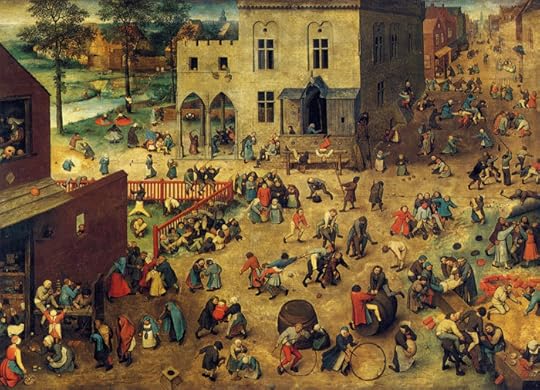
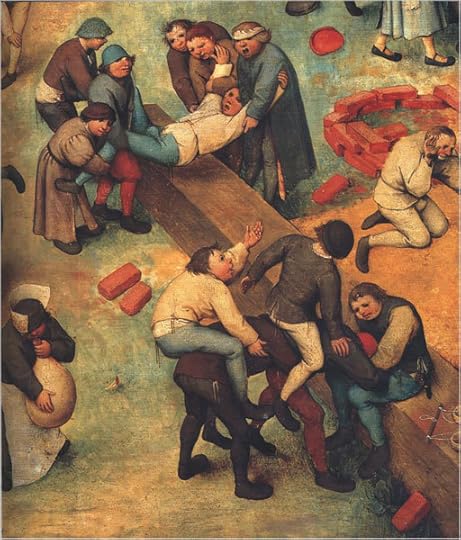
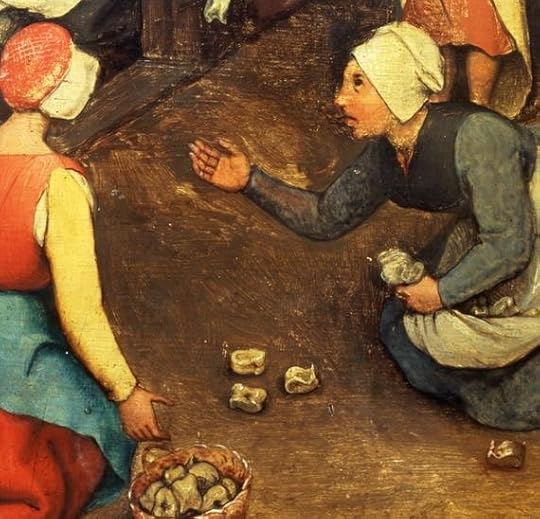
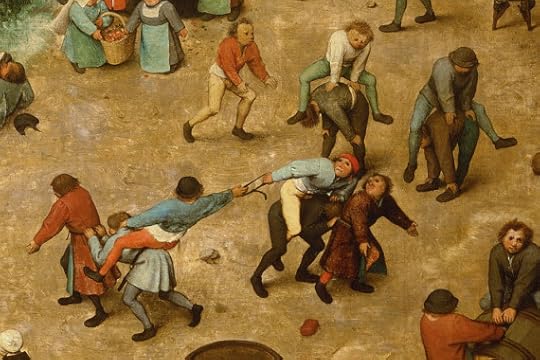
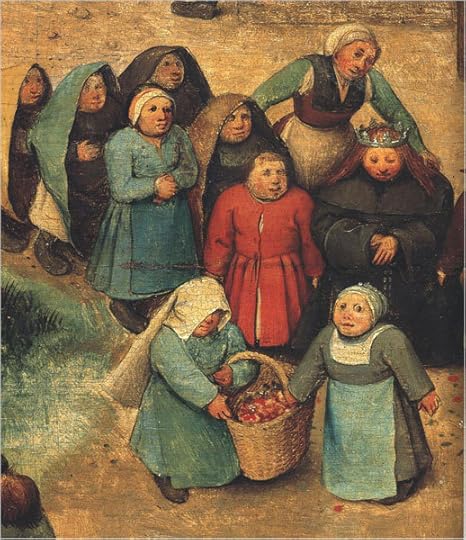
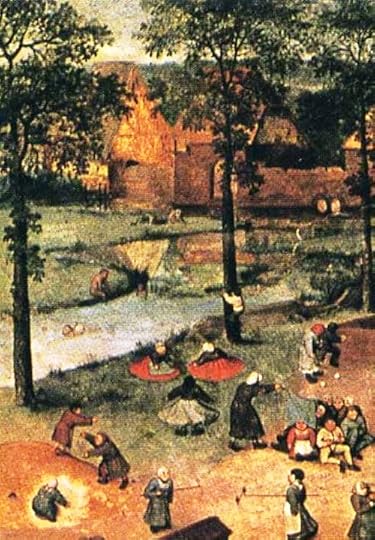
Part of the Masters of Arts Series, this outstanding coffee table book contains a detailed overview of the life and work of the great Netherlandish artist, Pieter Bruegel the Elder, who spent his most fruitful years in Brussels from 1553 to 1569. Included also are forty full-page color prints of Bruegel paintings along with a detailed essay on each by art historian Wolfgang Stechow. For the purpose of my review, I will focus on one particularly fascinating painting: Children’s Games. Thus, in addition to all of the pics I have included here, below are quotes from Wolfgang Stechow’s essay along with my modest comments:

“In Bruegel’s Vienna painting of 1560, children stand for adults, and it is the folly of adults that is chastised in a guise which makes no effort to disguise: these are children only by size and (partly) by dress.” ---------- One feature of medieval society and culture I have always found disturbing, how young teenagers - thirteen, fourteen and fifteen-year olds - married and became parents. One well-documented consequence of children having children was flagrant and widespread child abuse.


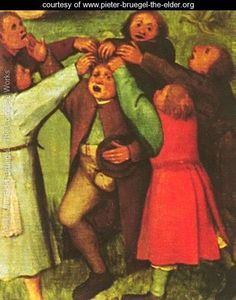
“When five of them pull the hair of a single victim and when they kill flies, they act more savagely than normal children would.” ---------- Thank you, Wolfgang Stechow. This has been my sense in viewing this painting, although I lacked the background of an art historian to adequately articulate my perception.


“The trundling of a hoop and the whipping of a top become frantic efforts; among the hundreds of children’s faces that this picture contains, there is not a single one that expresses childlike enjoyment of what the body is doing in its compulsive action.” ---------- Again, this is one aspect I find most troubling – how men and women lack a sense of ease or harmony, even when they are engaged in play, which ideally should be a time of joy and relaxation.


“The gnomelike figures resemble puppets manipulated by an invisible hand exactly as do Bruegel’s adults.” ---------- I take the author’s statement here as underscoring how the people in the painting are so constrained and constricted by their suffocating society, they are bound rather than free when expressing emotions and inhabiting their bodies.

“This is a panorama of folly rather than of childhood.” ---------- And that’s folly not in innocent foolishness but in brutish stupidity.


“The top of a central pyramid, the sides of which are emphasized by the house wall and the diagonal part of the red fence on the left and the long beam and the group of boys playing leapfrog on the right, is marked by a child bride procession seen strictly from the front.” ---------- With the dozens and dozens and dozens of children in this painting, the artist provides a clear structure by a precise, subtle underlying architecture – quite the master stroke.


“It is a relief to escape from the frantic actions of the main part of the picture to the brilliantly and sketchily painting landscape at the upper left which increasingly frees itself from its human burden.” ----------- As Wolfgang Stechow goes out to say, in a world filled to the brim with the folly of man, Bruegel envisioned one redeeming feature - nature left to herself.

Profile Image for Illiterate.
2,825 reviews57 followers
March 2, 2025
Bruegel blends pessimism about human sinfulness, wry humor, nature as redemptive. Stechow’s analysis is good.
Profile Image for Boweavil.
426 reviews3 followers
November 4, 2021
Serious, scholarly, well thought out, and sometimes controversial overview of Bruegel's paintings. There is not as much information about his drawings, but this is still a great resource.
Profile Image for Jana.
914 reviews119 followers
October 5, 2010
Beautiful color plates of my favourite painter's work. What's not to love? I'm very pleased this one is my very own...I can return to it often.
Profile Image for Chris Gager.
2,062 reviews88 followers
November 5, 2011
PB was an early master of realism painting. Apparently he wasn't interested in the "historical" stuff. I wonder what his "market" was?
Displaying 1 - 5 of 5 reviews

Can't find what you're looking for?

Get help and learn more about the design.