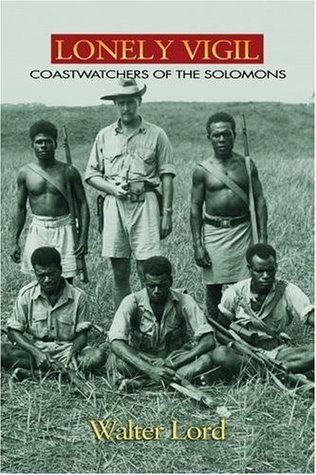
Thirty years after the end of World War II, Walter Lord travelled to the South Pacific to gather stories from the survivors among the 400 coastwatchers employed by the Australian Intelligence Board. At the time, little had been written about them -- particularly since their exploits (like codebreaking) were kept highly secret during the war.
The chain of largely Australian, New Zealand and Solomon Island coastwatchers covered much of the South Pacific but was particularly critical in the Solomon Isands -- so that is where Lord centers his story. Walter Lord's "A Night to Remember" ties together all of the people in the sinking of the Titanic and he does the same thing here, though the span of events is in years not hours. Most of those serving as coastwatchers had experience living and working in the islands. They would build networks of scouts and assistants from the Micronesian population, who often couldn't tell the difference between a Japanese or American because of their remote islad life.
Coastwatchers achieved some fame in James Michener's "Tales of the South Pacific," who casts the "Remittance Man" as an Englishman in his book but who becomes Lt. Joe Cable in the movie. In fact, Benjamin Nash, a former Colorado rancher, was American. He would be paired with Arthur Reginald Evans and witness the sinking of PT-109 as a Japanese destroyer sliced it in half. Later they'd be alarmed to learn that military authorities were looking for "Kennedy" -- and they assumed that it was coastwatcher Donald Kennedy, already a legend. Instead it was John F. Kennedy, the PT boat commander who was already well-known as son of the U.S. ambassador to the U.K. and as author of a book, "Why England Slept". Eventually their team of scouts would rescue the future American president and most of his crew.
Beyond being the early warning system or the movement of Japanese ships and aircraft, the coastwatchers also rescued downed Allied pilots; captured Japanese pilots; scouted Japanese installations; evacuated foreign nationals (including missionaries) and occasionally led commando teams. Lord accounts for 118 pilots rescued by coastwatchers in the Solomons, not counting several hundred rescued from the sinking of the cruiser Helena, PT-109 and other ships. Lord does not mention it in his book, but some coastwatchers received bounties of $1 million for the number of Allied and Japanese pilots handed over to the military.
However, fighting was not the mission of the coastwatchers. Commander Eric Feldt, the Australian who established the service, chose the bull "Ferdinand" as the code-name for the service from a popular children's book about a bull, The Story of Ferdinand. Feldt explained it by saying:
"Ferdinand ... did not fight but sat under a tree and just smelled the flowers. It was meant as a reminder to coastwatchers that it was not their duty to fight and so draw attention to themselves, but to sit circumspectly and unobtrusively, gathering information. Of course, like their titular prototype, they could fight if they were stung."