Yes, perhaps it was the "three centuries of murderous desire" that caught my eye - a subtitle I hope one day to borrow for my first autobiography. But this is exactly the sort of non-fiction I enjoy, a detailed study of an unknown unknown. Sure, I was dimly aware of Russia's sometime capital in its capacity as literary and revolutionary backdrop, and some of its name changes, but otherwise it had never even occurred to me that I didn't know much about it. And while the book is littered with the typos and glitches apparently endemic to modern publishing, Miles does an excellent at capturing the alternate squalor and grandeur of the city, and at bringing to (often revolting) life those who inhabit it, or merely intersect with those who do - so while I knew that van Leeuwenhoek was a pioneer in the investigation of microscopic life, I was not aware quite how ready he was to make himself his own spectacularly gross laboratory. We open, inevitably, on the city's founder, Peter the Great. What kind of man builds a 'window on the West' on land that's frozen half the year and swampy the rest? A new, modern face for Russia which is founded on 30,000 corpses, with plenty more to come? Well, I already knew a little of Peter from his London sojourn, but he sounds like the archetype of the large adult son. This is a nightmare version of The Windsors' take on Prince Harry, happy to turn mass executions into a drinking game - #bantz - or fatally inflate a guy's bowels with a bellows - #madman - or pursue an envoy who didn't want to down a litre and a half of vodka up a ship's rigging, booze at his belt and giant cup in hand - #absoluteledge. A nightmare in most respects, Quixotic in his siting of his new city...and yet still somehow not wholly dislikeable. After all, for all his sins he was as happy to take up an axe himself in making a ship as slaying an enemy. Menshikov, his right-hand man and chief kleptocrat, was a pieman promoted to the highest office on account of having a smart yet respectful riposte when he met Peter in the street. For the monarch delighted in promoting drinking buddies and the manifestly unsuitable to great offices, sometimes with surprisingly good results - and other times not. One wonders briefly whether Theresa May's cabinet is inspired by a copy of Management Secrets of Peter the Great. See also the bit where Peter is outraged by corruption, and plans to execute all peculating officials - but the Procurator General explains "we all steal. Some take a little, some take a great deal, but all of us take something' How things change, or not.
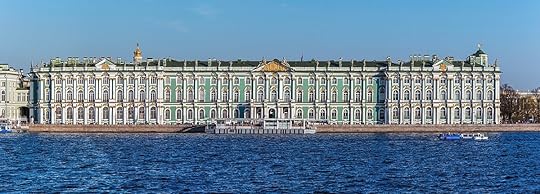
A recurring note in the story is the way that the city represents Russia's doomed efforts to catch up with the West - who, like the mean kids at school, keep changing the rules on what's in whenever Russia has just bought a new bag, or calendar. I knew about Russia having Julian long after we went Gregorian, but not that only under Peter had they even gone Julian - 1700 would otherwise have been 7208, dated of course from the creation of the world (meaning even that date didn't match the not-remotely-ridiculous calculations of the notorious Bishop Ussher). The modern oligarchs' attempts to spend their way to taste turn out to have a long history, with even the great Hermitage gallery initially stuffed by vulgar over-purchase of art. And as grand collections are assembled and mighty edifices erected, wolves roamed the streets, devouring the citizenry, many of whom had only moved there under compulsion. At the smaller level, giardia was endemic, with other epidemics joining in fairly frequently, and roughly one major flood a year - "the site was - as the poet Anna Akhmatova later put it - 'particularly well suited to catastrophe'."
Not that it was enough for the environment to be hostile: Peter's successors were mostly at least as terrible as he was when considered as bosses. Consider the jealous empress Elizabeth, shaving heads of the other women at court and then giving them shit wigs, like the Blackadder take on her namesake. Nor did the spirit of drunken excess ever take much of a break between Peter's All-Joking, All-Drunken Synod of Fools and Jesters and the later antics of Rasputin (surveillance reports of whom measured his intoxication on a four point scale: 'very', 'absolutely', 'completely' and 'dead drunk'). I was particularly taken with the Neapolitan violinist who married a goat for a lark. The overall effect is often piratical - grand buildings crumbling, elegant outfits grown old and tatty, a society desperate to keep up appearances but without the economical base to do so in any sane way. Again, one might suggest that little has changed, though the picture is much less gender-normative than recent reinventions of Russian history might suggest: casual homosexual dalliances were unremarkable for either sex; the female rulers and aristocrats were as voracious in their consumption of lovers and booze as the men, and as into antics which are fun to read about but would have been a right pain in practice. Still, I suppose deceit and autocracy have also their fashions - and even among the tsars you'd get the odd one who was inflexible and sober, and as such every bit as much of a danger as the manic pissheads. Then too, consider how seldom any of their paranoia was well-directed; long before Stalin decided that the only person he did trust was Hitler, you have Empress Anna, leaving loaded firearms all over the palace because the risk of assassins was less significant to her than the chance to take more impromptu potshots at wildlife.
And so we stagger through the decades of palace coups, Decembrists, repression and unrest. The Romanovs give way to the Communists and then to the new breed of kleptocrat, but one suspects that a few centuries down the line this distinction will be considered as niche and specialist a distinction as one ancient Egyptian dynasty giving way to the next. For those at the bottom of the heap, little changes, unless it's going from bad to worse. The city's Second World War siege must be the nadir, though - encapsulated in the note regarding the two different Russian words for cannibalism, depending on whether or not you killed them specially. And yet, set against that, the heroism, the Shostakovich symphony played over the loudspeakers which convinced awed German soldiers that they could never take this city. I think this was the point where I most understood why Miles had written a book about a city which, a lot of the time, he really doesn't seem to much like. Indeed, he's seldom shy about expressing his sentiments in terms which verge on the uncomfortably pseudo-objective. In his defence, it's often at least amusing, for instance the description of Chernyshevsky as "positively the worst significant novelist in Russian literature". Elsewhere, though...look, I realise this is an odd thing to say regarding one of the absolute worst people in history, but there were times when I felt Miles might have been overdoing the anti-Stalin sentiment. Still, there are harder crimes to forgive, and I did like the quotation from Koestler: "within the short span of three generations the Communist movement had travelled from the era of the Apostles to that of the Borgias".
So where do those three centuries leave us? I have a note: "the inequality at least as grave as under the old regime". Which I think was about the transition from hereditary to Party autocrats, but works just as well for the shift to whatever you want to call the current system in Russia. And while Miles obviously makes note of the city's role as Putin's nursery, there's always that problem of ending a non-fiction book whose story is still clearly ongoing. Still, it's hard to think of a better place at least to pause it than the quote on the last page, referring to "Chaadaev's celebrated statement that Russia exists simply to alert the world that its way of doing things should be avoided, whatever the cost". Just a shame that their bots and fake news factories now seem to have snookered the world into doing exactly that.