Elizabeth (Harman) Pakenham, Countess of Longford, CBE was born on 30 August 1906. She was the daughter of Nathaniel Bishop Harman. She married Sir Francis Aungier Pakenham, 7th Earl of Longford, KG, PC, son of Thomas Pakenham, 5th Earl of Longford and Lady Mary Julia Child-Villiers, on 3 November 1931. She died on 23 October 2002. Her married name became Pakenham.
The Elizabeth Longford Prize for Historical Biography was established in 2003 in memory of Elizabeth Longford (1906-2002), the British author, biographer and historian. The £5,000 prize is awarded annually for a historical biography published in the preceding year. The Elizabeth Longford Prize is sponsored by Flora Fraser and Peter Soros and administered by the Society of Authors.
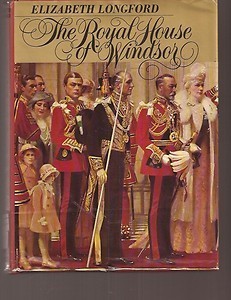
This is one of those hidden-treasure books that, upon reading them, you are very grateful for the existence of that old adage about not judging books by their covers - because this lovely book has the misfortune to be saddled with two covers that make you have to be wary of it. The first is the binding, the spine, which makes the book seem like it will be a fairy story: the title is laid out in elegant, loopy script, on the backdrop of a colour I am hereby naming "fairytale sparkly purple-pink." So the first test is merely pulling the book out of the bookcase. Second, the actual cover. Since there isn't an image of it here on Goodreads, I'll provide one for you:
Despite the documentary nature of that painting (the coronation of King George V, who established the House of Windsor), for a book cover it's just a bit heavy-handed, and feels like the story is going to be a ponderous, stuffy one.
But, seriously, the book banishes both impressions halfway through the first page.
It is a riveting, beautiful book that paints recent royal history with all of the profound richness and humanity of the personalities which comprised it. Elizabeth Longford presents her protagonists as people, with tempers and tenderness, loss and love, hardship and heart. She explains the historical position of the monarchy without ever getting lost in tedious details that none other than a Briton would pretend to understand, and mentions the politics of the period of each monarch in a way that contextualises him (or her, of course) yet does not relegate him (or her, again) to the pages of the past. Furthermore, she philosophises about the monarchy and its past, as well as its future, just enough to inspire admiration but also to provoke thought and examination for oneself. For this reason, many many passages are just as relevant today, four years from the 100th anniversary of the establishment of the House of Windsor, as they were in 1977, the year the book was published and 25 years after HM became the Queen.
As a whole, the book is skillfully written, giving each member of the House of Windsor his or her due. In that regard, it never seems to take the easy way out - presenting someone or other as black, or white. All of its characters are fully-rounded, and given the space to shine and breathe as people, as well as monarchs (or other members of the aristocracy). For that reason, I felt it completely okay to be emotional about the deaths of Kings George V and VI, even though I was reading in a NYC park during my lunch break from work.
And if she gets a bit mawkish and reverential from time to time about the state of the monarchy, as well as about today's monarch Herself, it does the reader good to remember that Ms. Longford herself belongs to a particular tier of aristocracy, being married as she was to the 7th Earl of Longford, so she's allowed.
In July 1917, struggling against his German cousins in a world war, George V of the House of Saxe-Coburg-Gotha decided that if he were going to be effective as king of Great Britain he would have to replace his overly-German family name. He and all his English relatives would now represent the House of Windsor. Though not as charismatic as his playboy father, George was much loved and respected at his death. His eldest son, Edward VIII, was another matter and his abdication was undoubtedly a good thing for the country in the long run. Edward’s brother, George VI, shared their father’s shyness but became a symbol of national unity in the next world war. George’s daughter, Elizabeth II, continues to muddle along. The author relates the facts but puts them in the context of the vast changes Britain and the world experienced in the 20th century: The disappearance of the empire, the tabloidization of royal family crises, and the magnified effects of personal eccentricities and foibles on British society. (On the other hand, she seems to pass over completely the greatly enhanced role of the United States in world affairs.)
The late Countess of Longford was both a committed socialist and a Roman Catholic convert, and produced several writers among her eight children, including Lady Antonia Fraser. They certainly came by their talents honestly, since their mother’s work displays both a gift for biography and an easy, communicative style that combines serious history with popular narrative. She also had obvious inside help in compiling much of the detail in this useful dynastic overview.