
Jump to ratings and reviews
Rate this book

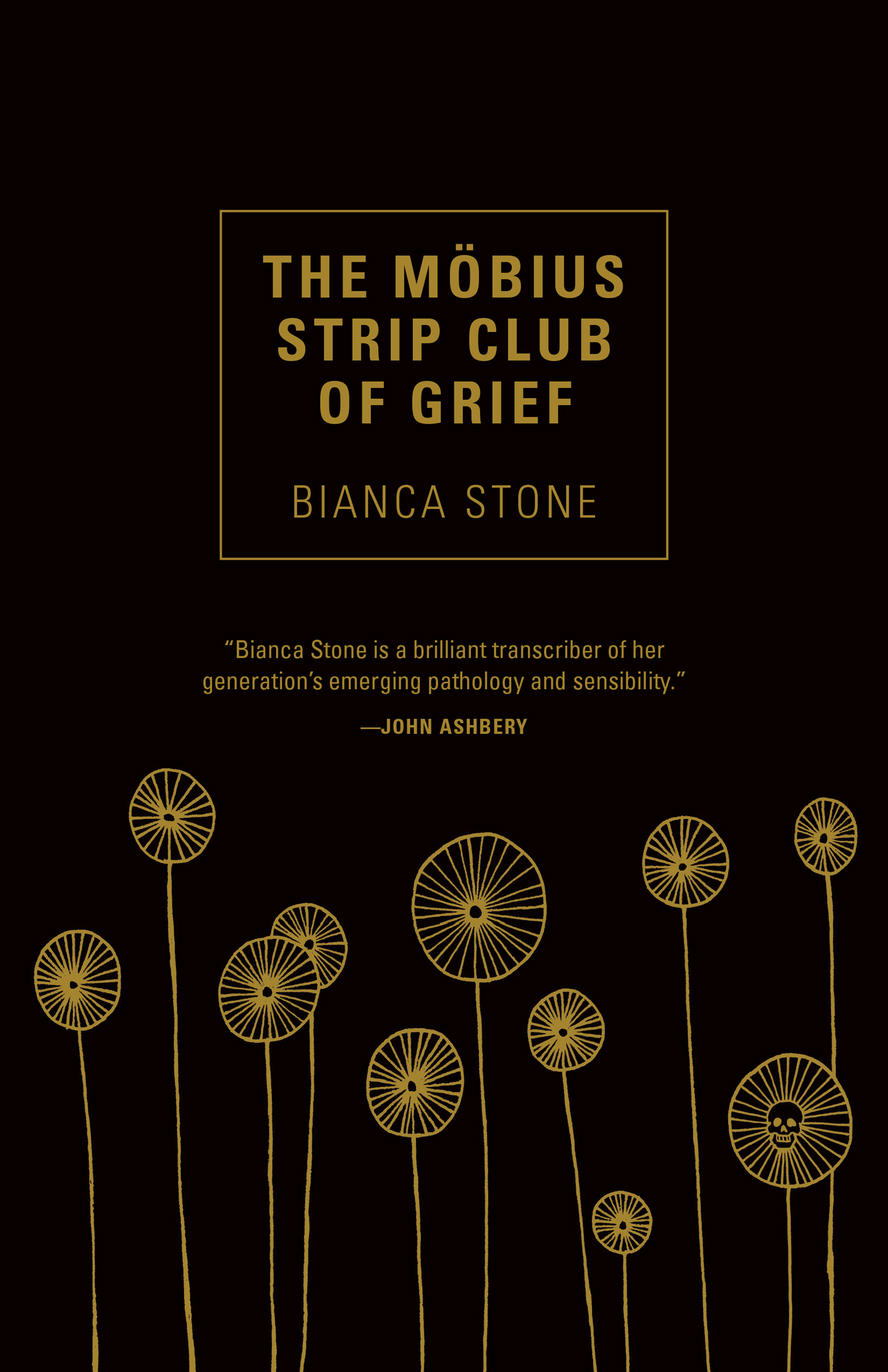
The Mobius Strip Club of Grief

Rate this book
"Bianca Stone is a brilliant transcriber of her generation's emerging pathology and sensibility." ―John Ashbery

A Paris Review  Staff Pick and Most Anticipated Book of 2018 at NYLON, Bustle, Autostraddl e, and more. The Möbius Strip Club of Grief  is a collection of poems that take place in a burlesque purgatory where the living pay―dearly, with both money and conscience―to watch the dead perform scandalous acts otherwise “$20 for five minutes. I’ll hold your hand in my own,” one ghost says. “I’ll tell you you were good to me.” Like Dante before her, Stone positions herself as the living poet passing through and observing the land of the dead. She imagines a feminist Limbo where women run the show and create a space to navigate the difficulties endured in life. With a nod to her grandmother Ruth Stone’s poem “The Mobius Strip of Grief,” Stone creates a labyrinthine underworld as a way to confront and investigate complicated family relationships in the hopes of breaking the never-ending cycle of grief.

101 pages, Paperback

First published February 27, 2018

27 people are currently reading
901 people want to read

About the author

Bianca Stone

24 books69 followers
Bianca Stone is a writer and visual artist. She was born and raised in Vermont and moved to New York City where she received her MFA from NYU in 2009. Her poems, poetry comics, and nonfiction have appeared in a variety of magazines including The New Yorker, Poetry Magazine, American Poetry Review and many others.

She has returned to Vermont with her husband and collaborator, the poet Ben Pease, where she is director of programs for The Ruth Stone House, a literary nonprofit artist residency, letterpress studio and community poetry center.

Ratings & Reviews

What do you think?
Rate this book

Friends & Following

Create a free account to discover what your friends think of this book!

Community Reviews

5 stars
171 (34%)
4 stars
186 (37%)
3 stars
100 (20%)
2 stars
30 (6%)
1 star
3 (<1%)
Displaying 1 - 30 of 56 reviews
Profile Image for Gabriel Congdon.
182 reviews19 followers
June 3, 2018
FUCK YOU


is the subtext of these poem. I’m psyched to scream about them.

Here’s some blood on the page.

Here’s a severed head that’ll answer well-worded questions.

Finally, some fierce-ass American poetry, some savage guts. These poems don’t give a goddamn grape whether you like them or not. They’re not written with us in mind.

The reason these poems were written is because there’s a gold orb around the world and amazing shit like this evanescence’s into it and throughout all time some people sustain it.

I’d recommend these poems to anyone who feels the urge to headbutt books out of empathetic anger. Those condemned to die by way of meteor, would have these poems read to them-rite, I beliebe. To we who, in moments of duress, turn to the bible and find comfort from its violent imagery.

I’d fight somebody these so poems are so damn good.

Anybody have a problem with what I just said?


“tell all the Truth but tell it Slant.”
-Emily D.
Profile Image for D.
68 reviews18 followers
September 20, 2018
You have to show a scar to the bouncer to get in - any scar will do. And you have to tell a story about your mother. Something she suffered through. But once you’re in, you’re in forever.

Wow. What a book of poetry. I stood in a bookstore for an hour reading this (before getting a copy!). I didn't want to take a break to sit down, I just wanted to keep reading until I consumed all of the poems in this collection. I've read a lot of poetry this year, and this book may be the most memorable. The first part of the book is set in a purgatory-based strip club. A weird setting for poems, but Bianca Stone's brief world-building creates a memorable backdrop for poems about grief, loss, love, and life. I don't want to spoil any of the weirdness of these poems, but know that they can be weird in the best way.

The second part of the book is a little more "normal". Not all of the poems explicity reference the Mobius Strip Club of Grief, but instead dive into Bianca Stone's family relationships. They are beautiful and haunting in a different way.

I wouldn't say this collection is for everyone - it can be a little explicit, sometimes a little weird or disturbing, but for those who aren't immediately put off by the idea of The Mobius Strip Club of Grief, I definitely recommend giving it a try. This is one of my absolute favorite poetry collections.
Profile Image for Jaime.
Author 3 books12 followers
February 2, 2019
Although Bianca Stone wrote The Möbius Strip Club of Grief before fourth-wave feminism picked up the “Me Too” tagline, the book’s publication and my reading of it landed smack in the middle of all the news stories in which empowered and angry women demanded (once again) an end to rape culture. Right when I struggled to place myself in the discourse—I had worried the language was more symbolic than paradigm-shifting—Bianca Stone’s newest collection of poetry entered my life. The Möbius Strip Club of Grief builds on the intellectual work of its feminist forebears and offers a vision of womanhood that is raw, raging, sad, and beautiful. The women in Stone’s poems don’t fit any of the definitions of woman that society has neatly provided; her poems blur, challenge, and outright erase those definitions completely. In their place, Stone offers a womanhood in which we can find some sort of personal freedom from all the grief of simply living. A womanhood that will last long after the current trends have lost their shine and we still need to be heard.

Stone’s first collection of poems, Someone Else’s Wedding Vows—as well as her collection of poetry, comics, and several chapbooks—are full of falling in love, being lost and found, sometimes desperate, sometimes joyful abandon. The Möbius Strip Club of Grief maintains Stone’s sassy humor and startling imagery, but this collection is thematically linked by the world-building of a purgatorial strip club (the MSCOG). This collection feels more mature than the earlier work, if only in the tasks it takes on: growth, defying the world, and mourning. The Möbius Strip Club of Grief begins as an elegy for Bianca Stone’s grandmother, the poet Ruth Stone, and becomes an elegy for America.

The opening poem introduces the MSCOG as where Odin goes when he sees “everything blown to shit. The gods with it.” It’s a purgatorial afterlife and underworld where Bianca Stone’s grandma and all the other grandmas are strippers; we can visit, have a cocktail or a joint, read a few poems, and find a little comfort. Much of Part I takes place in the aftermath of a funeral, inside the MSCOG, exploring personal loss and grief. “Introduction” beckons readers into the strip club with a grotesquely gleeful circus-caller style. Inside, “there’s Grandma, with / her breasts hanging at her stomach—gorgeous with a shook / manhattan, and murderous with a maxi pad.” There is a real tenderness for grandma’s body, and these poems are a bluntly sketched celebration of women’s bodies in all their forms. One dead stripper admonishes us for not visiting much when she was alive, then offers “$20 for five minutes; / I’ll hold your hand in my own. I’ll tell you / you were good to me.” The comfort and reassurance found here is exactly what we didn’t realize we needed. In “Last Words,” a grief-maddened mother asks, “Who will pay? Who will pay? Who will pay,” with each iteration blossoming larger, from personal grief to the responsibility of our country’s broader paradigm for inflicting its tragedies on us.

The elegy progresses from an intimate and personal grief to a broader, psychological grief. In “Hunter,” Stone explains, “I can’t tell anymore whether I am grieving you particularly / or simply find life and death erroneous.” In “Cliff Elegy,” she imagines the grief particular to falling in love like an extended falling scene akin to that of Wile E. Coyote or Alice in Wonderland. There is an elegy for male honeybees dying from orgasm, and one for Emily Dickinson, whose poems are “like grenades that fit in the hand.” Stone also explores the grief in families. The stunning eighteen-page, twelve-part poem “Blue Jays” makes associative leaps, linking her mother to a blue jay, portraying her as both a source of grief and “so much joy.”

I love my mother, the way I love birds.
The blue jay always
is the biggest bird around the bird feeder—makes
strange loud songs,
a little aggressive, but gorgeous, known
for its intelligence and complex social systems
with tight family bonds, a biblical fondness for acorns,
spreading oak trees into existence
after the last glacial period.

What a celebration of motherhood: those flawed and forceful women who made you who you are and who are sometimes the source of sadness. The mother is Stone’s mother, and mine, and all of our ungentle and irreplaceable mothers.

Stone’s book has still more enlarging to do as her grief comes to include the American patriarchy that causes pain for all of us. In an early poem, Stone proudly accepts the tacit belief that a woman being loyal to her own creative genius entails “unfaithfulness” to her husband. Stone commands, “Ladies, enjoy the pleasures of your own mind! The creative woman in this living patriarchy wants to be both object and subject of creation. Blow up your television, love me instead, my genius says to me.” In the later half of the collection, Stone gets more pointed about this toxic American culture, comparing the world to “a wolf tied to a flower [. . .] Something too violent / is attached to something / so living.” In “Ones Who Got Away with It,” she recalls a bulimic thirteen-year-old girl who was “shared” by a frat boy and his friends, and who decided to be proud of what happened to her. Stone envisions those men now, “important men, I imagine. Men who now run conglomerates / and have well-to-do families. Or maybe men I see / every day at work. Or whose books I read.” She’s shining a light on the reality and daring us to acknowledge our own complicity. When I read this poem, I felt pissed off and heartbroken and alive, which is the point; Stone says “do something drastic / like live and live and live.”

Stone’s poems ultimately draw a connection between a toxic, patriarchal paradigm and today’s American system. “Nothing burns quite like the System. It comes at you / when you ask for help, displaying its super-talons / around a clutch of arrows, saying No.” The image of the patriotic, arrow-clutching eagle refusing our needs seems insurmountable. The final long poem responds directly to our current era, where “Trump . . . oils his way across the tangible world.” In this final elegy, Stone balances hopelessness with fierce determination. She asks herself about the collection, “Why am I writing this psychosexual opus to the mind of my women?” Because, Bianca, we need to hear it. We need all the inspiration we can get right now. In this poem, Stone gets as close as she can to an “answer” to the particular grief of women which is: “we must invent, while living a life: / nothing irrelevant here, nothing stopping you—invent! / invent! / invent! / stretch out / a social destiny!” It is through the “genius” or the creativity of women—grandmas, mothers, daughters—that we can find some salvation or solace. It’s poetry itself that gives us our agency and helps us overcome our multitude of grief.

Review originally published in Kenyon Review: https://www.kenyonreview.org/reviews/...
Profile Image for Aidan.
211 reviews6 followers
November 28, 2024
this is a selection of poetry that wields some of the richest, most lucid images i’ve seen, some of the most hungry and galvanic and aggressively-explorative poems, seething with rage and sadness as they meet just north of despair — my god are the highlights high.

but jesus christ do the low points blow. at these i want just to scream stop, you’re nailing it with the natural ones, just don’t force the poem into places it doesn’t want to go. it doesn’t want to be on pinterest. don’t let the poem go to pinterest.

utterly conflicted. ugh. love some, and i know many will love all. but many moments lack gusto, any emotional core, to me, as compared to the truly remarkable and unforgettable ones.
Profile Image for Medland Wallace.
3 reviews1 follower
December 22, 2024
I loved this book. Bianca Stone is so talented. I didn’t know grief could be your dead grandma twerking.
Profile Image for Annie.
197 reviews3 followers
March 12, 2018
Darkly comic and resonant -- a book full of evocative, weird, ticklish poems on loss. Imagines a seedy underworld where the dead swing around stripper poles and give lap dances to their living, mourning guests.

Bianca Stone has a vivid imagination, and is able to effortlessly pull off tricks like turning simple biological facts into poetry (see "Honeybee"). My other favorites were "Elegy with a Swear Word," "Math," and "Retreating Knights and Riderless Horses: Or Poem With Another Poem Halfway Through."

The title is apparently a wry reference to a poem by her grandmother, Ruth Stone: "The Mobius Strip of Grief." Grandmothers figure prominently at club.

I'm no expert on contemporary poetry, but this one stuck with me.
Profile Image for Mary Rose.
587 reviews141 followers
February 4, 2019
You can’t just write a poem about having a spiritual awakening while watching an episode of Supernatural and think I won’t call you out on it!

In all seriousness, there’s nothing poetic in here. It’s just ugly.
Profile Image for Margaret Adams.
Author 8 books20 followers
Read
August 17, 2019
As Gabe said, “I’d recommend these poems to anyone who feels the urge to headbutt books out of empathetic anger.”

(Thanks for the rec, Gabe.)

I feel like your rejection slips, collated in a folder. Outdated
science magazine
of inaccurate information—
I would love to “move on.” But I carry you around like a scar,
forgetting sometimes that it is even there
until I follow a stranger’s eye to it during a handshake.

-from Interior Designs

Watch me loving you forever, Mom, on this strip of land
we call grief—but it is only life!

Do you know the game?
The game is called Being Unhappy, Just in Case.
or Gratitude as a Weakness.

And we play sometimes when there is nothing else to do.

-from Blue Jays
Profile Image for Ryan.
91 reviews
Read
May 9, 2024
had to put this one down at least three or four times during my short time with it because it gave me existential dread and i am already terrified of death and this one certainly isn't a good read to comfort that fear. its really good and i can tell she is talented because when i read this all i could think was how much smarter she was than me - in the best way possible. long form poems can be difficult to absorb me so when one poem goes on for 8-10 pages i can feel like its dragging but she did it well enough where they feel unique on each page. thought the early stuff about the club was some of the worst stuff in the whole collection ironically but it manages to stick the landing in a sense after giving you the contextual grace, etc.
Profile Image for Mariel.
Author 3 books44 followers
March 16, 2019
This book is so good. Bianca Stone's poetry is surprising and weird and beautiful and ugly and conversational and lyrical and irreverent and many other contradictory adjectives. The MSCOG is a dark and strange place, and its function as setting and launch point is unbelievably good. I can't wait to read more of her work.
Profile Image for Meg Ready.
Author 3 books8 followers
October 14, 2019
I enjoyed this collection esp the first half when it revolved around this strip club and ideas of grief but later I felt the images took a backseat to abstractions and philosophy that I didn't find as compelling, but overall there are some poems that will stay with me.
Profile Image for shezal.
141 reviews
June 15, 2020
Sigh, I suppose this was the kind of anthology that I couldn't like even if I tried to.

Sure, there are a few pieces dedicated to grief, pain and many other things and I appreciate the rawness and brutality of emotions the way Stone presents them but there wasn't a lot to take away from these poems.

In the end, they didn't grab my attention as much as the title did.
Profile Image for Jill.
20 reviews11 followers
January 8, 2019
Maybe 3.5? Part I is horribly macabre - or wonderfully so, depending on your sensibilities. Not really to my taste. I was about to put it down, but I’m happy I kept going. Part II is where the work shines for me.
Profile Image for Joy.
113 reviews31 followers
April 18, 2023
Good fucking lord this is what I want when I read a book of poetry. This This This. I want to curl up at her feet while she reads these poems to me every night. I'm going to eat this book.
Profile Image for Joe Imwalle.
120 reviews6 followers
April 6, 2019
Bianca Stone is my newest favorite poet. I found a poem of hers in The New Yorker and sought out more of her work. I bought this book and am glad I did. Her poems aren’t easily accessible like Mary Oliver or that sort of thing. They take work but, I find, they needn’t be worked at too much. You just need to stay alert while reading and let the various images and surreal visions parade and sashay through your mind. More sashaying than parading. Lines like...

A burning bush in the middle
of a transcendental bar fight.

Or these lines about waiting for the bathroom on an airplane...

whenever I walk across the sky
to stand in line for the bathroom
I think, finally,
I am just like a ghost
walking over the world
trying to distract myself
from boredom
and hysteria. It’s a kind of
holy moment
that unfills
anger.

This book is primarily about grief. It gets right the emotional turmoil of grief that can be both out of control and peaceful at once. I recommend reading the poems in order rather than opening at random to read. And don’t try too hard to understand, rather focus on experiencing them.
271 reviews3 followers
October 15, 2019
Bianca Stone is shaking things up in this unified collection of her poems revolving around a macabre strip club where women regain power after death. The after-death experiences have a taste of Dante, but are original, intense experiences that all find their causes in the world in which we live. "For the masochist, nothing quite hurts like the truth." You will pay a price for entering this world:
our funerals are like poker games
in the back room
of the Möebius Strip Club of Grief.
The stakes are high.
You have to have pneumonia to get in.
Most of the events are so justified in the Strip Club of Grief that they may cause a tight-lipped chuckle. They all stretch back to life in this world, where the poems eventually focus. The imagery is brilliant and personal - "Your genius trapped like a moth on the screened-in porch of your pain." The final poems evoke the "Trumped out" world of our current Dark Age:
"human decency' has nothing to do with poems....
we must proceed through the outrageous, cryptic medium of vision, which is only curiosity at being alive." These poems provide a naked truthful look and be read again and again.
Profile Image for Margaryta.
Author 6 books50 followers
January 20, 2019
More acurrately a 3.5. I found the description of the collection to be a bit misleading - I had hoped that "The Mobius Strip Club of Grief" would, indeed, be like a feminist take on the scene of Aeneas descending into the underworld and was a bit disappointed by how little, or at least how indirectly, the club seemed to be mentioned. So that's my own fault for hoping for a more all-encompassing narrative and world-building approach. Stone deserves credit though for how well she wades in and out of the collective and the individual and how she weaves the two components together in her poems. There is also an exciting directness to her poems which, though occasionally feels a bit meandering and unexpected, makes for a very thoughtful and entertaining read that deserves another chance, as I don't think it's a kind of humour nor approach that everyone will warm up to instantly.
Profile Image for Luke Gorham.
619 reviews40 followers
March 20, 2018
3.5ish. Appreciate the melancholia of the proceedings, and the thematics here of the headfirst dive into's life's suffering as armor against pain and catalyst for appreciation of joy. This passage from "The Fall" could well be a thesis for the collection: "What to do with this mind?/ Throw everything / into the fire and scream / into the internet / that there's nothing to do / but stand in the dark recesses / throwing a bright red dodge ball / against the bone facade / and fall in and out of love / with suffering?"

That said, there's a certain demand on the reader here to connect extraneous stream-of-conscious threads in some poems that don't feel as organic or intuitive as the poet seems to think. Definitely a poet I will check out again, but not quite as cohesive as expected.
Profile Image for Dripta.
42 reviews14 followers
January 28, 2019
In this collection of poems we can hear a distinctively 21st century female voice - clear, loud yet calm; trying to connect with her predecessors, both ancestral and literary. A strange mood of macabre sadness permeates throughout the volume as the poet talks about soil and blood and milk and urine and flesh and flames.
In the two parts of this volume, the poet visits modern versions of inferno and purgatory. However, we only see some glimpses of paradise but that place seems too far to reach from this contemporary nexus of hell - which is both physical and psychological. Silent and undead female voices rule this underworld who all enable themselves to break the manacles of asphyxiating patriarchy, slowly but efficiently.
Profile Image for Danielle.
96 reviews2 followers
February 6, 2023
Given the description I thought this would be a book like "People From My Neighborhood", a collection of short stories with whimsy, and in this case a more morbid setting. I found myself very disappointed, I didn't see cohesion and a reoccurring plot, I was very confused with the amount of (what felt like) tangents. I also admit I don't think I'm the intended audience because I did not get a lot of the allusions to other authors and literary works. I was honestly very excited for this given the description :/
Profile Image for Nova Papasodora.
142 reviews
November 21, 2018
This collection explores ideas such as the physical vs. the intellectual, and the living dead vs. the living in a humanistic sense.

It's written fantastically and really struck home on certain poems. The atmosphere of the strip club is very well created and rather specific. I liked that a lot of the poems were seemingly placed in the same place as it gave the entire collection a sense of completion and oneness.

I highly recommend!
Profile Image for Juliano.
Author 2 books39 followers
January 22, 2025
“Halfway through the poem another poem took over. / The two poems fought. It was / a bloody battle that lasted seven hundred years. / Big choices were made / and gods among men died.” The Möbius Strip Club of Grief, by Bianca Stone, is perhaps my favourite-titled collection of poems, and fittingly is full to the brim with brilliant poems, existential and searching and funny and unbearably dark. “And I lit my head on fire. / Danced a dance for the gods.”
Profile Image for Caroline.
724 reviews31 followers
March 17, 2018
2.5 stars

Yeah, this was just a bit too weird and macabre for me. There were definitely some individual poems that I liked, but they were the less conceptual ones. I particularly loved "Self-Destruction Sequence" and its ending: "It's a kind of holy moment that unfills anger." There were aspects of Stone's style that I really enjoyed, but most of this was just too abstract for me.

Profile Image for Emilie.
33 reviews
April 4, 2018
Bianca Stone's tells of the fast and desperate passage of time. Of how that desperation leads us to sex, booze, making apple jam, or unburying the bones of a dead grandmother. She speaks to that theme in so many fresh ways that the reader is propelled forward to no certain end. It reads like rock 'n' roll.
Profile Image for Charlie.
732 reviews51 followers
May 15, 2018
A uniquely depressing, biting, and humorous collection of poetry that uses the structure of the 'mobius strip club of grief,' the place where women (and specifically, sex workers) can exist beyond death and danger to renegotiate power structures away from the patriarchy. A fantastic collection qua collection, not just a series of poems but a whole universe to exist in.
Profile Image for Olivia Rose.
66 reviews
January 2, 2020
Bianca Stone delightfully fuses classical images and backdrops with the titled subject, grief-- a subject of reflection and inquiry so endlessly bold and deep that it never grows tired of consideration. I admire her stark, calculated wordage and lyrical poeticism that borderlines narrative, but felt the collection was lacking in something to cut me to my core in an unforgettable way.
Displaying 1 - 30 of 56 reviews

Can't find what you're looking for?

Get help and learn more about the design.