Covering a period of five hundred years, from the arrival of the Ottomans to the aftermath of the Arab uprisings, James McDougall presents an expansive new account of the modern history of Africa's largest country. Drawing on substantial new scholarship and over a decade of research, McDougall places Algerian society at the centre of the story, tracing the continuities and the resilience of Algeria's people and their cultures through the dramatic changes and crises that have marked the country. Whether examining the emergence of the Ottoman viceroyalty in the early modern Mediterranean, the 130 years of French colonial rule and the revolutionary war of independence, the Third World nation-building of the 1960s and 1970s, or the terrible violence of the 1990s, this book will appeal to a wide variety of readers in African and Middle Eastern history and politics, as well as those concerned with the wider affairs of the Mediterranean.
I became interested in Algeria while visiting Nice, France. Sunbathing on the Mediterranean, gazing out across the invitingly calm waters, I speculated how easy it must have been for early Frenchmen to sail across. With the many island stops available, or even the beautiful Spanish coastline to follow, it seems only natural that early Frenchmen would embark south, enticed by those looming Atlas Mountains.
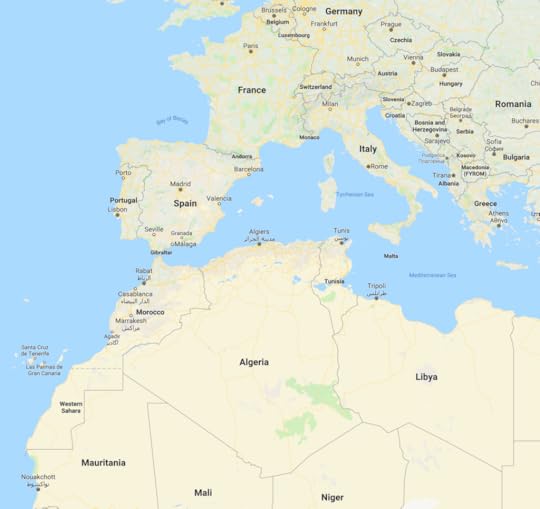
My geography lessons had taught me that Algeria lay directly south of France, but I realized that, aside from having read The Plague , a fictional Camus novel, set in Oran, I was largely ignorant of the country. And hence I found this history to read.
I must warn any potential reader that this book is generally difficult, as it tends to spew a profusion of facts with little consideration for maintaining the readers interest; perhaps being better adapted for one with a preexisting Algerian background. Even more perplexing is the author's tendency toward an anachronistic presentation of facts, a rather chaotic organization, and a tendency to cram too much information into single sentences, which often causes him to lose control of his message. There is, also, an outrageous use of abbreviations that proliferates the writing and exacerbates the difficulty of the reading. I would not be reluctant to advise those interested in Algeria to consider an alternative history, but I would acknowledge the value of this book to those willing to diligently persevere through this writing.
The value of this book manifests in an enhanced understanding of the real impacts of European colonialism and how the trauma of inflicted evil often perpetuates itself in later generations. Studying the exploitation of indigenous peoples by greedy Europeans reveals many ways in which this past evil remains a catalyst for modern social unrest. Reading about distinctly different countries and cultures is vital for understanding foreign peoples and the reasons they behave as they do; and for understanding the stream of prejudices that flow into modernity because of ancient conflicts, cultural indoctrination and longstanding traditions.
International peace and prosperity may be amplified when we take time to learn about and understand one another. Most Americans look at the horrible violence in places like Algeria without fully understanding how it has resulted from 132 years of French colonial occupation (1830-1962) and, even before that, domination by the Ottoman empire.
Ottoman Algeria
Once the Ottoman Empire captured Constantinople in 1453, the Ottoman Regency of Algiers came into existence in this region of North Africa. Ottoman Algeria was an overwhelmingly rural and nomadic society. Extended family groups, associated by lineage, were historically recognized by their rights to cultivable plots and access to water. There was a strictly hierarchical social differentiation established by descent, ethnicity, occupation or place of habitation. The peasantry constituted the great majority of the population and were mainly Arabic speaking.
The best lands were owned by the Ottoman viceroy of one of Algeria's three provinces: Oran, Algiers and Constantine. Such lands were generally share-cropped by peasants, who received one-fifth of the harvest. The rights to live on and work the land were understood to be heritable to the children of the workers. Land ownership or use defined a highly stratified society, with sharp divisions based upon privilege, wealth, ethnicity, religious affiliation, age, and gender. Algeria consisted of a rich mix of cultural diversity: Muslims, Jews, foreigners, Arabs, and Berbers.
In the late 16th century, Algeria's wealthy elite came to be infiltrated by Moorish refugees fleeing the collapse of Muslim Spain. These are paler skinned peoples in comparison to the darker skinned Arabs and such racial distinctions persist today. By the late 18th century, many Algerian families had become affiliated with one of the several Sufi mystical orders or "brotherhoods of Islam", which practiced memorization/recitation of the Qur'an and imposed shari'a law.
From the early 18th century, the French made substantial purchases of grain from Algeria. French ships traded between Algiers, Marseille and other Mediterranean ports, carrying Algerians to Istanbul and Alexandria (in route to Mecca). However, in 1830, the French descended with crushing weight upon Algiers, bringing Ottoman rule to an abrupt end.
French Ascendance
After the loss of the Bourbon monarchy's empire overseas and the defeat of Napoleon's empire, France sought to recover its national greatness. A dispute over payments for Algerian grain resulted in a declaration of war and French ships blockaded Algiers. The assault on Algiers represented a last attempt by the restored Bourbon king, Charles X, to gain international prestige. Three weeks after the raid upon Algiers, a revolution in Paris overthrew Charles X and put Louis-Philippe, Duke of Orleans, on the throne.
Six hundred and seventy-five ships carrying 37,000 men pillaged Algiers treasury, carrying off over 43 million francs in gold and silver. Protesting Algerians were evicted at bayonet-point. The French made use of expeditious public executions to establish their power. Algeria became a French possession through the deployment of indiscriminate violence, when and where necessary.
The French showed their contempt for the simplest and most natural rights of indigenous peoples. They used the excuse of "a backward people" to justify every act of expropriation and brutality. In reply to this, one contemplative Frenchman remarked that France had: "outdone in barbarism the barbarians whom it came to civilize and it still complains of not being able to succeed in civilizing them". The blatant hypocrisy against France's own Declaration of the Rights of Man was lost in the arrogance of assumed French superiority.
Power in Algeria was delegated to a military governor to rule by decree, bypassing parliamentary accountability or legal recourse. Much like the more modern U.S. invasion of Iraq, the French really had no coherent long-term plan for their occupation and their ultimate intentions could only be guessed at. The French policy in Algeria became a matter of shady deals and personal profits. The French burned crops, emptied grain stores, and took prisoner unarmed men, women, and children, laying basic Algerian society to waste. Livestock was seized or destroyed. Villages and huts were torched.
By 1843, all of Algeria's urban centers were in French hands. For the next 40 years, sporadic and desperate uprisings would punctuate what the French began to call the "pacification of Algeria". Tribes that could not or would not pay taxes saw their property destroyed; whole populations, including women and children, were destroyed. Indiscriminate looting, rape, and murder became the norm. Raged, starving, and ill, thousands of Algerian men, women, and children dragged themselves into the civil territories where they begged for aid, to the consternation of the French settlers. By the 1870's hundreds of thousands of hectares, including much of the country's best agricultural land, had passed into French hands.
The French settlers saw their place as viable only by the complete subordination of Algerian territory and resources. Algerians were pacified to a fate of exclusion, dispossession, denigration, and impoverishment. The French population in Algeria grew rapidly, with most concentrated in Algiers and Oran. The French recruited Algerian settlers by providing assisted passage to Algeria and offering them land. The French even recruited beggars, criminals, and other troublemakers to alleviate social tension in Paris. Algeria was seen as an outlet for an excess of proletarians and colonization as a means of finding a future for the French lower classes. Emigrants saw Algeria as an opportunity to improve their lot and were given free transport, rations, land, housing, tools, seed, and work.
Additionally, French Joint stock companies acquired vast Algerian estates and employed the cheap labor of the dispossessed Algerians. Spectacular fortunes were made by the French. Lands were summarily sequestered from peasants and notable families and re-distributed to French settlers. The French set aside Islamic law. Peasants were pushed into wage labor and their debts mounted due to usury.
The Prussian victory over Napoleon III in 1870 resulted in the displacement of French citizens from the Alsace-Lorraine, which became German territory. The French moved these displaced peoples upon Algerian lands.
French Settler Society
Most of Algeria's European society were initially poor, self-reliant migrants, small proprietors, artisans, and workers, of generally modest origins, who made enormous gains because of their imposed legal privilege over the majority of the country's indigenous inhabitants. The perspective of the settlers was that their prosperity had been well won by the work of their penniless migrant origins, in a land they had made their own. Nevertheless, the setters were animated by their French-ness, which they would not disavow for anything in the world.
The state of the colony was scandalous, with corrupt local politics, embezzling mayors, and rampant oppression of the indigenous population. The settlers were anti-Semitic in much the same manner as was the metropole, being more firmly associated with the racialized nationalism of the right. One settler newspaper put it like this:
"It would be a good thing if we stopped assimilating the vanquished to the victors, and reminded the former that we are, once and for all, the masters; that we wish to take care of our own affairs, and even of their interests, without their having any say in the matter." -Constantine Newspaper Ageron
Similarly, the French governor, Bugeaud (1784-1849), announced to the Algerians as follows in 1845:
"You must frankly accept the decree of God by which we have come to govern this county. You know what ills have befallen those tribes who have risen in revolt against us and against the will of God." -Thomas Robert Bugeaud
Here we see the routine propaganda exerted by European imperialism: to use God and religion to subjugate, as it is often still used to this very day to pacify the impoverished into accepting less while serving and observing the indulgence of the rich, who promote religion but ignore its relevance to themselves.
The political dominance of the French minority was posited as a transitional state of social evolution, awaiting the effects of civilization. Such evolution supposedly necessitated an abandonment of Islamic law in favor of French law. Decree after decree of petty despotism plagued the Algerians with criminalization and denial of due process. Virtually everything the Algerians might do or omit to do was criminalized, from failing to show respect to concealing goods to moving around the country without a permit. The Algerians protested with public disorder, delayed payment of taxes, departure from their place of residence without authorization, disrespect for authority, refusal to provide information to authorities, seditious speeches, and other acts of hostility against French sovereignty. Algerians were tried by special repressive tribunals instead of by the regular courts. Such activities eventually became punishable on the spot and without appeal.
Those Algerian's who gained a French education and made the difficult decision to divest themselves of Muslim status in order to become naturalized French citizens were labeled apostates and found themselves shunned as traitors by friends and family. They were also considered by the colonialists as dangerous and pretentious upstarts. No matter what actions the indigenous Algerian's might take, even converting to Christianity, they always faced a wall of rejection from settler society. It became clear to them that France's Algeria would always belong to France and would never be theirs.
The Algerian population grew rapidly while French population growth eventually leveled. The rate of Algerian population growth outstripped the resources of the countryside and unmanageable migration to towns became a problem. By 1941, when the Nazi-leaning Vichy regime held sway in France, shantytowns had sprung up in major Algerian cities. The swarming Algerian population also begin to move across the Mediterranean to factory and construction jobs in France. These emigrants formed a new urban proletariat in many French cities, from Marseille to Paris. Additionally, many Algerians served in the French army.
The Turbulence of Revolt
It was not that the Algerians were not capable of being assimilated into the colonial system, it was that the colonial system never had any intention of doing so, except in the make-believe way of imagining it in some far distant future. The Algerians initially sought peaceful, negotiated solutions, but to no avail. The promises of reform that they received were nothing but an illusion, just as French Republican Liberalism, the idea of liberty, fraternity, democracy, and "the rights of man" were essentially an illusion in other French colonies, like Haiti, and even in France itself, where birthright meant everything. The settlers racialized citizenship and maintained a regime of property and prosperity for the white minority. As one Muslim remarked: "For one hundred years they have taken care that the Arab should be an ass, that we should not understand. We have become as strangers within our own country."
In 1945, Algerian nationalist militants organized peaceful marches, along with those of communists and trade unions, against French fascism, as represented in the Vichy government. Police fired upon the protestors, killing several, and injuring many more. Panic and murder then spread in the streets. Peasants in town for market began attacking Europeans at random, killing many. Police shot into the Algerian crowds, eyewitnesses spoke of bodies lying everywhere in the streets. The Army began patrolling the streets and shooting Algerians on sight. Arms were distributed to the settlers. This was followed by summary mass executions organized by the local militia. Regular French troops then began aerial bombing of villages and naval bombardment of large populations. Thousands were killed and many more beaten and imprisoned.
In these actions, France revealed its true character to the Algerians and a nationalist cult of martyrdom spread. The Algerian nationalist movement became radicalized, calling for the abolition of colonization. Algerians began to claim the public space in the cities and the police's attempts to keep them out resulted in routine violence. The army was apprehensive of mass disorder for which it had insufficient means to quell and the settlers exhibited insecurity and vigilantism. De Gaulle sought to pacify the Algerians by offering French citizenship, but it was too little too late. The Algerians called instead for an Algerian republic.
The French continued to try containing the majority population within an unreformed colonial order of minority rule. Social banditry ensued where young activists began to make periodic raids. Reminiscent of the Inquisition, those captured were tortured by the French until confessions were extracted. Among Algerians, the armed struggle began to gain a mythical sense of popular resistance. The conflict came to a head in 1954 when Francois Mitterrand, then Minister of the Interior, told mayors assembled in Oran that the French presence would be maintained in Algeria. Terrorist attacks began all across the country. The revolutionaries drew on international inspiration, particularly from Moscow. Spasms of violence continued over the next six years.
It became a full-scale war in 1955. The local peasantry, men, women, and children, armed with knives, hatchets, and agricultural tools, launched themselves against police stations, army camps, and urban centers. Algerians were rounded up and summarily executed. Whole villages were destroyed. A spontaneous lynching spree occurred. So-called "little rat hunts" became common, as settlers made killing incursions among the Algerian populace. But the Algerians were receiving arms from outside the country and Algerian soldiers began to desert the French army and join the indigenous guerilla groups.
Unfortunately, European opinion in Algeria and in Paris pushed inexorably towards escalation of the conflict. But the struggle was becoming a symbol against imperialism throughout the Third World. Algeria's national army was encouraged by leadership from abroad. Slowly, the revolutionary forces began to bring the countryside under authoritarian and military rule, collecting taxes and enforcing disciplines like abstinence from tobacco and alcohol, staying out of cinemas, etc. Persistent smokers would have their noses cut off and women condemned as prostitutes would be murdered. Villages that had accepted French protection were burned and all the adult men killed.
The revolutionary movement gained ground in 1956 and 1957 and their operations became more ambitious, as they began attacking the European civilian population in the cities. The European police responded by rounding up and torturing terrorist suspects, deploying beatings, water, electricity, and rape. Finally, liberal opinion in France began to manifest itself as activists such as Jean-Paul Sartre, Simone De Beauvoir, and others began to support Algerian independence, arguing that it threatened French democracy. Conscripts began refusing to serve in the French army against Algeria.
In 1958, the Algerians residing in France began to protest and in 1961 about 120 Algerians were murdered by police in Paris. As a result, tens of thousands of Algerians came out into the Paris streets to protest. Many of the demonstrators were shot or beaten to death. Algerian women who had long ago given up the wearing of the veil (haiks) began to put it on again in protest against French culture.
With its newly discovered hydrocarbon resources in the Sahara, in 1956, the French were reluctant to relinquish control of Algeria. However, the independence, in 1956, of Morocco and Tunisia provided a basis of support for the revolutionaries. Tens of thousands of Algerians took to the streets in the cities and hundreds were killed as soldiers fired into the crowds, but the demonstrators nevertheless made visible a decisive shift.
Algeria's Europeans now saw themselves as the last bastion of France's grandeur in the world. Too little, too late, they fruitlessly sought to bring about a national unity of the metropole with its Algerian province. De Gaulle came to Algeria to try and mend things but could not. International pressure and the disintegration of colonial society made De Gaulle realize that Algeria was becoming an impediment and in 1959 he announced "self-determination" for Algeria. This led to a ceasefire and a referendum in which Algerian independence was declared by a vote of six million to 16,500.
I wanted to learn more about Algerian history and after a brief search, this book came up as a potentially great starting point, neutral or rather from an outsider's perspective, neither Algerian nor French. Additionally, it is written by what appears to be an Oxford historian who visited the country, incorporated the writings of various major works and figures in and on Algeria, and even knows French and Algerian Arabic enough to quote every relevant expression instead of using some generic translation or second hand accounting. I was pleasantly surprised with the quality of the work and the effort that seems to have been put into it. I lack the extensive historical knowledge to assess factuality, I lack the experience with the historical method and historical writing to judge this as an academic history book, but as far as my own knowledge and experience go, this book is a very well written historical account of Algeria. The first section is a little dry but I advise everyone to go through it as it will be important later, setting up a context often ignored where people would start Algerian history with the French conquest and ignore what was before. All in all, I cannot recommend this book enough to anyone interested in learning Algerian history.
Algeria is the country right next to mine. I am a Moroccan and lived in Morocco my whole life, and long for the day North Africa will be united as one country Maghreb and leave all the conflicts and crap behind. Countries of North Africa have had the same history; ruling Muslim dynasties, the Ottoman Empire occupation (Morocco has resisted it and stayed independant ever since its founding with capitals based interchangeably in Fes and Marrakech); colonisation by European countries and then independance at last with some civil tensions all the way through.
I have picked up this book because I have become more interested in Algerian history lately (now I'm actually considering a 15-day trip). Algeria has undeniably played a role in the Sahara conflict, and I heard recently many of my compatriots blame Algeria for the intense developments happening now in 2020. Unfortunately, the book does not go into the conflict (some reference here and there), which was disappointing, but it was still a great, enjoyable and enlightening read.
I have considered all my life the people of Algeria and neighboring North African countries my people, since we share the same history, same language, same religion and, more or less, the same culture and traditions. Other than that, I have always had an immense respect for the history of Algeria, mainly because of the iconic revolution and war of independance during the 50's and early 60's. The movie Battle of Algiers (1966) documents the events pretty accurately. The revolutionary nation-state of Algeria has earned the respect of many leftists and anti-establishment individuals for their fierce resistance to colonisation, disenfranchisement of Algerian Natives, and for, to put it simply, standing up for their God-given rights.
The Ottoman occupation, which lasted 3 centuries, doesn't come across as oppressive as the term "occupation" entails, especially when one takes into consideration that it was the Natives who welcomed the intervention of the Ottomans in the early 16th century in order to counterattack the Spanish invasion and settlment in numerous coastal cities, in what would look like a pre-occupation of the whole territory of the Kingdom of Tlemcen. Right when Algerians started growing weary of the Ottoman rule, the French took the opportunity to maintain a blockade on Algiers and therefore invade and rule over what they would later on call Algeria. The French referred to Algeria as a colony, or part of the French territory indivisible from mainland France. The resistance was brutal as well, with the famous Emir Abdelkader creating what people consider the first Algerian state, but sadly he had to let go of it and be exiled. (Read the book to know what happened, it involves Morocco) The so-called pacification of Algeria or what I call the humiliation of the indigenous population and their forceful subjugation to French rule happened simultaneously with lots of attacks, massacres on Algerians, from the beginning of the 19th century to their independance (one million Algerians died during French rule). In the early 1900's, Algerians demanded equal rights as French citizens, which is not an absurd demand since you took their land and made it inseparable from France. It's the 1930's and not only is the French Assembly still undecided on that, but they also tapdanced around discriminatory laws (an Algerian would gain French citizenship only if they renouced their Muslim faith, only 4000 did out of 6 millions. That should tell you how important religion was for the Natives) Anyway, when they sensed that they are not going to get equal civil rights, they demanded full independance and separation from France. Alright. Go big or go home!
I gotta say, I was unsurprisingly fascinated by the revolutionary figures; Emir Abdelkader, Messali Hadj and women. Yes, women had a big role in the revolution, some of them had to look like European settlers to carry attacks/counter-attacks. Some of them were tortured into giving information, and the famous Hassiba Bouali was bombed in a house in the Casbah of Algiers because she didn't want to surrender to French authorities. To summarize, every single Algerian, from all ages and both genders, fought, peacefully or not, in the revolution for independance, and they won.
Despite not learning anything on the Sahara conflict from this book, it was still instructive, and not so boring, as far as history books go. I'm planning a trip to Algeria, and everybody is invited.
Fear now occupies a great deal of space among us; all that space that used to be taken up by pity.
There are no shortage of works in English concerning numerous periods of violence in Algeria - most famously Alistair Horne's 'A Savage War of Peace' about the war of 1954 to 1962 - but longue durée overview histories and those that look beyond war and terrorism are much harder to come by. Perhaps the closest until now was John Ruedy's 'Modern Algeria', but James McDougall's 2017 'A History of Algeria' looks set to be the go-to introductory work for general audiences for sometime to come.
I can't say its the most readable of histories. Even with (or as a function of) the numbing prevalence of war, torture, and repression, it manages to be quite dry and detail-oriented, which can be both a blessing and a curse in conveying information to the reader. It's broadly chronological but sub-chapters focus on particular issues and there is necessarily some overlap.
This is especially the case with chapters two and three, which both primarily concern the early period of French conquest, one primarily from the Algerian perspective and another from the French. The first chapter provides a view of the three centuries of Ottoman rule which is more than perfunctory but less than comprehensive. The later chapters are in some respects more engaging as primary sources are easier to come by and the author personally interviewed a number of subjects.
For as much as McDougall aims to provide a well-rounded cross-disciplinary picture, it frequently reads as a political history and that is the axis around which discussions of socio-cultural, religious, economic, diplomatic, and military matters rotate. Identity and nationalism are especially complex subjects here given France's conceptual and legalistic approach to the colony, unusual among its own conquests and those of other European powers. The gap between the rhetoric and reality of 'French Algeria' as a theoretical extension of the Metropole is richly explored here, as are the thorny issues of competing ethnic, linguistic, and religious identities.
It may not be an easy read but it is a good compromise between dense detail and broader themes, and a solid starting point for further study into Africa's largest country.
Still the best introduction to a history of Algeria. Is it dry? Probably, if you're looking for a more 'fun' read this isn't it. There are probably more interesting oral histories, individual memoirs. But you've probably found this book looking for an overview of an oft-misunderstood country where general histories are already lacking. It's a greatly rewarding book.
It skews, quite explicably, towards political and cultural history, aided by an the attention to detail to local dynamics and ongoing international linkages. The coverage across the centuries is quite even too. Note that this is an academic work, probably best meant at the undergrad level. The general lack of work at a simpler level is lamentable.
NB: Slight bias since James teaches at Trinity College, where I'm at. But a spectacular work nonetheless.
Ahead of making a trip to Algeria I wanted to learn more about the history of the country. This book is an excellent introduction to the subject combining sympathy for the country and its people with a clear sense of objectivity. It covers the period from 17th C, when this region became part of the Ottoman empire, to the present day and while a "proper history book" is clear and readable. An important narrative of the impact of colonialism in a country whose journey to independence and history after it has been particularly difficult.
Great introduction to the recent history of Algeria. The author has an impressive knowledge of the country, of its history, and of its important figures. Very well documented, scientific, and largely unbiased account of the history of Algeria far from prejudices or the propaganda that one can hear coming either from French or Algerian politicians. The book is a bit short for such a long period; it does not always go into details and can elude some aspects. The style is a bit heavy a times.
Perhaps this book should not be the first one to read about Algerian history, but it is a good book to help understanding the complex history of the country. It could do with a good edit. The author uses very long sentences which do not help one trying to make connections between politicians, the people and events.