Ronald William Fordham Searle, CBE, RDI, is an influential English artist and cartoonist. Best known as the creator of St Trinian's School (the subject of several books and seven full-length films). He is also the co-author (with Geoffrey Willans) of the Molesworth series.
He started drawing at the age of five and left school at the age of 15. In April 1939, realizing that war was inevitable, he abandoned his art studies to enlist in the Royal Engineers. He trained at Cambridge College of Arts and Technology, currently Anglia Ruskin University, for two years, and in 1941, published the first St Trinian's cartoon in the magazine Lilliput.
In January 1942, he was stationed in Singapore. After a month of fighting in Malaya, Singapore fell to the Japanese, and he was taken prisoner along with his cousin Tom Fordham Searle. He spent the rest of the war a prisoner, first in Changi Prison and then in the Kwai jungle, working on the Siam-Burma Death Railway. The brutal camp conditions were documented by Searle in a series of drawings that he hid under the mattresses of prisoners dying of cholera. Liberated late in 1945, Searle returned to England where he published several of the surviving drawings in fellow prisoner Russell Braddon's The Naked Island. Most of these drawings appear in his 1986 book, Ronald Searle: To the Kwai and Back, War Drawings 1939-1945. At least one of the drawings is on display at the Changi Museum and Chapel, Singapore, but the majority of these original drawings, approximately 300, are in the permanent collection of the Imperial War Museum, London, along with the works of other POW artists.
Searle produced an extraordinary volume of work during the 1950s, including drawings for Life, Holiday and Punch. His cartoons appeared in The New Yorker, the Sunday Express and the News Chronicle. He compiled more St Trinian's books, which were based on his sister's school and other girls' schools in Cambridge. He collaborated with Geoffrey Willans on the Molesworth books (Down With Skool!, 1953, and How to be Topp, 1954), and with Alex Atkinson on travel books. In addition to advertisements and posters, Searle drew the title backgrounds of the Sidney Gilliat and Frank Launder film The Happiest Days of Your Life.
In 1961, he moved to Paris, leaving his family and later marrying Monica Koenig, theater designer and creator of necklaces. In France he worked more on reportage for Life and Holiday and less on cartoons. He also continued to work in a broad range of media and created books (including his well-known cat books), animated films and sculpture for commemorative medals, both for the French Mint and the British Art Medal Society.[2][3] Searle did a considerable amount of designing for the cinema, and in 1965, he completed the opening, intermission and closing credits for the comedy film Those Magnificent Men in Their Flying Machines. In 1975, the full-length cartoon Dick Deadeye was released. Animated by a number of artists both British and French, it is considered by some to be his greatest achievement, although Searle himself detested the result.
Searle received much recognition for his work, especially in America, including the National Cartoonists Society's Advertising and Illustration Award in 1959 and 1965, the Reuben Award in 1960, their Illustration Award in 1980 and their Advertising Award in 1986 and 1987. In 2007, he was decorated with France's highest award, the Légion d'honneur, and in 2009, he received the German Order of Merit. His work has had a great deal of influence, particularly on American cartoonists, including Pat Oliphant, Matt Groening, Hilary Knight and the animators of Disney's 101 Dalmatians. In 2005, he was the subject of a BBC documentary on his life and work by Russell Davies.
In 2010, he gave about 2,200 of his works as permanent loans to Wilhelm Busch Museum Hannover (Germany), now renamed Deutsches Museum für Karikatur und Zeichenkunst. The ancient Summer palace o
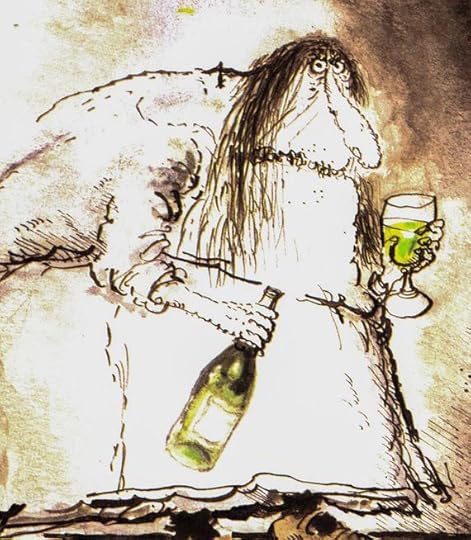
Here Ronald Searle, the infamous satirical cartoonist, takes a look at the magnificent world of wine tasting and the phrases that professional tasters sometimes use. Often more baffling that the choices of wine themselves, these phrases have not improved since this book was written, back in 1984, and, if anything, have got markedly worse!
I don't think I'll look at wine in the same way again and will be picturing this bunch of oddballs each time I read the labels! 3.5 stars.
Ronald Searle was masterful at composing drawings that were artfully accidental, palimpsest of scratches, blots and lines, grotesquely graceful in celebrating ugliness in all its beauty. His style resonates beautifully with the linguistic accidents of "winespeak", that semantic monster created to express what words cannot describe, in attempts by people whose inability for clarity of expression may well hide an ineptness at perceiving the nuance they try to fathom. In the meantime, it's them who have had the wine, and us who are left to find comfort in the ruthless way with which Searle destroys their phrases by taking them literally. A wonderful little gem of a book, best enjoyed with a fine tawny port and a piece of Stilton, or any good vin de réflexion.
Is this book still Out-of-Print? If I take this out to a tasting, I won't let it out of my sight! Besides the art/tasting note pairing, I love his introduction where he calls out those critics that do a disservice to the wine world and to language! I don't take myself too seriously when it comes to wine (and it shows), and this reminds me to get fired up and listen to the Guns-N-Roses song "Get in the Ring".
You can read this in 20 minutes, going slowly. Fun, absurd drawings of people, as always. I think it's a reprint, so it seems vaguely fuzzy or something, but that is my deep Ronald Searle nerd speaking.
Searle expresses his ire at "the agonising and often excruciating acrobatics of those whose duty it is to enlighten the baffled consumer regarding the more esoteric aspects of, say, Rotterdam rouge" by drawing cartoons of their phrases. Conceptually, there's not an enormous amount to it - "Exceptionally full-bodied" and "Round and supple" are both variations on the theme of the wine having boobs, while most of the others see descriptions of the drink become descriptions of variously unappealing drinkers of same. The magic, of course, being in exactly how he draws them, his eye and line elevating easy gags into art just as he made us care about the life of the gerund. A process one can hardly attempt to define without risking exactly the same sort of acrobatics that annoyed him in the first place. Besides, I purchased this because I wanted to support a delightfully peculiar little bookshop, and if I hadn't I'd never have learned that the proprietor sat opposite an Arcimboldo-esque sculpture of her late husband, which I'm convinced speaks to her when no customers are intruding, so in that sense any merit in the book itself is just a bonus.
A quick, refreshing, chuckle-inducing, five-minute read with outlandish, outrageous, hysterical drawings -- what more is there to say? Some of my favorites, both the descriptions and the cartoons are --
Intense, aromatic, lots of body A little sullen Full bodied, with great character Lacks subtlety Really quite forward Has voluptuousness and charm in an earthy sort of way
funny short read. nothing can get more hilariously pretentious than a snob, critic or blogger trying to describe the flavor of a particular wine, microbrew or spirit.
the drawings kind of reminded of shel silverstein for some reason although they are two different artists.
buy it a thrift-store for a $1 & then laugh for five minutes.
Humorous and entertaining. Myself and some other librarians were going through books and came across this gem. For those who don't take wine tasting seriously. Very tongue-in-cheek. Loved it.