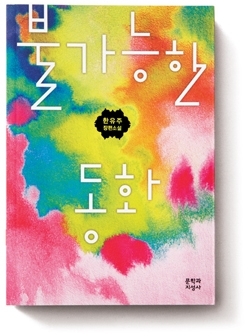
This book is published by a small UK publisher Tilted Axis who publish “books that might not otherwise make it into English, for the very reasons that make them exciting to us – artistic originality, radical vision, the sense that here is something new.” Their name refers to their aim to tilt “the axis of world literature from the centre to the margins ...… where multiple traditions spark new forms and translation plays a crucial role.”
It was founded by Deborah Smith, the English-Korean translator of Han Kang’s “The Vegetarian” and winner with her of the 2016 Man Booker International Prize.
Smith has commented on the founding of Tilted Axis “The idea initially came out of my own work as a translator, getting an insider’s view of the publishing industry and discovering some of the implicit biases preventing certain books from making it through into English. So our main objective is to subvert or circumvent as many of those biases as possible by publishing under-represented writing, which is an intersection of original language, style, content, and often its author’s gender. To publish it properly, in a way that makes it clear that this is art, not anthropology. To spotlight the importance of translation in making cultures less dully homogenous. To push for better rates and recognition for translators themselves”.
The original author of this book is the Korean Han Yujoo, herself both a translator (in her case of English literature into Korean) and a publisher (her own micro-press Oulipo Press focuses on experimental literature).
The translator of this book is Janet Hong a writer and translator living in Canada. In fascinating end note to her translation she comments that just as she was embarking on the translation she read a very favorable review of the original book by a Korean literary critic who then “noted that the story relied heavily on wordplay …and that such sections would unfortunately be lost in translation”.
It is clear both from the translation that a kind of stream of consciousness wordplay, relying on word association and transitions between similar words is key to the novel – and the complexity of this is I think increased by the key role played in this by Korean characters and by what I understand to be the greater prevalence of onomatopoeia in the Korean language compared to English.
My first reaction when I hear of the attempted translation such a book is two-fold – firstly to ask whether the book itself is really in any sense the same book as was originally written; secondly to query if the effort in translation can really be justified.
To her credit the translator addresses effectively both these issues in her end note. The first by saying that she worked with the author on the translation (something I think which must be made a lot more valid by the author’s own translation ability and presumably English fluency). Secondly by stating (in what I think is an admiral sentiment) that the translation is a result of “a humble, passionate and joyous attempt [to share] this chilling, exquisite, mesmerizing tale with readers who otherwise would not have had access to the original”.
The book has two distinct parts. The first tells the story of two children – the first is two contrasting twelve year old classmates.
The first is Mia, a child with (for reasons not entirely clear) two fathers, from both of whom her mother seems estranged, a situation she exploits to her own advantage, by leveraging the guilt of the three parents to get what she wants. Mia herself could be described as pre/early-adolescent, feeling to herself misunderstood and unfortunate, but to others as being blessed with looks, intelligence and possessions. She talks about violent acts (being for example taken with a detective novel where someone is killed by the sharp end of fountain pen dropped from a great height) and thinks about killing others, but its clear her talk and thoughts are very theoretical and childish.
The second is quite literally anonymous, both to us and to her classmates – known only as “The Child”. She is clearly physically and mentally abused by her parents – and yet, as part of her anonymity and invisibility, the other children and more damningly the adults at the school, completely overlook and even rationalise the clear evidence and signs of that abuse (bleeding, bruises, even ripped off fingernails). The Child also thinks violent thoughts – but it is clear in her case firstly that her experience and knowledge of violence is much more real and mature, and secondly that the boundary between thought and action is much more blurred (for example when she murders a stray cat).
The children’s society is one marked by the almost casual acceptance of violence – the children by small chicks and then devise ways to kill them, their default game when adults are not present is the “fainting game” where they choke each other to the point of passing out.
As a fairytale this owes much more to the traditional fairytales, with their assumption of darkness and malevolence, than the Disney-fied versions of childhood innocence – and there is an unsettling undercurrent to the story which we know is going to end far from happily ever after.
Chapters alternate between the viewpoints of The Child and Mia, and the Child’s sections in particular grow in menace, undercut by the increasing use of rhythmic and often violent word imagery and associations. A repeated theme in this section is a series of forking paths outside of the school.
The second part of the book takes a distinct meta-fictional turn – it starts with a series of odd dream sequences, but then the narrator of the second part, seemingly a teacher is confronted in a class by an unexpected and familiar face. We realise that the narrator is the author of the first part of the book, and the other character her fictional creation The Child, and that time is somehow mixed between the events of the book, and the period in which the author meets her own creation (possibly 8 or 15 years later). The Child retraces some of her actions in the first part, reads the journals the author wrote when she was reading the book and debates with the author who was really responsible for The Child’s actions in the first part – The Child or the author who had planned out what she was going to do.
As an example in the journal, The Child reads (in what serves as an excellent description of the contrasting characters of Mia and her in the first part)
“Scary, fearful, sickening, terrifying, hideous, frightful, chilly”. These were probably meant for me. And below were these adjectives “premature, immature, unripe, young, delicate, childish”. These were probably meant not for me, but someone else. I’m sure of it
There are further hints that in writing the first part, the author based the character of The Child (and possibly Mia) on aspects of her own childhood. Before she meets The Child, she says
I can disguise my childhood and as I disguise it I can make allusions, and as I reveal details about the allusions, I can make them appear fictitious, and in this way I can deceive you all.
When The Child confronts her after class, the meeting is precipitated by the narrator falling down stairs (in the same was as happens to The Child frequently in the first part); further her initial reaction to seeing The Child face to face is:
The face is unfamiliar. The face watches me in silence. I see myself in that face. It’s actually mine. We may have had the same childhood. She’s me. You’re me. But I’m not me and I don’t look like anyone else. I sense that the writing about me has already begun
This impression is made stronger by a powerful section in the first part, which completely goes against the flow of the rest of that part, and features short paragraphs on each of the class members, featuring some incident from their childhood which they remember (seemingly as adults).
The second section, like the first, features the same stream of consciousness, word-association, wordplay. Unfortunately this technique is not always (in fact not often) successful and instead distracts from what from the core elements of each part – the growing menace of the first part and the meta-fictional aspects of the second.
As an example a bizarre dream sequence early in the second part, contains repeated variation around a nag which is nagging the narrator, a dog which has dried out, discussions of the word confusion having no opposite, some very odd discussions of the differences between lilacs and buttercups and lots of repetition of the word bricks.
Some of this effect may be lost in translation – for example I have no idea of what lies behind the choice of the nag that nags and what was in the original Korean, but whatever it was the effect in English is very weak. However I suspect that most of the fault is not barriers in the translation, but ones that the author has added herself in the original Korean. Disappointingly and surprisingly for someone who I understand started her writing career in short stories, Han Yunjo seems unable to write the tight prose that is really needed to add real menace to the first part and real insight into the authorial process into the second.
My thanks to Tilted Axis for a review copy.