Deux amis d'enfance, l'un à Copenhague, l'autre à New York. Une lettre qui arrive après la mort de son expéditeur. Une femme, sœur de l'un et maîtresse de l'autre. Des estampes japonaises, un hôtel de passe, une grande demeure bourgeoise. Comment comprendre la vie d'Adrian, terrassé par une crise cardiaque à quarante ans à peine, à partir de ces quelques éléments, comment renouer les fils épars de l'histoire de leur amitié? C'est à ces questions que le narrateur de Bruits du cœur, dont nous ne saurons jamais le nom, essaie de répondre, en remontant le cours de ces deux vies étroitement liées. Il revient sur leur enfance, leurs échecs sentimentaux, leurs choix professionnels, cette envie d'être à la place de l'autre. Mais avant tout, il cherche à comprendre les mouvements du cœur et du désir qui ont donné à la vie d'Adrian et à la sienne ces contours parfois chaotiques.
Jens Christian Grøndahl is one of the most celebrated and widely read authors in Europe today. He has written plays, essays, and eleven novels. The publication of Silence in October marks Grøndahl's U.S. debut. His novel Lucca was awarded the prestigious Golden Laurels Prize in 1999. He lives in Copenhagen.
Bibliography:
Kvinden i midten - 1985 Syd for floden - 1986 Rejsens bevægelser - 1988 Det indre blik - 1990 Skyggen i dit sted - 1991 Dagene skilles - 1992 Stilheden i glas - 1993 Indian summer - 1994 Tavshed i oktober - 1996 (translated into English, Silence in October 2000) Lucca - 1998 (translated into English under same title 2002) Hjertelyd - 1999 Virginia - 2000 (translated into English under same title, 2003) Et andet lys - 2002 (translated in English, An Altered Light 2005) Piazza Bucarest - 2004 Røde hænder - 2006 Tre skridt tilbage - 2007 (essays) Den tid det tager - 2008
Modern Love Heartbeat is the fourth novel of the Danish author Jens Christian Grøndahl I have read. Like the other three novels I read by him, the novel revolves around the themes of love, loneliness, fate and longing – love in different shapes and during different stages of life, love taking more or less space in one’s life, love bringing harmony as well as conflict and friction, fulfilment and incompletion:
I believe that it is the same love that flares up in you and takes such different forms, the same hunger and desire and the same tenderness, which is directed towards those who are available; the adults you meet, the children you have with them, and the strangers for whom you feel you have to leave everything to follow them. But the forms of love are confusing, so different and strange. It seems incredible that they are made of the same material, you don't believe it, and maybe it is just as well, because that way it always appears new, the same old love.
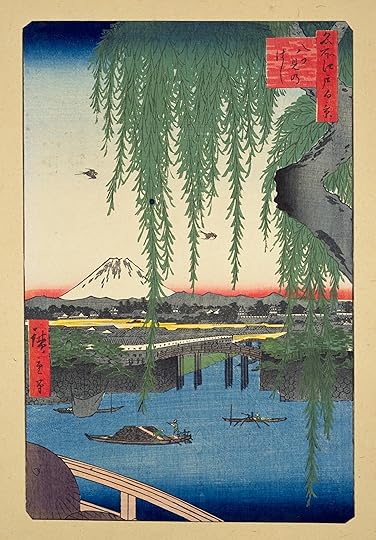
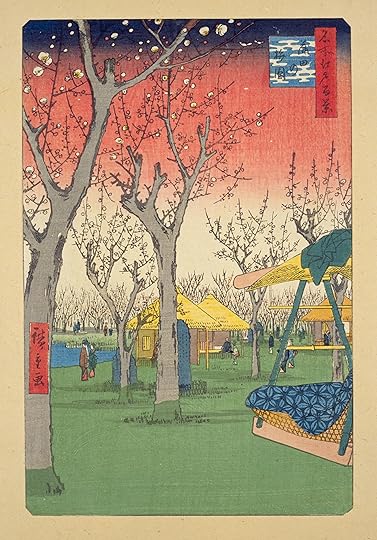
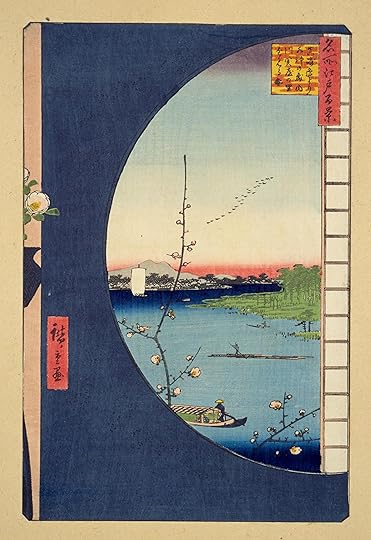
The unnamed protagonist is a former architect who lives a reclusive, sober life with his teenage son in Copenhagen as a vendor of Japanese woodblock prints. His attitude is one of wait-and-see, introspective, reacting rather than acting, reflecting on rather than giving shape to his life. He is impelled to look back on his life the moment he receives a mysterious letter of his youth friend Adrian – a mystery that he cannot solve easily because Adrian has suddenly died of a heart attack after sending the letter. Adrian’s death catapults Adrian’s sister Ariane back in the life of the protagonist – the great love of his youth. Reflecting on the relationships he had since both Ariane and Adrian mostly disappeared from his life, his moods, thoughts and impressions are echoed and illustrated by the recurrent evocation of some of the prints from the series of Utagawa Hiroshige’s woodblock prints series “One Hundred Famous Views of Edo” (1856–1858), which depicted various scenes of the city through the seasons, from bustling shopping streets to splendid cherry orchards.
These echoes and allusions on the impermanence and sensuality of the Floating World (Ukiyo) seem wonderfully attuned to the lives of Ariane, Adrian and the protagonist and to the significance of love in their lives – the series a fitting metaphor for the psychological and geographical itineraries of this trio.
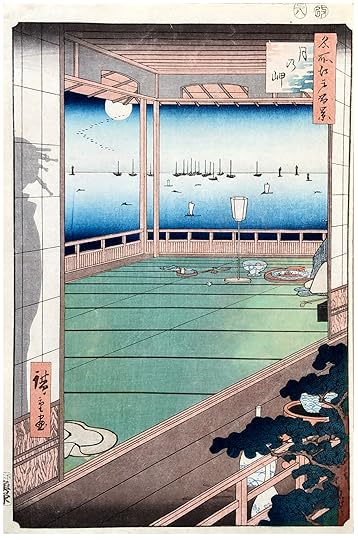
I could only identify the first print that is mentioned as no 82 in the series (Moon-Viewing Point) – and the choice of this is meaningful, playing more on what the viewer might suppose rather than see, as such referring to a key moment in the novel that G leaves open to interpretation, making it equally ambiguous to the reader as to the protagonist):
Hiroshige has chosen to describe the pause, the silent interval between the scene that has ended and the scene that has not yet begun. Both situations are represented, one in the form of the remnants of being together, the other as an allusion to what is to come. It is both a quiet and a tense moment, balancing in the silent void between memory and expectation
It is a novel that needs to be read and savoured slowly. Grøndahl’s prose is smooth as velvet and superbly contemplative and lucid, the imagery and nature descriptions are vivid and alluring. There are beautiful moments, when a pair of grey eyes comes to symbolize harmony, calm and homecoming after turbulence – at least for the time being. Although I thought the writing even more beautiful than in Often I Am Happy, the storylines of Heartbeat left me fairly indifferent, unlike the affecting, powerful and inspiring story of Often I Am Happy. The narrative is so chock-a-block with a variety of erotic adventure (often including a transgressive twist, a stretch possibly to contrast it with the unassuming life of the protagonist (warning - slightly spoilery - as there are: stalking, incest, prostitution, fathering a child on order of a lesbian friend, a stepfather impregnating his stepdaughter while stile married to her mother, some whiffs of adultery), I was wondering if Grøndahl couldn’t make up his mind in choosing the most dramatic one, often only touched upon in passing without much further thought. Particularly the moment Adrian was caught naked wearing a dog collar was simply des Guten zu viel, as turning the narrative gradually a little ludicrous – and rather silly in spurs (‘this week I made two women weep’).
I am hopelessly old-fashioned. Sometimes I see myself from the outside: a man who will soon be middle-aged, absent-minded and bald, sitting in a dusty room in a side street, hunched over his yellowed woodcuts from a time that is gone. A world gone forever. It's like the image of a loser, a dreamer stuck on one of life's shunting tracks, while the more enterprising and purposeful ones tear by, but what can I do? I love the Japanese sense of beauty in the everyday, the small pleasures, as they say, the cherry tree in bloom, the way the moon shines between the branches and the blossom of the tree.
Even if the intricacies of the storytelling or the characters do not come across as memorable, what will stay with me from the book is the graceful prose and a yearning to explore the series of Hiroshige in more depth.
Μάλλον άνισο το βιβλίο του Γκόνταλ, αφού αλλού ξεκινάει και αλλού καταλήγει. Με αφετηρία μια παιδική φιλία που παίρνει τέλος ο ανώνυμος ήρωας ξεδιπλώνει μια ιστορία για τον έρωτα, την αγάπη, τη λήθη, τη συγχώρεση κ.α. χωρίς όμως να επικεντρώνεται πουθενά. Ίσως αυτό να είναι το πρόβλημα του βιβλίου, δεν έχει συνοχή, αντίθετα είναι ένας μικρο λαβύρινθος της ερωτικής ζωής του ήρωα που μεταπηδά από την μια ερωτική ιστορία στην άλλη και πάλι πίσω. Κάπου κουράζει και κάπου φανερώνει μια ματαιότητα σε όλο αυτό αν και στο τέλος υπάρχει φινάλε. Καθόλου άσχημο αλλά και πάλι λίγο άχρωμο, ίσως και κουραστικό.
Bien que la lenteur en début de roman m'a ennuyée, j'y ai finalement trouvé une belle histoire qui me change de mes romans habituels. Une amitié entre deux hommes qu'on lit trop peu souvent. Un léger suspense qui nous donne envie de se rendre jusqu'à la fin.
Het was leuk om weer een genre te lezen wat ik een tijd niet heb gelezen, maar de schrijfstijl is niet helemaal mijn ding. Ik vind het gebruik van flashbacks vaak verwarrend, soms duurt het regels voor je door hebt dat je ergens anders/in een andere tijd bent, dan je eigenlijk dacht te zijn.
Een architect heeft zijn baan opgegeven en heeft nu een klein winkeltje in Japanse prenten. Samen met zijn zoon heeft hij een kalm leventje, tot hij een telefoontje krijgt van de zus van zijn beste vriend Adrian. Zij vertelt hem dat hij is overleden. Als jongeman was hij verliefd op deze zus en door het telefoontje gaan zijn gedachten weer terug in de tijd. Zo komen wij alles te weten over zijn vriendschap met Adrian en met zijn zus. Vlak voor zijn dood krijgt hij nog een brief van Adrian, waarin hij zegt hem te willen spreken. Hierdoor neemt zijn leven een onverwachte wending.
Ik las eerder al enige boeken van deze auteur ("Stilte in oktober", "Dat weet je niet", "Vaak ben ik gelukkig") en ze lijken allemaal zo op elkaar qua thematiek. Liefde en relaties, de kortstondigheid daarvan en het geworstel er mee. Als je de flapteksten van de meeste van zijn romans leest, krijg je de indruk dat je ze al gelezen hebt. Grøndahl schrijft niet slecht maar er is erg weinig afwisseling in zijn onderwerpen. Vandaar maar 3 sterren.
Het was het eerste boek van Grøndahl dat ik las. Ik kan alleen besluiten dat de blurb veelbelovender klinkt dan het boek zelf. Het boeide me niet, hier en daar komt het nogal melig over. Niet echt een pakkend verhaal dus. Af en toe word je uit de saaiheid gehaald door erotische en sexuele transgressies (overspel, stalking, incest, prostitutie, BDSM,...). Waarbij ik me dan afvraag of dit dan misschien de kapstokken van het verhaal zijn?
De beste stukjes vond ikzelf de verwijzingen naar de Japanse houtsneden van Hiroshige, die meer dan de moeite waard zijn om nader te bestuderen. Een fijne herontdekking!!
Un roman danois sympathique sans être mémorable. Quelques heures après l'avoir terminé, au moment d'écrire ces quelques lignes, il m'avait fallu quelques instants pour me souvenir de l'histoire de ce roman. J'ai apprécié cette lecture, même si ce ne sera pas mon livre de l'année. Bien écrit, agréable à lire, mais pas inoubliable.