Jump to ratings and reviews
Rate this book

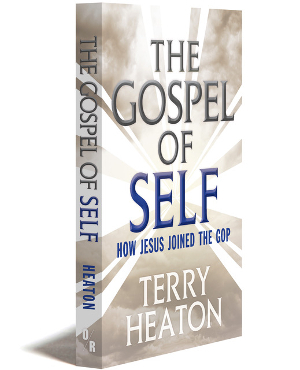
The Gospel of Self: How Jesus Joined the GOP

Rate this book
"When a former right-hand man of Pat Robertson and one of the key players of the religious right tells you what he really thinks, you'd better listen. I'm grateful for Terry Heaton's courageous new book, The Gospel of Self: How Jesus Joined the GOP. It could not be more timely." —Brian McLaren, author, The Great Spiritual Migration

"Heaton’s stories of his involvement with Pat Robertson and The 700 Club, as well as other fascinating stories, pepper his incredibly deep and insightful analysis of contemporary Christianity in the West. I recommend this book to anyone who wants a thorough exposition of the state of Christianity, theology, and the Church today." —David Hayward, The Naked Pastor and Questions Are The Answer

"In this masterful apologetic, Terry Heaton has skillfully analyzed the trend of modern Christian politics from a self-incriminating perspective as the former executive producer of the Christian Broadcast Network’s flagship program, The 700 Club with Pat Robertson. ...The Gospel of Self is a must-read for anyone grappling with the great taboos of polite society—the corruption of politics and religion" —Danuta Pfeiffer, author, Chiseled, A Memoir of Identity, Duplicity and Divine Wine and former co-host, The 700 Club

The bitter political and religious divides we see today in America have roots that go back many decades. The televangelist Pat Robertson was one the first to determine how battlelines were drawn. Robertson, now a leading and unflinching Trump supporter, rose to national prominence in the 1960s with his Christian Broadcasting Network and his hit show The 700 Club.

Terry Heaton, who worked alongside Robertson at The 700 Club and became its executive producer, provides the inside story of how evangelical Christianity forced itself on a needy Republican Party in order to gain political influence on a global level. Using deliberate and strategic social engineering, The 700 Club moved Christians steadily into the Republican Party–and moved the party itself to the right.

With a gospel message that appealed to self-interest, The 700 Club violated numerous laws in an attempt to create a Shadow Government of Evangelicals, all in the name of doing God’s work on earth. The results of this longterm campaign were fully on display in the 2016 electoral season.

222 pages, Paperback

Published May 25, 2017

18 people are currently reading
241 people want to read

About the author

Terry Heaton

7 books6 followers
Terry Heaton is a former executive producer of the Christian television news show The 700 Club, where he assisted Pat Robertson in his run for President in 1988, and where he was in a unique position to observe and participate in the development of the Christian right. A media theorist, he is the author of Reinventing Local Media and has written for media news websites and media companies throughout the United States. Heaton plays guitar and five-string banjo and is a bluegrass music aficionado. He lives in Madison, Alabama.

Ratings & Reviews

What do you think?
Rate this book

Friends & Following

Create a free account to discover what your friends think of this book!

Community Reviews

5 stars
9 (20%)
4 stars
13 (29%)
3 stars
15 (34%)
2 stars
5 (11%)
1 star
2 (4%)
Displaying 1 - 12 of 12 reviews
Profile Image for James.
1,525 reviews117 followers
June 29, 2018
Every wonder why the Republican party is the party that self-consciously allies itself with the Christian Faith, even as its leadership has suspect moral values and betrays the OR Book Going Rougebiblical call to care for the vulnerable? According to Terry Heaton, the answer is Pat Robertson, the 700 Club, and his CBN empire.  Heaton writes:
When I worked with him the 1980s, we practiced and promoted a brand of Charismatic Christianity that was seen as a breath of fresh air to a faith that had grown stale in every aspect from its music to its preaching, and we worked long, hard hours to move hearts and souls in the way we felt was right. In so doing, we altered the course of political power in the United States, and it was as natural as our Christian calling. Taking positions on social issues formerly held by conservative Democrats such as the sanctity of life, religious liberties, patriotism, family, school prayer, and respect for individualism and tradition, we spoke to primarily rural and suburban Christians on behalf of the Republican Party. We presented as Biblical mandates or "laws" economic views that catered to a culture, teaching that being one of the haves was available for everybody. Our arguments and teaching helped move the GOP to the right on the political spectrum and created a following that continues to baffle even the smartest political analysts in the country who are confounded by how such people would act against their own interests in giving power to Republicans. (2-3)

Jesus joined the GOP because as Pat Robertson wagged on about God, he wagged the dog, diverting evangelicals toward partisan politics and Republicanism. Heaton tells this story in The Gospel of SelfHe had a front-row seat for most of this. In the 1980s, he was the executive producer of The 700 club, helping to transform it to its news-style format which would, in turn, influence the shape of conservative politics. Heaton sees their work at CBN as pioneering the sort of point-of-view-journalism which prefigured the likes of Rush Limbaugh, Conservative Talk Radio, and Fox news.
History will record that The 700 Club was the tap-root of that which moved the Republican Party to the right and provided the political support today for a man like Donald Trump.  A 2015 Harvard report concluded that right-wing media was driving the GOP, not Republican leadership, but this assumes that in order for people to behave as cultural radicals, they must be manipulated into doing so. This is a misleading interpretation of human nature and the power of personal faith. (12-13).

Heaton sees the work of CBN, and later right-wing media outlets, as instrumental in manufacturing political opinion.  Much of the book recounts the story of CBN's success in the 1980s and the political genius of Pat Robertson. The book is called the Gospel of Self because of the evangelistic emphasis on self-interest in Robertson (and other evangelicals) which dovetailed with fiscal conservative concerns for personal, economic prosperity. Heaton describes the growth of Robertson's empire, his influence, his nearly successful bid for the GOP nomination, before being investigated by the IRS (Heaton suggests the government pressure came because George H W Bush was Vice President and Robertson's chief opponent).  In the final two chapters,  Heaton offers his critique of media manipulation and the return of real independent journalism, and his suggestions for the emerging church in the post-Christian/postmodern era.

This is a critical look at Pat Robertson and his influence, but Heaton is not vindictive or bitter about his experience at CBN. Like Robertson, he was convinced they were doing the Lord's work. So even as he talks about the way The 700 Club's sometimes exaggerated or manipulative claims of healing, or Robertson's overstated prophesies,  Heaton also extolls the good. The ways Robertson and CBN impacted real lives and made a difference, Robertson's genius, and fundraising and commitment to Christian mission. Heaton now advocates a brand of Christianity that is less top-down, more relational and less manipulative (204), but I didn't feel like this book is out to smear Robertson's character (even as he points at some glaring problems).

The real value of the book is the insider perspective that Heaton offers on Robertson. Robertson and his impact on Evangelicals in politics are highly significant for understanding American political landscape. Of course, Robertson was not alone. There was also Falwell's Moral Majority, Francis Schaeffer, Chuck Colson, and a host of other voices. Heaton doesn't really tell their story (he briefly mentions Falwell, or segments Colson did on The 700 Club), but he was too close to the sun all other luminaries paled in comparison. Heaton linking Robertson's 1980s empire to Trump did seem a bit tenuous, other than to point out ways in which conservative politics and Evangelical sociopolitical identity became entangled.  Though he does make some interesting suggestions on how motivated conservatives and evangelicals are by self-interest, and the ways social-care, a gospel prerogative, was short-shrifted by evangelicals (and the GOP).   A book like Francis FitzGerald's The Evangelicals (Simon & Schuster, 2017) does a better job of tracing the movement of Evangelicalism towards the GOP and the rise of Trumpism, but Heaton's perspective is interesting as one. I give this three-and-a-half-stars.
Notice of material connection: I received a copy of this book from SpeakEasy in exchange for my honest review.
Profile Image for Darrell Grizzle.
Author 14 books80 followers
February 1, 2018
One of the early pioneers of modern televangelism is Pat Robertson, founder of the Christian Broadcasting Network (CBN), whose daily TV show, The 700 Club, broadcasts in 138 countries and claims a million weekday viewers and 11,000 daily callers to its prayer line. This new book, The Gospel of Self: How Jesus Joined the GOP, is by Terry Heaton, who worked side-by-side with Pat Robinson for several years during the 1980’s, becoming the executive producer of The 700 Club. This is a fascinating inside look at the inner workings of CBN during a time when Pat Robertson and others made a conscious effort to move evangelical voters closer to the Republican Party – and the GOP itself further to the right.

As you can tell from its title, the author of The Gospel of Self now views the brand of evangelicalism that he helped promote in the 1980’s (and which is still being promoted by many evangelical leaders today) as a self-centered, Americanized form of Christianity that is not always faithful to what Jesus himself taught in the gospels. Terry Heaton states at the beginning of the book: “The evangelist’s message has always been self-centered, for it preaches the gospel as a means to saving one’s own ass from eternal hellfire and damnation in the afterlife. Evangelical Christianity has refined the message over the years and turned it today into the means for blessings in this life as well.” That emphasis on “blessings” is what fuels the multimillion-dollar budgets of CBN and other evangelical “non-profit” organizations to this day.

Terry Heaton provides a look at how The 700 Club tried to become a “news” show as well as a Christian talk show, paving the way for other news agencies to embrace “advocacy journalism” become less objective in their reporting. “Fox News would never have found the success it has known if CBN News hadn’t blazed the trail,” he writes. Heaton doesn’t necessarily think advocacy journalism is a bad thing, as long as journalists are transparent with their biases. One whole chapter is basically an essay defending (not very convincingly) such “point-of-view journalism.”

Heaton is honest about Pat Robertson’s political aspirations and how Pat was really “a political strategist who happened to be a minister” – not just during the time when Robertson himself ran for president, but throughout his career. He quotes Robertson as saying in 1985: “We must form a shadow government. We must begin to find and train Christian people, so that they can be placed in every position that matters…” in local governments as well as in national politics. Heaton is also honest about the ethics that were stretched and the laws that were broken, sometimes by Heaton himself, in carrying out CBN’s political, religious, and fund-raising objectives.

As a former evangelical who watched The 700 Club and The PTL Club in the 1980’s, I found myself fascinated by the book’s coverage of how Pat Robertson responded to the televangelist scandals of 1987 involving Jim Bakker and others. Heaton describes actions taken by Robertson that he disagreed with, even while he was still working with Robertson, as well as some of Robertson’s blatant lies to Heaton and others during that era. But the book is not a tell-all scandal book; Heaton still very clearly regards Robertson with affection and some measure of respect, even all these years later. There’s no bitterness here. But Keaton’s continuing affection for Pat Robertson doesn’t get in the way of his honest assessment of the damage Robertson has done to evangelical Christianity as it is today.

The book ends with two chapters that are basically appendices, one about “point-of-view journalism” and one about postmodern “Emergent” Christianity. Not everyone will find those two chapters interesting or their arguments convincing (I didn’t), which is the only reason I give the book 4 stars instead of 5. But the rest of the book is highly recommended for anyone who wants a deeper understanding of how evangelical Christianity played – and continues to play – such a prominent role in today’s political landscape.
Profile Image for Haley.
83 reviews9 followers
May 26, 2018
Highly recommend in general (easy to read, a unique perspective on the religious right and associated media), 4 instead of 5 stars because the last chapter or two departed in some ways from the strongest narrative Heaton presented (there's a discussion about post-modernism, predictions about the media moving forward, and discussion of what it means for us to head toward a "post-Christian" world, where the church as an institution doesn't have the same political power).

Pat Robertson, the televangelist who campaigned for the Republican nomination for President against George H.W. Bush, is a Yale Law grad who created the Christian Broadcasting Network and the show The 700 Club. (According to Wikipedia, he still serves as CEO of Regent University and chairman of CBN.) Terry Heaton was the executive producer of The 700 Club in the late 1980s, and describes the show as intentionally cultivating the modern religious right, in part by intentionally skewing perceptions of Christians and the way God was working - e.g., showcasing only young, "attractive," educated Christians - a cohort Heaton claims the church has lost/is losing since - to counteract stereotypes of ignorance. He also talks about the illegal use of 501-c-3 funds for political purposes that sparked a massive IRS investigation during Robertson's campaign and a settlement in the '90s. The show was intended to shift American culture and politics (specifically, moving the Republican party farther right), and seems to have been wildly successful, given where we are now.

Heaton has written the book for a Christian audience - "This is a book for Christians of all stripes, because we are the only ones who can make this right" - and what he views as needing to change is the self-centeredness of modern evangelicalism. Recommend for my evangelical and ex-vangelical friends, as well as those who have no experience with the religious right - Heaton is right that you are missing an important piece of the story if you don't understand that there are genuine and zealous religious beliefs at work in the modern Republican party, even if to "outsiders" the beliefs seem wildly out of step with the policies the party advocates - as Heaton says, there's a case to be made that the Democratic Party is actually more in step with Biblical mandates, but that's not where we're at culturally. I think it gives a more plausible explanation of why many on the right are willing to vote against their own material interests than many accounts since the election have, though that analysis isn't always as clear and explicit as it is in other accounts.
Profile Image for Jim.
501 reviews5 followers
September 6, 2023
Very interesting story of one aspect of the aligning of the GOP with right-wing religion. As well, it's an interesting perspective on Pat Robertson.
Although there have been so many changes, new players, variations, turns, etc., in the story of the GOP's link to a certain type of Christianity, this seems to document the earliest beginnings of the televangelism/political congealing. The author's portrait of Pat Robertson is fascinating, too, in the portrayal of a bright man who believed God was personally telling him what to do and his use of technology to get there. Heaton has a very high opinion of his own skills and those of the staff he hired, but he may be quite right that they were the best. Both strategically and tactically, both he and Robertson made sound decisions.
The period of time during which Robertson both discerned that God wanted him to run for President and then ran, is fascinating, too. Perhaps Robertson truly believed that God told him to run – and told Robertson that he would win, which seems to be what Robertson believed – but it was such a disastrous run that one suspects ego may have defeated Robertson in some way. To those of us not in that world, it seems ridiculous, laughable, and a mistake.
There were times Heaton's self-regard and repetitious style got in the way, bogging down the book, but all in all, it's worth the read.
84 reviews
November 15, 2017
This was an interesting insider account of the rise of the Christian Right and how it has metastasized into its current manifestation of unthinking outrage. I was hoping for a little more analysis on top of the stories, though. Still, other than the last chapter on postmodernism, which felt like it probably belongs in a different book, it is a worthy read and helps with understanding the path that led us to our current point in history.
Profile Image for Jules Findlay.
39 reviews2 followers
August 13, 2018
Pat Robertson was this huge evangelical Christian who was, and still is a bit, the face of CBN (Christin broadcasting network). Terry was his mate and produced a lot of the content. Basically, this book really helps to understand the GOP today especially how much Christians love Trump and the rise of FOX news. It's not amazingly written and there are too many personal anecdotes, but essential reading for these here odd times.
Profile Image for Christopher Lewis.
182 reviews1 follower
August 29, 2017
This book is very interesting. A man who was on the inside of CBN in the 1980's reveals the extremes Pat Robertson went to manipulate the public & misuse the Gospel in a feat of political social engineering. The author demonstrates the role Robertson played in setting the stage for many of the problems America faces today.
8 reviews
June 18, 2023
From a liberal Episcopal Christian

A very thought-provoking view of Evangelicals in both the past and future. Of course, the future will influence both liberal and conservative Christians. I can't wait to "participate" in a discussion about how my church will end up in the Postmodern future.
Profile Image for Jesska.
131 reviews2 followers
September 16, 2017
Boooooooriiiiiing
This entire review has been hidden because of spoilers.
7 reviews
June 3, 2019
Interesting, but not my "cup of tea". Very good information to know.
696 reviews11 followers
April 27, 2017
As always, OR books challenge me to think about a usually taboo topic. _Gospel of the Self_ is no different. Written by a producer and right hand of Pat Robertson at CBN in the 1980's, he gives an inside account of the what and why of that era.

Through the CBN and its 700 Club program, the message of service to others was warped to be service to oneself. Throughout the book, the author attempts to atone for the social engineering (his words) used by CBN to essentially manipulate its audiences into the gospel of self. The primary reason was money. Saying that service to others will get you into heaven, but does nothing for you here in the mortal realm, does't garner much for ratings. But convincing people that by giving money to the ministry and drive Jesus everywhere, they could obtain health, success and wealth here on Earth.

The author also states many times that they had the best of intentions at CBN, but the results got out of their control. By telling people that their god would guide them and the world was theirs due to their special status, the audience didn't feel the need for self improvement or critical thinking. The author points out that CBN News and the 700 Club pulled those identifying as evangelical Christians far to the right. The Republican Party then tapped into this and the party for the weathly became the party for the far right.

There is a lot here to absorb. As the author is highly experienced with TV news, he has excellent commentary as to the state of the press & media in today's world. The book was completed just after the election of the current president, so he is able to provide interesting commentary and reflection.
Displaying 1 - 12 of 12 reviews

Can't find what you're looking for?

Get help and learn more about the design.