

What do you think?

Clara's Grand Tour: Travels with a Rhinoceros in Eighteenth-Century Europe
In 1741, an enterprising Dutch sea captain transported a young, female Indian rhinoceros from Assam to Europe where she was displayed before everyone from peasants to princes. In an age before railways and modern roads, the three-ton Clara traveled in an enormous coach drawn by eight horses. She journeyed across mainland Europe and Britain for 17 years, becoming a favorite of Frederick the Great and Louis XV. She modeled for scientific portraits and etchings; she inspired poems, songs, and fashions; and she was duly immortalized in everything from tin coins to the finest porcelain. Awarded the prestigious Institute of Historical Research Prize, Glynis Ridley's sparkling history brings Clara's tragicomic story vividly to life. Clara's Grand Tour is also a portrait of an era that saw the rhinoceros as both an object of marvel and a challenge to fundamental philosophical and theological beliefs.
240 pages, Paperback
First published January 1, 2004
About the author
Glynis Ridley
6 books8 followersFrom Book Cover:
Glynis Ridley is the author of Clara's Grand Tour: Travels with a Rhinoceros in Eighteenth-Century Europe, which won the Institute of Historical Research (University of London) Prize. A British citizen, she is now a professor of English at the University of Louisville.
Glynis Ridley is the author of Clara's Grand Tour: Travels with a Rhinoceros in Eighteenth-Century Europe, which won the Institute of Historical Research (University of London) Prize. A British citizen, she is now a professor of English at the University of Louisville.
Ratings & Reviews
Friends & Following
Create a free account to discover what your friends think of this book!
Community Reviews
Displaying 1 - 21 of 21 reviews

February 17, 2015
This is going to be a split review. For content, interesting subject matter, and presentation this would have an extra star. I definitely consider this a fun non-fiction book for people scared of non-fiction. Unfortunately, it does read like a slightly inflated dissertation, and from other sources listed in the bibliography, I gather that it isn't the first publication on this particular animal, but that isn't the deal-breaker for me. My problem is that Ridley refers to MANY artistic pieces in great detail that the reader cannot see. There are a smattering of plates in the middle of the book (8 pages) but the captions are often very general even though she refers to the artist and title of the work within the book. Aside from those few plates, there are several works she describes thoroughly that just are not depicted within the book. This is extremely frustrating because despite her citation of the work, artist, and current owner (if known) many of these images are difficult to find by searching online. Otherwise, a fun journey into the milieu of the 1740-50s that examines the importance of publicity, marketing, and shrewd showmanship.

November 28, 2022
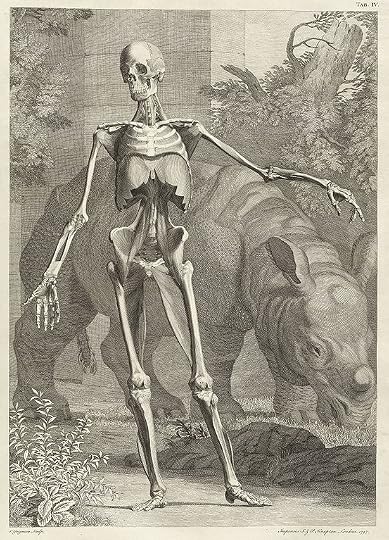
I first came across this engraving and had nearly dismissed it as something purely whimsical. It went into a book on human anatomy by Albinus. But after a little digging, it turned out that the rhino even had a name "Clara" - and had its origins in Assam, caught and gifted by a nawab to a Dutch East India "nabob" trader in Calcutta. It then went to a ship captain who made a spectacle of the rhino, taking it across Europe. If you are envious of the European travels of this rhino, you have to read this story of her travels contemporary accounts.

March 7, 2024
I thought it was fascinating, but I had to use google to find many of the pieces of art that are described in the book. I did have the benefit of seeing the exhibit at the Rijksmuseum in Amsterdam a while back, which had a lot of the art and various other things associated with Clara.
June 7, 2025
This repetitive book introduces us to Clara, and if it says once that she was the only rhino in Europe, and the only one people going to see her displayed were ever likely to see, it says it every chapter. For displayed she was – the chap who owned her had bought her in India, somehow thought it a bright idea to have her on a boat for the six month voyage back to Belgium, and eventually went out on the road with her, aiming at the hot spots of royalty and rich benefactors. That said, she became a phenomenon because the average citizen could see her as well, meaning she herself, and some astute merchandising and marketing, made quite the superstar of her.
This is quite enjoyable in the telling – or would be but for the drumming into us of the same details time over. We actually get insight new to me about the Durer "Rhinoceros" engraving, but get told so blatantly often how Clara managed to remove that seemingly ever-lasting false impression from the public mindset. The book is concerned with the perception of Clara and of Indian rhinos in general, and with the ins and outs of touring her – the bespoke covered wagon, the issues with the roads and the watermen, and the fact she might be tempted by oranges but was definitely not the trainable kind of gal.
If this is readable and enjoyable and informative – educating us about something we probably never expected to learn about – it is assuredly down to Clara. This is a friendly form of academia, bringing a peculiar quirk of history to light very well for the common reader much as Clara's owner made her visible to the common audience of his day, but it could also have been better. Clara herself is a definite spur to making this a four-star read, but isn't quite strong enough. Three and a half, then.
This is quite enjoyable in the telling – or would be but for the drumming into us of the same details time over. We actually get insight new to me about the Durer "Rhinoceros" engraving, but get told so blatantly often how Clara managed to remove that seemingly ever-lasting false impression from the public mindset. The book is concerned with the perception of Clara and of Indian rhinos in general, and with the ins and outs of touring her – the bespoke covered wagon, the issues with the roads and the watermen, and the fact she might be tempted by oranges but was definitely not the trainable kind of gal.
If this is readable and enjoyable and informative – educating us about something we probably never expected to learn about – it is assuredly down to Clara. This is a friendly form of academia, bringing a peculiar quirk of history to light very well for the common reader much as Clara's owner made her visible to the common audience of his day, but it could also have been better. Clara herself is a definite spur to making this a four-star read, but isn't quite strong enough. Three and a half, then.

October 17, 2022
I threw this book in my bag before a trip to Amsterdam only to discover when I got there an exhibition on Clara at the Rijksmuseum! https://www.rijksmuseum.nl/en/whats-o...
I am really enjoying the book and it was great to see some of the paintings and other objects (including the clock!) described in the book in person.
I am really enjoying the book and it was great to see some of the paintings and other objects (including the clock!) described in the book in person.
June 10, 2023
Given the book was about a Rhinoceros travelling around 18th century Europe the author managed to make the book remarkably dull.

January 24, 2013
In 1741 a Dutch sea captain, Douwemout Van der Meer, bought a live rhinoceros named Clara. He spent the next seventeen years touring Europe with Clara, the first and only rhinoceros most eighteenth century people ever saw.
Clara's Grand Tour: Travels with a Rhinoceros in Eighteenth-Century Europe
by Glynis Ridley is the story of this grand tour, of Clara's fame and of Van der Meer's careful handling of that fame.
It's almost as much fun as the title implies. I mean, how can you possibly go wrong with the story of a rhinoceros touring Europe in a coach-and-eight? It'd be pretty hard to mess up. Ridley has a clear, engaging writing style and an attention to detail that keeps the tale focused. And by "attention to detail" I mean I have no idea how she tracked down all the letters, accounts, and drawings she did. The resulting picture is fascinating. To give a few details: I was quite enchanted to think that Boswell's description of Johnson's laugh "Tom Davies described it drolly enough, 'He laughs like a rhinoceros'" likely came from a visit to see Clara. Similarly, the image of eighteenth-century Florentine women doing their hair "a la rhinoceros," (a fact gleaned from letters) or of the fashionable Parisian world going rhinoceros-crazy are beautifully human and wonderfully absurd. It's a look back at another world, one full of the usual array of foolish, wise, studious, frivolous folk, and I loved it.
One of the more interesting little nuggets to me was the suggestion that Durer's famous, and somewhat maligned, picture of an earlier rhinoceros to reach Europe was not a case of poor, silly Durer thinking that the rhinoceros's "armor-like" skin was literally like armor plating, but the result of said rhinoceros having actually been in armor at the time it was described to Durer. The rhinoceros in the picture probably looks like there are flowers on its skin because there were, in fact, flowers around the rhino. I'm not quite sure why this caught my attention so thoroughly. I think it's because I dislike the kind of condescension that sometimes creeps into discussions of earlier people's understanding of the world, and I like the idea (and evidence) that Durer was, in fact, being quite sensible after all.
Two things I wish there had been more of: Mostly, I wish Ridley had let loose with her enthusiasm a bit more. I mean, Clara's Grand Tour is the story of a rhinoceros! Touring Europe! In the Eighteenth century! In a coach! It's pretty amazing. I think a little jig or two is called for. Sometimes Ridley drops her guard and allows the sheer wonder and absurdity to shine through. Often, however, she pulls back a bit in favor of more scholarly commentary on the management of fame and the probability that Clara took this or that route on her journey. The results are impressive, and they're worth reading, but I don't think the addition of some more marveling would have hurt anything.
Also, I wish there were more first-hand accounts by people visiting Clara. In this, I'm just greedy. I loved what Ridley dug up, and I wish there had been more for her too dig. Likely Ridley wishes the same thing. There probably aren't that many eighteenth-century file cabinets full of breathless letters from people who'd just been to see Europe's one-and-only rhino.
Recommended: Yes. Be aware that Clara's Grand Tour, while clearly written, is not precisely light reading; you'll want a few brain-cells available (ie: Read it when you feel like focusing, not when you want the nearest fluffy brain-candy).
---
Note: This was originally written and published on my blog, Bookwyrme's Lair. Stop by for more reviews, link lists, photographs, and general thoughts about interesting things.
It's almost as much fun as the title implies. I mean, how can you possibly go wrong with the story of a rhinoceros touring Europe in a coach-and-eight? It'd be pretty hard to mess up. Ridley has a clear, engaging writing style and an attention to detail that keeps the tale focused. And by "attention to detail" I mean I have no idea how she tracked down all the letters, accounts, and drawings she did. The resulting picture is fascinating. To give a few details: I was quite enchanted to think that Boswell's description of Johnson's laugh "Tom Davies described it drolly enough, 'He laughs like a rhinoceros'" likely came from a visit to see Clara. Similarly, the image of eighteenth-century Florentine women doing their hair "a la rhinoceros," (a fact gleaned from letters) or of the fashionable Parisian world going rhinoceros-crazy are beautifully human and wonderfully absurd. It's a look back at another world, one full of the usual array of foolish, wise, studious, frivolous folk, and I loved it.
One of the more interesting little nuggets to me was the suggestion that Durer's famous, and somewhat maligned, picture of an earlier rhinoceros to reach Europe was not a case of poor, silly Durer thinking that the rhinoceros's "armor-like" skin was literally like armor plating, but the result of said rhinoceros having actually been in armor at the time it was described to Durer. The rhinoceros in the picture probably looks like there are flowers on its skin because there were, in fact, flowers around the rhino. I'm not quite sure why this caught my attention so thoroughly. I think it's because I dislike the kind of condescension that sometimes creeps into discussions of earlier people's understanding of the world, and I like the idea (and evidence) that Durer was, in fact, being quite sensible after all.
Two things I wish there had been more of: Mostly, I wish Ridley had let loose with her enthusiasm a bit more. I mean, Clara's Grand Tour is the story of a rhinoceros! Touring Europe! In the Eighteenth century! In a coach! It's pretty amazing. I think a little jig or two is called for. Sometimes Ridley drops her guard and allows the sheer wonder and absurdity to shine through. Often, however, she pulls back a bit in favor of more scholarly commentary on the management of fame and the probability that Clara took this or that route on her journey. The results are impressive, and they're worth reading, but I don't think the addition of some more marveling would have hurt anything.
Also, I wish there were more first-hand accounts by people visiting Clara. In this, I'm just greedy. I loved what Ridley dug up, and I wish there had been more for her too dig. Likely Ridley wishes the same thing. There probably aren't that many eighteenth-century file cabinets full of breathless letters from people who'd just been to see Europe's one-and-only rhino.
Recommended: Yes. Be aware that Clara's Grand Tour, while clearly written, is not precisely light reading; you'll want a few brain-cells available (ie: Read it when you feel like focusing, not when you want the nearest fluffy brain-candy).
---
Note: This was originally written and published on my blog, Bookwyrme's Lair. Stop by for more reviews, link lists, photographs, and general thoughts about interesting things.

June 16, 2008
This was a delightful read - it went along at about as quick of a pace as Clara ate hay. Along the way, I learned lots of interesting things about rhinoceroses, travel during the middle 1700's and some things about European history and culture during the mid 1700's that I know I never knew before. Now I really want to find a nearby zoo where there is at least one Indian rhino to look at, so that I can have a live view of what people saw when they viewed Clara. Not surprised at all that this won a special historical research/writing prize - it had a lot of obvious research behind it, and the writing was very well done.

January 4, 2010
Really liked this book. (with the only frustrating thing is losing the book 100 pages from the end and then searching for it.) It was a fantastic convergence of natural science, art, and philosphy in the 18th century. Clara was a very lucky rhinoceros who not only got to see the world, but re-created the whole way of thinking about rhinoceros in her time. She inspired artists, poets, science, fashion all to be created (for a brief nistant) in her image. It was rhinoceros mania and it really infected all aspects of history. As the author likes to remind people, her handler- Van der Meer, sucessfully mounted the first successful PR campaign in Europe.

November 29, 2008
Not much about rhinos in the end. I would recommend it to people interested in history especially the 1740s-1750s in Europe; also for art historians. The most interesting part was about how research leads from info to other info and on and on. How little things can make a big impact on history. It was dry and boring at times, but overall a good read. I really wish that it had more illustrations.

Read
July 29, 2011That was a quick read! Perfect for those afternoons when you don't want to commit to something dense and there is nothing compelling on the fiction shelf. The chapters are short and enjoyable. I won't spoil your enjoyment with the handful of tidbits I gleaned. But what could I say - it's about a freakin' rhinoceros hitting the European hotspots in the eighteenth century! You get a little politics, a little art, and a little reminder of European culture's long-standing issues with hubris.

Want to Read
June 13, 2008Still in the process of reading this book - but it just reminds me of how much I love to read well-researched books about subjects I had no idea even existed. And how the true story of a rhino traveling the continent can turn into a story about media and marketing, but in the most interesting sense.

January 5, 2009
I don't know what to say...this just tickled my fancy.
The sheer technical feat of traveling across Europe with a rhinoceros in an era before trains is amazing. Better still were the details of Clara's upbringing (she ate off china plates and loved oranges and the smell of tobacco). The description of the craze for all things "Rhino" is quite humorous.
The sheer technical feat of traveling across Europe with a rhinoceros in an era before trains is amazing. Better still were the details of Clara's upbringing (she ate off china plates and loved oranges and the smell of tobacco). The description of the craze for all things "Rhino" is quite humorous.

September 19, 2011
Well-done history of an oddity: the peregrinations of an 18th-century Indian rhinoceros throughout Europe. Clara got to meet everyone who was anybody, modeled for the lucky artists of Meissen, had her own stretch limo (or the enlightenment's version of one) and lived to a ripe old age. I wonder if she missed home?

February 13, 2008
I liked this book. Really, it's kind of odd to read about a rhinoceros that was toured through Europe in the 17th century, especially because most of the details are speculation, but it was interesting because it shows that marketing and promotion hasn't really changed much in the last 400 years.
July 28, 2008
couldn't resist reading about the true story of a 3 ton rhinocerous who was shipped from India to Europe in 1741 and then travelled from country to country for 17 years in the back of a wagon as a showpiece - not your average rhinos life

March 1, 2010
I love European history in the 1500s-1700s, and this is a pleasant twist - the story of the first rhinoceros to make a tour of Europe and gain the favor of kings and queens. It's also the story of her handler, a quiet man with a crazy dream, a clever ad-man, who made himself rich.

December 29, 2010
Interesting little book about Europe and the first Rhinoceros seen for a millenia... you really get a feel for how commoners and royalty both were hungry for novelty & real experience of things they had heard legends about.

June 26, 2011
Ridley focuses more on the woodcut images of the rhinoceros than she does on the rhinoceros. Maybe because the rhinoceros's main activity is eating 150 lbs. of vegetation per day??

June 3, 2013
great subject, read more like someone's college thesis

April 13, 2017
This book gives a very interesting account of Clara's journey through Europe in the 18th Century. The European history and politics are palatable but the book suffers from frequent repetition. Unsurprisingly there is a fair amount of speculation given that not all movements are documented but it is certainly an engaging account of the enterprising Van der Meer and his Rhino's travels.
Displaying 1 - 21 of 21 reviews