
Jump to ratings and reviews
Rate this book

An Ethiopian Romance

Rate this book
"Upon a rock sat a maiden of such inexpressible beauty as to be supposed divine. . . . Her head inclined forward without moving, for she was looking fixedly at a young man who lay at her feet. The man was disfigured with wounds, but seemed to rouse himself a little as from a deep sleep, almost of death itself. Pain had clenched his eyes, but the sight of the maiden drew them toward her. He collected his breath, heaved a deep sigh, and murmured faintly. "My sweet," said he, "are you truly safe, or are you too a casualty of the war?"

The Romance novel didn't begin with Kathleen Woodiwiss or even with the Bronte sisters. By the time Heliodorus wrote his "Aethiopica"--or "Ethiopian Romance"--in the third century, the genre was already impressively developed. Heliodorus launches his tale of love and the quirks of fate with a bizarre scene of blood, bodies, and booty on an Egyptian beach viewed through the eyes of a band of mystified pirates. The central love-struck characters are Charicles, the beautiful daughter of the Ethiopian queen, and Theagenes, a Thessalian aristocrat. The story unfolds with all the twists and devices any writer would employ today, with the added attractions of dreams, oracles, and exotic locales in the ancient Mediterranean and Africa.

Hadas's was the first modern English-language translation of this story, which was first translated into English in 1587 and was a favorite among the Elizabethans. His version of this earliest extant Greek novel remains accessible and appealing." -- back cover.

The novel is thought to have originally been written in the 2nd or 3rd century A.D. Nothing is known about the author, Heliodorus.

277 pages, Paperback

First published January 1, 300

32 people are currently reading
2196 people want to read

About the author

Heliodorus of Emesa

40 books7 followers
Greek writer Heliodorus of Emesa (now near Homs, Syria) generally dates to the third century AD who is known for the ancient Greek novel or romance called the Aethiopica (the Ethiopian Story) or sometimes "Theagenes and Chariclea".

According to his own statement, his father's name was Theodosius and he belonged to a family of priests of the sun. Socrates Scholasticus (5th century AD) identifies the author of Aethiopica with a certain Heliodorus, bishop of Trikka. Nicephorus Callistus (14th century) relates that the work was written in the early years of this bishop before he became a Christian and that, when forced either to disown it or resign his bishopric, he preferred resignation. Most scholars reject this identification.

Ratings & Reviews

What do you think?
Rate this book

Friends & Following

Create a free account to discover what your friends think of this book!

Community Reviews

5 stars
149 (19%)
4 stars
241 (32%)
3 stars
264 (35%)
2 stars
72 (9%)
1 star
21 (2%)
Displaying 1 - 30 of 81 reviews
Profile Image for Christopher.
730 reviews270 followers
March 9, 2014
How old is the novel? Can you identify the first novel? I've heard lots of people say Don Quixote is the first. It was written in the early seventeenth century. The most commonly cited first novel is The Tale of Genji, dated to the late tenth, early eleventh century. If you google the words "oldest novel", Genji is the top result.

I don't understand how this and other ancient Greek novels were overlooked, though. Heliodorus's work, alternatively known as Aithiopika, An Ethiopian Story, etc. is a 250+ page novel about two lovers cast about the Egyptian, Persian and Ethiopian countrysides, continuously falling in and out of captivity, always in danger of being sacrificed to a heathen god or killed in battle or sold into slavery. It is a novel by any common definition. And it predates Genji by about 700 years. The truly oldest novel known to the modern world, Chariton's Callirhoe, was written in the first century of the common era, almost a thousand years before Genji. I'm sure Genji is a fine piece of writing, but COME ON, PEOPLE!

As for the book itself... it's an incredibly fun adventure story, filled with swashbuckling and horse riding and wrestling matches. It's basically the authentic The Princess Bride.

Another thing that makes it really interesting and fun is that it's a book of stories within stories within stories. Often, a character will start a story only to meet a character within his story who would like to tell a story of his own, within which, of course, lies another story. This is known as subsequent layers (a fact taught to me by the all-knowing Wikipedia.) It can get confusing, but it's all riveting stuff. And all the stories are relevant to the main plot, unlike many of the digressive stories of Don Quixote or the essays within Les Misérables.

And I must mention that William Shakespeare was apparently a fan. He references Aithiopika in Twelfth Night when he writes:

Why should I not, had I the heart to do it,
Like to the Egyptian thief at point of death,
Kill what I love?


Aithiopika feels very Shakespearean, in fact. It has the gravity of Shakespeare's tragedies without itself being a tragedy. Its intricate and complex plot recalls those of the bard.

Obviously, highly recommended. It's not easy to find, however. I figured it would be readily available on the interwebs in ebook format, but all I could find were badly scanned PDFs. I would recommend getting Collected Ancient Greek Novels, which will give you several ancient gems, including the aforementioned oldest extant novel.
Profile Image for Karmologyclinic.
249 reviews36 followers
May 29, 2019
Μια σύντομη ματιά στην σελίδα του βιβλίου στο goodreads μου αποκάλυψε ότι δεν δείχνει να έχει διαβαστεί από κανέναν Έλληνα (τουλάχιστον η τωρινή ολοκληρωμένη μετάφραση). Κι όμως τα Αιθιοπικά του Ηλιόδωρου (3-4 αιώνας μ.Χ,) ήταν πολύ δημοφιλές κείμενο στο Βυζάντιο, και μετά την μετάφρασή τους τον 15 αιώνα μ.Χ., έγινε εξαιρετικά δημοφιλές και στην Αναγεννησιακή Ευρώπη. Λατρεμένο στην Ελισαβετιανή Αγγλία, γνωστό στον Σέξπηρ που αναφέρεται σε αυτό (και πιθανόν δανείζεται και ευρήματα της πλοκής), στον Θερβάντες που συγγράφει αυτό που νόμιζε ότι θα παραμείνει το πιο γνωστό του έργο, Τα Πάθη του Περσίλες και της Σιγισμούντα, βασισμένος στα περί Θεαγένην και Χαρίκλειαν, αγαπημένο ανάγνωσμα του Ρακίνα που στηρίζει την Φαίδρα πάνω του και βάση της έμπνευσης για την Άιντα του Βέρντι.... αλλά στην Ελλάδα ξεχασμένο από το Βυζάντιο και μετά. Λογικό. Μέχρι πρότινος υπήρχε μόνο μια παράφραση του Κοραή από το 19ο αιώνα και μια πρόσφατη μισή μετάφραση των τριών πρώτων βιβλίων, συνεπώς δεν είναι να απορεί κανείς που το βιβλίο είναι άγνωστο στους Έλληνες αναγνώστες, ενώ κοσμεί την λίστα με τα 1001 βιβλία που πρέπει να διαβάσεις πριν πεθάνεις. Το μεγάλο αυτό κενό καλύπτουν οι εκδόσεις Άγρα και η εξαιρετική μετάφραση της Αλόης Σιδέρη που κυλάει στα νεοελληνικά χωρίς να σε πλακώνει με την δυσκινησία που χαρακτηρίζει πολλές νεοελληνικές μεταφράσεις αρχαιοελληνικών κειμένων που προσπαθούν να μην ξεφύγουν από το πρωτότυπο, κάπως "σχολικές" ή "τριτοδεσμίτικες" για τους γηραιότερους (όχι για μένα , χα!). Από το 1997 που εκδόθηκε το βιβλίο κι ακόμα παραμένει σχετικά άγνωστο στην Ελλάδα. Προσωπικά αποφάσισα να το εξερευνήσω όταν το βρήκα να αναφέρεται
στο The Novel: An Alternative History: Beginnings to 1600 του Moore. Και χαίρομαι που το αποφάσισα.
Γιατί από τις πρώτες κιόλας γραμμές βρίσκεσαι εν μέσω μιας αιματοβαμμένης σκηνής ναυαγίου και σφαγής στα Αιγυπτιακά παράλια, με μόνο μια κόρη να κλαίει έναν σκοτωμένο(;) και παρέα με τον αναγνώστη παρακολουθούν τη σκηνή από έναν λόφο κρυμμένοι ληστές. Ξέρεις αμέσως ότι κάτι έχει πάει στραβά και ετοιμάζεται να στραβώσει παραπάνω. Ο αναγνώστης ξενκινάει το ταξίδι μέσα στην άγνοια θα πρέπει να αφήσει τον συγγραφέα να ξετυλίξει το κουλουριασμένο φίδι (όπως το λέει ο Ψελλός) της πλοκής μέσα από ενδοδιηγήσεις και εξωδιηγήσεις χαρακτήρων που θα συναντήσουμε στις λίγες μέρες που η παρούσα πλοκή διαδραματίζεται και που θα μας ταξιδέψουν στο χρόνο για να μάθουμε τι έχει συμβεί τα τελευταία 17 χρόνια και μας έφεραν σε αυτό το σημείο. Το οποίο και επιτυγχάνεται στη μέση του βιβλίου και το δεύτερο μισό είναι πολύ πιο γραμμικό. Αν σας θυμίζει η κατασκευή αυτή κάτι, είναι η Οδύσσεια, από την οποία εμπνέεται δημιουργικά ο Ηλιόδωρος.
Ο Ηλιόδωρος συνειδητά, αποφεύγει να παραθέσει σε απλή χρονική συνέχεια τα γεγονότα και δημιουργεί μια περίπλοκη λογοτεχνική κατασκευή, που είναι και αυτή που κάνει το μυθιστόρημα ενδιαφέρον για τον σύγχρονο αναγνώστη. Γιατί από άποψη βασικής πλοκής, είναι φυσικά ένα μοτίβο τόσο παλιό όσο οι άνθρωποι που λένε ιστορίες, ο νέος και η κόρη που ερωτεύονται και περνούν τα χίλια μύρια για να καταλήξουν ευτυχισμένοι στο τέλος. Η βασική πλοκή όλων των Ντίσνει παραμυθιών εν τέλει. Και δεν περιμένω ο σύγχρονος αναγνώστης να θεωρήσει αυτήν την πλοκή ενδιαφέρουσα, αλλά ο τρόπος που είναι γραμμένο το μυθιστόρημα, κρατάει το ενδιαφέρον αμείωτο, γυρίζεις τις σελίδες να δεις πως θα γίνει αυτό που ξέρεις ότι θα γίνει. Επίσης γυρίζεις τις σελίδες γιατί είναι γεμάτες από ταξίδια, πειρατές, οράματα, θυσίες και τελετές στους Δελφούς, χρησμούς, ζηλιάρες συζύγους, λάγνες γυναίκες και μηχανορραφίες, βασανιστήρια, πειρατές, κρυφές σπηλιές με λάφυρα, φόνους, Αιθίοπες, Πέρσες, Αιγύπτιους ιερείς, νεκρομαντείες και ζόμπι (ΝΑΙ ΕΧΕΙ ΚΑΙ ΖΟΜΠΙ), καταπληκτικές περιγραφές σκηνών μάχης, δολοπλοκίες, κρασιά με δηλητήρια, καλούς βασιλιάδες, κακούς βασιλιάδες, Γυμνοσοφιστές βίγκαν και μια παρολίγον παιδοκτονία. Α και ένα μίνι δοκίμιο του γιατί ο Όμηρος ήταν Αιγύπτιος!!!
Αν ένα βιβλίο έχει ώς σκοπό να μας περιβάλλει με τον μανδύα του τεχνητού του κόσμου και να μας ταξιδέψει, τότε τα Αιθιοπικά εξετέλεσαν τον στόχο σε μένα, με όση επιτυχία θα είχε κι ένα σύγχρονο φάντασι πχ. Με λίγα λόγια, δεν μπορούσα να σταματήσω να διαβάζω, ειδικά όπου υπήρχαν περιγραφές τελετών και θυσιών, στα κυνηγητά, στις μηχανορραφίες και στις μάχες . Υπάρχουν σημεία που η περιγραφή των αρετών και της ομορφιάς της Χαρίκλειας για εκατοστή φορά μπορεί να γίνει κουραστική αλλά συγχωρείται γιατί ουσιαστικά η Χαρίκλεια και η εξυπνάδα της είναι που κινούν την δράση (όπως αντίστοιχα και οι περισσότερες γυναίκες στο βιβλίο κάνουν το ίδιο, οι άντρες ακολουθούν).
Ο Ηλιόδωρος αγαπάει το θέατρο και τον Ευριπίδη, οι αναφορές σε θεατρικούς όρους είναι συχνές και συχνά σπάει τον τέταρτο τοίχο με αυτές, αντιμετωπίζει το μυθιστόρημα σαν μια εναλλαγή θεατρικών σκηνών, τοποθετεί τον αναγνώστη ως θεατή και τον ταξιδεύει κατά βούληση, μπρος πίσω στον χρόνο και στον χώρο, δίνοντας και παρακρατώντας πληροφορίες για να δημιουργήσει ένταση, σκηνοθετεί. Κάτι πολύ σύγχρονο.
Κάποιος που ενδιαφέρεται περισσότερο φιλολογικά για την αρχαία ελληνική γραμματεία θα βρει και ενδιαφέροντα στοιχεία στην Εισαγωγή και στις σημειώσεις τις μεταφράστριας. Μια δική μου συμβουλή είναι να αφήσει ο αναγνώστης την Εισαγωγή για το τέλος, εκτός των άλλων είναι φουλ σπόιλερ και ακόμη και τότε δεν είναι απαραίτητη για να ευχαριστηθεί ή να καταλάβει κάποιος το κείμενο. Αν και εξαιρετικό δοκίμιο, είναι ακαδημαϊκού ενδιαφέροντος μόνο και αρκετά αποθαρρυντικό ως πρώτη επαφή. Τρεις φορές ξεκίνησα να διαβάζω την εισαγώγη και τρεις φορές εγκατέλειψα, μέχρι που αποφάσισα να την αγνοήσω και βρέθηκα μέσα σε λίγες γραμμές στον μαγικό gory κόσμο του Ηλιόδωρου.
Profile Image for Evan Leach.
466 reviews163 followers
June 20, 2016
Theagenes and Chariclea

Just another dusty, dry classic featuring the following:

• Pirates;
• Secret bandit lairs;
• Mistaken identities;
• Semi-mythical African kingdoms;
• Prophecies; and
• Human sacrifice.

The Aethiopica is one of five complete novels to survive from Greek antiquity. Written around the third century AD, it was probably composed a bit later than the other works in its group. Along with a couple of Roman novels and some other Greek prose works that are novel-esque, these texts make up a fascinating and underappreciated (although happily this may be slowly changing) subset of ancient literature.

The Greek novels are romances that all share certain features. They are written in prose, and they inevitably feature a virtuous young couple whose love is tested by a variety of fantastic tribulations before they can finally live happily ever after. In the Aethiopica, our heroes are Theagenes and Chariclea, two beautiful, remarkable youths whose passion takes them on an epic journey from Greece to Egypt to, ultimately, Ethiopia. As noted above, the story is filled with dramatic events that make the Aethiopica a real page-turner, at least relative to other texts from its era.

Now, while the ancient Greek novels have their merits, I would definitely describe them as second-tier classics, in the sense that if I were to recommend 5-10 Greco-Roman books to someone, these would be unlikely to make the cut. They can be formulaic and melodramatic, they sometimes slide into sophistry, and (as far as can be detected in translation, anyway), the prose and other literary considerations tend to take a backseat to the plot. That said, they are often quite fun, and of the five extant novels the Aethiopica may be the best of the bunch. Structurally it is far and away the most interesting and ambitious of the novels; it starts out in media res with a dramatic, exciting scene and ends with a showy Ethiopian setpiece. In between, the story jumps around between a relatively large supporting cast, alternating between present events and narrative flashbacks. This actually made the plot a little confusing at times, at least for me, but overall I appreciated the structure, which had the benefit of making the book much more interesting.

I would put this up with Daphnis and Chloe as the best of the ancient Greek novels, and I would recommend either to readers interested in the development of the novel or just looking for an entertaining and exciting story. 4.0 stars, recommended!
Profile Image for Zadignose.
307 reviews178 followers
Read
March 15, 2016
Heliodorus's Ethiopian Story was engaging, complex, and inventive. It was also a kind of mixed bag for me. At times it is clear that this is a sort of proto-soap opera, and sometimes I felt I'd had just about enough of Theagenes and Chariclea repeatedly proving, in more and more extreme ways, how desperately they loved one another and how utterly committed they were to preserving their chastity. And all the jeopardy, and jeopardy averted, only to arrive at even greater jeopardy. But then, for the significant majority of the story, mainly when Kalasiris was involved, the story had some excellent moments and interesting turns. And then, there was an amazing military siege and several other narrative flourishes to surprise and keep one engaged.

The book, surely, does prove Steven Moore's central thesis in The Novel: An Alternative History, that the novel is a very old phenomenon. And the development of literature from ancient to post-modern has not been one of gradual linear progress from primitive to a sudden late discovery of advanced forms, but rather, everything inventive that goes into the creation of a great novel has been with us for a long long time, and there have been a great variety of interesting digressions and quirks along the way, all participating in a sort of dialog of innovation.

The book is notable for it's elaborate narrative structure, and intertwining of lives and stories. It also proves to be quite a remarkable precursor to the romantic ideals and notions of chivalry that will arise about a millennium later in Europe. It makes one wonder, How is it that this book was off-the-map of western culture for so long--only "rediscovered" in the late renaissance--yet it seems to have been so influential on much of literature between its disappearance and reemergence? Either it was influential, but the descendants had lost sight of their progenitor, or else was itself a reflection of other influential works unknown. Of course it is profoundly indebted to Homer's works, and more immediately influenced by Callirhoe, but it is neither of those; it is an invention or unique elaboration.

As a minor addendum, regarding the version edited by J.R. Morgan, in the B.P. Reardon collection Collected Ancient Greek Novels (a very valuable collection that Moore pointed me to), I felt there were too many intrusive notes. The editor felt compelled to point out every possible instance where a passage or phrase could be traced to an original source, such as an allusion to the Iliad. While some of these are surely solid connections and direct quotes that cannot be disputed, others seem like more speculative associations, and very few of the notes actually added to the reader's understanding or appreciation of the work, so I think this material would have been better handled in an appendix or afterword, perhaps indexed if necessary.
Profile Image for Dario Boen.
163 reviews13 followers
October 2, 2024
Certified Hood classic.

This fucking miscreant Heliodorus really dropped a generationally impactful book and then dipped. Amazing from start to finish, this translation really brought the story home for me and made this incredibly smooth to read. The book felt surprisingly modern and actually made me laugh on many occasions. My professors had this guy's meat in their mouths and I'll be joining the sausage party. I will glaze this greek fossil for as long as it takes
Profile Image for Mercedes Fernández Varea.
294 reviews102 followers
September 26, 2020
Reseña en 5 minutos y desde la memoria

Vuelvo a despedirme de uno de esos libros por los que siento cariño pero cuyo estado es tan lamentable (vamos, que amarillea y apesta) que no puede quedarse conmigo. Le rindo honores con esta reseña y me cuesta mucho menos deshacerme de él (para qué engañarnos, eufemismo de tirarlo a la basura).

Hace ahora unos 35 años empecé una especie de proyecto que consistía en la lectura de las obras más importantes de la literatura mundial, siguiendo para ello la Historia de la Literatura Universal de Riquer/ Valverde.

Por esto motivo hubo unos cuantos meses de mi vida en que me dediqué a leer sin freno clásicos de la literatura griega y latina, siempre con interés, pero con mayor o menor grado de aburrimiento. Sin embargo, con esta obra de la que hoy me despido me lo pasé especialmente bien y por este motivo le tengo tanto cariño. Incluso recuerdo que se la pasé a mi madre, que no tiene conocimientos literarios pero que es una gran lectora, para que la leyera.

Se trata de una obra clásica bastante poco conocida, escrita en griego antiguo hacia el siglo II-IV d. C., pero que fue redescubierta en el siglo XVI. Recuerdo un argumento de aventuras muy agradable y una narración que empieza con algo que se llama "in media res", que significa ni más ni menos que la narración comienza en un punto y desde allí nos vamos al pasado. Escribo este dato porque en estos más o menos 35 años siempre he asociado el libro Las etiópicas con el término "in media res", un hecho que me hace cuestionar cómo funciona nuestra mente, la cual olvida datos importantes y recuerda tonterías...

Si a fecha de hoy una persona sin pretensiones filológicas me pidiera que le recomendara alguna de todas aquellas obras en latín y griego que leí sin dudarlo le diría Las Etiópicas de Heliodoro.

Adiós, libro, ahora ya me da menos pena tirarte...

Edito para aclarar una cosa:
- Aunque este es un libro clásico que recomendaría por su facilidad de lectura, en mi corazón grecorromano están la Odisea (en primerísimo lugar y muy por encima de lo demás) y La Apología de Sócrates.
Profile Image for Leni Iversen.
237 reviews58 followers
January 27, 2021
"...and lives there the man of so iron and adamantine an heart, as not to be enchanted with listening to the love of Theagenes and Chariclea, though the story were to last a year?"
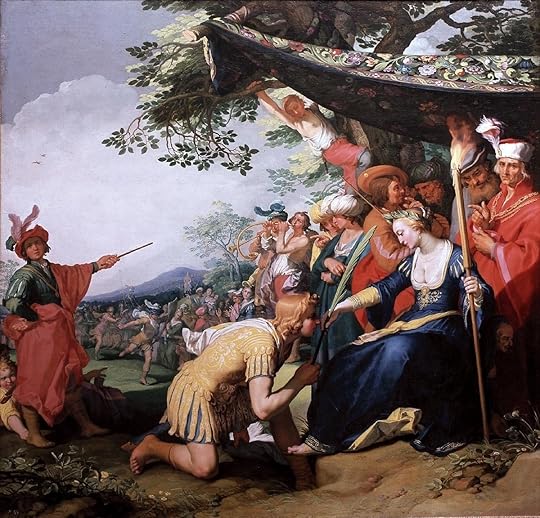

Theagenes receiving the palm of honour from Chariclea by Abraham Bloemaert, 1626


I admit I am glad the story didn't last a year in the reading, but it was rather enchanting while it lasted.

Next I must admit that I didn't actually read the edition I am reviewing. I read a digitalised version of the 1889 The Greek Romances of Heliodorus, Longus and Achilles Tatius Ethiopics, Daphne and Chloe, Clitopho and Leucippe , translated by the Rev. Rowland Smith, M.A. However, since I haven't read the Longus and Achilles parts of that book I am reviewing here on what I hazard is a singled out copy of the same translation. Maybe. Ok, back to the review part.


The Aethiopica (The Ethiopics) is surprisingly modern for being one of the very first novels in Western literature. It starts in medias res, with dead pirates all strewn all over the place, and Chariclea seated like Artemis come to life, bow and arrow in hand, contemplating the half-dead lover at her feet.

Ambroise Dubois (1543-1614)<br />Theagenes and Chariclea , c. 1610
Ambroise Dubois (1543-1614)
Theagenes and Chariclea , c. 1610

What exactly has happened we find out, in slow drips, as the story progresses. This progress is frequently impeded by digressions and new calamities. Every new character the couple comes into contact with must tell their own backstory, and the main story is actually told by a third party rather than by the lovers themselves. And of course all storytelling is frequently interrupted by ever more bandits, soldiers, and random merchants and royals who fall violently in love with one or the other of the two beautiful youths. The story actually felt very much like an 18th century Gothic novel to me. There is insta-love - pure and eternal - between starcrossed lovers, a long journey, high drama, intrigue, long digressions, a couple of suspected ghosts, divination and prophecy, raising of the dead, and a lot of weeping - both of the maidenly and of the manful sort. All that's lacking is the gloomy architecture, and of course there's the fact that the story was written almost a millennium and a half before the first Gothic novel (The Castle of Otranto, in case you were curious). Actually, Goths hadn't even emerged as a Germanic tribe yet when The Aethiopica was published around year 300CE.

Another way in which The Aethiopica is surprisingly modern, and less like a Gothic novel, is that Chariclea has a surprising amount of agency for someone who was literally renamed in the image of a random Greek, Charicles, whom she just happened to be left with at the age of seven or eight. Actually, the girl racks up quite the number of fathers. She is prone to fits of crying and soliloquizing whilst tearing her own hair out, true. And she is rather quick to determine that her best course of action is probably death. But she is also stubborn, quick witted, a trained priestess, an excellent archer with no compunction about killing her enemies, and quite good in a crisis. Much better and brighter than Theagenes who is basically just very pretty, and very good at athletic feats and fighting. He is definitely no shrewd Odysseus on this long journey. That part falls to Calasiris - another of Chariclea's accumulated fathers - who is definitely the devious brains of the outfit. Although I'll give Theagenes this: If he has none of Odysseus good characteristics, nor does he have his flaws. He is as pure of heart and body and loyal in his dedication to his beloved as Chariclea is.

A way in which it isn't modern is that Chariclea, for all that she is an Ethiopian, is fair skinned and looks Greek. And the explanation for this is that her mother was looking at a painting of Andromeda at the time of conception. (Yeah, pull the other one.) Why Andromeda, herself an Ethiopian princess - daughter of Cepheus and Cassiopeia - looks Greek is not explained, but they're part of Greek mythology so I guess they all look Greek there and that's that.

The Aethiopica was on the original Boxall 1001 book-list, but was removed after the first edition. I'm not sure what it was exchanged for, but I think it should have remained. The plot and the storytelling have flaws, certainly. It is, however, not only one of the earliest surviving novels in Western tradition (yes, I admit, there are a few who are even older), it is also a well spun adventure and an intriguing look at the notions and traditions of a time far gone. It is not surprising that the story has inspired a slew of artwork (mainly in the early 1600s from the look of it). It also inspired such greats as Shakespeare and Lord Byron, whereas Heliodorus himself borrowed here and there from Homer (as one does).

As I opened with a quote, I shall leave you with the following comparison from the book:

"...the mind of a lover, like that of one overcome with wine, cannot long remain in the same situation, both their souls fluctuating with weak and unsteady passion. For which reason a lover is disposed to drink; and he who has drunk is inclined to love."
Profile Image for Noah.
550 reviews74 followers
August 6, 2020
Die Aithiopiká des Heliodor zählt zu den wenigen Romanen, die uns aus der Antike überliefert sind. Dieser Roman aus dem 3. Jahrhundert erzählt eine etwas kitschige Liebesgeschichte und eine wilde Hatz durch das antike Griechenland über Ägypten nach "Äthiopien" (gemeint ist der Süden Oberägyptens). Das ganze ist vielleicht einem Roman von Alexandre Dumas vergleichbar. Unterhaltsam aber nicht unbedingt von großem literarischem Wert. Viel interessanter ist die Wirkmacht der erzählerischen Mechanik. Der Roman kommt einem von Anfang bis Ende bekannt vor, weil erzählerische Tricks aus diesem Roman von allen Großen der Weltliteratur übernommen wurden. Man sieht hier, woher Shakespeare, Cervantes, Goethe oder E.T.A Hoffmann erzählerische Techniken entnommen haben. Insbesondere Goethes "Wilhelm Meister" und Hoffmans "Elexire des Teufels" haben viele Wendungen und dramatische Effekte dem Heliodor entlehnt. Deswegen ist dieses Werk nicht nur recht unterhaltsam, sonder literaturhistorisch von immenser Bedeutung.
Profile Image for Viktor.
187 reviews
June 23, 2025
two thousand year old in medias res go brrrrrr


Dario has been egging me on to read this book for the longest time and honestly at some point i didn’t even wanna read it just to spite him. unfortunately, all jokes are on me now…

i had read the other extant Greek novels before and besides Daphnis and Chloe they were all kinda… idk… eh…? they had interesting moments or scenes but overall were quite difficult to enjoy to the end. Heliodorus however has blown them all out of the water. the plot structure, the colourful characters, the funny and sometimes even absurd things that happen, as well as the truly fascinating passages that are so revealing about the customs of the ancient Greeks, Egyptians and Ethiopians - all of these elements contributed to a wonderful reading experience.

i don’t wanna go into too many details lest i spoil the whole experience for future readers but this book narrates some truly remarkable events. the narrative structure is just pristine and where other ancient Greek novels linger on their boring ass love stories, this novel perfectly distributes the weight of its story over different characters, places and events. shoutout Heliodorus and shoutout Dario fr

4.5 stars
Profile Image for Esme N.
229 reviews921 followers
March 24, 2022
This is the most annoying Ancient Greek novel /srs
Profile Image for Czarny Pies.
2,828 reviews1 follower
July 12, 2019
Written in the 3rd or 4th century the "Aethiopica" is a romance relating the improbable adventures of two virtuous young lovers. The mood is very close to that "Daphnis and Chloe" written by Longus in the 2nd century. The two works also have many plot elements in common (a baby exposed to die, kidnappings by pirates, etc.) The tone is very sweet in both cases. The reader knows that providence will find a solution to the problems of the two pairs of morally righteous protagonists. The tragic spirit of Classical Antiquity is entirely absent.

The "Aethiopica" and "Daphnis and Chloe" also had a shared posterity. Jacques Amyot produced French translations in the middle of the great 16th century which together had a great impact. Different sources have cited Jean Racine, Miguel Cervantes, and Torquato Tasso as having been influenced by the two novels from Greek Antiquity. I personally was able to see the influence most clearly in the work of Honoré d’Urfé. By the 18th century, the fad for sentimental romances based on the antique Greek model was over. The reader of the 20th century will have trouble relating to either the "Aethiopia", to "Daphnis and Chloe" or to any of the works they inspired during the Renaissance.

I encourage the GR reader to read either the "Aethiopica" and "Daphnis and Chloe" as they represent a sensibility which occasionally surfaces in our culture. Unfortunately I have no way of suggesting which one to pick. I found them to be two peas in a single pod.
Profile Image for Kelly_Hunsaker_reads ....
2,269 reviews73 followers
May 25, 2019
Aithiopika/Aethiopica was written around 300 A.D., and is by far the oldest book I have read. The closest I have come to these stories is a short unit on the myths that I learned from my seventh grade teacher more than 40 years ago, and a couple of modern myth retellings. So, I had no idea what to expect. And while I see the importance of these books in the history of literature and can see the influence of these themes on even the most modern stories, I didn't really enjoy the book. For me it felt quite repetitive and the women were - as expected - not the kinds of feminine characters I like to spend my time with.

The story revolves around a pair of lovers. Chariclea is the daughter of Ethiopian royalty and is in love with Theagenes. Heliodorus tells the story in a unique way, as he starts the story in the middle of timeline and allows much of the story to be told as tales by other characters. Typically, the lovers are beset by one misfortune after another, and Theagenes must rescue Chariclea. This is the part I liked least, as a modern day feminist.

I found the book a bit overly dramatic and far too repetitive. But it is also fast-paced It’s very dramatic, fast-paced, and surprisingly easy to read for such an old text. It is a familiar story which makes it feel unoriginal but that is because all the other stories are paying tribute to this one -- which came first.

****
Please consider following me on my Facebook book blog:
https://www.facebook.com/Kelly-Hunsak...
Profile Image for Richard Seltzer.
Author 27 books133 followers
December 12, 2022
The beautiful heroine of this story was born white to two black parents, the king and queen of Ethiopia.

As a baby her mother abandoned her to die, for fear that her husband would think that she had cheated on him. This is the tale of how the daughter survives and eventually finds her way home as an adult, together with her soulmate lover.

It is told with many meandering digressions with multiple narrators, one story leading to a backstory, leading to another backstory.

Fun detail -- the author (writing around 200-300 AD) claims that Homer was an Egyptian (pp. 69 and 73).
Profile Image for Ευθυμία Δεσποτάκη.
Author 31 books239 followers
June 27, 2017
Απάτη! Το τομάκι περιέχει μόνο το ένα τρίτο της ιστορίας, η οποία ειρήσθω εν παρόδω, και τι δεν έχει: ληστές, ιερείς, Αιγύπτιους, προφήτες, σπηλιές, λάφυρα, καράβια, κόλπα, αφηγήσεις, επιχειρηματολογία πάνω στο γιατί ο Όμηρος είναι Αιγύπτιος (!) κι άλλα πολλά. Απορώ τι άλλο θα διαβάσω ως το τέλος!
110 reviews1 follower
May 4, 2025
one of the very first novels. ever. stunning how exciting and relevant the story is. it is filled with many greek romance novel clichés, and is also a sort of russian doll of stories, which can be confusing, but overall it is a very fun read. translator did a great job
Profile Image for Jen.
337 reviews1 follower
January 20, 2016
Aethiopica is an early Greek Romance. It tells the tale of two lovers: Chariclea, daughter of Ethiopian Royalty and Theagenes. The plot begins at what seems to be halfway through the progression of events, and much of the story is told as tales by other characters (stories within the stories). The poor lovers always seem to fall from one misfortune into the next and of course all is resolved at the very last minute. It’s very dramatic, fast-paced, and surprisingly easy to read for such an old text.

I thought it was entertaining enough but not something I really felt that I was missing out on by not having read it previously. I do always find it amusing in these older romances how just the mere sight of someone from across the room is enough to make characters want to marry each other. It seemed like these two lovers were cursed by being so beautiful that they couldn’t walk down the street without someone wanting to kidnap them and/or force them into marriage or relationships. I would say formulaic and unoriginal but since it was one of the earliest (maybe the earliest) of Greek Romances, it can be considered an original and likely drove the structure of other similar romances.
Profile Image for Illiterate.
2,774 reviews56 followers
June 1, 2023
Adventurous romance. Its plot is better handled than other Ancient Greek novels but it lacks the pastoral charm of Daphnis.
Profile Image for Kyriakos Sorokkou.
Author 6 books213 followers
Read
February 18, 2024


Αρχαία Ελληνική Λογοτεχνία

1) Θεογονία / Έργα και Ημέραι / Ασπίς Ηρακλέους (750-650 π.Χ.)
2) Λυρική Ποίηση (630-570 π.Χ.)
3) Πέρσαι (472 π.Χ.)
4) Δύσκολος: Ή Μισάνθρωπος (317 π.Χ.)
5) Αργοναυτικά (283 - 221 π.Χ.)
6) Ερωτικά Παθήματα (52 - 26 π.Χ.)
7) Περί Της Κατά Μωυσέα Κοσμοποιίας (15/10 π.Χ. - 40 μ.Χ.)
8) Ικαρομένιππος / Αληθινή Ιστορία / Πλοίον ή Ευχαί (120 μ.Χ. - 192 μ.Χ.)
9) Δάφνις και Χλόη

10) Αιθιοπικά (370 μ.Χ.)

χρόνος ανάγνωσης κριτικής: 47 δευτερόλεπτα

Μου πήρε ένα περίπου μήνα (τέλη Σεπτεμβρίου - μέσα Οκτωβρίου) και πέντε βιβλία για
να βρω ξανά κάτι που να διαβάζω με ενδιαφέρον.
Το Game of Thrones αν ήταν γραμμένο στα αρχαία ελληνικά από
εξελληνισμένο Σύρο συγγραφέα (Ηλιόδωρος ο Εμεσηνός) γραμμένο πριν το
τέλος του 4ου μ.Χ. αιώνα.
Αν αφαιρεθούν οι 88 σελίδες της εκτενούς εισαγωγής και οι μισές (ακαδημαϊκής φύσεως)
υποσημειώσεις, και μπει και ένα πιο μοντέρνο εξώφυλλο, αυτό το βιβλίο εύκολα θα το
έβαζες σε ράφι με βιβλία ιστορικής λογοτεχνίας ή γιατί όχι
και ιστορίας του φανταστικού, διότι περιέχει και τέτοια στοιχεία.
Είναι γεμάτο δράση γεμάτο σκηνές βίας, με δολοπλόκους χαρακτήρες, μάγισσες, μάχες,
ξεκινά in medias res πάει πίσω με εγκιβωτισμένα flashbacks, έχουμε cliffhangers
και plot twists.
Και με όλα αυτά να το κάνουν μοντέρνο παρά την χιλιόχρονη και βάλε ηλικία του.
Μοντέρνο διότι θα ελκύσει και τον πιο απαιτητικό αναγνώστη του φανταστικού.
Καλή ώρα εγώ.

Τα Αιθιοπικά του Ηλιόδωρου είναι το δεύτερο από τα πέντε (ακέραια) αρχαία
ελληνικά μυθιστορήματα που διαβάζω. Το προηγούμενο ήταν το βουκολικό
Δάφνις και Χλόη του Λόγγου που δεν είχε την καταιγιστική δράση των Αιθιοπικών.
Θα αναζητήσω στο μέλλον φυσικά και τα υπόλοιπα 3. Το Τα περί Χαιρέαν και Καλλιρρόην
το Τα κατά Λευκίππην και Κλειτοφώντα και τα Εφεσιακά.
Και τα τρία του βεληνεκούς του Δάφνις και Χλόη.
Profile Image for Lee Foust.
Author 11 books213 followers
February 8, 2024
The fifth of the nine Greek romances of the Roman period in my reading queue, the Ethiopian Story is easily the best written so far, with even a light touch of postmodern meta narrative used as a kind of wink to the reader. This self-awareness was light enough to be clever rather than distracting or too cutesy. The story as well here was a tad more interesting than the others as rather than the couple getting separated and the romance narrative creating its back-and-forth intertwined double plot of their adventures trying to be reunited, our twin heroes here remain together through most of the narrative but pass from trial to tribulation, ruler's hand to ruler's hand, until the Gods set everything to rights at the end. But lest this bore the reader with its predictability, Heliodorus cleverly begins in medias res and then proceeds to go forward with the plot while stopping and doubling back through different character's tales (thus POVs) to fill us in on all that went before. If Christopher Nolan made this into a movie tomorrow everyone would say, "Ah, a typical Nolan narrative." Nothing new under the sun. Like all of these romances it perhaps goes on a bit long to the inevitably cliche conclusion, but if you're only going to read one this--at least so far--is the best, even if much of its bestness comes from how it plays against the other texts, by so cleverly subverting and winking at the conventions of the genre as a whole.
696 reviews20 followers
March 7, 2022
Aethiopica is a very early Greek romance/drama/action-adventure story. This tells the story of two lovers: Theagenes and Chariclea, a daughter of Ethiopian Royalty. This tale, thought to be one of the first novels, includes so many literary devices and plots. There are pirates, battles between kingdoms, royalty and slaves, stories within stories, dream sequences, mistaken identity, secret love, pledges, intrigue, and lost of twists of jeopardy and luck. The story is sometimes hard to follow, especially be cause of the dreams and stories within stories, but this couple definitely has a wild ride in their romance escapades!
Profile Image for Alex Cotterill.
190 reviews3 followers
September 26, 2023
read for a module in year 3 of uni.

Plot was decent, tad slow though. The thematic importance of the opening with the girl on the island with the boy and the dead sailors is high.

There are also quite a few Odyssey/ Golden Ass references as well.

Nice that the author included a short summary of what each section was about; same with the notes at the end.
Profile Image for MG King.
145 reviews3 followers
October 19, 2025
When I take over the department of education, I’m putting Heliodorus back on the menu. Insane how we don’t talk about the Aethiopika anymore. Fire.
Profile Image for Stephanie Katz.
94 reviews1 follower
June 15, 2021
This is the first ancient epic I’ve read, and I quite enjoyed it. Yes, everything bad that could ever possibly happen does, and the coincidence plots are incredibly convenient by modern day storytelling standards; however, for a book that is from the age of Homer and Vergil, the non linear storytelling is incredibly advanced. A really neat read.
Profile Image for Roxana.
461 reviews14 followers
October 24, 2021
The story itself is trivial - two star-crossed lovers eventually appease the gods and receive their reward after trial upon trial. What I found most valuable in this book were the glimpses into religious and social customs of the old age, along with surprisingly modern narrative techniques.
Profile Image for Rosemary.
2,195 reviews101 followers
July 26, 2016
First I have to say, if you’re going to read this book (on the 1001 Books You Must Read Before You Die list) I recommend finding a modern translation. The edition that I had was a print-on-demand reprint of an out-of-copyright translation that prided itself on being based on something from the 17th century, and it was not an easy read.

The story itself is a lively if confusing tale of the stunningly beautiful and perfectly chaste heroine Chariclea and the love of her life Theagenes. Chariclea is kidnapped because of her beauty and carried off around the countries of the Eastern Mediterranean. Any time she is about to be married to one of her capturers, she and Theagenes either escape or are rescued, only to be recaptured by someone else, sometimes within minutes. They pretend that Theagenes is her brother so that they can stay together. Pirates, thieves and kings all fall madly in love with Chariclea and Theagenes is a constant temptation to her chastity but virtue prevails and she also manages to find out her true parentage along the way.
Profile Image for Deanne.
1,775 reviews135 followers
March 7, 2013
Fascinating that this is a story over 1500 years old, and a chance to read about characters and civilisations that are so distant. However Ethiopian story is one of those tales where the two characters are subjected to a series of trials and tribulations. They are tested and seem to go from one difficult situation to another.
Chariclea's life seems particularly complicated, did find it fun to see how the author was going to solve each problem. The book ends quickly and I did find it a bit to easily explained away.
Profile Image for Silvia.
3 reviews
November 24, 2022
Esta historia me ha dejado con la boca abierta, ¡épico final!.
Cabe aclarar que al principio no pensaba de esa manera, porque tanto a Teágenes como Cariclea pasan por situaciones muy difíciles y que pondrán en prueba su fidelidad entre ambos, y cuando me refiero a situaciones es porque son MUCHAS situaciones, excesivamente trágicas. Es como una rueda en la que hay situaciones desgarradoras, después otras alegres, y así sigue. Me ilusioné mucho en partes de la historia pensando que ambos podían estar finalmente juntos, pero Heliodoro pone más pruebas complejas ahhh!!! Además de que a veces sentía que no avanzaba los relatos porque hay muchas explicaciones. Yo pensaba que probablemente no tendría final feliz, hasta que en las últimas páginas... ÉPICO.
Me dejó esta historia intrigada con ganas de saber que sucedería en la siguiente página, la disfruté y sufrí por los personajes tan inocentes y que el destino les dejó muchas pruebas. Experimente tanto alegría, como frustración, rabia, tristeza... en fin, te dejará muchas emociones.
Mi personaje favorito fue sin duda Cariclea, una joven, que a pesar de todo, siempre mantuvo su dignidad y principios en alto; aunque muchas veces dudaba, seguía con valentía adelante sabiendo que los dioses escuchaban sus súplicas. Un personaje leal, simpática, fiel, devota, valiente, persistente ante la adversidad.
Recomiendo mucho este libro para los que aman las aventuras y el romance épico.
Profile Image for Maria.
642 reviews32 followers
October 29, 2023
In the beginning I had a little trouble getting into the story (mainly due to my unfamiliarity with the names and the connections the personages had with each other.
After about the first third of the book, I started getting into the story a lot better and actually quite enjoyed it, despite the references to ancient custom and slightly archaic language at times.
One thing that stood out to me is the plea in the end, where the main characters help convince the Ethiopian people that human sacrifice isn't what the Gods are pleased with, and that animal sacrifice isn't very well received either. The story reminds me of the story in the Bible where the Isrealites are ordered not to mingle with the peoples around them, because they sin by sacrificing their own offspring. It makes me wonder what Heliodorus his beliefs had been at the time he wrote Aithiopika. He sounds like a Greek writer (I might be ignorant here, I'm well aware). If so, was the Greek lifestyle influenced by Jewish / Christian moral thought? And did Heliodorus sympathize with Judaism / Christianity? I might dive into this deeper, but these are just some questions that arose after finishing this love story.
Profile Image for Tammy.
357 reviews
December 11, 2017
Rounding up a bit because of the age of this book. I mean, this is one of the first novels and it tells an enjoyable tale, though a bit rambling and losing focus at times.

The story is of a beautiful woman trying to get home with her beloved and the trials they encounter en route. At times, it was surprising how modern and familiar the tropes were, and it was fun to see now-common sights (like certain animals) described from an ancient point of view. It was also very interesting to read about how people lived at the time -- how do you meet up with someone in a faraway city without cell phones or phones or mail or....?

Bottom line: If you can deal with some diversions and a bit of old language, this is a worthwhile read. I liked it, considering its age. If it was a modern book, it would just be okay.
Profile Image for Elena.
143 reviews
March 31, 2021
Αν πω ότι δεν βρήκα κουραστική την ανάγνωση, θα είναι ψέμα, ιδίως στα σημεία που καθυστερούσε την εξέλιξη της ιστορίας, για να αφηγηθεί μια άλλη ιστορία, η οποία λειτουργούσε επεξηγηματικά για τα τωρινά μελλούμενα. Δεν λέω κάποια στοιχεία ήταν πολύ ενδιαφέροντα και διαφωτιστικά για την ιστορία της ανθρωπότητας από την αρχαιότητα μέχρι και σήμερα και τα κρατάω σαν μια πρόσθετη ματιά.
Ευτυχώς, πριν ξεκινήσω την ανάγνωση είδα τα σχόλια στο goodreads και απέφυγα να διαβάσω την εισαγωγή, κάτι που προσπάθησα να κάνω μετά την ολοκλήρωση της ανάγνωσης αλλά τελικώς δεν ολοκλήρωσα. Άλλωστε ήταν μια περιεκτική σύνοψη της ιστορίας, με κάποιες, ακαδημαϊκού τύπου, πληροφορίες για το βιβλίο και την εποχή του. Άμα θέλεις να λες ότι διάβασες το βιβλίο χωρίς και να το διαβάσεις είναι το κατάλληλο εργαλείο.
Displaying 1 - 30 of 81 reviews

Can't find what you're looking for?

Get help and learn more about the design.