

What do you think?

The Bible: Authorized King James Version with Apocrypha
The Bible is the most important book in the history of Western civilization, and also the most difficult to interpret. It has been the vehicle of continual conflict, with every interpretation reflecting passionately held views that have affected not merely religion, but politics, art, and even science.
This unique edition offers an exciting new approach to the most influential of all English biblical texts--the Authorized King James Version, complete with the Apocrypha. Its wide-ranging Introduction and the substantial notes to each book of the Bible guide the reader through the labyrinth of literary, textual, and theological issues, using the most up-to-date scholarship to demonstrate how and why the Bible has affected the literature, art and general culture of the English-speaking world.
The Bible: Authorized King James Version also includes the latest biblical research, evaluated and put into context as well as discussing centuries of critical opinion. A non-sectarian, historical approach makes it suitable for a wide range of readers. A Glossary of terms used in the Notes and six maps of the Holy Land further illuminate the meaning of this most culturally influential version of the Bible.
This unique edition offers an exciting new approach to the most influential of all English biblical texts--the Authorized King James Version, complete with the Apocrypha. Its wide-ranging Introduction and the substantial notes to each book of the Bible guide the reader through the labyrinth of literary, textual, and theological issues, using the most up-to-date scholarship to demonstrate how and why the Bible has affected the literature, art and general culture of the English-speaking world.
The Bible: Authorized King James Version also includes the latest biblical research, evaluated and put into context as well as discussing centuries of critical opinion. A non-sectarian, historical approach makes it suitable for a wide range of readers. A Glossary of terms used in the Notes and six maps of the Holy Land further illuminate the meaning of this most culturally influential version of the Bible.
1746 pages, Paperback
First published January 1, 1611
About the author
Anonymous
3,454 followersBooks can be attributed to "Anonymous" for several reasons:
* They are officially published under that name
* They are traditional stories not attributed to a specific author
* They are religious texts not generally attributed to a specific author
Books whose authorship is merely uncertain should be attributed to Unknown.
See also: Anonymous
* They are officially published under that name
* They are traditional stories not attributed to a specific author
* They are religious texts not generally attributed to a specific author
Books whose authorship is merely uncertain should be attributed to Unknown.
See also: Anonymous
Ratings & Reviews
Friends & Following
Create a free account to discover what your friends think of this book!
Community Reviews
Displaying 1 - 30 of 91 reviews

taking-a-break
December 23, 201812/23/2018
GENESIS is kinda like those modern ~edgy~ retellings of children's tales... except it's the original. I grew up with picture books about Noah and his adorable animals so it's funny to read the old familiar story as an adult and then see "by the way, Noah then cursed one of his sons for doing something unspeakable to him while he was drunk and naked." The whole saga of Lot is weird in endless ways and I love it. And I like how Sarah, despite her ridiculously advanced age, remains so hot that men would kill her husband to get her... the original sexy old lady.
12/31/2018
EXODUS: the first half is bizarre, the second half is building instructions. I'm reading this on Serial Reader and I got to know that every "issue" I opened would be the same specs for the Ark rewritten. God comes off as petty in Exodus. Much like the time that I watched the entire Leprechaun franchise without understanding the limits and extent of the Leprechaun's powers, it's really hard to understand the character motivations here.
01/07/2019
The infamous LEVITICUS (the one that people refer to when they want to go out and stone gay people) is a grueling read - a long list of laws and minutiae concerning sacrifices. It is interesting in terms of the Old Testament's fixation on dividing: in Genesis, dividing the light from the dark etc., and in Leviticus, dividing the "clean" from the "unclean." It's also funny that while some of these rules are extremely antiquated, some are still part of human culture. For example, I don't know anyone who would eat an owl, regardless of whether or not they were kosher. Eagle is a different example - here nobody would think of eating an eagle because they're revered in both Native American and USA culture... but KJV Leviticus says they're inedible because they're the opposite, an "abomination."
1:2o gave me a laugh:
because at first I didn't get that it was an oldtimey way of saying bugs, and instead imagined some grimy diseased bird dragging itself along the ground with its wings.
01/16/2019
Between the censuses and the continued commandments, NUMBERS really advances the story. I think it's a basis for a lot of sf and fantasy, particularly generation ship stories, with the Israelites dying and being replaced while wondering through the wilderness (outer space) guided by God in the ark (alien supercomputer?). I learned that the word "unicorn" is in the Bible (23:22).
On a scarier note... on a few occasions the book uses "matrix" as a replacement for "womb," which intrigued me because I've seen that word a million times in math but never thought about the word origin. I made the mistake of trying to specifically search for the biblical usage... which led me to discover blogs full of people who are convinced that Satan is altering the Bible to add references to the 1999 science fiction film "The Matrix." Because if Satan had the power to act in our universe, the first thing he would do would be to slowly fill our holy texts with fringe references to Keanu Reeves movies.
01/27/2019
DEUTERONOMY is my favorite book of the Pentateuch. I particularly enjoyed the long and complex curse of Chapter 28. It's full of great everyday phrases, like "Circumcise therefore the foreskin of your heart" (10:16) and customary insults like spitting in the face of a man who won't marry his brother's widow, un-shodding him, and then forever referring to his family as "the house of him that hath his shoe loosed" (25:10).
02/02/2019
JOSHUA starts out as the most action-packed book so far, as the Israelites move in and start killing kings and yelling at cities loud enough that they're destroyed. Then there's this long section about which tribes inherit which land, which might be interesting if you're from that time and part of the world, but is like when old people tell stories and get caught up in the minutest details - "well, at that time, Norma was living down on Hudson Street... or was it Summit Place?" Halfway through I realized I was picturing Joshua entirely based on the Dolly Parton album of the same name.
02/09/2019
JUDGES. It was the good old days, when Israel had no king, and everyone did whatever they wanted. It was a simpler time, when if your concubine was ravaged and murdered in the streets, you could chop up her corpse and send it to your countrymen and they would sympathize with you.
Most effective methods to kill a king, according to Judges
1. Throw a millstone down on his head from a tower (BONUS: if you are a woman, he will ask his buddy to stab him afterward, because only wimps get killed by girls)
2. Say you're bringing him a "present," and when you're alone with him, reveal that the present is a knife in the stomach
3. Give him milk and then nail his head to the ground with a tent stake
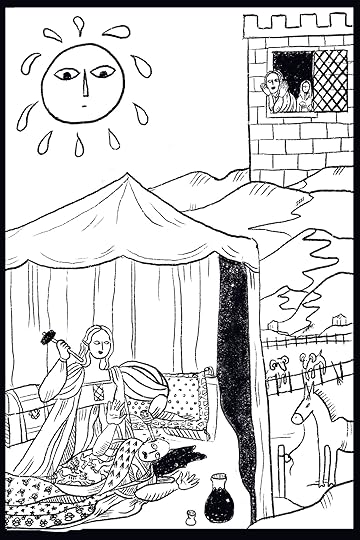
My rendition of Jael nailing Sisera
There is an echo of Lot in Sodom - evidently in Biblical times, if you had a guest and a mob of bloodthirsty/horny men came to your door, it was only polite to refuse them the man and instead throw them any woman in the house who was handy - daughter, concubine, whatever.
There's also a classic fairytale situation - much like how in the wilderness you gladly pledge to give the fairy the thing in your house that you don't know is there only to find out that the "thing" is your wife's surprise pregnancy, Jephthah promises to give God the first thing to walk through his doors which then happens to be his only daughter. Another lesson in Biblical etiquette - if you're going to ritually slaughter your daughter, it is polite to give her a few days to go up in the mountains and "bewail her virginity" first. Remember!
02/10/2019
RUTH is a strange little story about the law that entitled a widow to a new husband from the deceased's family... or perhaps rather entitled the deceased to "descendants" via his widow and a relative. What is the obsession with feet? Back in Deuteronomy where this law is explained the punishment for the man who won't marry the widow is to remove his shoes. Here when the unnamed kinsman agrees to let Boaz take the land and Ruth, he takes off a sandal (which is explained as a custom when making a deal). And in order to convince Boaz to "redeem" Ruth, Naomi instructs her to sneak up on him while he's sleeping and uncover his feet.
02/18/2019
1 SAMUEL: After begging Daddy (God) the Israelites finally get a king, Saul. Pros: very tall. Cons: steals cattle, occasionally flies into rages and tries to kill family members with a javelin. This is the book with the famous David and Goliath story, as well as the Witch of Endor (not to be confused with the Witch-king of Angmar). The whole thing basically goes like: 1) Saul says he will do something nice for David 2) Saul tries to kill David 3) Saul apologizes, repeat. Oh, and another phrase we should bring back into the vernacular: referring a male as "one who pisseth against the wall."
02/23/2019
2 SAMUEL: I'm interested to see, over the next books, how this king thing works out. Because I know a lot of monarchies were built on being chosen by God, but in 1 Samuel God seems to think it's a Bad Idea to have a king, and so far David and Saul have gotten into some shady stuff. For example, in this book, David spies on a woman taking a bath, decides he wants her for a concubine, and then sneakily sends her poor husband to the front lines to get an Instant Widow. Maybe I'm supposed to get more out of David's occasional piety and praise songs but the biggest message for me now is Kings Suck. I'm hardly a patriot but I'm pretty happy to at least live in a country that's never had a monarchy.
03/01/2019
1 KINGS, better 1 PROPHET DRAMA. This book introduces the prophet Elijah who is the coolest guy in the whole Bible so far - getting fed by ravens, hanging out in sacred caves, getting God to light things on fire, and generally being a pain to Jezebel and Ahab. [I wonder if Melville chose the name Ahab because of "the ivory house which he made" (22:39)? That and a streak of petty obsession.] Prophets get to tell people fun things, like, "a lion shall slay thee" (20: 36) and "shall dogs like thy blood, even thine" (21:19). But they're also in danger of being killed, because for some reason they piss people off. It's a trade-off.
Chapter 13 was particularly interesting - Prophet A has been told by God not to retrace his steps and not to eat or drink. Prophet B comes and finds him and tells him that God said he could go back to the city and eat and drink at Prophet B's house (a lie), and Prophet A follows. I expected Prophet B to be punished for lying, but instead it's Prophet A who gets killed by a lion for disobeying his original orders.
03/10/2019
2 KINGS: My favorite story this time around is near the beginning. A bunch of brats call Elisha "bald head," so Elisha gets God to do him a solid and summon a she-bear to eat the kids. I also loved the very dramatic tale of King Josiah rediscovering the book of the law while renovating the temple, and having an "oh-shit-God's-gonna-kill-us" moment. His history also has one of the rare and welcome examples of a woman who's more than someone's wife/mother - Huldah, though only briefly mentioned, is a prophet and teacher. This book is a bit harder to track because as it progresses it shoots through a long list of kings, with no real main character, giving a rundown of how old they were when they started to rule, their parents, and whether they respected God or were rotten heathens like their fathers (spoiler alert, it's mostly the latter).
03/31/2019
1 and 2 CHRONICLES may be an exact re-telling of 1 and 2 Kings, but I couldn't tell you exactly because I can't keep track of most of these olde-tymey names. It has a much cleaner view of David and Solomon, showing David taking his dear sonny-boy Solomon under his wing and giving him plans for the house of God, instead of Solomon's mother coming to intercede on her son's behalf while old David is snuggling with a medicinal virgin. I think 1 Chronicles 21:1 is the first mention of "Satan." And there's one infuriatingly laconic verse, 2 Chronicles 36:9
Like, you can't just tease us and then NOT give us the whole story of the world's most evil eight-year-old! Disappointing, Chronicles.
04/03/2019
EZRA is short and sweet, about the dedication of the rebuilt House of God (with the blessing of Persian kings) and a new resolution to rid the Jews of "strange marriages." I like this melodramatic king's threat: "let timber be pulled down from his house, and being set up, let him be hanged thereon; and let his house be made a dunghill for this" (6:11).
04/07/2019
NEHEMIAH, I did not like. It is the same story as Ezra, but Nehemiah has a more obvious narrator, and he is a little bit too concerned that God should remember him for all the great things he's done.
04/09/2019
ESTHER is a classic heroic story and a lot of fun. Summary: the king's advisor Haman wants to destroy the Jews, the king's favorite lady-friend Esther is Jewish (on the down-low), and at the urging of her uncle Mordecai (who once saved the king's life), she influences the king to take down Haman. One detail that was new to me: when Mordecai gets permission to reverse Haman's order, instead of writing a decree saying NOT to kill the Jews, he writes to give the Jews permission to slaughter anyone who comes at them, setting the stage for a giant bloodbath rather than peace.
04/16/2019
JOB is the most metal book. "Behold, he put no trust in his servants; and his angels be charged with folly: How much less in them that dwell in houses of clay, whose foundation is in the dust, which are crushed before the moth? They are destroyed from morning to evening: they perish for ever without any regarding it"(4:18-20). Features: 2nd mention of Satan (1:6), origin of The Doors of His Face, the Lamps of His Mouth (41:14-19).
05/07/2019
Kinda losing steam here...
PSALMS. The psalm you know: "The Lord is my shepherd." The psalm you don't know: "Break their teeth, O God, in their mouth . . . As a snail which melteth, let every one of them pass away: like the untimely birth of a woman, that they may not see the sun."
PROVERBS. For a collection of "wisdom" this is oddly fixated on telling people to not mingle with "strange women" and blaming promiscuous women for the downfall of society.
With ECCLESIASTES the cycle of repetitiveness is finally broken and I enjoyed this book simply for NOT being the same thing over and over. Which is weird because it's about how the history of the world is the same thing over and over, with people never learning.
GENESIS is kinda like those modern ~edgy~ retellings of children's tales... except it's the original. I grew up with picture books about Noah and his adorable animals so it's funny to read the old familiar story as an adult and then see "by the way, Noah then cursed one of his sons for doing something unspeakable to him while he was drunk and naked." The whole saga of Lot is weird in endless ways and I love it. And I like how Sarah, despite her ridiculously advanced age, remains so hot that men would kill her husband to get her... the original sexy old lady.
12/31/2018
EXODUS: the first half is bizarre, the second half is building instructions. I'm reading this on Serial Reader and I got to know that every "issue" I opened would be the same specs for the Ark rewritten. God comes off as petty in Exodus. Much like the time that I watched the entire Leprechaun franchise without understanding the limits and extent of the Leprechaun's powers, it's really hard to understand the character motivations here.
01/07/2019
The infamous LEVITICUS (the one that people refer to when they want to go out and stone gay people) is a grueling read - a long list of laws and minutiae concerning sacrifices. It is interesting in terms of the Old Testament's fixation on dividing: in Genesis, dividing the light from the dark etc., and in Leviticus, dividing the "clean" from the "unclean." It's also funny that while some of these rules are extremely antiquated, some are still part of human culture. For example, I don't know anyone who would eat an owl, regardless of whether or not they were kosher. Eagle is a different example - here nobody would think of eating an eagle because they're revered in both Native American and USA culture... but KJV Leviticus says they're inedible because they're the opposite, an "abomination."
1:2o gave me a laugh:
All fowls that creep, going upon all four, shall be an abomination unto you.
because at first I didn't get that it was an oldtimey way of saying bugs, and instead imagined some grimy diseased bird dragging itself along the ground with its wings.
01/16/2019
Between the censuses and the continued commandments, NUMBERS really advances the story. I think it's a basis for a lot of sf and fantasy, particularly generation ship stories, with the Israelites dying and being replaced while wondering through the wilderness (outer space) guided by God in the ark (alien supercomputer?). I learned that the word "unicorn" is in the Bible (23:22).
On a scarier note... on a few occasions the book uses "matrix" as a replacement for "womb," which intrigued me because I've seen that word a million times in math but never thought about the word origin. I made the mistake of trying to specifically search for the biblical usage... which led me to discover blogs full of people who are convinced that Satan is altering the Bible to add references to the 1999 science fiction film "The Matrix." Because if Satan had the power to act in our universe, the first thing he would do would be to slowly fill our holy texts with fringe references to Keanu Reeves movies.
01/27/2019
DEUTERONOMY is my favorite book of the Pentateuch. I particularly enjoyed the long and complex curse of Chapter 28. It's full of great everyday phrases, like "Circumcise therefore the foreskin of your heart" (10:16) and customary insults like spitting in the face of a man who won't marry his brother's widow, un-shodding him, and then forever referring to his family as "the house of him that hath his shoe loosed" (25:10).
02/02/2019
JOSHUA starts out as the most action-packed book so far, as the Israelites move in and start killing kings and yelling at cities loud enough that they're destroyed. Then there's this long section about which tribes inherit which land, which might be interesting if you're from that time and part of the world, but is like when old people tell stories and get caught up in the minutest details - "well, at that time, Norma was living down on Hudson Street... or was it Summit Place?" Halfway through I realized I was picturing Joshua entirely based on the Dolly Parton album of the same name.
02/09/2019
JUDGES. It was the good old days, when Israel had no king, and everyone did whatever they wanted. It was a simpler time, when if your concubine was ravaged and murdered in the streets, you could chop up her corpse and send it to your countrymen and they would sympathize with you.
Most effective methods to kill a king, according to Judges
1. Throw a millstone down on his head from a tower (BONUS: if you are a woman, he will ask his buddy to stab him afterward, because only wimps get killed by girls)
2. Say you're bringing him a "present," and when you're alone with him, reveal that the present is a knife in the stomach
3. Give him milk and then nail his head to the ground with a tent stake
My rendition of Jael nailing Sisera
There is an echo of Lot in Sodom - evidently in Biblical times, if you had a guest and a mob of bloodthirsty/horny men came to your door, it was only polite to refuse them the man and instead throw them any woman in the house who was handy - daughter, concubine, whatever.
There's also a classic fairytale situation - much like how in the wilderness you gladly pledge to give the fairy the thing in your house that you don't know is there only to find out that the "thing" is your wife's surprise pregnancy, Jephthah promises to give God the first thing to walk through his doors which then happens to be his only daughter. Another lesson in Biblical etiquette - if you're going to ritually slaughter your daughter, it is polite to give her a few days to go up in the mountains and "bewail her virginity" first. Remember!
02/10/2019
RUTH is a strange little story about the law that entitled a widow to a new husband from the deceased's family... or perhaps rather entitled the deceased to "descendants" via his widow and a relative. What is the obsession with feet? Back in Deuteronomy where this law is explained the punishment for the man who won't marry the widow is to remove his shoes. Here when the unnamed kinsman agrees to let Boaz take the land and Ruth, he takes off a sandal (which is explained as a custom when making a deal). And in order to convince Boaz to "redeem" Ruth, Naomi instructs her to sneak up on him while he's sleeping and uncover his feet.
02/18/2019
1 SAMUEL: After begging Daddy (God) the Israelites finally get a king, Saul. Pros: very tall. Cons: steals cattle, occasionally flies into rages and tries to kill family members with a javelin. This is the book with the famous David and Goliath story, as well as the Witch of Endor (not to be confused with the Witch-king of Angmar). The whole thing basically goes like: 1) Saul says he will do something nice for David 2) Saul tries to kill David 3) Saul apologizes, repeat. Oh, and another phrase we should bring back into the vernacular: referring a male as "one who pisseth against the wall."
02/23/2019
2 SAMUEL: I'm interested to see, over the next books, how this king thing works out. Because I know a lot of monarchies were built on being chosen by God, but in 1 Samuel God seems to think it's a Bad Idea to have a king, and so far David and Saul have gotten into some shady stuff. For example, in this book, David spies on a woman taking a bath, decides he wants her for a concubine, and then sneakily sends her poor husband to the front lines to get an Instant Widow. Maybe I'm supposed to get more out of David's occasional piety and praise songs but the biggest message for me now is Kings Suck. I'm hardly a patriot but I'm pretty happy to at least live in a country that's never had a monarchy.
03/01/2019
1 KINGS, better 1 PROPHET DRAMA. This book introduces the prophet Elijah who is the coolest guy in the whole Bible so far - getting fed by ravens, hanging out in sacred caves, getting God to light things on fire, and generally being a pain to Jezebel and Ahab. [I wonder if Melville chose the name Ahab because of "the ivory house which he made" (22:39)? That and a streak of petty obsession.] Prophets get to tell people fun things, like, "a lion shall slay thee" (20: 36) and "shall dogs like thy blood, even thine" (21:19). But they're also in danger of being killed, because for some reason they piss people off. It's a trade-off.
Chapter 13 was particularly interesting - Prophet A has been told by God not to retrace his steps and not to eat or drink. Prophet B comes and finds him and tells him that God said he could go back to the city and eat and drink at Prophet B's house (a lie), and Prophet A follows. I expected Prophet B to be punished for lying, but instead it's Prophet A who gets killed by a lion for disobeying his original orders.
03/10/2019
2 KINGS: My favorite story this time around is near the beginning. A bunch of brats call Elisha "bald head," so Elisha gets God to do him a solid and summon a she-bear to eat the kids. I also loved the very dramatic tale of King Josiah rediscovering the book of the law while renovating the temple, and having an "oh-shit-God's-gonna-kill-us" moment. His history also has one of the rare and welcome examples of a woman who's more than someone's wife/mother - Huldah, though only briefly mentioned, is a prophet and teacher. This book is a bit harder to track because as it progresses it shoots through a long list of kings, with no real main character, giving a rundown of how old they were when they started to rule, their parents, and whether they respected God or were rotten heathens like their fathers (spoiler alert, it's mostly the latter).
03/31/2019
1 and 2 CHRONICLES may be an exact re-telling of 1 and 2 Kings, but I couldn't tell you exactly because I can't keep track of most of these olde-tymey names. It has a much cleaner view of David and Solomon, showing David taking his dear sonny-boy Solomon under his wing and giving him plans for the house of God, instead of Solomon's mother coming to intercede on her son's behalf while old David is snuggling with a medicinal virgin. I think 1 Chronicles 21:1 is the first mention of "Satan." And there's one infuriatingly laconic verse, 2 Chronicles 36:9
Jehoiachin was eight years old when he began to reign, and he reigned three months and ten days in Jerusalem, and he did that which was evil in the sight of the LORD.
Like, you can't just tease us and then NOT give us the whole story of the world's most evil eight-year-old! Disappointing, Chronicles.
04/03/2019
EZRA is short and sweet, about the dedication of the rebuilt House of God (with the blessing of Persian kings) and a new resolution to rid the Jews of "strange marriages." I like this melodramatic king's threat: "let timber be pulled down from his house, and being set up, let him be hanged thereon; and let his house be made a dunghill for this" (6:11).
04/07/2019
NEHEMIAH, I did not like. It is the same story as Ezra, but Nehemiah has a more obvious narrator, and he is a little bit too concerned that God should remember him for all the great things he's done.
04/09/2019
ESTHER is a classic heroic story and a lot of fun. Summary: the king's advisor Haman wants to destroy the Jews, the king's favorite lady-friend Esther is Jewish (on the down-low), and at the urging of her uncle Mordecai (who once saved the king's life), she influences the king to take down Haman. One detail that was new to me: when Mordecai gets permission to reverse Haman's order, instead of writing a decree saying NOT to kill the Jews, he writes to give the Jews permission to slaughter anyone who comes at them, setting the stage for a giant bloodbath rather than peace.
04/16/2019
JOB is the most metal book. "Behold, he put no trust in his servants; and his angels be charged with folly: How much less in them that dwell in houses of clay, whose foundation is in the dust, which are crushed before the moth? They are destroyed from morning to evening: they perish for ever without any regarding it"(4:18-20). Features: 2nd mention of Satan (1:6), origin of The Doors of His Face, the Lamps of His Mouth (41:14-19).
05/07/2019
Kinda losing steam here...
PSALMS. The psalm you know: "The Lord is my shepherd." The psalm you don't know: "Break their teeth, O God, in their mouth . . . As a snail which melteth, let every one of them pass away: like the untimely birth of a woman, that they may not see the sun."
PROVERBS. For a collection of "wisdom" this is oddly fixated on telling people to not mingle with "strange women" and blaming promiscuous women for the downfall of society.
With ECCLESIASTES the cycle of repetitiveness is finally broken and I enjoyed this book simply for NOT being the same thing over and over. Which is weird because it's about how the history of the world is the same thing over and over, with people never learning.

December 22, 2023
They don’t write books like this anymore, do they? Nothing could be more absurd or embarrassing than “reviewing” this, so I’m of course not doing it. Just some completely random notes.
The experience, the experience. It’s like protoplasm, a primordial literature mush out of which all genres gradually emerge. The founding myths come first, of course, the archetypes of fall or flood. But what is it about these impossibly detailed and non-existent genealogies? And mirroring it existent but even more absurdly detailed geographies – map-less, the space compressed into the temporality of speech.
But as far as lists go, nothing is more maddening than instructions for building tabernacle, the most infuriating IKEA manual ever. Exodus 27-35. Yes, eight chapters of ridiculously and needlessly precise construction instructions.
The patriarchs are generated as half-human mythological figures, and they gradually gave place to the masses of people who once shout in one voice, other times they murmur in cacophonic chaos - they're led ultimately by Moses, who, in touching twist of fate, doesn't get to enter the promised land.
All this somehow coalesces into chronicles of Deuteronomistic history books. Repetitive and boring as good history books are. All of this is about making sense of history, and of being abandoned, of being on the receiving end despite being righteous. You learn that from the Ten Commandments, the first is the crucial one. Like you have one fucking job: Worship YHWH. Don’t go whoring with Baal. And yet, here we are. God’s patience is endless, but ultimately Israelites are shipped to Babylonian captivity. Much of the Deuteronomistic history books is about making sense of this catastrophe. And it boils down to disobedience.
With regard to making sense of history: how about violence? There are occasional outbursts of genocidal violence in Pentateuch. Genocide of Midianites in Numbers 31 – not even required by God, but realized out of Moses’ own initiative. But genocidal frenzy erupts in full in Joshua. Remorseless, celebratory, without hint of modern embarrassment. There was not a question of making sense of that while captured in Babylon, but how to make sense of it now?
A hypothesis of mine that needs to be worked out: having God commanding genocide in your Holy Scripture can make you more attentive and thoughtful about violence, and ultimately make you abhor it more. There’s a lot of “Biblical” violence in Western history, but secular mind can cut it off as not being part of its story, separate oneself from it. That’s an easy way out – but for Abrahamic religious mind, genocides are part of your story. Accepting the genocidal foundations, which are everywhere objectively, can lead one to abhor it more. (Or less – Joshua was employed to justify colonial conquests, of course.)
At the same time, another more caring theme runs through the Old Testament: care about the strangers. You were strangers in Egypt, so you know the experience. Don’t be the pharaoh to strangers. In Ezekiel 22:29, this is how God rebukes the Israelites: “The people of the land have used oppression, and exercised robbery, and have vexed the poor and needy: yea, they have oppressed the stranger wrongfully.”
The historical reflection and sense-making is thus more nuanced. There’s anti-monarchist slant in Samuel and Kings. There’s anti-anarchist slant by the end of Judges – episode starting with 17:6: “In those days there was no king in Israel, but every man did that which was right in his own eyes.” Of course, it gets relentlessly violent from then on. It’s also strangely beautiful.
It’s also fascinating how God withdraws from the world the more we get to present. In 1 Maccabees, there’s literally no God. God doesn’t do anything. God’s implied presence is what motivates those like Judas Maccabeus, but God’s actually absent. Secularism is already reached as an option within theism.
On the back of the historical sense-making, more genres are produced as outshoots. Such as straightforward “court drama” of Susannah in Daniel. The skits: what is it with two she bears that Elisha employs to maul 42 kids in 2 Kings 2:23? Pointlessly violent, Tarantinesque episode that has no consequence on anything whatsoever.
The tantalizing eroticism of Song of Solomon, contained within Bible for no reason whatsoever.
The poetic beauty of Ecclesiastes, probably my favorite book in Bible, the ultimate, “musical” meditation on the meaning. “That which hath been is now; and that which is to be hath already been” (3:15).
The equal beauty of Book of Job, where “man is born into trouble as sparks fly upwards” (5:7). Where Job is angry at God for not at least ending the misery he caused him. Where the problem of evil is tackled. Where the solution is God basically rebuking Job: Did you really think you could fucking get it? What were you thinking? “Where wast thou when I laid the foundations of the earth? Declare, if thou hast understanding” (Job 38:4).
The psychedelic beauty of Revelation. The linguistic beauty of the simple expressions such as “and it came to pass” and “well stricken in age” in Genesis, where somehow even language is born. The grandiose beauty of that simplest but most poignant of expressions in Exodus 3:14 – one that will haunt Western philosophy to these days.
The eye-ring-angels of Ezekiel. The utterly depressive desolation of Lamentations of Jeremiah. The beasts in visions of Daniel. The incomprehensibly gory, imposing but mesmerizing imagery of Leviticus. The disturbingly detailed condemnation of sex with animals like it was not a theoretical problem. The “rivers of Babylon”, “where we sat down”, and “yea, we wept, when we remembered Zion” (Psalm 137). Isaiah, whose words, unknown to me (why didn’t I know, though? what’s this intellectual laziness?), made way to Händel’s Messiah. The lusting for horse dicks in Ezekiel 23:20. And politics presented as marriage in Hosea.
Also, for me it’s so interesting to learn that there’s basically no afterlife in Old Testament (except for, maybe, 2 Maccabees). You die, you die - how are you buried depends (if you’re eaten by dogs, that’s bad), but overall it’s the nation that lives on, not individual souls. (There’re hints at resurrection, though, such as Ezekiel 37:3-5.)
But there are also the quiet parts, the infuriating boredom, of most of the Proverbs, most of the Psalms. The Twelve being mostly pointless. And Jeremiah can’t get more tiring in condemnation of idolatry. The repetitiveness of Chronicles that causes headache.
A mush explodes to multiplicity and variability. The life emerges – the literary life, preceding the factual life. But what happens with that zealotish figure of Jesus, preaching perfection, chastising hypocrisy. Preaching love, but also exhorting to fight. “Think not that I am come to send peace on earth: I came not to send peace, but a sword. For I am come to set a man at variance against his father, and the daughter against her mother, and the daughter in law against her mother in law” (Matthew 10:34-35).
But also, finally, the complete delegitimization of not only genocidal violence, but also of conquests. It’s all about hearts and minds now, not about land.
That’s a simplification of the complexity, the collapse of multiplicity, an intense focus. The history begins anew, it’s about how we make it. The revolutionary coda to the circular sense-making. The seeds of further simplification, maybe? “Every man according to his ability” (Acts 11:29), “to all men as every man has need” (Acts 2:45).
(A lot revolves around the ultimate question of men’s penises. The circumcision. Is it necessary, as Leviticus requires, or can our foreskins enter the Heaven? Paul’s decisive move towards the universality of Christian Church is to preach “the circumcision of the heart, in the spirit” – Romans 2:29 – instead of the actual one.)
The ultimately Platonic simplification in the beginning of Gospel of John – Jesus as logos.
But also the weight of the past – Jesus as presupposed in Isaiah. The fulfillment of the law instead of its cancellation. But also the preference of love, charity, above the law. But also the random relapses into Leviticus law, like in James’ epistle. All simplifications are illusory, unstable, the multiplicity pulsates and flows over.
What else, what else. Yes, Paul’s view of the position of women is troubling sometimes. Jesus, the Son of Sirach, is a bit better, but not much. But I can’t hear them over the shouts of Deborah (Judges 5), the prophetess. And the courage of apocryphal Judith.
Yes, I know those six verses that can be misconstrued as condemnation of homosexual relationship. But I’m too mesmerized by the gay bromance of David and Jonathan, and by the lesbian power of Ruth and Naomi.
But ultimately, it’s all about those expressions that unknowingly to me penetrate my whole life, become part of my cultural baggage. Of stories that haunt us. And of finding all this in the context that explains nothing, that makes everything even more disorienting. The basic blocks of the thinking turn against me in whirlwind. I no longer know where I stand, but I’m just fascinated, with my eyes open.
The experience, the experience. It’s like protoplasm, a primordial literature mush out of which all genres gradually emerge. The founding myths come first, of course, the archetypes of fall or flood. But what is it about these impossibly detailed and non-existent genealogies? And mirroring it existent but even more absurdly detailed geographies – map-less, the space compressed into the temporality of speech.
But as far as lists go, nothing is more maddening than instructions for building tabernacle, the most infuriating IKEA manual ever. Exodus 27-35. Yes, eight chapters of ridiculously and needlessly precise construction instructions.
The patriarchs are generated as half-human mythological figures, and they gradually gave place to the masses of people who once shout in one voice, other times they murmur in cacophonic chaos - they're led ultimately by Moses, who, in touching twist of fate, doesn't get to enter the promised land.
All this somehow coalesces into chronicles of Deuteronomistic history books. Repetitive and boring as good history books are. All of this is about making sense of history, and of being abandoned, of being on the receiving end despite being righteous. You learn that from the Ten Commandments, the first is the crucial one. Like you have one fucking job: Worship YHWH. Don’t go whoring with Baal. And yet, here we are. God’s patience is endless, but ultimately Israelites are shipped to Babylonian captivity. Much of the Deuteronomistic history books is about making sense of this catastrophe. And it boils down to disobedience.
With regard to making sense of history: how about violence? There are occasional outbursts of genocidal violence in Pentateuch. Genocide of Midianites in Numbers 31 – not even required by God, but realized out of Moses’ own initiative. But genocidal frenzy erupts in full in Joshua. Remorseless, celebratory, without hint of modern embarrassment. There was not a question of making sense of that while captured in Babylon, but how to make sense of it now?
A hypothesis of mine that needs to be worked out: having God commanding genocide in your Holy Scripture can make you more attentive and thoughtful about violence, and ultimately make you abhor it more. There’s a lot of “Biblical” violence in Western history, but secular mind can cut it off as not being part of its story, separate oneself from it. That’s an easy way out – but for Abrahamic religious mind, genocides are part of your story. Accepting the genocidal foundations, which are everywhere objectively, can lead one to abhor it more. (Or less – Joshua was employed to justify colonial conquests, of course.)
At the same time, another more caring theme runs through the Old Testament: care about the strangers. You were strangers in Egypt, so you know the experience. Don’t be the pharaoh to strangers. In Ezekiel 22:29, this is how God rebukes the Israelites: “The people of the land have used oppression, and exercised robbery, and have vexed the poor and needy: yea, they have oppressed the stranger wrongfully.”
The historical reflection and sense-making is thus more nuanced. There’s anti-monarchist slant in Samuel and Kings. There’s anti-anarchist slant by the end of Judges – episode starting with 17:6: “In those days there was no king in Israel, but every man did that which was right in his own eyes.” Of course, it gets relentlessly violent from then on. It’s also strangely beautiful.
It’s also fascinating how God withdraws from the world the more we get to present. In 1 Maccabees, there’s literally no God. God doesn’t do anything. God’s implied presence is what motivates those like Judas Maccabeus, but God’s actually absent. Secularism is already reached as an option within theism.
On the back of the historical sense-making, more genres are produced as outshoots. Such as straightforward “court drama” of Susannah in Daniel. The skits: what is it with two she bears that Elisha employs to maul 42 kids in 2 Kings 2:23? Pointlessly violent, Tarantinesque episode that has no consequence on anything whatsoever.
The tantalizing eroticism of Song of Solomon, contained within Bible for no reason whatsoever.
The poetic beauty of Ecclesiastes, probably my favorite book in Bible, the ultimate, “musical” meditation on the meaning. “That which hath been is now; and that which is to be hath already been” (3:15).
The equal beauty of Book of Job, where “man is born into trouble as sparks fly upwards” (5:7). Where Job is angry at God for not at least ending the misery he caused him. Where the problem of evil is tackled. Where the solution is God basically rebuking Job: Did you really think you could fucking get it? What were you thinking? “Where wast thou when I laid the foundations of the earth? Declare, if thou hast understanding” (Job 38:4).
The psychedelic beauty of Revelation. The linguistic beauty of the simple expressions such as “and it came to pass” and “well stricken in age” in Genesis, where somehow even language is born. The grandiose beauty of that simplest but most poignant of expressions in Exodus 3:14 – one that will haunt Western philosophy to these days.
The eye-ring-angels of Ezekiel. The utterly depressive desolation of Lamentations of Jeremiah. The beasts in visions of Daniel. The incomprehensibly gory, imposing but mesmerizing imagery of Leviticus. The disturbingly detailed condemnation of sex with animals like it was not a theoretical problem. The “rivers of Babylon”, “where we sat down”, and “yea, we wept, when we remembered Zion” (Psalm 137). Isaiah, whose words, unknown to me (why didn’t I know, though? what’s this intellectual laziness?), made way to Händel’s Messiah. The lusting for horse dicks in Ezekiel 23:20. And politics presented as marriage in Hosea.
Also, for me it’s so interesting to learn that there’s basically no afterlife in Old Testament (except for, maybe, 2 Maccabees). You die, you die - how are you buried depends (if you’re eaten by dogs, that’s bad), but overall it’s the nation that lives on, not individual souls. (There’re hints at resurrection, though, such as Ezekiel 37:3-5.)
But there are also the quiet parts, the infuriating boredom, of most of the Proverbs, most of the Psalms. The Twelve being mostly pointless. And Jeremiah can’t get more tiring in condemnation of idolatry. The repetitiveness of Chronicles that causes headache.
A mush explodes to multiplicity and variability. The life emerges – the literary life, preceding the factual life. But what happens with that zealotish figure of Jesus, preaching perfection, chastising hypocrisy. Preaching love, but also exhorting to fight. “Think not that I am come to send peace on earth: I came not to send peace, but a sword. For I am come to set a man at variance against his father, and the daughter against her mother, and the daughter in law against her mother in law” (Matthew 10:34-35).
But also, finally, the complete delegitimization of not only genocidal violence, but also of conquests. It’s all about hearts and minds now, not about land.
That’s a simplification of the complexity, the collapse of multiplicity, an intense focus. The history begins anew, it’s about how we make it. The revolutionary coda to the circular sense-making. The seeds of further simplification, maybe? “Every man according to his ability” (Acts 11:29), “to all men as every man has need” (Acts 2:45).
(A lot revolves around the ultimate question of men’s penises. The circumcision. Is it necessary, as Leviticus requires, or can our foreskins enter the Heaven? Paul’s decisive move towards the universality of Christian Church is to preach “the circumcision of the heart, in the spirit” – Romans 2:29 – instead of the actual one.)
The ultimately Platonic simplification in the beginning of Gospel of John – Jesus as logos.
But also the weight of the past – Jesus as presupposed in Isaiah. The fulfillment of the law instead of its cancellation. But also the preference of love, charity, above the law. But also the random relapses into Leviticus law, like in James’ epistle. All simplifications are illusory, unstable, the multiplicity pulsates and flows over.
What else, what else. Yes, Paul’s view of the position of women is troubling sometimes. Jesus, the Son of Sirach, is a bit better, but not much. But I can’t hear them over the shouts of Deborah (Judges 5), the prophetess. And the courage of apocryphal Judith.
Yes, I know those six verses that can be misconstrued as condemnation of homosexual relationship. But I’m too mesmerized by the gay bromance of David and Jonathan, and by the lesbian power of Ruth and Naomi.
But ultimately, it’s all about those expressions that unknowingly to me penetrate my whole life, become part of my cultural baggage. Of stories that haunt us. And of finding all this in the context that explains nothing, that makes everything even more disorienting. The basic blocks of the thinking turn against me in whirlwind. I no longer know where I stand, but I’m just fascinated, with my eyes open.

May 5, 2017
The Bible, "the books", presents an overwhelming sample of literature. Myth and storytelling, law and customs, philosophy and poetry all find themselves under one roof in a way that's far more unified than any other slapped together amalgam of these genres would otherwise be. And beyond genre you get treated to wide and disparate snapshots of moments and ideas in different times, places, and cultures. You couldn't expect less from having the holy books of two major religions in one. The Old Testament itself is a comprehensive thousand page primary source for the customs, ideas, art, hopes, and fears of a civilization thousands of years old. How often does that happen? Imagine if we could get our hands on such a comprehensive document of the thoughts and feelings of the Sumerians. Then we have the Apocrypha, which fills in a little piece of the time gap with some familiar Greek names running around, and also immediately calls attention to the writing of the Septuagint and the reformation centuries later with its arguments for why these books belong in their own quarantine. Finally of course comes the New Testament, with the way it reshapes and reinterprets the ancient Hebrew laws, the sense of life under Roman rule, and the founding of the church. It all follows. But we're still not done, because this is the KJV, in which you get intimate with the Anglican church, you get to catch the subtle dogma in its translation (e.g. the Adversary in Job translated as Satan), and of probably the greatest worth to people who read books is the incredible influence the KJV had on the English language, you can't go too long without tripping over a phrase you've heard thousands of times, whether or not if you've opened a single holy book. So if you go back and add all that together, you get one book that has its tendrils in all eras of literature (not to mention civilization as a whole), like an omnipresent god in its own right.
Going into the Old Testament, you get treated to this interim moment of theology, which accounts for the "why does the Lord act like a dick" complaints it gets, and also the significance of the Christian reinterpretation to follow. If you go into the Enuma Elish and other ancient texts, the gods appear as mythopoeic explanations of worldly phenomenon. If a rock moves, it must have been a rock god that moved it. If there is no rain, we must have upset the rain god and we must make sacrifice to please it. There are two problems that come about this because you get a massive pantheon of gods the more you attribute different phenomena to them, and the way they personify their gods runs into the issue Xenophanes cleverly put forth that if cows had gods they would all have hooves, and if fish had gods they would all have fins, etc. YHWH of the Hebrews is not an entity with a form, He comes in the form of speech (the word), He comes only through intermediaries (burning bushes, angels), and He is the sole originator and mover of everything.
As new a development as this is, He still has the same place the old gods had. Thus the imperative of Hebrew law is essentially the same idea as the far ancients in that you need to follow the traditions and customs to the letter so you may please the Lord. Because after all, if a natural phenomenon happens it's because you did something wrong. But instead of the boulder hurtling down at you from the mountain because the boulder didn't like you, the boulder is the creation of the all-powerful and you must have done something elsewhere to anger the all-powerful. That's why you practice the law and the tradition.
What follows in the Old Testament then is a fairly logical progression: the Pentateuch establishes the laws and how they came to be, the histories show how the people of Isreal constantly fucked up because they failed to follow the laws, there are the poetic exhortations to this power, and it ends with the prophets who wrap it all up by interpreting the histories and laws with their own poetic flourishes. Don't believe anyone who says you can skip around in the Old Testament. Sure it's a mix of differing genres and thoughts, but there's a rather unified progression to it. The books build on one another, and even the books further out of line like the Song of Solomon work to flesh out other areas of ancient Hebrew culture that might be neglected otherwise. The thing is massive to be sure, but there's always something new coming up.
As for the Apocrypha, it's a bit of a letdown with how much not new there is in it. These books were left out due to their lacking a presence in actual Hebrew scripture, but my unscholarly interpretation would be that they'd be left out because they're like a far less interesting Old Testament 1.2 coming back around the corner after exhausting yourself on the thousand pages of the OT. They're boring for the most part, they're not these sexy forbidden books so much as books made redundant by the canonical books you've already read. Some stuff doesn't even gel, like Tobit's theological defense of incest. It's worth it for the small additions to the book of Daniel, and Maccabees is genuinely great, but you can be assured that a lot of this lacked value even before the protestants slashed em out.
The New Testament, on the other hand deserves the title of New. It's first of all significant that it sets in stone for western literature the process of exegesis. It's a reading of the books of the OT. It's full of "what did he mean by this? well let me explain," and thus literature was ruined forever. The biggest innovation however is the moral one. Because as we've established, the Hebrew laws were "follow the traditions or surely you shall die." The NT moves beyond that, outside its strict "because I said so" territory and actually gives a basis for doing good rather than just not doing bad. The psalms and prophets already explored the tensions of this, and then the NT really fleshes out being good in your soul rather than just acting good outwardly. There's a self awareness that the ancient Hebrew laws don't account for.
Reading the gospels, Jesus somehow comes off more enigmatic than the general idea of him we tend to have. It's hard to pin him down as prophet or philosopher or anything else, and with or without messianic belief he's still fascinating. The four Gospels account for half of the NT, and Revelation aside, you get the epistles which document the struggles of establishing the budding christian church, and which feel strange to be included as holy books. They suggest problems and infighting that foreshadows all the major and minor schisms the church would later go through. The zealous Paul does the most faith wrangling here, establishing a distinctly non-Jewish set of ideas that may appeal to a more broader base, and yet even his struggle for a one single doctrine runs amok when you read for example, "For the kingdom of God is not in word, but in power" (1Cor. 4:20) against the iconic first line of the gospel of John "In the beginning was the Word, and the Word was with God, and the Word was God." It's a potent set of ideas presented in the NT, but its focus on interpretation only goes to foreshadow the centuries of reinterpretation the Bible is then to go through. Even the act of translation is an act of interpretation.
So all of that is fine and good, but why get this particular edition? And I don't mean KJV (being the biggest influence on the English language next to Shakespeare is enough for that point.) This particular OWC version is unadorned when it comes to the text. It's the exact text of the KJV as printed in 1611, back when they were still including Apocrypha. The notes and commentaries are scant because, as the editors argue, you could fill a library with biblical notes and commentaries. Instead you get an excellent introductory essay, and one to three page commentaries on each individual book, covering the major ideas, how to read it, and whatever issues or controversies the text may have. The absolute best part of it though, and the reason why I'd recommend this edition, is it provides a sea of reference points in biblical scholarship, an amount that would fill bookshelves. If there's any book of scripture or any particular aspect of a book that strikes your interest then the editors likely have a book or a few books to point you where you can learn more about that one topic. Even if you're not likely to look up some, let alone most of them, it's still an incredible resource to have if you want it. And honestly, it's probably far better to point people in the direction of credible scholasticism rather than littering the text itself with footnotes or endnotes which may fool you into thinking you're getting some comprehensive understanding from it that you aren't really getting.
So overall this is an incredible, albeit exhausting, book to go through and it's such an important work that everyone should go through it in some form at some point in their lifetime. Though I wouldn't dawdle getting to such genuinely incredible books like Job. Yes, alright, I recommend the Bible.
Going into the Old Testament, you get treated to this interim moment of theology, which accounts for the "why does the Lord act like a dick" complaints it gets, and also the significance of the Christian reinterpretation to follow. If you go into the Enuma Elish and other ancient texts, the gods appear as mythopoeic explanations of worldly phenomenon. If a rock moves, it must have been a rock god that moved it. If there is no rain, we must have upset the rain god and we must make sacrifice to please it. There are two problems that come about this because you get a massive pantheon of gods the more you attribute different phenomena to them, and the way they personify their gods runs into the issue Xenophanes cleverly put forth that if cows had gods they would all have hooves, and if fish had gods they would all have fins, etc. YHWH of the Hebrews is not an entity with a form, He comes in the form of speech (the word), He comes only through intermediaries (burning bushes, angels), and He is the sole originator and mover of everything.
As new a development as this is, He still has the same place the old gods had. Thus the imperative of Hebrew law is essentially the same idea as the far ancients in that you need to follow the traditions and customs to the letter so you may please the Lord. Because after all, if a natural phenomenon happens it's because you did something wrong. But instead of the boulder hurtling down at you from the mountain because the boulder didn't like you, the boulder is the creation of the all-powerful and you must have done something elsewhere to anger the all-powerful. That's why you practice the law and the tradition.
What follows in the Old Testament then is a fairly logical progression: the Pentateuch establishes the laws and how they came to be, the histories show how the people of Isreal constantly fucked up because they failed to follow the laws, there are the poetic exhortations to this power, and it ends with the prophets who wrap it all up by interpreting the histories and laws with their own poetic flourishes. Don't believe anyone who says you can skip around in the Old Testament. Sure it's a mix of differing genres and thoughts, but there's a rather unified progression to it. The books build on one another, and even the books further out of line like the Song of Solomon work to flesh out other areas of ancient Hebrew culture that might be neglected otherwise. The thing is massive to be sure, but there's always something new coming up.
As for the Apocrypha, it's a bit of a letdown with how much not new there is in it. These books were left out due to their lacking a presence in actual Hebrew scripture, but my unscholarly interpretation would be that they'd be left out because they're like a far less interesting Old Testament 1.2 coming back around the corner after exhausting yourself on the thousand pages of the OT. They're boring for the most part, they're not these sexy forbidden books so much as books made redundant by the canonical books you've already read. Some stuff doesn't even gel, like Tobit's theological defense of incest. It's worth it for the small additions to the book of Daniel, and Maccabees is genuinely great, but you can be assured that a lot of this lacked value even before the protestants slashed em out.
The New Testament, on the other hand deserves the title of New. It's first of all significant that it sets in stone for western literature the process of exegesis. It's a reading of the books of the OT. It's full of "what did he mean by this? well let me explain," and thus literature was ruined forever. The biggest innovation however is the moral one. Because as we've established, the Hebrew laws were "follow the traditions or surely you shall die." The NT moves beyond that, outside its strict "because I said so" territory and actually gives a basis for doing good rather than just not doing bad. The psalms and prophets already explored the tensions of this, and then the NT really fleshes out being good in your soul rather than just acting good outwardly. There's a self awareness that the ancient Hebrew laws don't account for.
Reading the gospels, Jesus somehow comes off more enigmatic than the general idea of him we tend to have. It's hard to pin him down as prophet or philosopher or anything else, and with or without messianic belief he's still fascinating. The four Gospels account for half of the NT, and Revelation aside, you get the epistles which document the struggles of establishing the budding christian church, and which feel strange to be included as holy books. They suggest problems and infighting that foreshadows all the major and minor schisms the church would later go through. The zealous Paul does the most faith wrangling here, establishing a distinctly non-Jewish set of ideas that may appeal to a more broader base, and yet even his struggle for a one single doctrine runs amok when you read for example, "For the kingdom of God is not in word, but in power" (1Cor. 4:20) against the iconic first line of the gospel of John "In the beginning was the Word, and the Word was with God, and the Word was God." It's a potent set of ideas presented in the NT, but its focus on interpretation only goes to foreshadow the centuries of reinterpretation the Bible is then to go through. Even the act of translation is an act of interpretation.
So all of that is fine and good, but why get this particular edition? And I don't mean KJV (being the biggest influence on the English language next to Shakespeare is enough for that point.) This particular OWC version is unadorned when it comes to the text. It's the exact text of the KJV as printed in 1611, back when they were still including Apocrypha. The notes and commentaries are scant because, as the editors argue, you could fill a library with biblical notes and commentaries. Instead you get an excellent introductory essay, and one to three page commentaries on each individual book, covering the major ideas, how to read it, and whatever issues or controversies the text may have. The absolute best part of it though, and the reason why I'd recommend this edition, is it provides a sea of reference points in biblical scholarship, an amount that would fill bookshelves. If there's any book of scripture or any particular aspect of a book that strikes your interest then the editors likely have a book or a few books to point you where you can learn more about that one topic. Even if you're not likely to look up some, let alone most of them, it's still an incredible resource to have if you want it. And honestly, it's probably far better to point people in the direction of credible scholasticism rather than littering the text itself with footnotes or endnotes which may fool you into thinking you're getting some comprehensive understanding from it that you aren't really getting.
So overall this is an incredible, albeit exhausting, book to go through and it's such an important work that everyone should go through it in some form at some point in their lifetime. Though I wouldn't dawdle getting to such genuinely incredible books like Job. Yes, alright, I recommend the Bible.

October 17, 2011
* this review contains spoilers*
This book is one of the most famous, and certainly one of the most intriguing historical family dramas ever written. Psychologically and emotionally it is in many ways "ahead of its time", charting as it does the life, loves and turbulent relationships of a father and son over a period of 1,000 years. The structure of the book is near genius, splitting the story into two main sections "The Old Testament" which looks at the life of the father and the "New Testament" focussing mainly on the son. What I particularly liked about this was the way the section forces us, as readers to reshape, reinterpret and re-evaluate the story as it was initially told by God. It's in some ways a very freudian tale, God, being single and lonely tries to ingratiate himself to a tribe of people but eventually becomes too domineering and controlling and they eventually reject him. Naturally he gets angry and upset with these people and the first section plays out as a battle of intellectual and emotional wits between God (aka Yahweh) and the Jews. Feeling rejected God eventually has an affair with Mary, giving birth to Jesus, but finding Jesus a less vengeful, more rounded individual who won't help him punish the Jews but keeps preaching instead about love and turning the other cheek, he ends up denying his love for Mary and engineering Jesus -his own son's - death. In the end, family drama blends with gothic horror as Jesus rises from the dead and eventually finds a way to forgive his father for the pain and torture that he put him through.
This is a simplification of the plot. What's so great aout this book are the myriad subplots and sidestories and clever narrative strategies that are used throughout. For instance this book gives us some of the most classic examples of the unreliable narrator. If Jesus' story questions the original Yahweh/God tale then the further layers of subtlety that are added on by the fact that every single chapter/section is written by someone else who may or may not have known Jesus, may or may not have understood his story correctly, or may simply be making it all up, is genius. For instance, Jesus' initial tale is told four times from different perspectives and some of the events overlap or have differing perspectives. The introduction of a further character "Paul" who attempts to take Jesus' tragic story and profit from it as a kind of popularity contest, often putting words into Jesus mouth and convincing others that they should create some kind of "cult" around him truly adds to the atmosphere of the book, creating a real sense of dread and paranoia that only HP Lovecraft was to match several thousand years later.
It may be a bit of a chore to read the opening "Old Testament" section for many since there aren't many good or heroic characters which the reader can relate to. Whilst there is love and romance in the book the main thrust of the story is dominated by Yahweh and his spite and vengeance, and generally his nefarious plans come to fruition. For instance, in one section he torments and plagues an innocent man, Job, destroying his possessions and his offspring and plaguing him with disease just to prove that he's in control. Regardless Job continues to love and forgive God (a theme picked up by Jesus in the latter half of the book). Ultimately though, what made this initial section so intriguing for me was the realistic psychology and the way the narrators of the stories handle living their lives in fear of a tyrant. Yahweh is clearly a paranoid, deluded schizophrenic psychopath trying himself to come to terms with his own mental illness and people's continued rejection of him. It's quite touching that he's accepted by the Jews repeatedly, despite his crimes against them (and the other tribes that he continually insists that the Jews destroy on his behalf in fits of deluded righteous anger). It's certainly an exciting section in many ways but it can be hard to stomach at times.
Most modern readers are probably going to prefer book two, for its contrasting whimsy and optimism. Jesus is a decent, loveable guy who doesn't have a bad word to say about anyone, even his horrible neighbours. Given his father's temperament his kindness and mild-mannerdness is surprising although it's clear at times that he's inherited some form of mental illness as he often quotes himself as being his father. Like his father he has a desire to lead and to control but he does so in more subtle ways even if by the end of the book there are suggestions that he too would bring hellfire on all of those who do not follow him. Ultimately one has to conclude that Jesus is overcompensating for his father's ill mannered aggressive "love" and that he's perhaps a little naive in the ways of the world. His meekness eventually gets himself killed and his followers persecuted in ways that one feels could have been avoided.
To conclude, then, this is perhaps the perfect book, the ultimate story of love and betrayal, a sweeping epic with a historical background (even for its times, this stuff was "history" taking place hundreds of years before the book was written) with a psychological depth that Tolstoy would - must - have envied and with an eye to postmodern narrative conepts I think may have had an influence on the likes of Pynchon and Delillo. I can't do it justice in one short review, everyone should read and learn from this book.
This book is one of the most famous, and certainly one of the most intriguing historical family dramas ever written. Psychologically and emotionally it is in many ways "ahead of its time", charting as it does the life, loves and turbulent relationships of a father and son over a period of 1,000 years. The structure of the book is near genius, splitting the story into two main sections "The Old Testament" which looks at the life of the father and the "New Testament" focussing mainly on the son. What I particularly liked about this was the way the section forces us, as readers to reshape, reinterpret and re-evaluate the story as it was initially told by God. It's in some ways a very freudian tale, God, being single and lonely tries to ingratiate himself to a tribe of people but eventually becomes too domineering and controlling and they eventually reject him. Naturally he gets angry and upset with these people and the first section plays out as a battle of intellectual and emotional wits between God (aka Yahweh) and the Jews. Feeling rejected God eventually has an affair with Mary, giving birth to Jesus, but finding Jesus a less vengeful, more rounded individual who won't help him punish the Jews but keeps preaching instead about love and turning the other cheek, he ends up denying his love for Mary and engineering Jesus -his own son's - death. In the end, family drama blends with gothic horror as Jesus rises from the dead and eventually finds a way to forgive his father for the pain and torture that he put him through.
This is a simplification of the plot. What's so great aout this book are the myriad subplots and sidestories and clever narrative strategies that are used throughout. For instance this book gives us some of the most classic examples of the unreliable narrator. If Jesus' story questions the original Yahweh/God tale then the further layers of subtlety that are added on by the fact that every single chapter/section is written by someone else who may or may not have known Jesus, may or may not have understood his story correctly, or may simply be making it all up, is genius. For instance, Jesus' initial tale is told four times from different perspectives and some of the events overlap or have differing perspectives. The introduction of a further character "Paul" who attempts to take Jesus' tragic story and profit from it as a kind of popularity contest, often putting words into Jesus mouth and convincing others that they should create some kind of "cult" around him truly adds to the atmosphere of the book, creating a real sense of dread and paranoia that only HP Lovecraft was to match several thousand years later.
It may be a bit of a chore to read the opening "Old Testament" section for many since there aren't many good or heroic characters which the reader can relate to. Whilst there is love and romance in the book the main thrust of the story is dominated by Yahweh and his spite and vengeance, and generally his nefarious plans come to fruition. For instance, in one section he torments and plagues an innocent man, Job, destroying his possessions and his offspring and plaguing him with disease just to prove that he's in control. Regardless Job continues to love and forgive God (a theme picked up by Jesus in the latter half of the book). Ultimately though, what made this initial section so intriguing for me was the realistic psychology and the way the narrators of the stories handle living their lives in fear of a tyrant. Yahweh is clearly a paranoid, deluded schizophrenic psychopath trying himself to come to terms with his own mental illness and people's continued rejection of him. It's quite touching that he's accepted by the Jews repeatedly, despite his crimes against them (and the other tribes that he continually insists that the Jews destroy on his behalf in fits of deluded righteous anger). It's certainly an exciting section in many ways but it can be hard to stomach at times.
Most modern readers are probably going to prefer book two, for its contrasting whimsy and optimism. Jesus is a decent, loveable guy who doesn't have a bad word to say about anyone, even his horrible neighbours. Given his father's temperament his kindness and mild-mannerdness is surprising although it's clear at times that he's inherited some form of mental illness as he often quotes himself as being his father. Like his father he has a desire to lead and to control but he does so in more subtle ways even if by the end of the book there are suggestions that he too would bring hellfire on all of those who do not follow him. Ultimately one has to conclude that Jesus is overcompensating for his father's ill mannered aggressive "love" and that he's perhaps a little naive in the ways of the world. His meekness eventually gets himself killed and his followers persecuted in ways that one feels could have been avoided.
To conclude, then, this is perhaps the perfect book, the ultimate story of love and betrayal, a sweeping epic with a historical background (even for its times, this stuff was "history" taking place hundreds of years before the book was written) with a psychological depth that Tolstoy would - must - have envied and with an eye to postmodern narrative conepts I think may have had an influence on the likes of Pynchon and Delillo. I can't do it justice in one short review, everyone should read and learn from this book.

October 26, 2014
The book that almost undid me—
I’ve spent 143 days—that’s 4 months and 21 days—reading this, and that’s by far the longest I’ve ever spent reading any book, longer even than the 3 months I spent reading Shakespeare’s Complete Works from cover to cover years ago (the book was so big and heavy it was a workout to be lugging it everywhere and reading it on the train).
Anyway, when I was slogging through the Paulian letters, it was definitely more out of the determination to finish the damn thing (blasphemy!) than anything remotely resembling pleasure—literary, religious, or otherwise.
I chose King Jame’s Version because of its vast influence on English literature across the centuries ever since it was first translated back in 1611. Some say it’s a masterpiece of translation, pointing out its beautiful cadence and poetic renderings from the original Hebrew and Greek. Having read the whole thing, though, I question this conventional assessment. Sure, it reads well for the most part, and rhythmically it’s quite pleasant to read aloud (e.g., “And I will bring you out from the people, and will gather you out of the countries where in ye are scattered, with a mighty hand, and with a stretched out arm, and with fury poured out”). But then I sometimes wondered if it reads well precisely because the Biblical style has been so integral to the formation of the modern English language. That is, is it not conceivable that it has permeated the English literature to the extent that it has basically become a model of what poetic/beautiful English ought to sound like? It’s the same problem of trying to measure the measuring stick: you can’t.
I suppose it’s impossible to judge a classic of this statur objectively for other reasons, too: for one, it’s almost taboo to voice any doubts about its literary quality (the same sort of literary idolization that puts certain works, like Shakespeare’s, beyond reproach). It’s the Bible. You’re supposed to like it, adore it, worship it with all your heart without questioning it. (This in turn makes me wonder if this kind of literary fervor comes from the same source of human need as religious zeal, or if it’s just the latter in disguise.) And how can anyone assess the literary quality of such an ancient book? Who could put aside the prejudices and values and experience and preferences of a twenty-first century reader and read it “objectively”? Maybe some people can; not me.
As a human product, it isn’t perfect. There were mistranslations, awkward phrasings, incomprehensible passages where I needed to consult the New International Version to understand.
The Torah in particular is full of repetitions and tedious catalogues that would blow Homer out of the water with all those names and numbers of each tribe of Israel and the exhaustive measurements and descriptions of the temple at Jerusalem. Though as a purportedly historical document, the inclusion of all that information makes sense. And also from the information theory perspective, the redundancies and repetitions built into the text also make perfect sense—in speech, unlike in writing, redundancies are necessary to help us communicate better.
What’s fascinating about the Bible for me as a writer—other than its literary quality—is how “messy” it is. It’s a veritable hedgepodge of myth, history, fiction, theology, epistles, prophecy, poetry, and philosophy. And as Nassim Taleb (of the Black Swan fame) mentioned once, part of the Bible’s appeal may lie in the fractal nature of its content: just as we’re drawn to the fractal “messiness” of nature and repulsed by—or at least not comforted to the equal degree by—Euclidean orderliness of straight lines and sharp edges. Though I struggled to get through many parts, especially in the Old Testament, overall it was not a bad read.
The boring parts aside, the Old Testament has surprisingly good moments. As a creation story, Genesis is packed full of wild adventures and tales. So we get Jacob’s daughter Dinah getting raped by the king of Shechem and then her brothers taking revenge by deceiving the king and slaughtering every male of the city in cold blood, saying, “Should he deal with our sister as with an harlot?” (Genesis 34:31)
Or take the Book of Kings, where the prophet Elijah battles it out with 400 false prophets, or the Books of Samuel where David delivers a bad-ass comeback before his battle with Goliath (and this must be read aloud):
“Thou comest to me with a sword, and with a spear, and with a shield: but I come to thee in the name of the Lord of hosts, the God of the armies of Israel, whom thou hast defied.
“This day will the Lord deliver thee into mine hand; and I will smite thee, and take thine head from thee; and I will give the carcases of the host of the Philistines this day unto the fowls of the air, and to the wild beasts of the earth; that all the earth may know that there is a God in Israel.” (1 Samuel 17:45-46)
In fact, both Books of Samuel have more juicy conspiracies and betrayals than you can get from a week’s worth of TV watching, and it’s in general a really fun romp through the political messiness of the legendary Jewish kingdom.
Other than these, my favorites were Ecclesiastes (all is vanity!), Jona (who tries to run away from God and is promptly swallowed by the whale), Ezekiel (whose trippy prophetic visions, except the exhaustive and confusing description of the Third Temple at the end, are great fun to read) and Daniel of the lion den fame.
Apocrypha, too, offers good old entertainment, and my favorite was Judith who singlehandedly routs the Assyrian army by ingratiating herself with the general Holophernes and when he, drunk, invites her to his tent expecting to get finally laid, gets in turn beheaded. The books of Macabees are also interesting, especially the contrast between the first and second: the former emphasizes the heroic adventures of the Maccabees and their guerilla army while the latter tells the same story, from a theological point of view.
The New Testament, at a third of the length of the Old Testament, doesn’t have the grand narrative feel to it, and the Pauline letters can get quite impenetrable in 17th-century English, but there are highlights. Matthew blew me away with just how many cultural references it managed to call to my mind: Abe Lincoln’s “house divided against itself” speech, Flannery O’Connor’s cryptic short story “Revelation” about pigs and devil, Caravaggio’s The Calling of St. Matthew, the mustard seed epigram of Dostoevsky’s The Brothers Karamazov, Nietzsche’s idea of the “priest” who accomplishes the transvaluation of values in his Genealogy of Morals (e.g., “But he that is greatest among you shall be your servant. And whosoever shall exalt himself shall be absed; and he that shall humble himself shall be exalted), etc. etc.
Although Paul’s letters are a slow read for the most part, it is interesting to see the shift from “the law of Moses” to pure “faith” and how the famed apostle creates his own belief system out of whole cloth from Jesus’ resurrection. The letter of James that immediately follows is quite good too, arguging—contra Paul—faith alone doesn’t cut it, and you need to actually do good works to be saved.
But the crowning achievement of the New Testament is its superb appropriation of the Old Testament for a radically new Christian vision, and the Book of Revelation is both the epitome and literary culmination of such Nietzschean hijacking of older values. And it is, I must say, a magnificient ending to the entire Biblical narrative, coming full circle through the prophetic visions reminiscient of the Old Testament phrophets all the way to the Garden of Eden in the final vindication of the Judeo-Christian God.
Definitely worth the time to get through.
I’ve spent 143 days—that’s 4 months and 21 days—reading this, and that’s by far the longest I’ve ever spent reading any book, longer even than the 3 months I spent reading Shakespeare’s Complete Works from cover to cover years ago (the book was so big and heavy it was a workout to be lugging it everywhere and reading it on the train).
Anyway, when I was slogging through the Paulian letters, it was definitely more out of the determination to finish the damn thing (blasphemy!) than anything remotely resembling pleasure—literary, religious, or otherwise.
I chose King Jame’s Version because of its vast influence on English literature across the centuries ever since it was first translated back in 1611. Some say it’s a masterpiece of translation, pointing out its beautiful cadence and poetic renderings from the original Hebrew and Greek. Having read the whole thing, though, I question this conventional assessment. Sure, it reads well for the most part, and rhythmically it’s quite pleasant to read aloud (e.g., “And I will bring you out from the people, and will gather you out of the countries where in ye are scattered, with a mighty hand, and with a stretched out arm, and with fury poured out”). But then I sometimes wondered if it reads well precisely because the Biblical style has been so integral to the formation of the modern English language. That is, is it not conceivable that it has permeated the English literature to the extent that it has basically become a model of what poetic/beautiful English ought to sound like? It’s the same problem of trying to measure the measuring stick: you can’t.
I suppose it’s impossible to judge a classic of this statur objectively for other reasons, too: for one, it’s almost taboo to voice any doubts about its literary quality (the same sort of literary idolization that puts certain works, like Shakespeare’s, beyond reproach). It’s the Bible. You’re supposed to like it, adore it, worship it with all your heart without questioning it. (This in turn makes me wonder if this kind of literary fervor comes from the same source of human need as religious zeal, or if it’s just the latter in disguise.) And how can anyone assess the literary quality of such an ancient book? Who could put aside the prejudices and values and experience and preferences of a twenty-first century reader and read it “objectively”? Maybe some people can; not me.
As a human product, it isn’t perfect. There were mistranslations, awkward phrasings, incomprehensible passages where I needed to consult the New International Version to understand.
The Torah in particular is full of repetitions and tedious catalogues that would blow Homer out of the water with all those names and numbers of each tribe of Israel and the exhaustive measurements and descriptions of the temple at Jerusalem. Though as a purportedly historical document, the inclusion of all that information makes sense. And also from the information theory perspective, the redundancies and repetitions built into the text also make perfect sense—in speech, unlike in writing, redundancies are necessary to help us communicate better.
What’s fascinating about the Bible for me as a writer—other than its literary quality—is how “messy” it is. It’s a veritable hedgepodge of myth, history, fiction, theology, epistles, prophecy, poetry, and philosophy. And as Nassim Taleb (of the Black Swan fame) mentioned once, part of the Bible’s appeal may lie in the fractal nature of its content: just as we’re drawn to the fractal “messiness” of nature and repulsed by—or at least not comforted to the equal degree by—Euclidean orderliness of straight lines and sharp edges. Though I struggled to get through many parts, especially in the Old Testament, overall it was not a bad read.
The boring parts aside, the Old Testament has surprisingly good moments. As a creation story, Genesis is packed full of wild adventures and tales. So we get Jacob’s daughter Dinah getting raped by the king of Shechem and then her brothers taking revenge by deceiving the king and slaughtering every male of the city in cold blood, saying, “Should he deal with our sister as with an harlot?” (Genesis 34:31)
Or take the Book of Kings, where the prophet Elijah battles it out with 400 false prophets, or the Books of Samuel where David delivers a bad-ass comeback before his battle with Goliath (and this must be read aloud):
“Thou comest to me with a sword, and with a spear, and with a shield: but I come to thee in the name of the Lord of hosts, the God of the armies of Israel, whom thou hast defied.
“This day will the Lord deliver thee into mine hand; and I will smite thee, and take thine head from thee; and I will give the carcases of the host of the Philistines this day unto the fowls of the air, and to the wild beasts of the earth; that all the earth may know that there is a God in Israel.” (1 Samuel 17:45-46)
In fact, both Books of Samuel have more juicy conspiracies and betrayals than you can get from a week’s worth of TV watching, and it’s in general a really fun romp through the political messiness of the legendary Jewish kingdom.
Other than these, my favorites were Ecclesiastes (all is vanity!), Jona (who tries to run away from God and is promptly swallowed by the whale), Ezekiel (whose trippy prophetic visions, except the exhaustive and confusing description of the Third Temple at the end, are great fun to read) and Daniel of the lion den fame.
Apocrypha, too, offers good old entertainment, and my favorite was Judith who singlehandedly routs the Assyrian army by ingratiating herself with the general Holophernes and when he, drunk, invites her to his tent expecting to get finally laid, gets in turn beheaded. The books of Macabees are also interesting, especially the contrast between the first and second: the former emphasizes the heroic adventures of the Maccabees and their guerilla army while the latter tells the same story, from a theological point of view.
The New Testament, at a third of the length of the Old Testament, doesn’t have the grand narrative feel to it, and the Pauline letters can get quite impenetrable in 17th-century English, but there are highlights. Matthew blew me away with just how many cultural references it managed to call to my mind: Abe Lincoln’s “house divided against itself” speech, Flannery O’Connor’s cryptic short story “Revelation” about pigs and devil, Caravaggio’s The Calling of St. Matthew, the mustard seed epigram of Dostoevsky’s The Brothers Karamazov, Nietzsche’s idea of the “priest” who accomplishes the transvaluation of values in his Genealogy of Morals (e.g., “But he that is greatest among you shall be your servant. And whosoever shall exalt himself shall be absed; and he that shall humble himself shall be exalted), etc. etc.
Although Paul’s letters are a slow read for the most part, it is interesting to see the shift from “the law of Moses” to pure “faith” and how the famed apostle creates his own belief system out of whole cloth from Jesus’ resurrection. The letter of James that immediately follows is quite good too, arguging—contra Paul—faith alone doesn’t cut it, and you need to actually do good works to be saved.
But the crowning achievement of the New Testament is its superb appropriation of the Old Testament for a radically new Christian vision, and the Book of Revelation is both the epitome and literary culmination of such Nietzschean hijacking of older values. And it is, I must say, a magnificient ending to the entire Biblical narrative, coming full circle through the prophetic visions reminiscient of the Old Testament phrophets all the way to the Garden of Eden in the final vindication of the Judeo-Christian God.
Definitely worth the time to get through.

March 26, 2021
You don't review the Bible, it reviews you. As translations go the majesty of the King James Bible is unmatched, and it shines brightest in the Old Testament and the Gospels.

May 3, 2013
I can't do it. Got to page 827. Took a break to read some Burroughs. And realised, what's the point in punishing myself.
It's shit, don't bother.
It's shit, don't bother.

June 28, 2024
I really liked the introduction by Robert Carroll and Stephen Prickett in this edition from Oxford University Press. Their introduction, as well as the explanatory notes at the end certainly enriched my understanding and it would be fair to say that without these I'd be pretty lost, lacking so much context and intertextual references. Of course, one needs much more context, study, criticism etc. for a serious study of the Bible, but I think the notes in the current edition do an almost perfect job for a first reading; there's also a lot of extra resources given both as a list, and in the footnotes for the more curious reader. What else can I ask for? I really appreciated that!
Another excellent resource, external to the book, that enriched my perspective is "Introduction to the Old Testament (Hebrew Bible)". This lecture series (freely available on YouTube as "Introduction to the Old Testament With Christine Hayes") made publicly available by Yale University and given by Prof. Christine Hayes not only deepened my perspective about so many different aspects, but also gave me a lot of pointers for further study.
Apart from these points, it was also like a journey in time linguistically, witnessing the English of 1600s, making comparisons, thinking about the evolution of the language, thinking about the relationship between English and other languages... I'll most probably revisit some sections and think again about multitude connections to different texts and times.
Another excellent resource, external to the book, that enriched my perspective is "Introduction to the Old Testament (Hebrew Bible)". This lecture series (freely available on YouTube as "Introduction to the Old Testament With Christine Hayes") made publicly available by Yale University and given by Prof. Christine Hayes not only deepened my perspective about so many different aspects, but also gave me a lot of pointers for further study.
Apart from these points, it was also like a journey in time linguistically, witnessing the English of 1600s, making comparisons, thinking about the evolution of the language, thinking about the relationship between English and other languages... I'll most probably revisit some sections and think again about multitude connections to different texts and times.

April 12, 2018
As to be expected, much of the bible is a slog. The X begat X, the unfamiliar town and city names, and lack of guidance in terms of time of the events make the read difficult.
What makes the bible a worthy read are the well-known references, the great stories, the poetic verse and historical significance. The book is huge. 1600 pages.
The intro is pretty tough to get through. However, the summary is excellent. Concise. Great short recaps of all the chapters. Many interesting observations on time, politics, historical anomalies and inconsistencies.
PRO TIP: If you don't want to slog through the entire text, you can skip to the summary, which is only 100+ pages long. The summary asks many questions like: "Why are there 4 versions of the life of Jesus?" It points out the dominance of Paul's interpretations of Christianity in the New Testament. It points out troubling passages in the New Testament that have lead to antisemitism.
PAGES:
1000+ Old Testament
200+ Apocrypha
300+ The New Testament
Here's a quick overview of the books.
THE OLD TESTAMENT:
GENESIS: God creates the earth. God creates Adam and Eve. Noah's ark. Intro to Moses.
EXODUS: Moses leads Jews out of Egypt after god sends 10 curses on the Pharaohs.
LEVITICUS: The Old Testament rule book. Moses delivers the 10 commandments and other rules. Burnt offerings (Old Testaments was big into animal sacrifices), observance of the sabbath, etc.
NUMBERS: Moses. The 12 tribes of the Jews. God asks Moses to count the tribes.
DEUTERONOMY: Laws, tenants and observance of gods commandments. Moses.
JOSHUA: Successor to Moses. The Jews gain land and it is distributed to the 12 tribes.
JUDGES: A list of the successors to Joshua.
RUTH: Short book. Ruth is praised for her loyalty and devotion to her mother-in-law.
SAMUEL I: Prophet Samuel explains that the first King of the Jews is called for. The first king is Saul. David comes on the scene by killing Goliath with his slingshot. David and Saul are soon vying for power. David becomes king.
SAMUEL II: David's reign. He is still battling Saul's factions and displeases god with many of his excesses. David dies after ruling for 40 years.
KINGS I: Solomon is successor to David. Has 700 wives. Rules for 40 years. Praised for his wisdom.
KINGS II: Prophet Elijah is featured. After Solomon there are many kings. Ahab and Jezebel conspire against the Jews. War with the Syrians and Assyria.
CHRONICLES I: Rewind. Another rendition of King David's life. More favorable to David than Samuel II.
CHRONICLES II: Rewind. Another rendition of King Solomon. Solomon builds a temple to God. Ends with Babylonian king Nebekaneezer defeating the Jews, robbing their temples and destroying Jerusalem.
EZRA: After Solomon, many different kings.
NEHEMIAH: The Jews build a wall in Jerusalem.
ESTHER: Good story! Esther becomes queen. Her king does not realize she is Jewish. She works to save Mordecai and Jews from extermination and turns the table on their persecutor.
JOB*: Considered one of the most poetic of the Old Testament. Job lives an honorable life but is suffering. He complains to god and asks why a righteous man as he must suffer. In the end, God takes care of Job and he lives in wealth to an old age.
PSALMS: Prayers to god. Mostly attributed to King David. Many requests for guidance, strength and the defeat of his enemies.
PROVERBS: Words of wisdom. Don't lie. Be true.
ECCLESIASTES: More extensive advice from god on how to live a righteous life.
SONG OF SOLOMON*: Fascinating. Sensual love poems as King Solomon admires his lovers.
ISAIAH: God is unhappy. His wrath is coming. A servant of god will bring destruction on sinners.
JEREMIAH: God is again unhappy. During Nebuchodneezer's time. The Jews are suffering due to their sins. God is also displeased with the gentiles and will exact his revenge on them as well.
LAMENTATIONS: Jeremiah is reflecting on the problems of his people.
EZEKIAL: God is REALLY unhappy. Destruction and wrath are coming. A shepard of man is coming (Jesus). A section discusses the proper way to build a temple to god.
DANIEL: During the time of Nebuchaneezer. Refuses to observe heathen practices. He is thrown to the lions but survives 7 days without being eaten. 3 Jews are sent to a furnace to be killed. They survive. God protects them for their faith.
HOSEA: Repent and god will forgive.
JOEL: God is not happy. He will destroy crops and bring famine and other calamities to sinners.
AMOS: God is unhappy. Repent.
OBIDIAH: Sins and land.
JONAH: Swallowed by a great fish but after 3 days with god's protection he emerges.
MICAH: Trust in god. A savior is coming to destroy the impious.
NAMUH: God is not happy. Trouble is coming.
HABAKKUK: God is not happy.
ZEPHANIAH: Repent and all will be forgiven.
HAGGAI: God is pleased with his new temple.
ZECHARIAH: Battle for Jerusalem. A prophet is coming and woe be to enemies of god. Shepard and wounds on hand predictions.
MALACHI: Beware wicked.
-end of Old Testament
APOCRYPHA
ESDRAS I: Similar to the battle for Jerusalem as previously mentioned in Old Testament. Nebuchodoneezer robs the temples and destroys Jerusalem.
ESDRAS II: Some similarities to book of Job. Questions why god is punishing his people.
TOBIT: His son Tobias marries Rachel whose 7 previous husband dies shortly after marrying her. Tobias rubs organs of a fish to protect himself from a similar death. He lives!
JUDITH: The city is under siege in the time of Nebuchodneezer. Judith's husband dies. The Jews lack water. Beautiful Judith treats with the enemy and lures their general Holofernes to get drunk. She cuts off his head and saves her people from the siege.
ESTHER: Extra chapters describing how Esther protected Mordecai from his persecutors.
THE WISDOM OF SOLOMON: Solomon asks god for wisdom. Submits to god's greatness.
ECCLESIATICUS Words of wisdom. Rules to live by.
BARUCH: Warns against praying to false gods and idolatry.
THE SONG OF THE THREE HOLY CHILDREN: Elaborates on the story where the pious Jews in the Book of Daniel survive the furnace by praying and trusting in god.
THE HISTORY OF SUSANNA: Susanna is attacked by leering old men. They accuse her of sleeping with a young man when she screams out to fend of their attacks. She is put on trial. Daniel proves she is innocent. The two men are put do death for bearing false witness on beautiful Susanna.
THE HISTORY AND DESTRUCTION OF BEL AND THE DRAGON: Daniel refuses to pay tribute to false gods in a temple where food is given to the false god Bel are made. Daniel proves that the food disappears only because women, children and men are stealing the food at night. A dragon is produced and the king asks Daniel to pay tribute to the beast. Instead Daniel slays the dragon. The king is impressed and believes Daniel's god is a mighty god.
MACABEES I: The Jews rise up with the leadership of Macabees and his sons, including Judas, Jonathan and Simon. His son Judas is a great warrior and wins many victories despite being greatly outnumbered. Judas falls and Jonathan takes his place. Jonathan falls and Simon is made head priest and leads the faithful.
MACABEES II: Same story as Macabees but more eloquently written. The story is more detailed and told from the point of view of the people and in less of a matter of fact historical way. Part of the persecution of the Jews is shown as a woman's 7 boys are put to death for refusing to eat pork.
-end of Apocrypha
THE NEW TESTAMENT
MATTHEW: Story of the life of Jesus from his birth till his death.
MARK: Story of the life of Jesus and an intro to John the Baptist as his predecessor.
LUKE: Story of the life of Jesus, also with the story of John the Baptist.
JOHN: Story of the life of Jesus. The most intense and righteous of the books. Seeds of antisemitism.
THE ACTS: The disciples spread to word of Christ after his death. Stephan is stoned to death. Conversion of Saul to Paul. Paul preaches far and wide. He is tried by King Agrippa and prevails. Hi is allowed to preach the gospel in Rome.
ROMANS: Paul sermons showing that Jesus died for our sins. Christ will accept Jews and Gentiles.
CORINTHIANS I: Paul explains the rules of Christianity including circumcision and how to live, marry and procreate. Much of the 10 commandments are included.
CORINTHIANS II: Paul acknowledges he has many shortcomings. He trusts in Christ for guidance and so should they.
GALATIANS: Paul explains learning from Peter. Talks more about circumcision.
EPHESIANS: Paul says that Christ saves Jews, Gentiles, circumcised and uncircumcised. People need to live without sin, don't fornicate and be faithful to spouses, parents and masters. Resist the temptations of the devil.
PHILIPPIANS: Paul says to be humble and rejoice in Jesus.
COLOSSIANS: Paul says to be thankful to Jesus.
THESSALONIANS I: Paul says to be good and god will take care of them. Be clean in mind and spirit. Rejoice in Christ.
THESSALONIANS II: Paul says do good work and god will provide.
TIMOTHY I: Paul speaking to Timothy. Be good, respect elders, be a servant to god.
TIMOTHY II: Paul speaking to Timothy. God and Jesus will judge us. Be in their good graces.
TITUS: Paul speaking to Titus. Advice to be pious. Speak no evil of others. Don't ask foolish questions.
PHILEMON: Paul to Philemon. Joy in the lord.
HEBREWS: Paul to Hebrews. Trust in god. Trust in Christ. Connection from David to Jesus. Connecting Old Testament with New Testament. Brotherly love.
JAMES: James tells of Jesus. Beware makers of war and men of riches. Do not be corrupt.
PETER I: Peter speaks of Jesus. Wives should submit to their husbands. Christ suffered for us. Partake in his glory.
PETER II: Beware false prophets. Glory in Christ.
JOHN I: God is the light. Jesus is righteous. God sent his son Jesus to the world to save us. Believe in Christ and love him.
JOHN II: Those who do not believe in Christ are the antichrist.
JOHN III: Do good and God will be good. Do evil and you will not see God.
JUDE: Woe to sinners. Judgement and coming.
THE REVELATION OF ST. JOHN THE DIVINE: The apocalypse is coming. Angels and devils will battle. The angels will blow their trumpets. Jesus as the Lamb of god. The seven angels destroying the evil. Lamb sits on Mount Sion (Zion). The true and righteous ascend to heaven.
-end of New Testament
The vast majority of the stories of the bible are relegated to a small geographic area with Jerusalem being in the center. The majority of the cities and towns in the bible are within a 100 mile radius of Jerusalem. In that sense, the Bible is very localized and does not account for far away lands like the America, Great Britain, western Europe, China and Eastern Asia, and Central and Southern Africa or Australia. It is interesting that the New Testament makes a point of connecting Jesus to King David. However, this is only through Mary's husband Joseph, so there is not a blood connection. The bible has a few heroic women such as Judith and Esther, but it is quite male-dominated. The New Testament does not speak much of the Virgin Mary nor Mary Magdalene.
Many of the stories of the bible we know are from Milton's "Paradise Lost" and expanded stories of heroes like Adam, Noah, Abraham, Moses, David, Solomon, Daniel, Samson, Jesus, the Virgin Mary, John the Baptist, and Paul, but the Bible is concise. The actual historical details are sparse. That has allowed many who claim to follow the bible to take liberties with the interpretations, sometimes with costly impact.
There is significant repetition throughout the bible. This seems to be on purpose to emphasize certain key tenants. Also, the repetition seems to be a function of different story tellers and authors contributing and giving their own takes on well-known biblical stories.
The King James' Bible was a significant undertaking as it brought the bible to much larger English-speaking audience. It also had to sort through a massive compendium of different scrolls, bibles and books to make a cohesive reference document. After nearly 400 years, it has maintained its prominence as the most authoritative version of the bible for the English language.
What makes the bible a worthy read are the well-known references, the great stories, the poetic verse and historical significance. The book is huge. 1600 pages.
The intro is pretty tough to get through. However, the summary is excellent. Concise. Great short recaps of all the chapters. Many interesting observations on time, politics, historical anomalies and inconsistencies.
PRO TIP: If you don't want to slog through the entire text, you can skip to the summary, which is only 100+ pages long. The summary asks many questions like: "Why are there 4 versions of the life of Jesus?" It points out the dominance of Paul's interpretations of Christianity in the New Testament. It points out troubling passages in the New Testament that have lead to antisemitism.
PAGES:
1000+ Old Testament
200+ Apocrypha
300+ The New Testament
Here's a quick overview of the books.
THE OLD TESTAMENT:
GENESIS: God creates the earth. God creates Adam and Eve. Noah's ark. Intro to Moses.
EXODUS: Moses leads Jews out of Egypt after god sends 10 curses on the Pharaohs.
LEVITICUS: The Old Testament rule book. Moses delivers the 10 commandments and other rules. Burnt offerings (Old Testaments was big into animal sacrifices), observance of the sabbath, etc.
NUMBERS: Moses. The 12 tribes of the Jews. God asks Moses to count the tribes.
DEUTERONOMY: Laws, tenants and observance of gods commandments. Moses.
JOSHUA: Successor to Moses. The Jews gain land and it is distributed to the 12 tribes.
JUDGES: A list of the successors to Joshua.
RUTH: Short book. Ruth is praised for her loyalty and devotion to her mother-in-law.
SAMUEL I: Prophet Samuel explains that the first King of the Jews is called for. The first king is Saul. David comes on the scene by killing Goliath with his slingshot. David and Saul are soon vying for power. David becomes king.
SAMUEL II: David's reign. He is still battling Saul's factions and displeases god with many of his excesses. David dies after ruling for 40 years.
KINGS I: Solomon is successor to David. Has 700 wives. Rules for 40 years. Praised for his wisdom.
KINGS II: Prophet Elijah is featured. After Solomon there are many kings. Ahab and Jezebel conspire against the Jews. War with the Syrians and Assyria.
CHRONICLES I: Rewind. Another rendition of King David's life. More favorable to David than Samuel II.
CHRONICLES II: Rewind. Another rendition of King Solomon. Solomon builds a temple to God. Ends with Babylonian king Nebekaneezer defeating the Jews, robbing their temples and destroying Jerusalem.
EZRA: After Solomon, many different kings.
NEHEMIAH: The Jews build a wall in Jerusalem.
ESTHER: Good story! Esther becomes queen. Her king does not realize she is Jewish. She works to save Mordecai and Jews from extermination and turns the table on their persecutor.
JOB*: Considered one of the most poetic of the Old Testament. Job lives an honorable life but is suffering. He complains to god and asks why a righteous man as he must suffer. In the end, God takes care of Job and he lives in wealth to an old age.
PSALMS: Prayers to god. Mostly attributed to King David. Many requests for guidance, strength and the defeat of his enemies.
PROVERBS: Words of wisdom. Don't lie. Be true.
ECCLESIASTES: More extensive advice from god on how to live a righteous life.
SONG OF SOLOMON*: Fascinating. Sensual love poems as King Solomon admires his lovers.
ISAIAH: God is unhappy. His wrath is coming. A servant of god will bring destruction on sinners.
JEREMIAH: God is again unhappy. During Nebuchodneezer's time. The Jews are suffering due to their sins. God is also displeased with the gentiles and will exact his revenge on them as well.
LAMENTATIONS: Jeremiah is reflecting on the problems of his people.
EZEKIAL: God is REALLY unhappy. Destruction and wrath are coming. A shepard of man is coming (Jesus). A section discusses the proper way to build a temple to god.
DANIEL: During the time of Nebuchaneezer. Refuses to observe heathen practices. He is thrown to the lions but survives 7 days without being eaten. 3 Jews are sent to a furnace to be killed. They survive. God protects them for their faith.
HOSEA: Repent and god will forgive.
JOEL: God is not happy. He will destroy crops and bring famine and other calamities to sinners.
AMOS: God is unhappy. Repent.
OBIDIAH: Sins and land.
JONAH: Swallowed by a great fish but after 3 days with god's protection he emerges.
MICAH: Trust in god. A savior is coming to destroy the impious.
NAMUH: God is not happy. Trouble is coming.
HABAKKUK: God is not happy.
ZEPHANIAH: Repent and all will be forgiven.
HAGGAI: God is pleased with his new temple.
ZECHARIAH: Battle for Jerusalem. A prophet is coming and woe be to enemies of god. Shepard and wounds on hand predictions.
MALACHI: Beware wicked.
-end of Old Testament
APOCRYPHA
ESDRAS I: Similar to the battle for Jerusalem as previously mentioned in Old Testament. Nebuchodoneezer robs the temples and destroys Jerusalem.
ESDRAS II: Some similarities to book of Job. Questions why god is punishing his people.
TOBIT: His son Tobias marries Rachel whose 7 previous husband dies shortly after marrying her. Tobias rubs organs of a fish to protect himself from a similar death. He lives!
JUDITH: The city is under siege in the time of Nebuchodneezer. Judith's husband dies. The Jews lack water. Beautiful Judith treats with the enemy and lures their general Holofernes to get drunk. She cuts off his head and saves her people from the siege.
ESTHER: Extra chapters describing how Esther protected Mordecai from his persecutors.
THE WISDOM OF SOLOMON: Solomon asks god for wisdom. Submits to god's greatness.
ECCLESIATICUS Words of wisdom. Rules to live by.
BARUCH: Warns against praying to false gods and idolatry.
THE SONG OF THE THREE HOLY CHILDREN: Elaborates on the story where the pious Jews in the Book of Daniel survive the furnace by praying and trusting in god.
THE HISTORY OF SUSANNA: Susanna is attacked by leering old men. They accuse her of sleeping with a young man when she screams out to fend of their attacks. She is put on trial. Daniel proves she is innocent. The two men are put do death for bearing false witness on beautiful Susanna.
THE HISTORY AND DESTRUCTION OF BEL AND THE DRAGON: Daniel refuses to pay tribute to false gods in a temple where food is given to the false god Bel are made. Daniel proves that the food disappears only because women, children and men are stealing the food at night. A dragon is produced and the king asks Daniel to pay tribute to the beast. Instead Daniel slays the dragon. The king is impressed and believes Daniel's god is a mighty god.
MACABEES I: The Jews rise up with the leadership of Macabees and his sons, including Judas, Jonathan and Simon. His son Judas is a great warrior and wins many victories despite being greatly outnumbered. Judas falls and Jonathan takes his place. Jonathan falls and Simon is made head priest and leads the faithful.
MACABEES II: Same story as Macabees but more eloquently written. The story is more detailed and told from the point of view of the people and in less of a matter of fact historical way. Part of the persecution of the Jews is shown as a woman's 7 boys are put to death for refusing to eat pork.
-end of Apocrypha
THE NEW TESTAMENT
MATTHEW: Story of the life of Jesus from his birth till his death.
MARK: Story of the life of Jesus and an intro to John the Baptist as his predecessor.
LUKE: Story of the life of Jesus, also with the story of John the Baptist.
JOHN: Story of the life of Jesus. The most intense and righteous of the books. Seeds of antisemitism.
THE ACTS: The disciples spread to word of Christ after his death. Stephan is stoned to death. Conversion of Saul to Paul. Paul preaches far and wide. He is tried by King Agrippa and prevails. Hi is allowed to preach the gospel in Rome.
ROMANS: Paul sermons showing that Jesus died for our sins. Christ will accept Jews and Gentiles.
CORINTHIANS I: Paul explains the rules of Christianity including circumcision and how to live, marry and procreate. Much of the 10 commandments are included.
CORINTHIANS II: Paul acknowledges he has many shortcomings. He trusts in Christ for guidance and so should they.
GALATIANS: Paul explains learning from Peter. Talks more about circumcision.
EPHESIANS: Paul says that Christ saves Jews, Gentiles, circumcised and uncircumcised. People need to live without sin, don't fornicate and be faithful to spouses, parents and masters. Resist the temptations of the devil.
PHILIPPIANS: Paul says to be humble and rejoice in Jesus.
COLOSSIANS: Paul says to be thankful to Jesus.
THESSALONIANS I: Paul says to be good and god will take care of them. Be clean in mind and spirit. Rejoice in Christ.
THESSALONIANS II: Paul says do good work and god will provide.
TIMOTHY I: Paul speaking to Timothy. Be good, respect elders, be a servant to god.
TIMOTHY II: Paul speaking to Timothy. God and Jesus will judge us. Be in their good graces.
TITUS: Paul speaking to Titus. Advice to be pious. Speak no evil of others. Don't ask foolish questions.
PHILEMON: Paul to Philemon. Joy in the lord.
HEBREWS: Paul to Hebrews. Trust in god. Trust in Christ. Connection from David to Jesus. Connecting Old Testament with New Testament. Brotherly love.
JAMES: James tells of Jesus. Beware makers of war and men of riches. Do not be corrupt.
PETER I: Peter speaks of Jesus. Wives should submit to their husbands. Christ suffered for us. Partake in his glory.
PETER II: Beware false prophets. Glory in Christ.
JOHN I: God is the light. Jesus is righteous. God sent his son Jesus to the world to save us. Believe in Christ and love him.
JOHN II: Those who do not believe in Christ are the antichrist.
JOHN III: Do good and God will be good. Do evil and you will not see God.
JUDE: Woe to sinners. Judgement and coming.
THE REVELATION OF ST. JOHN THE DIVINE: The apocalypse is coming. Angels and devils will battle. The angels will blow their trumpets. Jesus as the Lamb of god. The seven angels destroying the evil. Lamb sits on Mount Sion (Zion). The true and righteous ascend to heaven.
-end of New Testament
The vast majority of the stories of the bible are relegated to a small geographic area with Jerusalem being in the center. The majority of the cities and towns in the bible are within a 100 mile radius of Jerusalem. In that sense, the Bible is very localized and does not account for far away lands like the America, Great Britain, western Europe, China and Eastern Asia, and Central and Southern Africa or Australia. It is interesting that the New Testament makes a point of connecting Jesus to King David. However, this is only through Mary's husband Joseph, so there is not a blood connection. The bible has a few heroic women such as Judith and Esther, but it is quite male-dominated. The New Testament does not speak much of the Virgin Mary nor Mary Magdalene.
Many of the stories of the bible we know are from Milton's "Paradise Lost" and expanded stories of heroes like Adam, Noah, Abraham, Moses, David, Solomon, Daniel, Samson, Jesus, the Virgin Mary, John the Baptist, and Paul, but the Bible is concise. The actual historical details are sparse. That has allowed many who claim to follow the bible to take liberties with the interpretations, sometimes with costly impact.
There is significant repetition throughout the bible. This seems to be on purpose to emphasize certain key tenants. Also, the repetition seems to be a function of different story tellers and authors contributing and giving their own takes on well-known biblical stories.
The King James' Bible was a significant undertaking as it brought the bible to much larger English-speaking audience. It also had to sort through a massive compendium of different scrolls, bibles and books to make a cohesive reference document. After nearly 400 years, it has maintained its prominence as the most authoritative version of the bible for the English language.

December 4, 2025
I read this out of a certain duty I feel to understand western civilisation. The reason I read the King James translation came from a desire to read that translation which was the basis for all subsequent english literature written after it. This book is the beginning of so many things that to not read it would be doing myself a disservice.
The Old Testament was an immense slog. The general theme is the Israelites attempting to understand why they gained and why they lost their kingdom (kingdoms if one is to count Israel and Judah as separate political entities). Their answer is faithfulness to God. When they were faithful, God showed mercy unto them. When they sinned and broke the laws of the covenant, God showed them his wrath ultimately leading to the Babylonian exile and enslavement to Nebuchadnezzar. Though this wrath of God is still construed as an act of mercy on the part of God. The latter part of the Old Testament, prophets (Nevi'im in the Tanakh) gives the prophecies of various prophets. Christians have come to understand these prophecies as the coming of Jesus Christ. Jesus spends a lot of time in the gospels doing things that fulfil these prophecies. No doubt an attempt to legitimise Christ as the messiah to the Jews.
The New Testament was much easier to read. The idea being that Jesus has redeemed the whole world (not just the israelites) from sin. After the four synoptic gospels there are multiple epistles giving instruction to christians on how best to pursue their faith. These are mostly written by Paul but there are also others writers that wrote similar things. The last book, the book of Revelation is the judeo-christian completion of the dialectic of history. Where sin is eternally vanquished and all humans may walk with God but not after a thorough purging of all sinful elements. This eschatological account is very similar to parts of the Old Testament and provides a certain continuity between the two testaments.
All in all, whether one is a believer or not, it is worth reading if one wants to understand monotheistic civilisation. This is a book is about everything.
The Old Testament was an immense slog. The general theme is the Israelites attempting to understand why they gained and why they lost their kingdom (kingdoms if one is to count Israel and Judah as separate political entities). Their answer is faithfulness to God. When they were faithful, God showed mercy unto them. When they sinned and broke the laws of the covenant, God showed them his wrath ultimately leading to the Babylonian exile and enslavement to Nebuchadnezzar. Though this wrath of God is still construed as an act of mercy on the part of God. The latter part of the Old Testament, prophets (Nevi'im in the Tanakh) gives the prophecies of various prophets. Christians have come to understand these prophecies as the coming of Jesus Christ. Jesus spends a lot of time in the gospels doing things that fulfil these prophecies. No doubt an attempt to legitimise Christ as the messiah to the Jews.
The New Testament was much easier to read. The idea being that Jesus has redeemed the whole world (not just the israelites) from sin. After the four synoptic gospels there are multiple epistles giving instruction to christians on how best to pursue their faith. These are mostly written by Paul but there are also others writers that wrote similar things. The last book, the book of Revelation is the judeo-christian completion of the dialectic of history. Where sin is eternally vanquished and all humans may walk with God but not after a thorough purging of all sinful elements. This eschatological account is very similar to parts of the Old Testament and provides a certain continuity between the two testaments.
All in all, whether one is a believer or not, it is worth reading if one wants to understand monotheistic civilisation. This is a book is about everything.

March 8, 2025
Picked this up for $10 at a used book store so I have something academic with the apocrypha as I am teaching an undergraduate class on religious ethics

Read
May 27, 2020Thank god that's finished.
I wanted to read this because I've always wandered what so many great thinkers got from it, and I wander still. Without secondary reading on the side, specifically wiki and overviewbible.com this would have been largely a waste of time. With them however, this project has been a real hoot, and I've learned a few things. Finding out about the history and fragmentary pre-history of the Levant and its surroundings brings the bible to life has a historical document, but makes its importance in the far-flung corners of Europe and the rest of the world totally absurd. The bible is a total mess, ridiculously important total mess. Possibly my favourite part about the whole thing, is that if one hears terrible news, the natural response to immediately tear off all one's clothes.
Of the 66 books, I'd only recommend 3 or 4 from the old testament: Genesis, Exodus, maybe a little of Samuel 1, Ecclesiastes; and a single book from the new testament: Luke. Everything else in the OT is a boring mixture of random and repetitive, so once you've read a little of one you've got the idea of the rest. The prophets' books are the worst; if you want to read about spiritual hallucinations, either Erowid.com or Terrance McKena are much more useful and entertaining. The first three books of the NT, the gospels are the same story of Jesus' life; Luke is the clearest. After the gospels, Acts is a straight up plagarism, taking the exact same structure and storylines and replacing Jesus with his disciples. The majority of the NT is actually letters written from Paul and the apostles to struggling fledgling churches just starting up after Jesus died, mostly about how to be good christians; to really get something from these letters one ought to therefore really ba struggling christian, or better yet, a struggling christan church. Snuck in at the end of the NT is another trip report in the form of Revelations, a treasure trove of symbolism for those who seek symbols.
-------------NOTES----------------
~1600/1500BC Moses alive
~1400BC Tribes of Israel start conquering bunch of shit
~600BC Babylon conquers Judah and Jerusalem resulting in captives and exiles of elites.
~540BC Fall of Babylon to Persia results in Jewish return and construction of second temple to replace Babylonian-destroyed first (Solomon), which the Romans will later destroy in 70AD
70AD second temple destroyed as foreseen by Jesus, possible starting point for schism as Christians don't care as much for rebuilding. Also don't take part in big revolts. Islamic buildings now stand where some want rebuilt third temple.
-Yahweh was originally a son of El, the main Canaanite god. El lived in a tent on a mountain from whose base originated all the fresh waters of the world. His son Baal the god of thunder (a la Zeus y Thor) became the main god, and then later Yahweh became the storm and warrior god. El and Yahweh syncretized and El came to mean just god.
-After fall of Babylon, exiles came in close contact with older monothestic Zoroastrianism of Persia. Perhaps forgot Hebrew for a while. Supposedly (Ska, 2006) the Persian-overlord induced Jerusalemean synthesis in a single law-book of the history of both its wandering (Moses) and settled (Abraham) monothestic peoples. Conversely it's priestly (Moses) and its wealthy landowners (Deuteronomy) classes. Ritual emphasised to preserve the identity of the people. History and current circumstances all made mentally stable, all explainable and in God's will.
-Genesis came from Mesopotamian epics, flood came from 'Human' tribe. Exodus came from Ugaritic & Canaanite. Monothestic Egyptian influence found too.
-Main line: Adam... Noah... Abraham->Isaac->Jacob (renamed Israel)->12 sons and tribes of Israel. (ANAIJ, the tribes.)
-Judah was one of 12 sons of Jacob, begat Roman province of Judea and the demonym Jew, at first only endonymic. Splits from rest of Isreal sometimes, following god better.
-Canaan most referred to foreign tribe in bible, term very unclear, likely 2nd millennium BC Semitic speaking culture over all Levant, includes Phoenicians, and likely Israel evolved out of it - ethnic catch-all term covering various indigenous populations—both settled and nomadic-pastoral groups
-Only became a single canon with possible order when the codex became widespread. Still not agreed till Council of Nicaea (AD 325)
-NT authors: apostles Simon->Peter (means 'rock', Jesus relied on him, also a fisherman), John (the fisherman, not the Baptist, Jesus' cousin) and tax-collector Matthew. Late-comers doctor Luke, Mark, and converted former persecutor of christians Saul/Paul (Roman Pharisee jew from modern-day Turkey. Many go by two names, a Greek and a Hebrew version separately anglicized: James/Jacob, Judas/Judah, Paul/Saul
-God's names in KJV: LORD used for 'yhwh', and Lord for 'adonai', roughly lord. Possiblly originally written as just 'hwy' in Hebrew, from 'to be'. This became the unpronounced yhwh, which gained vowels to become jehova.
-Nietzsche condemns the bible, specifically the NT, as a holy book ought to record hard-earned long-accumulated cultural wisdom, not define it anew. He hates Paul for making a religion of weakness and self-pity.
NOT IN THE BIBLE
7 deadly sins
3 wise men
Specifically an apple in Eden
Horned red pitchfork-wielding devil
Hell (a little bit contentious)
Capitalisation of god's name
Advent, lent, clergy performing marriages
Jesus being poor, long-haired or bearded
Praying with hands folded
Churches
Cross in churches
I wanted to read this because I've always wandered what so many great thinkers got from it, and I wander still. Without secondary reading on the side, specifically wiki and overviewbible.com this would have been largely a waste of time. With them however, this project has been a real hoot, and I've learned a few things. Finding out about the history and fragmentary pre-history of the Levant and its surroundings brings the bible to life has a historical document, but makes its importance in the far-flung corners of Europe and the rest of the world totally absurd. The bible is a total mess, ridiculously important total mess. Possibly my favourite part about the whole thing, is that if one hears terrible news, the natural response to immediately tear off all one's clothes.
Of the 66 books, I'd only recommend 3 or 4 from the old testament: Genesis, Exodus, maybe a little of Samuel 1, Ecclesiastes; and a single book from the new testament: Luke. Everything else in the OT is a boring mixture of random and repetitive, so once you've read a little of one you've got the idea of the rest. The prophets' books are the worst; if you want to read about spiritual hallucinations, either Erowid.com or Terrance McKena are much more useful and entertaining. The first three books of the NT, the gospels are the same story of Jesus' life; Luke is the clearest. After the gospels, Acts is a straight up plagarism, taking the exact same structure and storylines and replacing Jesus with his disciples. The majority of the NT is actually letters written from Paul and the apostles to struggling fledgling churches just starting up after Jesus died, mostly about how to be good christians; to really get something from these letters one ought to therefore really ba struggling christian, or better yet, a struggling christan church. Snuck in at the end of the NT is another trip report in the form of Revelations, a treasure trove of symbolism for those who seek symbols.
-------------NOTES----------------
~1600/1500BC Moses alive
~1400BC Tribes of Israel start conquering bunch of shit
~600BC Babylon conquers Judah and Jerusalem resulting in captives and exiles of elites.
~540BC Fall of Babylon to Persia results in Jewish return and construction of second temple to replace Babylonian-destroyed first (Solomon), which the Romans will later destroy in 70AD
70AD second temple destroyed as foreseen by Jesus, possible starting point for schism as Christians don't care as much for rebuilding. Also don't take part in big revolts. Islamic buildings now stand where some want rebuilt third temple.
-Yahweh was originally a son of El, the main Canaanite god. El lived in a tent on a mountain from whose base originated all the fresh waters of the world. His son Baal the god of thunder (a la Zeus y Thor) became the main god, and then later Yahweh became the storm and warrior god. El and Yahweh syncretized and El came to mean just god.
-After fall of Babylon, exiles came in close contact with older monothestic Zoroastrianism of Persia. Perhaps forgot Hebrew for a while. Supposedly (Ska, 2006) the Persian-overlord induced Jerusalemean synthesis in a single law-book of the history of both its wandering (Moses) and settled (Abraham) monothestic peoples. Conversely it's priestly (Moses) and its wealthy landowners (Deuteronomy) classes. Ritual emphasised to preserve the identity of the people. History and current circumstances all made mentally stable, all explainable and in God's will.
-Genesis came from Mesopotamian epics, flood came from 'Human' tribe. Exodus came from Ugaritic & Canaanite. Monothestic Egyptian influence found too.
-Main line: Adam... Noah... Abraham->Isaac->Jacob (renamed Israel)->12 sons and tribes of Israel. (ANAIJ, the tribes.)
-Judah was one of 12 sons of Jacob, begat Roman province of Judea and the demonym Jew, at first only endonymic. Splits from rest of Isreal sometimes, following god better.
-Canaan most referred to foreign tribe in bible, term very unclear, likely 2nd millennium BC Semitic speaking culture over all Levant, includes Phoenicians, and likely Israel evolved out of it - ethnic catch-all term covering various indigenous populations—both settled and nomadic-pastoral groups
-Only became a single canon with possible order when the codex became widespread. Still not agreed till Council of Nicaea (AD 325)
-NT authors: apostles Simon->Peter (means 'rock', Jesus relied on him, also a fisherman), John (the fisherman, not the Baptist, Jesus' cousin) and tax-collector Matthew. Late-comers doctor Luke, Mark, and converted former persecutor of christians Saul/Paul (Roman Pharisee jew from modern-day Turkey. Many go by two names, a Greek and a Hebrew version separately anglicized: James/Jacob, Judas/Judah, Paul/Saul
-God's names in KJV: LORD used for 'yhwh', and Lord for 'adonai', roughly lord. Possiblly originally written as just 'hwy' in Hebrew, from 'to be'. This became the unpronounced yhwh, which gained vowels to become jehova.
-Nietzsche condemns the bible, specifically the NT, as a holy book ought to record hard-earned long-accumulated cultural wisdom, not define it anew. He hates Paul for making a religion of weakness and self-pity.
NOT IN THE BIBLE
7 deadly sins
3 wise men
Specifically an apple in Eden
Horned red pitchfork-wielding devil
Hell (a little bit contentious)
Capitalisation of god's name
Advent, lent, clergy performing marriages
Jesus being poor, long-haired or bearded
Praying with hands folded
Churches
Cross in churches

January 22, 2023
Only took me 12 years!

Did Not Finish
October 1, 2026Switched to the ESV mid year to shake things up. Life is a wild ride. 😉😊

July 4, 2024
• Mark 8:36 For what shall it profit a man, if he shall gain the whole world, and lose his own soul?
• Sus. 1:44 And the Lord heard her voice.
• Gal. 6:7 for whatsoever a man soweth, that shall he also reap.
• Rom. 12:21 Be not overcome of evil, but overcome evil with good.
• Isa. 40:31 But they that wait upon the LORD shall renew their strength; they shall mount up with wings as eagles; they shall run, and not be weary; and they shall walk, and not faint.
• Ecclus. 6:14 A faithful friend is a strong defence: and he that hath found such an one hath found a treasure.
• Ecclus. 11:1 Wisdom lifteth up the head of him that is of low degree, and maketh him to sit among great men.
• Ps. 31:30 Favour is deceitful, and beauty is vain: but a woman that feareth the Lord, she shall be praised.
• Ps. 1:1 Blessed is the man that walketh not in the counsel of the ungodly, nor standeth in the way of sinners, nor sitteth in the seat of the scornful.
• Sus. 1:44 And the Lord heard her voice.
• Gal. 6:7 for whatsoever a man soweth, that shall he also reap.
• Rom. 12:21 Be not overcome of evil, but overcome evil with good.
• Isa. 40:31 But they that wait upon the LORD shall renew their strength; they shall mount up with wings as eagles; they shall run, and not be weary; and they shall walk, and not faint.
• Ecclus. 6:14 A faithful friend is a strong defence: and he that hath found such an one hath found a treasure.
• Ecclus. 11:1 Wisdom lifteth up the head of him that is of low degree, and maketh him to sit among great men.
• Ps. 31:30 Favour is deceitful, and beauty is vain: but a woman that feareth the Lord, she shall be praised.
• Ps. 1:1 Blessed is the man that walketh not in the counsel of the ungodly, nor standeth in the way of sinners, nor sitteth in the seat of the scornful.

January 19, 2008
If ever all of the books of the world were to be destroyed forever, and there is only one book that is possible to be saved from this utter destruction, then that this is that Book to be saved! This Oxford Classic edition of the Authorised King James Version of the Holy Bible, with the Apocrypha, is the cornerstone, nay, indeed, the very life of the English language, and the very foundation of the institutions and values of the whole English-speaking world. Truly, this is the Book of the books, the foundation stone of English literature, and the fountainhead of all good that there is... This Oxford Classic edition is not only the creme de la creme, but is destined to be the Classic among the classics of world literature... Nothing compares to this Book...

January 4, 2009
This of course gets slotted under religion, but one thing that struck me this morning, as I was reading Lamentations, that the KJV is also, for me at least, the greatest book of poetry. Period. I know other versions are more accurate, but the soaring and beautiful language (that really needs to be read out loud) in this version is something that other versions cannot match. You never really finish reading something like this. (I did however roll through the entire book once, many years ago.)

July 31, 2011
After creating everything, God gets busy drowning, burning, smiting and cursing peoples' seed. Later his son turns up and suggests everyone be nice to each other. The people, far too keen on His dad's way of doing things, decide to kill him. The message of God's peace marches violently on until the last 100 pages, which are filled with a lot of colourful rabid nonsense that serial killers seem to like.
April 16, 2008
To complement my thriving exegesis skills I am determined to sift through this 1000 page tome of fiction, infant murder, genocide, incest and a host of other inhuman pestilences.

July 20, 2011
Decent story, but the delivery was pretty spotty. Plot holes everywhere. The antagonist (God) is rather inconsistent, he constantly gives mixed messages to various characters throughout the book.
January 11, 2012
Well, I did it. I actually finished it.
Will write more later on blog.
Will write more later on blog.

August 26, 2012
God, this book just goes on and on. The author was wise to remain "anonymous". Seriously, not a good book for an airplane trip or cruise. Will not read again.

January 29, 2013
Hell of a book!

Want to Read
September 21, 2013Author responded very rudely with lightning bolts when his absolute authority was questioned.

December 12, 2020
Can you really rate the Bible? Well, I have, so there!
I really enjoyed this edition, which gives some context to the writing of the various books as well as highlighting parts that have particularly influenced Western culture. It also comments upon the sections that confuse the bejesus out of scholars, and not just me!
As someone reading this for cultural and literary interest rather than religious purposes, there are some REALLY BORING genealogies and persnickety laws (the seemingly endless tabernacle-related instructions in the Torah are heavy going). On the other hand, there is such diversity here, showcasing fantastic imagery, great storytelling and poetic beauty. For grandiose myths, Genesis; for plot-driven drama, Samuel; for tragic verse, Lamentations; for an exploration of narrative bias, the gospels. (The Pauline letters were a particular guilty pleasure for me, because Paul is such a cantankerous so-and-so, always trying to be mild but exploding into acidulous critiques.)
There's plenty of long-winded dogma and spiritual metaphor that holds only a glancing interest for the casual reader, but between this is meaty philosophical food for thought.
I really enjoyed this edition, which gives some context to the writing of the various books as well as highlighting parts that have particularly influenced Western culture. It also comments upon the sections that confuse the bejesus out of scholars, and not just me!
As someone reading this for cultural and literary interest rather than religious purposes, there are some REALLY BORING genealogies and persnickety laws (the seemingly endless tabernacle-related instructions in the Torah are heavy going). On the other hand, there is such diversity here, showcasing fantastic imagery, great storytelling and poetic beauty. For grandiose myths, Genesis; for plot-driven drama, Samuel; for tragic verse, Lamentations; for an exploration of narrative bias, the gospels. (The Pauline letters were a particular guilty pleasure for me, because Paul is such a cantankerous so-and-so, always trying to be mild but exploding into acidulous critiques.)
There's plenty of long-winded dogma and spiritual metaphor that holds only a glancing interest for the casual reader, but between this is meaty philosophical food for thought.

October 12, 2023
Two years and a half! I gotta say I preferred the Old Testament and I will have to return to Genesis, Exodus, Job, Psalms, Proverbs, Ecclesiastes, Wisdom, and, finally, Revelation.

October 15, 2025
Yes I only read the 2 books in here that my Uni forced me to, yes it was so exhausting that I felt I deserved to log the whole thing

December 23, 2025
lots of dramatic people that could work on their dialogue and it dragged on quite a lot i liked the plot tho

January 25, 2014
Is this a KJV or a NKJV? Prof. Norton did far more than update the spelling and punctuation: he changed whole words, many words, not to make them more accurate but to make them more easily accessible to a modern reader. Words like "thine" are gone. Antiquated spellings like "Timotheus" are updated. The result? A less poetic text that is neither a King James Bible nor a New King James Bible. It's one scholar's odd brainchild.
Why did Norton and Cambridge offer this travesty? Imagine if such (high-handed?) editing were done to Shakespeare. Imagine if Shakespeare's word choices were altered for (supposedly) easier reading. Imagine that such changes were marketed as "faithful" and "accurate," contrary to all the evidence from our earliest printed Shakespeare works.
If you want a Bible that's *kind of* the KJV, go ahead and try this one. It's good readable English. It's a beautifully crafted book. But it's not the KJV we know; it's not the literature and poetry of 1611 (or any other AV of the past 400 years).
Why did Norton and Cambridge offer this travesty? Imagine if such (high-handed?) editing were done to Shakespeare. Imagine if Shakespeare's word choices were altered for (supposedly) easier reading. Imagine that such changes were marketed as "faithful" and "accurate," contrary to all the evidence from our earliest printed Shakespeare works.
If you want a Bible that's *kind of* the KJV, go ahead and try this one. It's good readable English. It's a beautifully crafted book. But it's not the KJV we know; it's not the literature and poetry of 1611 (or any other AV of the past 400 years).

Read
August 16, 2009Together with Shakespeare and the Book of Common Prayer, the Authorized Version had a decisive impact on the development of modern English. This edition presents it complete with the Apocrypha, which are an integral part of the translation (it was originally illegal in England to publish the Authorized Version without the Apocrypha). While other translations may be more suitable for scholarly use or study, the Authorized Version is without peer as a text for devotional and liturgical use, and for enjoyment of the sheer majesty of the translation.
Displaying 1 - 30 of 91 reviews