Trieste Publishing has a massive catalogue of classic book titles. Our aim is to provide readers with the highest quality reproductions of fiction and non-fiction literature that has stood the test of time. The many thousands of books in our collection have been sourced from libraries and private collections around the world.The titles that Trieste Publishing has chosen to be part of the collection have been scanned to simulate the original. Our readers see the books the same way that their first readers did decades or a hundred or more years ago. Books from that period are often spoiled by imperfections that did not exist in the original. Imperfections could be in the form of blurred text, photographs, or missing pages. It is highly unlikely that this would occur with one of our books. Our extensive quality control ensures that the readers of Trieste Publishing's books will be delighted with their purchase. Our staff has thoroughly reviewed every page of all the books in the collection, repairing, or if necessary, rejecting titles that are not of the highest quality. This process ensures that the reader of one of Trieste Publishing's titles receives a volume that faithfully reproduces the original, and to the maximum degree possible, gives them the experience of owning the original work.We pride ourselves on not only creating a pathway to an extensive reservoir of books of the finest quality, but also providing value to every one of our readers. Generally, Trieste books are purchased singly - on demand, however they may also be purchased in bulk. Readers interested in bulk purchases are invited to contact us directly to enquire about our tailored bulk rates.
Mary Louisa Molesworth, née Stewart was an English writer of children's stories who wrote for children under the name of Mrs. Molesworth. Her first novels, for adult readers, Lover and Husband (1869) to Cicely (1874), appeared under the pseudonym of Ennis Graham. Her name occasionally appears in print as M.L.S. Molesworth.
She was born in Rotterdam, a daughter of Charles Augustus Stewart (1809–1873) who later became a rich merchant in Manchester and his wife Agnes Janet Wilson (1810–1883). Mary had three brothers and two sisters. She was educated in Great Britain and Switzerland: much of her girlhood was spent in Manchester. In 1861 she married Major R. Molesworth, nephew of Viscount Molesworth; they legally separated in 1879.
Mrs. Molesworth is best known as a writer of books for the young, such as Tell Me a Story (1875), Carrots (1876), The Cuckoo Clock (1877), The Tapestry Room (1879), and A Christmas Child (1880). She has been called "the Jane Austen of the nursery," while The Carved Lions (1895) "is probably her masterpiece."
Mary Louisa Molesworth typified late Victorian writing for girls. Aimed at girls too old for fairies and princesses but too young for Austen and the Brontës, books by Molesworth had their share of amusement, but they also had a good deal of moral instruction. The girls reading Molesworth would grow up to be mothers; thus, the books emphasized Victorian notions of duty and self-sacrifice.
Typical of the time, her young child characters often use a lisping style, and words may be misspelt to represent children's speech—"jography" for geography, for instance.
She took an interest in supernatural fiction. In 1888, she published a collection of supernatural tales under the title Four Ghost Stories, and in 1896 a similar collection of six tales under the title Uncanny Stories. In addition to those, her volume Studies and Stories includes a ghost story entitled "Old Gervais" and her Summer Stories for Boys and Girls includes "Not Exactly a Ghost Story."
A new edition of The Cuckoo Clock was published in 1914.
She died in 1921 and is buried in Brompton Cemetery, London.
I just finished Four Winds Farm written by Mary Louisa Molesworth and published in 1887. Molesworth was an English writer of children's stories who wrote for children under the name of Mrs. Molesworth. Her first novels, for adult readers, Lover and Husband (1869) to Cicely (1874), appeared under the pseudonym of Ennis Graham. Her name occasionally appears in print as M. L. S. Molesworth. Here's what I found out about her:
She was born in Rotterdam, a daughter of Charles Augustus Stewart (1809–1873) who later became a rich merchant in Manchester and his wife Agnes Janet Wilson (1810–1883). Mary had three brothers and two sisters. She was educated in Great Britain and Switzerland: much of her girlhood was spent in Manchester. In 1861 she married Major R. Molesworth, nephew of Viscount Molesworth; they legally separated in 1879. She lived for an early part of her marriage in Tabley Grange, outside Knutsford in Cheshire, rented from George, 2nd Lord de Tabley.
Mrs Molesworth is best known as a writer of books for the young, such as Tell Me a Story (1875), Carrots (1876), The Cuckoo Clock (1877), The Tapestry Room (1879), and A Christmas Child (1880). She has been called "the Jane Austen of the nursery," while The Carved Lions (1895) "is probably her masterpiece." In the judgement of Roger Lancelyn Green:
Mary Louisa Molesworth typified late Victorian writing for girls. Aimed at girls too old for fairies and princesses but too young for Austen and the Brontës, books by Molesworth had their share of amusement, but they also had a good deal of moral instruction. The girls reading Molesworth would grow up to be mothers; thus, the books emphasized Victorian notions of duty and self-sacrifice.
Typical of the time, her young child characters often use a lisping style, and words may be misspelt to represent children's speech—"jography" for geography, for instance.
She took an interest in supernatural fiction. In 1888, she published a collection of supernatural tales under the title Four Ghost Stories, and in 1896 a similar collection of six tales under the title Uncanny Tales. In addition to those, her volume Studies and Stories includes a ghost story entitled "Old Gervais" and her Summer Stories for Boys and Girls includes "Not exactly a ghost story."
A new edition of The Cuckoo Clock was published in 1914.
She died in 1921 and is buried in Brompton Cemetery, London.
And now you know what I do, except I know she wrote a book called Four Winds Farm since I just read it. As for the farm with all it's wind we are told:
The first thing that little Gratian Conyfer could remember in his life was hearing the wind blow. It had hushed him to sleep, it had scolded him when he was naughty, it had laughed with him at merry times, it had wailed and sobbed when he was in sorrow. For the wind has many ways of blowing, and no one knew this better than Gratian, and no one had more right to boast an intimate acquaintance with the wind than he. You would be sure to say so yourself if you could see the place where the boy was born and bred-"Four Winds Farm."
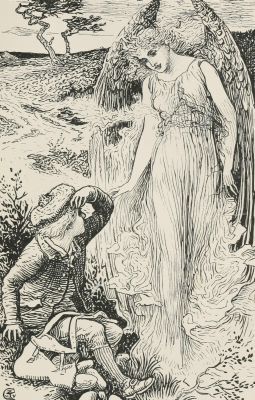
And there are four different winds, Gray-wings, White-wings, Green-wings, and Golden-wings. Little nine year old Gratian is a favorite of the four winds. They watch over him, they talk to him, they take him places faster than he can go himself. When he is out on the fields, and among the moors the winds are with him. The winds teach him lessons, right from wrong type of lessons. It has me wondering whether the winds are watching over other boys and girls in other places or do they only take care of Gratian, he is the only child living at Four Winds Farm, maybe that makes him special, special to the winds anyway. Here is Gratian's first meeting with the winds:
When he woke the room was quite dark; the clouds had hung their dusters over the moon's face by mistake perhaps, or else she had got tired of shining and had turned in for a nap, thought Gratian sleepily. He shut his eyes again, and curled himself round the other way, and would have been asleep again in half a minute, but for a sound which suddenly reached his ears. Some one was talking near him! Gratian opened his eyes again, forgetting that that could not help him to hear, and listened. Yes, it was a voice—two voices; he heard one stop and the other reply, and now and then they seemed to be talking together, and gradually as he listened he discovered that they came from the direction of the fireplace. Could it be the voices of his father and mother coming up from below, through the chimney, somehow? No, their voices were not so strangely soft and sadly sweet; besides their room was not under his, nor did they ever talk in the middle of the night.
"They are too sleepy for that," thought Gratian with a little smile. For the farmer and his wife were very hard-working, and even on Sunday they were tired. It was a long walk to church, and unless the weather were very bad they always went twice.
Gratian listened again, more intently than ever. The voices went on; he could distinguish the different tones—more than two he began to fancy. But how provoking it was; he could not catch the words. And from the strain of listening he almost began to fall asleep again, when at last—yes, there was no doubt of it now—he caught the sound of his own name.
"Gratian, Gra—tian," in a very soft inquiring tone; "ye—es, he is a good boy on the whole, but he is foolish too. He is wasting his time."
"Sadly so—sad—ly so—o," hummed back the second voice. "He only dreams—dreams are very well in their way, they are a beginning sometimes, so—me—ti—imes. But he will never do anything even with his dreams unless he works too—wo—orks too."
"Ah no—no—o. All must work save the will-o'-the-wisps, and what good are they? What good are the—ey?"
Then the two, or the three, maybe even the four, Gratian could not be sure but that there were perhaps four, voices seemed all to hum together, "What good are the—ey?" Till with a sudden rushing call one broke in with a new cry.
"Sisters," it said, "we must be off. Our work awai—aits us, awai—aits us."
And softly they all faded away, or was it perhaps that Gratian fell asleep?
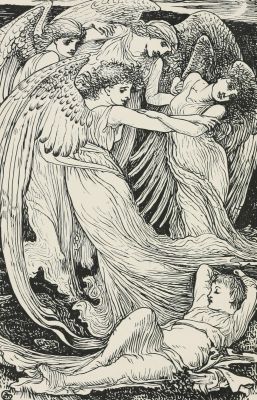
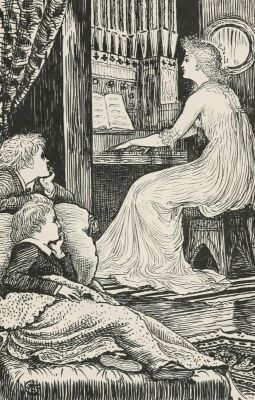
And that's what you have to look forward to, lots of whispering winds watching over Gratian. Gratian had never cared much for school and never cared much for learning. But now the winds had put into his head the idea of working hard, that nothing can be done without work, so he goes to school the next morning ready to work. And he does do better, eventually he is sent to spend his afternoons at the "big house" where a lady and her little boy have come to stay. The boy has had a fall and can't walk about or stand much, and would like to have a companion. So Gratian becomes that companion. And all the time, at school, at the Big House, at the farm, the winds are watching over him. The book has illustrations, that's always a plus for me. It was a cute little children's book. It didn't leave me wanting to read more books about the four winds though. And so I'm moving on. But first, the illustrations, a few of them anyway:
Victorian children's story about a young boy in which the morality blows stronger than the magic.
Gratian Conyfer is nine years old and lives in a house on the moorlands exposed to the elements which give the book its title. It so happens that the four winds themselves appear to him in the guise of blustery angels, teaching him some valuable lessons about working hard and doing the right thing.
The fact that they do this by alternately kissing him or smacking him on the face depending on whether he'd been naughty or nice was a bit strange, but there you go. He should just be thankful that they didn't change direction when he was pulling an ugly face, as the saying goes.
I had read one of the prolific Mrs. Molesworth's stories before, The Cuckoo Clock. That one had a greater amount of magic than morality, so I preferred it. I liked the way this one ended, with Gratian making a noble sacrifice that none of the adults ask of him.
The part I liked best though was the dedication at the start. I don't see how a children's author who is also a parent could ever say anything truer than this:
TO
MY YOUNGEST DAUGHTER
OLIVE
I INSCRIBE THIS LITTLE STORY
WHICH WE THOUGHT OF TOGETHER
(Who got the commission though, eh Mrs Molesworth? Did I see little Olive's name on the front cover?)