Savage Acerbic painting as social commentary George Grosz (1893–1959) was one of the most important exponents of Dadaism, and therefore of political painting in general. He not only condemned both militarism and bourgeois culture, but also set himself in opposition to traditional forms of art. The decisive element in Grosz’s paintings is their in them he pointed out defects in the political and social conditions, literally arraigning them before the public. For Grosz, painting served as a political “I drew and painted from a sense of contradiction and through my work tried to convince the world that it was ugly, sick, and phony.” Fascinated by the metropolis, Grosz depicted the wild and dissolute life in the bars and nightclubs of the Weimar Republic in the 1920s. He directed his attention to the shady side of life and filled his canvas with caricatures of distorted figures. Grosz never permitted human beings to emerge as individuals, but instead always portrayed types, as representatives of a social level or class. After the publication of his candidly drawn “pornographic illustrations,” Grosz fell under strong criticism in the 1920s. The Nazis castigated his works as “degenerate art.” About the Each book in TASCHEN’s Basic Art Series
This short book is a solid introduction to Grosz's art and the context of his social criticism. Reproductions are at the usual high quality I expect from Taschen.
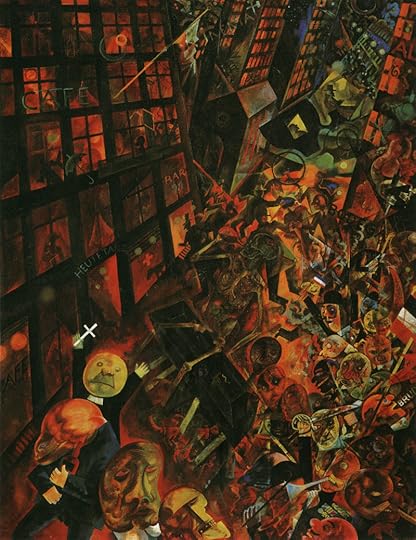
Here is one of his larger and more complex paintings, "The Funeral".
This work was dedicated to Oskar Panizza, German psychiatrist and avant-garde write who was sent to prison on a charge of blasphemy and then exiled for his play Das Liebeskonzil. It is now at the Staatsgalerie Stuttgart, a museum I recommend highly if you're ever in the area.
Grosz eventually left Germany as well, for New York. Americans may be familiar with him as a teacher of American artist and political cartoonist Romare Bearden.
"Germany: A Winter's Tale" 1919 (whereabout unknown)
Germany didn't treat Grosz or any modern artist too kindly, but at least his grave is Ehrengrab des Landes Berlin, which is something, I guess.
At start you think that a child made the drawing but then slowly you realise that he was a genius. His life quotes are equally good, such " first rule of dating is that all are beautiful" . A good looking man, with wife and kid, probably disgust with the morality of that period and try to express it in the best possible way. If you have ever see Pink Floyd the Wall movie, the judge at the trial is a copy of Grosz characters. Art nouveau? Bit of futurism? And a wild imagination, humour, provocation? You will find all that in him, especially a little kid that makes silly drawings but manages to masquerade them and create fine art as end result.
Com a qualidade da Taschen mesmo um pequeno resumo do artista serve como introdução para outras leituras. Em 1893, em Berlim nasce George Grosz, um artista profundamente influenciado pelo seu contexto social e político. Logo no quadro "Para Oscar Panizza" a crítica à loucura citadina é premente. O seu percurso inclui inúmeras e caricaturas corrosivas, passando pelo Dadaísmo e Realismo Crítico. Apesar do exagero (até infantil) de algumas pinturas Grosz sempre advertiu os seus compatriotas para o risco do nazismo e da sua figura mais mediática. O quadro "Caim, ou Hitler no inferno" é imagem clara da loucura do fanatismo.
A arte contemporânea desta primeira década do nosso século só terá o mesmo papel de alerta social se não for ignorada. (a boa notícia é que Serralves cresce em número de visitantes).
This is a very quick read, but it includes some valuable information about Grosz, one of my favorite artists. The prints are very nice and comprehensive; if I had one complaint, though, it's that there weren't more from the Ecce Homo series, which was groundbreaking in many ways. I also missed having a print of Bow to the Authorities, one of my favorite sketches. But that's really nitpicking. Every modern art fan should know about Grosz if he/she doesn't already, and this is a good place to start. It's introductory but an excellent base from which to learn more. Plus, it's a great coffee-table book!
This is surreal. I don't know what label is put on him as an artist expressionist or impressionist or maybe it is surrealist. His art makes me think what would have happened if Dali had met Francis Bacon and they had decided to work together. I love Grosz and I am glad this book allowed me to discover more about him. I am also comforted by the fact that I will never meet the warped mind that created such amazing and terrifying pieces of artwork.
Grosz was one of those "right person at the right place at the right time" people who, while miserable themselves, have left us a valuable historical account.