

What do you think?

Art of Italian Renaissance Courts, the, Perspectives Series
Alison Cole reveals to us another side of the Renaissance, that of the individual patrons and their world. This unique book is both a scholarly discussion in the tradition of Jakob Burckhardt and a tour through Renaissance Italy, described with charm and filled with detail.
192 pages, Paperback
First published March 1, 1995
Ratings & Reviews
Friends & Following
Create a free account to discover what your friends think of this book!
Community Reviews
Displaying 1 - 7 of 7 reviews

Read
October 30, 2018Long legged Italy,
Kicked poor Sicily,
Right into the middle of the Mediterranean Sea..
That was a familiar schoolyard rhyme back in primary school days, days I used to spend in a tiny classroom with large maps on the walls like so many colorful frescoes. The map of Europe dominated one entire wall with the boot shape of Italy featuring prominently. That brown boot, combined with the 'Long legged Italy' rhyme, convinced me that all Italians must be long-legged soldiers. I could see them clearly in my mind: musketeers in high-heeled boots marching across the map.
Another firm notion I had about Italy was that it was very 'ancient'. But a few years later I learned that the territory outlined on the school map only became unified in the nineteenth century, and that 'Italy' was really quite a modern concept. I was also learning Roman history by then and somehow the modern history got drowned out by the marching boots of ancient history, and I continued to think of Italy as always being a unified territory, always representing the 'ancient' in Europe, and always being over-run with soldiers.
Reading Alison Cole's account of Italian Renaissance Courts has helped to give me a better understanding of the effect of the collapse of the Western Roman Empire in the fifth century, and how 'Italy' disappeared completely as a unified concept (although wasn't it still being thought of as 'Italy' by outsiders, by all those people who documented their travels in 'Italy' over the intervening centuries?)
Alison Cole however is primarily interested in what eventually emerged from the chaos of the post fifth-century period. She describes the rise of a number of republican city-states such as Florence, and of various princely courts such as Naples during the medieval period so that by the end of the fifteenth century the brown boot I remembered from the classroom wall was in fact made up of many different colored patches.
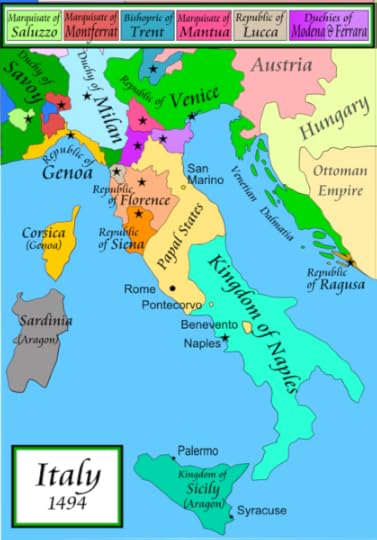
Having taken the reader neatly and quickly to the Renaissance era, Cole focuses on some of the princely courts, in particular Milan, Urbino, Ferrara, Mantua and, the largest court of all after Rome, Naples. She explains how such courts created powerful alliances by marrying off the daughters of the leading families where it best suited the ambitions of the court. Among those families were the Sforza and Visconti of Milan, the Montefeltro of Urbino, the Este of Ferrara and Modena, the Gonzaga of Mantua, the Malatesta of Rimini, the Bentivoglio of Bologna, the Cannegrande of Verona, the Medici of Florence, the Borgia and Delle Rovere of Rome, and the Aragonese dynasty based in Naples.
Such marriages allowed the smaller courts to grow stronger but there were advantages too for the larger courts like Venice and Naples. The dukes of some of the smaller courts were 'condottieri', highly trained mercenaries in command of large forces of armed men. The condottieri lent their armed strength to the larger courts, usually for monetary rewards - very large rewards, if they happened to be as skilled at military matters as Federico da Montefeltro of Urbino, for example. During the fifteenth century, these mercenary armies were constantly on the move throughout the multicolored boot of Italy. It seems my schoolchild imagination hadn't been completely wrong when it had associated Italy so completely with soldiers.
The main part of this book focuses on the treasures of art and architecture produced in the princely courts as they vied with each other to possess not only the most magnificent and well fortified palazzos but the most beautiful and elegant decor. Like many people, I'm familiar with the religious art produced during the Renaissance period for the Papal court in Rome, as well as for the churches of Florence and Venice, so it was refreshing to discover Alison Cole's many examples of secular fifteenth century art. And not only did I discover them in the beautifully illustrated pages of this book, but I also wore my boots out marching in Cole's footsteps from Milan to Mantua and Verona, from Bologna to Ferrare, from Rimini to Urbino. Her book is an ideal travel guide, and there were huge rewards at every point on the journey.
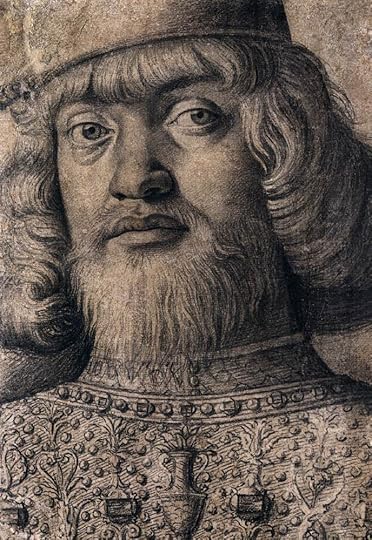
The artists she catalogues also travelled about from one court to another, seduced by the hope of ever better rewards. Sometimes they settled in one place for longer periods, as was the case of Andrea Mantegna who, in middle age, became the court artist of the Gonzaga family in Mantua where he lived until his death. This is a drawing by Mantegna of Francesco II Gonzaga, of Mantua, a seasoned condottiero who commanded the armies of the Republic of Venice:
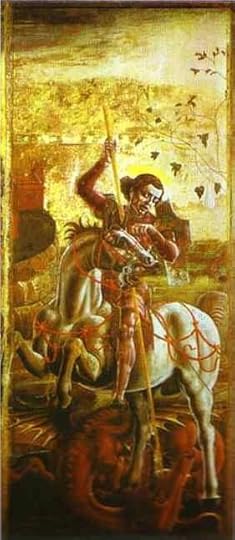
The Ferrarese artist, Cosmè Tura, worked for the Este family in Ferrara for a number of years. This is his very fierce and military-looking Saint George doing battle with the dragon:
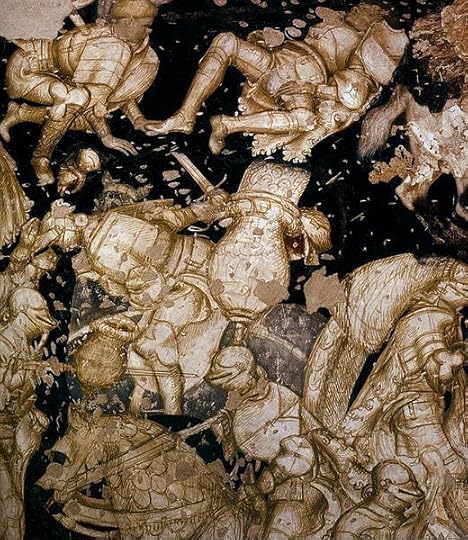
The early fifteenth century artist, Pisanello, was also associated with the Este family but he spent time at the Gonzaga court in Mantua too. He also worked at the courts of Verona, Milan and Rimini, as well as Rome, Venice and Naples. While in Mantua, he painted a giant fresco, crammed with soldiers engaged in fierce battle. The fresco covers several walls of one of the rooms of the Gonzaga Palazzo but unfortunately only patches of it remain intact. Still, it remains hugely impressive as this detail conveys:
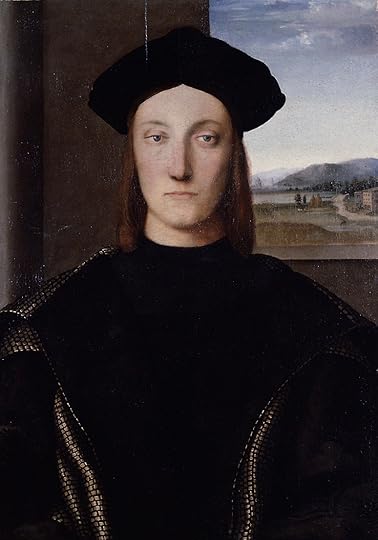
Raphael, a native of Urbino worked in the service of the local Montefeltro court before moving on to Florence and Rome. Before he left, he painted this portrait of the son of the great military man, Federico da Montefeltro. Guidobaldo was a soldier like his father, in spite of fragile health. He married Elisabetta Gonzaga of Mantua, and theirs is the elegant court described by Baldassare Castiglione in The Book of the Courtier.
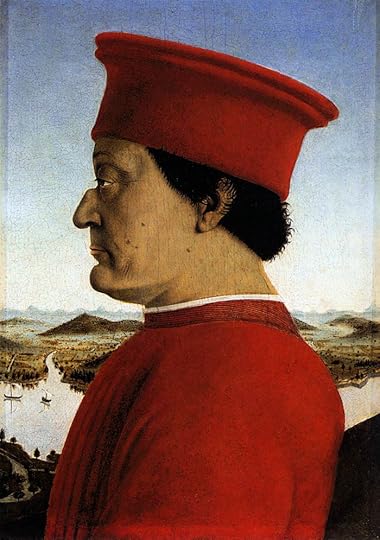
The artist Piero Della Francesca moved between his home town of Sansepolcro and the courts of Ferrara and Urbino where he painted condottiero Federico da Montefeltro.
Montefeltro always chose to be represented in profile as he had lost the bridge of his nose in battle:
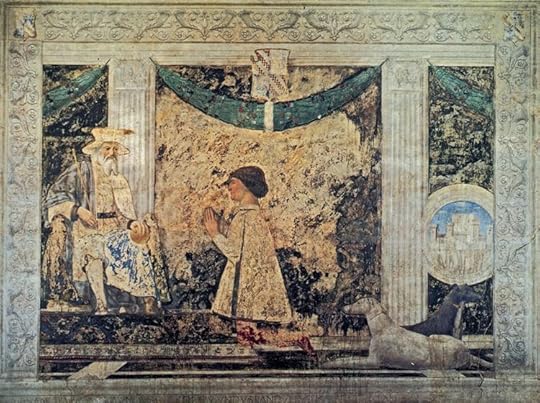
Piero also worked for another redoubtable condottiero, Sigismondo Malatesta of Rimini, a fierce enemy of Federico da Montefeltro. This fresco of Sigismondo, in full soldier regalia, is a perfect example of secular art in a religious setting.
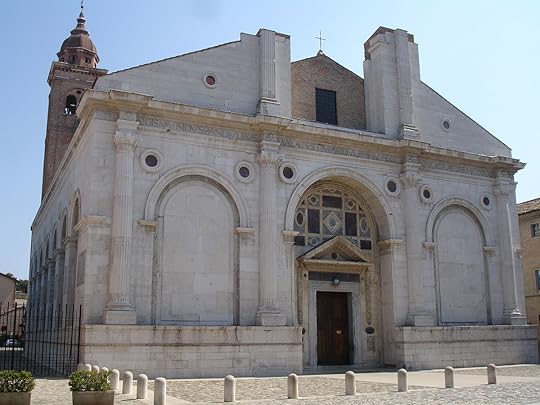
The fresco is housed in the Tempio Malatestiano in Rimini, a temple-like church designed by the renowned architect Leon Battista Alberti, and which the battle-hardened Malatesta had ordered to be constructed as a monument, not to any sacred personage, nor even to his first wife, Ginevra d'Este, nor to his second wife, Polissena Sforza, although they are both buried there, but to his favourite mistress, Isotta degli Atti, whom he eventually married. The Tempio caused both Sigismondo and Alberto to fall out of favour with the Pope of the day who pronounced the unfinished building more pagan than Christian.
Viewing Alberto's innovative Tempio, which was inspired by the classical architecture of pagan Rome, was a fitting way to round off my trip, reminding me of the continued presence of the ancient in the modern.
Kicked poor Sicily,
Right into the middle of the Mediterranean Sea..
That was a familiar schoolyard rhyme back in primary school days, days I used to spend in a tiny classroom with large maps on the walls like so many colorful frescoes. The map of Europe dominated one entire wall with the boot shape of Italy featuring prominently. That brown boot, combined with the 'Long legged Italy' rhyme, convinced me that all Italians must be long-legged soldiers. I could see them clearly in my mind: musketeers in high-heeled boots marching across the map.
Another firm notion I had about Italy was that it was very 'ancient'. But a few years later I learned that the territory outlined on the school map only became unified in the nineteenth century, and that 'Italy' was really quite a modern concept. I was also learning Roman history by then and somehow the modern history got drowned out by the marching boots of ancient history, and I continued to think of Italy as always being a unified territory, always representing the 'ancient' in Europe, and always being over-run with soldiers.
Reading Alison Cole's account of Italian Renaissance Courts has helped to give me a better understanding of the effect of the collapse of the Western Roman Empire in the fifth century, and how 'Italy' disappeared completely as a unified concept (although wasn't it still being thought of as 'Italy' by outsiders, by all those people who documented their travels in 'Italy' over the intervening centuries?)
Alison Cole however is primarily interested in what eventually emerged from the chaos of the post fifth-century period. She describes the rise of a number of republican city-states such as Florence, and of various princely courts such as Naples during the medieval period so that by the end of the fifteenth century the brown boot I remembered from the classroom wall was in fact made up of many different colored patches.
Having taken the reader neatly and quickly to the Renaissance era, Cole focuses on some of the princely courts, in particular Milan, Urbino, Ferrara, Mantua and, the largest court of all after Rome, Naples. She explains how such courts created powerful alliances by marrying off the daughters of the leading families where it best suited the ambitions of the court. Among those families were the Sforza and Visconti of Milan, the Montefeltro of Urbino, the Este of Ferrara and Modena, the Gonzaga of Mantua, the Malatesta of Rimini, the Bentivoglio of Bologna, the Cannegrande of Verona, the Medici of Florence, the Borgia and Delle Rovere of Rome, and the Aragonese dynasty based in Naples.
Such marriages allowed the smaller courts to grow stronger but there were advantages too for the larger courts like Venice and Naples. The dukes of some of the smaller courts were 'condottieri', highly trained mercenaries in command of large forces of armed men. The condottieri lent their armed strength to the larger courts, usually for monetary rewards - very large rewards, if they happened to be as skilled at military matters as Federico da Montefeltro of Urbino, for example. During the fifteenth century, these mercenary armies were constantly on the move throughout the multicolored boot of Italy. It seems my schoolchild imagination hadn't been completely wrong when it had associated Italy so completely with soldiers.
The main part of this book focuses on the treasures of art and architecture produced in the princely courts as they vied with each other to possess not only the most magnificent and well fortified palazzos but the most beautiful and elegant decor. Like many people, I'm familiar with the religious art produced during the Renaissance period for the Papal court in Rome, as well as for the churches of Florence and Venice, so it was refreshing to discover Alison Cole's many examples of secular fifteenth century art. And not only did I discover them in the beautifully illustrated pages of this book, but I also wore my boots out marching in Cole's footsteps from Milan to Mantua and Verona, from Bologna to Ferrare, from Rimini to Urbino. Her book is an ideal travel guide, and there were huge rewards at every point on the journey.
The artists she catalogues also travelled about from one court to another, seduced by the hope of ever better rewards. Sometimes they settled in one place for longer periods, as was the case of Andrea Mantegna who, in middle age, became the court artist of the Gonzaga family in Mantua where he lived until his death. This is a drawing by Mantegna of Francesco II Gonzaga, of Mantua, a seasoned condottiero who commanded the armies of the Republic of Venice:
The Ferrarese artist, Cosmè Tura, worked for the Este family in Ferrara for a number of years. This is his very fierce and military-looking Saint George doing battle with the dragon:
The early fifteenth century artist, Pisanello, was also associated with the Este family but he spent time at the Gonzaga court in Mantua too. He also worked at the courts of Verona, Milan and Rimini, as well as Rome, Venice and Naples. While in Mantua, he painted a giant fresco, crammed with soldiers engaged in fierce battle. The fresco covers several walls of one of the rooms of the Gonzaga Palazzo but unfortunately only patches of it remain intact. Still, it remains hugely impressive as this detail conveys:
Raphael, a native of Urbino worked in the service of the local Montefeltro court before moving on to Florence and Rome. Before he left, he painted this portrait of the son of the great military man, Federico da Montefeltro. Guidobaldo was a soldier like his father, in spite of fragile health. He married Elisabetta Gonzaga of Mantua, and theirs is the elegant court described by Baldassare Castiglione in The Book of the Courtier.
The artist Piero Della Francesca moved between his home town of Sansepolcro and the courts of Ferrara and Urbino where he painted condottiero Federico da Montefeltro.
Montefeltro always chose to be represented in profile as he had lost the bridge of his nose in battle:
Piero also worked for another redoubtable condottiero, Sigismondo Malatesta of Rimini, a fierce enemy of Federico da Montefeltro. This fresco of Sigismondo, in full soldier regalia, is a perfect example of secular art in a religious setting.
The fresco is housed in the Tempio Malatestiano in Rimini, a temple-like church designed by the renowned architect Leon Battista Alberti, and which the battle-hardened Malatesta had ordered to be constructed as a monument, not to any sacred personage, nor even to his first wife, Ginevra d'Este, nor to his second wife, Polissena Sforza, although they are both buried there, but to his favourite mistress, Isotta degli Atti, whom he eventually married. The Tempio caused both Sigismondo and Alberto to fall out of favour with the Pope of the day who pronounced the unfinished building more pagan than Christian.
Viewing Alberto's innovative Tempio, which was inspired by the classical architecture of pagan Rome, was a fitting way to round off my trip, reminding me of the continued presence of the ancient in the modern.

March 30, 2016
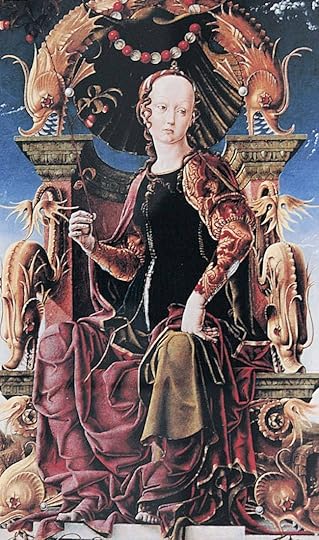
Calliope, by Cosme Turà.
I have read this book three times and can count on coming back to it in the future to reread sections. When considering art in Italy during the Renaissance, one immediately thinks of only three centres: The republics of Tuscany and the Veneto and, in the later period, Rome with its Papacy. But during the 15th century major political changes took place in other geographic units. Several leading secular courts were established during the 1470s – a few Duchies and a Marquisate. These courts also entangled themselves through marriages with various combinations of familial and political alliances forming, dissolving, and forming again.
The politics of this period are very complex. Apart from wars we see dislocations, such as when Pope Eugenius IV fled from Rome and ruled his papacy from Florence during ten years. We also see the King of Aragon made prisoner in the Milan court to then form an association with his captor so as to conquer the Kingdom that had been promised to him, but then withdrawn: the legendary Naples .
This book is a fascinating account of how these courts, in spite of being first and foremost engaged in political rivalries and wars, promoted the development of the arts and helped the artists to establish their persona. The period left treasures for posterity to admire.
These princes all built or rebuilt or renovated lavish residences. Libraries, frescoes, tapestries, furniture, chapels, reception rooms, and the more private and exquisite studioli. And the women- wives, sisters and daughters- got involved too. Magnificently.
After a couple of chapters on common grounds, Alison Cole goes into more detail in each of her courts, individually.
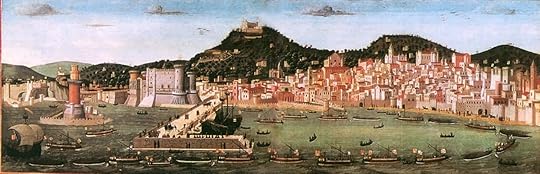
NAPLES
The Angevins in the previous century had already made Naples a magnet for various artists. Giotto (1276-1337) became a member of the court during five years. But it was with the arrival of Alfonso, the Magnificent (1396-1458), when Naples became even more international. Pisanello (1395-1455), like Giotto before, became a salaried member of the court. Pisanello was also the artistic link with the courts of Mantua and Ferrara. And the marriage of Alfonso’s daughter, Maria, to Lionello d’Este sealed the family ties with those centres. Later his granddaughter Eleanor married Ercole, Lionello’s youngest brother.
Alfonso’s interest in the arts, partly thanks to his Aragonese and Castilian roots (he was a Trastámara), focused his attention in the art of Flanders (very much appreciated by the Castilians), and had Rogier van der Weyden (1400-1464) travel to the Kingdom of Aragón and Naples. And when he wanted to renovate his Castel Nuovo (note the adjective) he engaged Dalmatian, Majorcan and Valencian architects and sculptors.
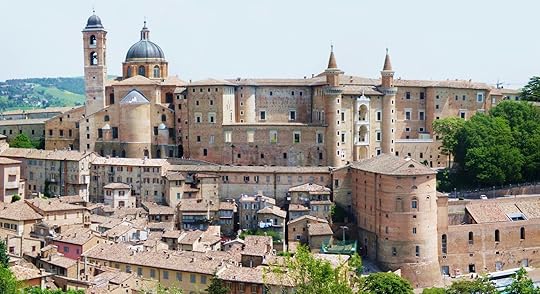
URBINO
This is another striking court.
Again a military man, a condottiero, Federigo da Montefeltro (1422-1482), after succeeding his assassinated half-brother, bothered with great interest, to put Urbino in the map of the Humanists. Several outstanding artists, Piero della Francesca (1410-1492); Luciano Laurana (1420-1479) and Melozzo da Forlì (1438-1494) were engaged there. Later also artists from other lands left a mark in this hilly town: Justus of Ghent (1410-1480) and Pedro Berrruguete (1450-1504).
Federigo’s ‘studiolo’ both in Urbino and in Gubbio, was one of the ones – all these courts seemed to compete for the most outstanding and precious small room that represented the quintessential exquisiteness of their lineage. These displays helped in raising themselves and Federigo got his Dukedom in 1474. Later the sophisticated court of Federigo’s son Guidobaldo (1472-1508) and the latter’s wife Elisabetta Gonzaga (link with Mantua then), inspired Castiglione to write his The Book of the Courtier.
Urbino became the model court for the whole of Europe.
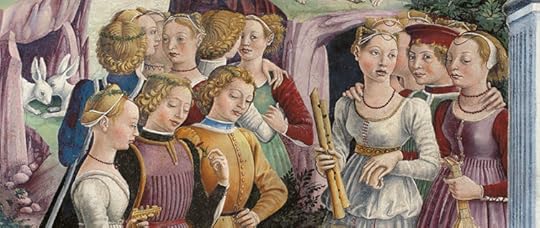
FERRARA
If Urbino gave birth the "The Courtier", Ferrara provided the grounds for extraordinary Music and Literature. Orlando, whether inamorato or furious, was born there. Boiardo and Ariosto. What would eighteenth century opera have done without them?
The D’Estes were an extraordinary clan. Niccolò III (1393-1441) was succeeded by his three sons. They all carried chivalrious names: Leonello (a heraldic Lion- 1407-1550); Borso (Sir Bors - Holy Grail, 1413-1471)), Ercole (Hercules, 1431-1505)) and with Germanic origins, eventually got their Dukedom too. In 1452, well before Urbino, Borso got the coveted title.
And if the imagination got to fly in the literature produced in this centre, so did its paintings. As a new Duke, Borso felt entitled to renew his Palazzo Schifanoia (meaning: to avoid boredom), and had the most eccentric of painters display their abilities on his walls. Cosme Turà (1430-1495), Francesco del Cossa (1430-1477), and Ercole dei Roberti (1451-1496) exercised their imagination; after all they painted the Muses, and came up with the most bizarre cycle of frescoes to be found in an Italian Palazzo until then. (later, Giulio Romano would provide his own crazy displays in Mantua).
MANTUA
May be these courts needed the Dukedom for unbuckling their extravagance. For during the time
of Ludovico III (1412-1478), the condottiero-turned-marquis, the decoration of the not-yet-Ducal Palace was of great prestige and elegance. Andrea Mantegna’s (1431-1506) art was particularly sober. The court acquired a greater level of literacy under Isabella d’Este (1474-1539) who had somewhat married down when she wedded Francesco, an excellent warrior, but who brought with her the excellences of the sophisticated court of Ferrara where she had grown up.
Isabella could have been an even greater patroness. She just lacked cash. She is however the first patron to buy art works in the secondary market. And then she had not just one studiolo but two: the first in the old part of the palace, from 1491, and the second, once she became a widow, in the new section from 1519. Only the latter remains.
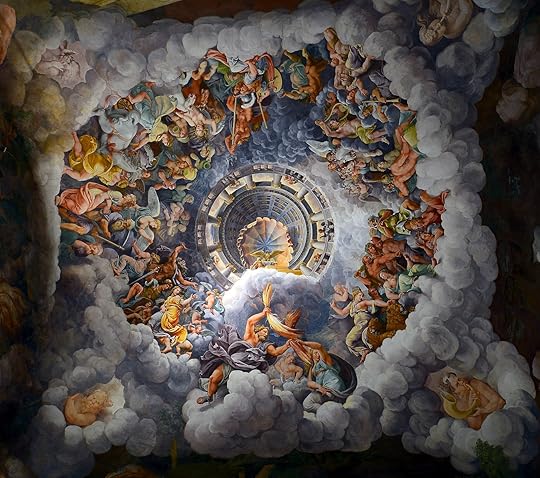
Mantua had to wait the longest for its Dukedom, and hence for the commission of a painted stravaganzza. Isabella and Francesco’s son, Federigo (1500-1540), was awarded his coveted title in 1530, when the Emperor, on his way to Bologna, became his guest. And the architectural pavilion that would welcome the imperial visit then surpassed the Ferrarese Schifanoia in its eccentricity. Giulio Romano concocted the unforgettable Chamber of the Giants in the Palazzo Té.
MILAN
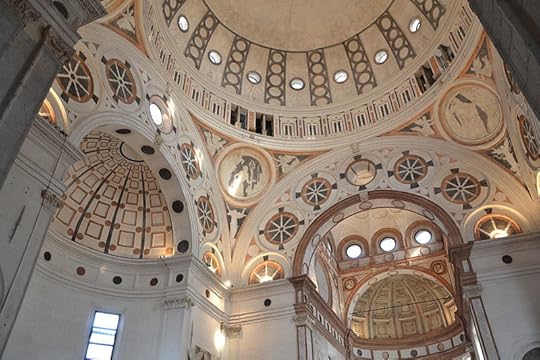
One of the strongest courts in the early 15C, for the Visconti had intermarried with the House of Savoy, and, even better, the Valois, finished the century hopelessly weakened. In the between, the Sforza, the self-proclaimed heirs to the Visconti, exerted great effort at aggrandizing their court and its prestige. Ludovico (1452-1508)bmarried Beatrice d’Este, Isabella’s younger sister, but Beatrice died very young, so the d’Este clout had less of an effect than in Mantua. But Ludovico engaged in several art and architecture endeavours: the Certosa in Pavia and its university, and the Castello and Santa Maria delle Grazie in Milan. For part of this, he hired two of the most prominent artists of the Renaissance, Leonardo (1452-1519) and Bramante (1444-1514).
The marriage links with the Valois, however, would eventually bring the fall of the Duchy as it became prey to one of the new kind of power that was forming in large parts of Europe: the nation states.
This review is just a minor survey in comparison with what this book offers. There is so much there and it fills such a large gap in our knowledge of the Renaissance in Italy. Grantly, it concentrates on the 15thC, leaving the 16thC silent. But then these courts, a fertile cultural ground, became something else in the following century.
There were also a few factual errors, but considering the large amount of material that Alison Cole has had to manage, it is a brilliant outcome. Writing this review made me think I would like to read it for the fourth time.

Read
May 19, 2026I read this book in preparation for my trip to Northern Italy just to look at art – a long-term plan. It was recommended by our GR friend Fionnuala – a well-known viewer of artworks. I never got to go, a personal matter intervened, so the plan was cancelled and placed on hold.
Princes all over Italy in the 15thC played out their own courtly world influenced by the times. The times had changed. The great power plays of the 14thC had shaped the political and regional landscape of the Italian peninsula. Trade brought more wealth and power. For Princes there had to be more to life than accounts and endless territorial battles with other princes. As Burckhardt wrote in his formative work on the Renaissance, power had to be accompanied by an aesthetic that captured the imagination. Get me some art!
The court of Mantua was the place I wanted to see the most. Ludovico Gonzaga employed Mantegna for decades, providing him with a house, a supply of food staples and a generous salary. Mantegna was allowed to do his own work and when it was opportune was also allowed time to work for others. It’s the frescoes in the bedroom – the camera – that most interested me from the moment I saw the tromp l ‘oeil oculus with the chubby little cherubs hanging precariously off the edge. What a fantastic effect this rounded ceiling painted on a flat plane makes. Gonzaga did well as a prince, despite Mantua being small and unable to support itself and a princely lifestyle from agriculture and its surplus. So he became one of the best known condottiero – or general for hire. Mantua was nicely placed between larger more powerful republics and principalities and so he earned substantial reserves of funds for the treasury to send mercenary armies in the employ usually of the Milan Sforzas and help them maintain their territories, but also Venice and Naples. His whole family where in the same business for generations since an ancestor managed to win the Mantuan principality for themselves back in the 1400s. An ideal prince in the Machiavellian study of political careers.
Securing a court painter became a double-sided quest – for the artist to obtain the kind of long-term stability and payment and for the prince to upgrade or establish their reputation as a man of the times. Because pursuing the arts were a kind of proof of success. For the courtier prince, being powerful wasn’t quite enough – there had to be something else to it all and it seems that acquiring an artist, adorning the walls of palaces and churches with frescoes, commissioning statues for public and private spaces was as important as building luxurious palaces. You weren’t a big artichoke unless you had art.
I especially liked the chapter on the court artist’s life. How much they got paid, what they got paid, where they were positioned in the hierarchy, all dependant on the prince themselves. Power wasn’t easy to get to get for artists.
At table, where the court hierarchy was at its most rigid and defined, the court artist was seated with the tailors, shoe-makers, musicians, upholsterers, barbers and other members of the salaried household.
Artists took the opportunities for ennoblement seriously and increasingly, tried to act like gentlemen. The humanists at the courts were beginning to associate painting, sculpture and architecture with the liberal arts – ‘liberal’ because they were ‘freely’ practiced. Instead of their manual skills, artists increasingly emphasised their talents as designers and devisers, which demanded intellectual resourcefulness (ingegnio) and a bravura display of imaginative and rational faculties (fantasia and invenzione).
The illustrations are really good, often full page and on glossy hard-wearing paper.
The regular paragraph font is good and readable. It has many long columns of margin notes on each page that describes the figure on the page, sometimes there are two in the margin column. These margins are in smaller font and somewhat faint making late night reading difficult, especially with lamplight reflecting strongly off the page. My copy is a hardback.
Princes all over Italy in the 15thC played out their own courtly world influenced by the times. The times had changed. The great power plays of the 14thC had shaped the political and regional landscape of the Italian peninsula. Trade brought more wealth and power. For Princes there had to be more to life than accounts and endless territorial battles with other princes. As Burckhardt wrote in his formative work on the Renaissance, power had to be accompanied by an aesthetic that captured the imagination. Get me some art!
The court of Mantua was the place I wanted to see the most. Ludovico Gonzaga employed Mantegna for decades, providing him with a house, a supply of food staples and a generous salary. Mantegna was allowed to do his own work and when it was opportune was also allowed time to work for others. It’s the frescoes in the bedroom – the camera – that most interested me from the moment I saw the tromp l ‘oeil oculus with the chubby little cherubs hanging precariously off the edge. What a fantastic effect this rounded ceiling painted on a flat plane makes. Gonzaga did well as a prince, despite Mantua being small and unable to support itself and a princely lifestyle from agriculture and its surplus. So he became one of the best known condottiero – or general for hire. Mantua was nicely placed between larger more powerful republics and principalities and so he earned substantial reserves of funds for the treasury to send mercenary armies in the employ usually of the Milan Sforzas and help them maintain their territories, but also Venice and Naples. His whole family where in the same business for generations since an ancestor managed to win the Mantuan principality for themselves back in the 1400s. An ideal prince in the Machiavellian study of political careers.
Securing a court painter became a double-sided quest – for the artist to obtain the kind of long-term stability and payment and for the prince to upgrade or establish their reputation as a man of the times. Because pursuing the arts were a kind of proof of success. For the courtier prince, being powerful wasn’t quite enough – there had to be something else to it all and it seems that acquiring an artist, adorning the walls of palaces and churches with frescoes, commissioning statues for public and private spaces was as important as building luxurious palaces. You weren’t a big artichoke unless you had art.
I especially liked the chapter on the court artist’s life. How much they got paid, what they got paid, where they were positioned in the hierarchy, all dependant on the prince themselves. Power wasn’t easy to get to get for artists.
At table, where the court hierarchy was at its most rigid and defined, the court artist was seated with the tailors, shoe-makers, musicians, upholsterers, barbers and other members of the salaried household.
Artists took the opportunities for ennoblement seriously and increasingly, tried to act like gentlemen. The humanists at the courts were beginning to associate painting, sculpture and architecture with the liberal arts – ‘liberal’ because they were ‘freely’ practiced. Instead of their manual skills, artists increasingly emphasised their talents as designers and devisers, which demanded intellectual resourcefulness (ingegnio) and a bravura display of imaginative and rational faculties (fantasia and invenzione).
The illustrations are really good, often full page and on glossy hard-wearing paper.
The regular paragraph font is good and readable. It has many long columns of margin notes on each page that describes the figure on the page, sometimes there are two in the margin column. These margins are in smaller font and somewhat faint making late night reading difficult, especially with lamplight reflecting strongly off the page. My copy is a hardback.

February 9, 2016
156 color photographs make this art and social history book about the 1400s in Italy a real treasure. Large print runs allow the publisher to sell this quality hardback book at a very reasonable price. If you have a friend or relative who is an amateur Italian Rinascimento art historian, then you've just discovered their perfect gift at a price that won't break the bank.
The subtitle of the book is "Art, Pleasure and Power" because the focus is on how the Renaissance's powerful elite commissioned art for two main reasons: for their own and their family's pleasure, and as a display of their power to their subjects and to other power players.
The text is scholarly. The images fit the text very well. I would have liked the image caption text to be larger and darker. If you love history and art, and you're traveling to the places covered in this book, or have recently traveled there, you should enjoy this book very much.
The displays of power and wealth by the rulers in Italy during the 1400s included much more than the paintings and sculptures one sees in museums when touring Italy. The author discusses all that the city-state Princes and the minor royals of Duchies, and the Popes commissioned:
buildings and city-renovation projects,
public parades and religious and secular festivals,
plays and musical compositions,
churches and religious community buildings,
commemorative medallions to give as gifts,
decorative arts like jewelry and glass and ivory carvings and tapestries, and
illuminated works of literature.
The 1400s power centers studied in this book include:
Naples under Alphonse of Aragon
Urbino under Federico da Montefeltro
Ferrara under the Este family
Mantua under the Gonzaga family
Milan-Pavia under Ludovico "Il Moro"
These power centers were actually military dictatorships run by either tyrants or benevolent Princes, along with a few so-called Republics which were in reality oligarchies.
Foremost in their thoughts when commissioning art was their own validation and aggrandizement in the eyes of everyone from their rival family members, rival Princes, the Pope, their subjects and the Holy Roman Emperor.
Family histories that purported to link the leader to historical greats were popular commissions from writers. It is amusing to note that narcissistic, wealthy people today emulate many of the commissions of the Renaissance (Rinascimento in Italian) elite.
Illumination art that included the family in monumental historical and religious events was common. It reminds me of the reproduction paintings wealthy people can commission today with the rich person's family members' faces replacing the original faces.
Ancient Roman style commemorative medallions attempted to show the link to the Roman Empire, with families often claiming to be descended from the ancient elite.
Behind all the pomp and self-serving commissions there was also pure pleasure as the author points out:
"Against the backdrop of constant warfare, factional rivalry, popular unrest, arbitrary violence, devastating plague epidemics and a litany of everyday concerns, there were real pleasure, spiritual nourishment and consolation to be found in the arts and scholarship that the courts commissioned and consumed."
This is a quality scholarly book sold at an insanely reasonable price. I received a review copy of the book. This is my honest review. For the full and illustrated (with illumination art) review please visit my Italophile Book Review site.
http://italophilebookreviews.blogspot...
The subtitle of the book is "Art, Pleasure and Power" because the focus is on how the Renaissance's powerful elite commissioned art for two main reasons: for their own and their family's pleasure, and as a display of their power to their subjects and to other power players.
The text is scholarly. The images fit the text very well. I would have liked the image caption text to be larger and darker. If you love history and art, and you're traveling to the places covered in this book, or have recently traveled there, you should enjoy this book very much.
The displays of power and wealth by the rulers in Italy during the 1400s included much more than the paintings and sculptures one sees in museums when touring Italy. The author discusses all that the city-state Princes and the minor royals of Duchies, and the Popes commissioned:
buildings and city-renovation projects,
public parades and religious and secular festivals,
plays and musical compositions,
churches and religious community buildings,
commemorative medallions to give as gifts,
decorative arts like jewelry and glass and ivory carvings and tapestries, and
illuminated works of literature.
The 1400s power centers studied in this book include:
Naples under Alphonse of Aragon
Urbino under Federico da Montefeltro
Ferrara under the Este family
Mantua under the Gonzaga family
Milan-Pavia under Ludovico "Il Moro"
These power centers were actually military dictatorships run by either tyrants or benevolent Princes, along with a few so-called Republics which were in reality oligarchies.
Foremost in their thoughts when commissioning art was their own validation and aggrandizement in the eyes of everyone from their rival family members, rival Princes, the Pope, their subjects and the Holy Roman Emperor.
Family histories that purported to link the leader to historical greats were popular commissions from writers. It is amusing to note that narcissistic, wealthy people today emulate many of the commissions of the Renaissance (Rinascimento in Italian) elite.
Illumination art that included the family in monumental historical and religious events was common. It reminds me of the reproduction paintings wealthy people can commission today with the rich person's family members' faces replacing the original faces.
Ancient Roman style commemorative medallions attempted to show the link to the Roman Empire, with families often claiming to be descended from the ancient elite.
Behind all the pomp and self-serving commissions there was also pure pleasure as the author points out:
"Against the backdrop of constant warfare, factional rivalry, popular unrest, arbitrary violence, devastating plague epidemics and a litany of everyday concerns, there were real pleasure, spiritual nourishment and consolation to be found in the arts and scholarship that the courts commissioned and consumed."
This is a quality scholarly book sold at an insanely reasonable price. I received a review copy of the book. This is my honest review. For the full and illustrated (with illumination art) review please visit my Italophile Book Review site.
http://italophilebookreviews.blogspot...

August 25, 2024
I studied Italian Renaissance art back in art college. It was a good survey of the artists from Giotto to Piero della Francesca, Fra Filippo Lippi, Mantegna, Leonardo, Raphael to Titian. We learned how paintings moved from the very flat medieval images to a more three dimensional depth and natural style of the the high Renaissance masters. Even the sculptures culminated in the breathtaking work of Michelangelo. Personally I was a big fan of Raphael until I saw a cartoon of Virgin of the Rocks by Leonardo at the National Gallery in London. This guy could draw.
Over the past forty years I saw more Italian Renaissance art in museums. My views changed on some artists and improved on others. In short there is a lot of stellar work now located all over the world, not just Italy. I am still a fan of Raphael but others seem to hold sway.
Of course when one studies these artists in art college, the angle is on how they painted and how they changed visual perception. What was sadly missing was how these artists managed to raise their bar so high. I knew about their patrons but until I read this book, I knew so little about how really important these patrons were.
Alison Cole has done a magnificent job of laying out the patrons according to those individual centers of power. Of course you had the Medicis in Florence and Pope Julius II in Rome but also Alfonso of Aragon and Federico da Montefeltro in Urbino or Ludovico Il Moro in Milan, the Gonzagas in Mantua and Este Ferrara (in Ferrara). These people, vying for power and wealth did so often by displaying that wealth by hiring all of those artists listed above to create wondrous images. I always thought of this period when so many artists were trying to out do the others (I am sure this happened) but one can easily see it was these rich and prosperous people climbing the social ladder who wanted this recognition. My palacio is better than yours.
It’s true it was a turbulent time as so many of these city states were often battling each other. Trade issues, family fighting and personal greed were often the roots of these challenges. Even the popes were frequently fighting with many city states. Life was one constant battle.
The side stories revealed so much. There is a famous portrait of the Duke of Urbino, Federico da Montefeltro looking at his wife Battista Sforza now found in the Uffizi Museum. The Duke has a charming red hat with a hooked nose while she has her hair elegantly done up. They look so noble. The painting is by Piero della Francesca (ca. 1472). Both are staring at each other in side profile but the reason it’s a side profile, despite this was the common form of displaying the ruling elite going back to images of Roman emperors on coins, is the fact that Federico lost his right eye and damaged the bridge of his nose in a jousting tournament. The painting itself was originally a diptych with a hinge so that the Duke of Urbino could carry this painting around with him, since his wife Battista had recently died. A commemorative piece.
https://en.wikipedia.org/wiki/Diptych...
Barely twenty years later, Leonardo painted Cecilia Gallerani, also known as The Woman with the Ermine (1489-90). Here the lady slightly turned, holding the ermine with a rather elongated hand and looking off as if listening to music or something. The slightest smile forms on her lips. No formal setting but rather a newer and more natural pose. On a side note, while Leonardo worked for the Gonzaga’s in Milan, including the famous Last Supper mural, getting paid was a bigger issue. Only when the French, who invaded Milan in 1499, would force Leonardo back to Florence was he able to find more stable pay.
https://en.wikipedia.org/wiki/Lady_wi...
As the Italian courts developed, the more they studied the ancient world. Although the Catholic church held sway, the power of humanism surfaced. Greek myths and Roman history became food for the patrons as reflected in the arts. Even the unearthing of the first century CE statue of the Laocoön in 1506 invoked the marvels of the ancient world and inspired Michelangelo. Mankind was becoming the center of the universe. And speaking of noble, with an almost intimate space, there is nothing like the a portrait of Baldassare Castiglione by Raphael (1514-15).
https://en.wikipedia.org/wiki/Portrai...
One of the things that my art history teacher failed to point out, or maybe I had nodded off back then (hey I was young) was the importance of the Flemish painters on the Italian style. Jean Fouquet, Jan van Eyck and Roger van der Weyden were known for their realism. The Duke of Urbino brought Flemish painters to his court inspiring Piero della Francesca to paint his wife in that style while the young son Francesco Este spent time in Burgandy and even had Rogier van der Weyden paint his portrait in 1460. One forgets that the Renaissance was a time of people travelling and the arts were to benefit so much from these travels.
Finally, I can only say this was an enlightening read and what surprised me was the fact the book was only 250 pages long. Typically these art history surveys are big tomes. Not in this case and the images found in this book are truly the crème de la crème of this period.
A big thank you to Kalliope for recommending this to me.
Over the past forty years I saw more Italian Renaissance art in museums. My views changed on some artists and improved on others. In short there is a lot of stellar work now located all over the world, not just Italy. I am still a fan of Raphael but others seem to hold sway.
Of course when one studies these artists in art college, the angle is on how they painted and how they changed visual perception. What was sadly missing was how these artists managed to raise their bar so high. I knew about their patrons but until I read this book, I knew so little about how really important these patrons were.
Alison Cole has done a magnificent job of laying out the patrons according to those individual centers of power. Of course you had the Medicis in Florence and Pope Julius II in Rome but also Alfonso of Aragon and Federico da Montefeltro in Urbino or Ludovico Il Moro in Milan, the Gonzagas in Mantua and Este Ferrara (in Ferrara). These people, vying for power and wealth did so often by displaying that wealth by hiring all of those artists listed above to create wondrous images. I always thought of this period when so many artists were trying to out do the others (I am sure this happened) but one can easily see it was these rich and prosperous people climbing the social ladder who wanted this recognition. My palacio is better than yours.
It’s true it was a turbulent time as so many of these city states were often battling each other. Trade issues, family fighting and personal greed were often the roots of these challenges. Even the popes were frequently fighting with many city states. Life was one constant battle.
The side stories revealed so much. There is a famous portrait of the Duke of Urbino, Federico da Montefeltro looking at his wife Battista Sforza now found in the Uffizi Museum. The Duke has a charming red hat with a hooked nose while she has her hair elegantly done up. They look so noble. The painting is by Piero della Francesca (ca. 1472). Both are staring at each other in side profile but the reason it’s a side profile, despite this was the common form of displaying the ruling elite going back to images of Roman emperors on coins, is the fact that Federico lost his right eye and damaged the bridge of his nose in a jousting tournament. The painting itself was originally a diptych with a hinge so that the Duke of Urbino could carry this painting around with him, since his wife Battista had recently died. A commemorative piece.
https://en.wikipedia.org/wiki/Diptych...
Barely twenty years later, Leonardo painted Cecilia Gallerani, also known as The Woman with the Ermine (1489-90). Here the lady slightly turned, holding the ermine with a rather elongated hand and looking off as if listening to music or something. The slightest smile forms on her lips. No formal setting but rather a newer and more natural pose. On a side note, while Leonardo worked for the Gonzaga’s in Milan, including the famous Last Supper mural, getting paid was a bigger issue. Only when the French, who invaded Milan in 1499, would force Leonardo back to Florence was he able to find more stable pay.
https://en.wikipedia.org/wiki/Lady_wi...
As the Italian courts developed, the more they studied the ancient world. Although the Catholic church held sway, the power of humanism surfaced. Greek myths and Roman history became food for the patrons as reflected in the arts. Even the unearthing of the first century CE statue of the Laocoön in 1506 invoked the marvels of the ancient world and inspired Michelangelo. Mankind was becoming the center of the universe. And speaking of noble, with an almost intimate space, there is nothing like the a portrait of Baldassare Castiglione by Raphael (1514-15).
https://en.wikipedia.org/wiki/Portrai...
One of the things that my art history teacher failed to point out, or maybe I had nodded off back then (hey I was young) was the importance of the Flemish painters on the Italian style. Jean Fouquet, Jan van Eyck and Roger van der Weyden were known for their realism. The Duke of Urbino brought Flemish painters to his court inspiring Piero della Francesca to paint his wife in that style while the young son Francesco Este spent time in Burgandy and even had Rogier van der Weyden paint his portrait in 1460. One forgets that the Renaissance was a time of people travelling and the arts were to benefit so much from these travels.
Finally, I can only say this was an enlightening read and what surprised me was the fact the book was only 250 pages long. Typically these art history surveys are big tomes. Not in this case and the images found in this book are truly the crème de la crème of this period.
A big thank you to Kalliope for recommending this to me.

December 20, 2024
Super interesting but insanely dense. Some of the information went over my head.

April 27, 2008
A sumptuous (illustrated! in colour!) tour of the Italian courts. Chapter 3, which deals with Urbino under Federico da Montefeltro is particularly good. Paintings by Berruguete! Oh my.
Displaying 1 - 7 of 7 reviews