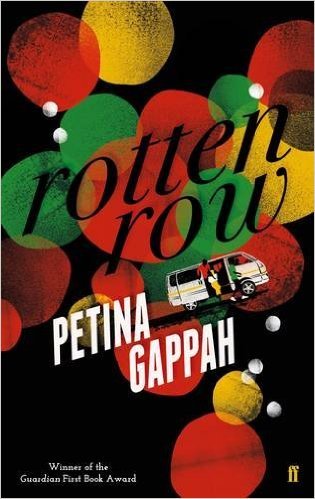
In her accomplished new story collection, Petina Gappah crosses the barriers of class, race, gender and sexual politics in Zimbabwe to explore the causes and effects of crime, and to meditate on the nature of justice. Rotten Row represents a leap in artistry and achievement from the award-winning author of An Elegy for Easterly and The Book of Memory. With compassion and humour, Petina Gappah paints portraits of lives aching for meaning to produce a moving and universal tableau.
Petina Gappah is a Zimbabwean writer with law degrees from Cambridge, Graz University, and the University of Zimbabwe. Her short fiction and essays have been published in eight countries. She lives with her son Kush in Geneva, where she works as counsel in an international organisation that provides legal aid on international trade law to developing countries.
I do not really know what to say about this book- it is not a bad book by a long stretch - but it definitely was not the book for me. I have been reading this book on and off for about two months now and never even felt compelled to add it to my currently reading shelf.
I have said before that I sometimes struggle with short story collections and with this one I definitely struggled. The whole experience was a bit overwhelming and I found myself always stopping after one story and not feeling like continuing. The stories all felt vey incomplete - and often like they were just working towards that final sentence, that punchline. But stories that rely on a punchline to have any impact do not work for me. I want my short stories to feel complete and for the characterisation to be on point - even in the limited time afforded by the medium. This means that I am maybe a lot more critical when it comes to short stories than I would be for full-length novels, so take my rating with a grain of salt.
I enjoyed reading about a place so unlike my own and I am really glad to have had the opportunity to read a book I would otherwise never have heard about. I am always eager to read outside my comfort zone and in this regard the book delivered. I could picture the Zimbabwe Petina Gappah describes perfectly and I think I would enjoy a novel written by her a lot more - her descriptions were interesting and wryly funny in places; in a setting where she could spend more time with her characters I might be able to empathise a lot more.
___ I received an arc of this book curtesy of NetGalley and Faber and Faber Ltd. in exchange for an honest review. Thanks for that!
Reading this book felt like walking into someone else's drugged up dream.
Rotten Row is apparently the street in Harare in which the criminal courts are situated, netherdowells abound. From this premise, Gappah brings the reader an incredibly diverse set of characters, from policeman to ghost, from hairdresser to hangman. Many of the stories are bizarre and frenetic, the meaning lost in my confusion. It felt like the author was shouting at me. Or perhaps that she hadn't considered me at all. Either way, I just didn't get it. Maybe that's on me more than the author, but I didn't enjoy the read at all.
Thanks to Petina Gappah, Faber & Faber, and Netgalley for the chance to read this review copy. All opinions are my own.
(3.5) I’d recommend these darkly comic stories set in Zimbabwe to fans of Chigozie Obioma’s The Fishermen. My three favorites were all from Part I, “Capital”: “The Dropper,” narrated by a hangman; “The News of Her Death,” about a hairdresser who doesn’t turn up not because she’s running late but because she’s the late Kindness; and, best of all, “The Death of Wonder,” which cleverly contrasts atheism and superstition in recounting the strange events that follow a wrongful death. I liked the scriptural epigraphs and the several stories in Part II (“Criminal”) that employ unusual formats: a court ruling, a web forum, and a postmortem report. In places the dialect use (here it’s “Shonglish,” from the Shona language) reminded me of Marlon James’s, and some of the lighter stories are comparable to the No. 1 Ladies’ Detective series. The approach is occasionally heavyhanded, and several of the samey stories, especially in the second part, could be culled to create a tighter book of more like 250 pages.
A collection of short stories that are not only only complete in themselves but have links and are interconnected throughout all the stories in the book, this book was interesting, rich and nuanced. Every story had it's own voice and style which kept me engaged.
It's always refreshing to have an authentic and layered approach to, in particular, Zimbabwean stories - where the tendency is usually to be shallow and one-sided. Gappah, achieves the perfect balance.
I've never read a book that captures Zimbabwean life and society in all it's complexity from race, religion, tribalism, and politics, as clearly as 'Rotten Row'. Reading this, Gappah's background as a lawyer is evident from the structured way she approaches storytelling - often mirroring a case report or submissions made by legal counsel. As a Zimbo coming from a legal background I enjoyed reading this book immensely. I would highly recommend this book for anyone who wants to know what Zimbabwe and the lived realities of its people look like.
I enjoyed this novel. In Rotten Row, Pettina Gappah writes a collection of short stories which are invariably snapshots into the lives of multiple Zimbabweans both within and out of the country. It is thrilling that most if not all the characters are linked in some way to another character. Gappah's writing is darkly comical and captures beautifully the nuances of African culture and humor.
It is not a book for everyone. Rotten Row is best enjoyed slowly by a reader who enjoys short stories and is willing to go on a ride into unfamiliar territory. As is typical of Gappah's books, there is generous use of indigenous language and I wished many times that I could understand to get even more out of her writing.
Still, a solid four star read, because as it is with short story collections, there were a couple of stories that honestly bored me to tears.
Rotten Row in Harare is unlike the wide, untarred road that runs through London’s Hyde Park. It is a busy thoroughfare in the Zimbabwean capital and home to the criminal courts where the characters in this collection go to willingly or not, to resolve their issues.
This would be grim were it not for Petina Gappa’s sense of humour and passion for her subject. We meet Kindness, a hairdresser who is late not because she should have been here an hour ago but because she is dead. Father Abraham, so named because every stray child that turns up at his door seems to be his, as well as Precious and Samson, Fortune and Zaka the Zulu. All are jostling to survive in Mugabe’s Zimbabwe, dealing with fate through spells and potions or getting drunk. We meet adulterers, ministers, VIPs, journalists, gamblers and schoolboys. These ill-fated characters have one story each, but are often related to the protagonists of another story so we end up seeing them from another angle, immersing ourselves in their lives and predicaments.
Rotten Row is one of the most engrossing and entertaining books I have read in a long time. I recommend it whole-heartedly.
An extremely well written book about the modern culture of Zimbabwe. Bitter-sweet cameos of real-life situations in Zimbabwe show the writer's intimate awareness of how ordinary Zimbabweans deal with their lot.
For the Zimbabwean reader it is a delight to read, for the outsider it is a powerful expose of modern African life across the continent. The frequent use of the Shona language is not in anyway distracting for the non-shona speaker - in fact it adds a well balanced nuance of meaning and curiosity - it hints at the wonderful sense of humor that belongs to her people. It personifies a nation that has had its fair share of political and social quirks, and has been able to see through them with a lightheartedness that borders on wisdom.
Petina is a master of her profession, her other books such as 'An elegy for Easterly', and 'The book of Memory' are African Jewels well worth reading. Zimbabweans can be rightfully proud of Petina Gappah
Petina Gappah's series of vignettes is a highly entertaining albeit heartbreaking portrayal of the lives of (fictional) everyday Zimbabweans. I loved how she uses a unique voice for each story and how previously seen characters kept popping up in new stories. There is a sad comic quality to this collection, which I found haunting.
I am personally not fond of short stories, but I must say there were some really good stories. Unfortunately, I also did not like a couple. I must commend her on the technique of tying the characters and the stories together. Some of the stories and characters fed into each other perfectly well but some connections were too loose. I believe that some of the stories have really strong plots and can easily become novels in their own right.
I began to read Petina Gappah's Rotten Row, which is set in Zimbabwe, as part of my Around the World in 80 Books challenge. I tend to adore short story collections, and whilst I admired the use of a single road in Harare as the geographical setting for each inclusion, this book simply did not work for me. I read the first three stories, all of which seemed quite exaggerated at times in terms of the cultural stereotypes which they portrayed. I did not connect with any of these tales, or feel anything for their characters, and so I gave up on it; quite disappointing, as Rotten Row sounded like a promising and enlightening read on the face of it.
This took me a long time to read and it's not the books fault. I just have a hard time reading short stories and feel like they either just pass me by without me paying any attention or wanting more out of a story. Some stories have stuck with me and I found Gappah's writing to be good. I enjoyed being in Harare for most of this book even though the topics changed a lot. Something flew over my head but I'm still really glad I read it.
As I didn't review this wonderful collection of stories when I first read it I am referring you to the following splendid review which says everything I would like to say but better then I ever could: https://www.theguardian.com/books/201...
Set in contemporary Zimbabwe, this critically-lauded book is a collection of inventive short stories whose main characters sometimes recur as extras in others, though without the drawstring of an overall plot. It's politically intelligent, it's vivacious, it paints an against-odds sunny and intriguing world, is never boring, and attains consistent near-success — even rising, in its best chapter, to complete reader-satisfaction. The stories are in the main tragedies of either minor or major significance within contemporary Indigenous society, all told with a sporadic irony which, perhaps subversive of author-intent, tends to minimise the traumas we're called upon to witness: Petina Gappah is a lawyer who may have shared some eccentric case anecdotes with her peers, donning the armour of humour against any pain or shame in identification, or at least such is the mood of her prose here. She seems to be balanced, with a kind of earnest unease, on the random but hard-earned good fortune of an expat fence, but this is what inspires her insight. Some of the protagonists are tradition-bound and superstitious, some are post-colonially religious, others merely opportunistic, but all live in some degree of poverty under the cold and stifling rule of Robert Mugabe, who like many an African dictator, once raised a rebellion to redeem for the people all the wealth and power of the colonisers in the name of freedom, and then, having won in blood, decided to keep it all for himself and never give it up. Rotten Row is the capital Harare's legal precinct, and serves as the thematic link between the various crimes, misdemeanours and misfortunes. Every chapter brings a new scenario and cast of characters, some well-rounded and others sketchy, so that when in later chapters you begin to meet references to the fate of players past, your memory of them may have become vague, if you can even remember their names. The book, while engaging, humorous and smart, didn't grip me enough for any rereading to clarify (possibly due to that absence of a longform plot), but when you do recognise a reprise appearance, you're often rewarded with some fun, often tabloidish comedy. There's a lot of untranslated dialogue in Shona, and while it doesn't mar momentum for the non-Shona reader, it may kind of detach you from engagement. The tone throughout is that of an adult looking upon children, of someone sitting both inside and outside their world, but as you progress, you start to realise that under the satirical affection lies an author's despair at the absence of hope in these lives, at the existential injustice that destiny has visited upon the Zimbabwean people. The very last story is the most touching, because in it a character encounters and faces, with the help of whimsical circumstance, a moral decision. Though this linked anthology is called a novel, I'd eagerly welcome something closer to the definition of one from Petina Gappa, in which she might apply to a more cohesive work the narrative principles of Rotten Row's quite beautiful final parable.
My husband bought this book for me for Christmas, along with An Elegy for Easterby by the same author, as he thought I would find them interesting. I am not normally a fan of short stories, as I like something to get my teeth into, but these are unusual in that many of the stories reference each other. My husband was right and I found these tales of the nature of the relationship between crime and justice in modern Zimbabwe fascinating. In turns dark, sad, touching, humourous, tragic and thought provoking, the characters stay with you. I am really looking forward to reading An Elegy for Easterby.
The White Orphan was my favorite story. I was left wondering what happened to this child who runs away from his adopted home to seek another more abundant world. Washington’s Wife Decides Enough is Enough was also a thrill, and rib-tickling. Truly delightful. There are really good stories in here. The kind that warm the heart. Though some seem rushed, as if hastily written to fill up the book. There intentions seem unclear.
I cannot recommend these short stories highly enough. Some of them are linked and it's interesting how they build on each other in some cases, or it's just a passing reference in another.
Gappah is a master at satire, her writing is like no other I've experienced. Rotten Row is a collection of short stories that centre on crime and justice. Overall though, this collection of short stories is a portrait of Zimbabwe in all of its complexities, beauty and flaws. I truly love how this writer is able to articulate life in Zimbabwe through the characters that she builds and the dialogue. The stories themselves also very powerful and weighty, showcasing various parts of life in Zimbabwe. She has this almost journalist way of writing though which seems almost objective in how she treats her subject. The stories also include a conversation on a blog post and a short story in the form of an autopsy report. Often when I read short story collections, I jump at stories randomly, but for this one you have to read them in sequential order as some characters make appearances in other stories and interact with characters from different stories. Do dive into this book if you love stories about contemporary Africa/Zimbabwe and are also big on satire. Gappah delivers like a master!
Rotten Row is a collection of short stories by Zimbabwean author Petina Gappah. All the stories have some link to Rotten Row in Harare, some more tenuous than others. But what the stories do all have in common is the theme of justice or injustice. I also loved the way that many of the stories are subtly entwined with others, with names cropping up that you recall from a previous tale.
Most of my favourites were those that looked at Chivanhu (what Nigerians would call juju) particularly, The Death of Wonder, and A Small House in Borrowdale Brook. I also liked The President Always Dies in January for a look at a Zimbabwean refugee in the UK and his internet trolling activities. Washington's wife decides enough is enough also made me laugh... family politics at their best.
These dark little stories, often comic, are set around Rotten Row, Zimbabwe's Criminal Division, and centre on the people who work there, and those who for good reasons and bad pass through. There was much to enjoy. Clever characterisations, clever changes of voice ('From a Town Called Enkeldoorn' is entirely written as comments on a web forum, for instance), and above all, the introduction to each story with a quote from the Bible, written in Shona (I love 'Buku yaMuprofita Jeremia' - that's 'The Book of Jeremiah' to you) make these stories, often of an underclass, to be page turners. In the end though, some of these tales got a bit samey-samey and I didn't finish the book. I would if I had my own copy, by picking the stories up again from time to time. But it's from the library, and they want it back.
Short story collection that paints an engrossing, historicized, darkly humorous and thoughtful portrait of intertwined community in Harare. Some stories stuck out to me more than others - the one on government aid workers (this one in particular had me laughing!! maybe one of the best short stories I've read in my life), on a young daughter's relationship to her mother's romantic life, on the alleged thief and community's response - but others were less moving and memorable, so a real range. Appreciated the writing range required to depict so many different characters across age, ethnicity, race, gender and political ideology, in order to bring a story about the district Rotten Row to life, especially the significance it has to national political and social history.
I usually avoid books set in Zimbabwe or South Africa. I find them quite triggering.
This has sat on my to read list for over 6 years and I finally bought and read it.
Eish!! I been blown away by it.
It was like having parts of your childhood transcribed and described. The places, the names, the sights, sounds and smells. I was transported back.
It was incredibly funny and hideously sad. It does not shy away from the dark side of life in Zimbabwe, and the poverty, corruption, cruelty and craziness. But there is also lots of tenderness, gentle humour and truth.
It’s also really good to read stories about Zimbabwe, not written from a white perspective. I wish books like this had been part of our school curriculum as they would have expanded our world view considerably.
I bought this book by an author unknown to me after meeting a large, lively family from Zimbabwe in the UK. Rotten Row is not easy reading; some of the stories are liberally interlaced with both English and Shona (or other languages spoken in Zimbabwe.) That was disconcerting and sometimes annoying. These short stories are interlaced - there are references occasionally to characters or events in earlier stories. A lot about the mixture of Christianity with other spiritual beliefs. A lot about violence, family hardship, some joy (not a whole lot), frustration of daily life. But engaging and well written.
A great, fresh find! For someone not closely familiar with the culture of Zimbabwe and its local languages, following the stories may seem difficult at first, but this trouble is soon forgotten. The themes of crime and justice are universal, as are the humane characters Gappah describes: they love, they cheat, they laugh and they mourn. Although the topic is rough and the inequality and corruption present in the stories at points extremely frustrating, this book made me laugh more than any other in awhile! Recommended to anyone looking for a new perspective and at the same time a world that is very much familiar.
Petina is a great writer but this book just didn’t do it for me. I generally like short stories, but a lot of them left me asking “so what?” at the end. I didn’t feel compelled to go on and it uncharacteristically took me 3 months to complete. I never take more than a week for similarly styled novels. What I did love is the nostalgia this book aroused, especially if you grew up in Harare. The description of Mabelreign, the kombis, the mob mentality, landlords, policemen. Loved every bit of that.
This entire review has been hidden because of spoilers.
Short stories set in Zimbabwe round a rotating cast of characters - with a mixture of legal and social themes. I enjoyed the linkages between the characters in the stories, and description of city that I dimly remember from a visit in the early 90's. There are lots of asides (in Shona I suppose) that went over my head, and not knowing what a "small house" was left me a bit mystified till I looked it up, so I found it a bit difficult to get into the book at first, but it was worth preserving with.
Rotten Row is a collection of short stories written by Petina Gappah.
I enjoyed reading stories set against a legal background, that encompass religion, politics, the class divide and so much more. Her writing contains elements of dark humor, which I personally enjoy.
As always with short stories, some are an absolute hit, and others are a miss. I had picked up a sort of legal theme running through some of the stories which I understood as the author is a lawyer, but some of the short stories felt so out of place and I would wonder why it’s part of the book, but it’s still a decent body of work that gives insight into the fortunates or rather misfortunes of ordinary people in Zimbabwe.