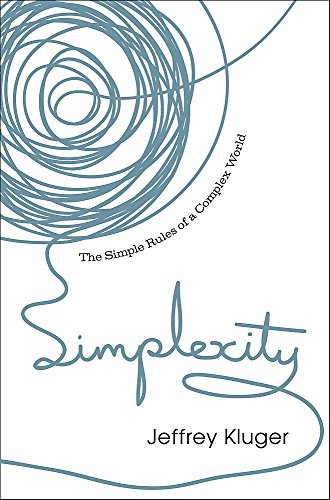
Why does kicking the TV work? What can the US military learn from the lowly bacterium? Why are the instruction manuals for cell phones incomprehensible? How does a spark of a single virus trigger an epidemic that claims millions?
In recent years, cutting-edge studies in fields such as economics, genetics, stock-market analysis and child development have hit on a startling new theory - 'simplexity'. To put it simply, simple things can be more complicated than they seem, and complex things more simple. The evidence is before our in your elaborate network of household plumbing actually run on a very basic mechanism, or the crystal paperweight on your desk, spectacular in its complexity.
As simplexity moves from the research lab into popular consciousness it will challenge our models for modern living. You'll never unknowingly whack the TV again and you'll understand just how much it means to smile at your child. Popular science journalist Jeffrey Kluger adeptly translates cutting-edge theory into a high-octane history of everything, which will have you rethinking the rules of business and pleasure. From the micro to the macro, Simplexity is a startling reassessment of the building blocks of life and how they affect us all.
Jeffrey Kluger is Editor at Large at Time, where he has written more than 45 cover stories. Coauthor of Lost Moon: The Perilous Voyage of Apollo 13, which was the basis for the movie Apollo 13, he is also the author of 13 other books including his latest book Gemini: Stepping Stone to the Moon, the Untold Story.
God knows why I even thought I would like this book. I probably picked it up for Marc, actually. I got about 30 pages into it and realized that I did not give a rat's ass about anything I had read so far.....ugh. So I put it down and moved on.
This book gets 4 stars because it is entertaining, informative, and brief enough to not be laborious. If you like books that deal with a conceptual idea and then provides many examples so that you can have stuff to talk about afterwards, this should fit the bill. Is it the best in the genre, no. But is it not bad, and fairly interesting. Yes.
It did not get 5 stars, because it is not the sort of book that all lovers of this genre will enjoy, namely because of the book's structure and the wording of the subtitle. First, there is some validity to the reviewer that suggests the chapters are a bit disjointed. However, I didn't mind this. I felt the different questions which formed the title/thesis and "disjointedness" allowed the book not to be overly repetitive, a failing of many of the books in this genre of leisure non-fiction. That said, a friend of mine who read the book also remarked that the book felt too all over the map and so, I can not give the book 5 stars.
The second minor issue, as pointed out by another reviewer, is that the author does not fulfill all the claims of the title. The author does not explain "How complex things can be made simple", at least, not in any direct manner. There are hints that his point is that the human mind somehow reduces complex action into something simple, but that most are unaware that they are doing something rather complex. However, those that think this book is about HOW to make something complex simple, would be better off in Business, "How to", Speech and debate sections.
4 stars is a solid rating though, as it does fulfill the title and the first half of the subtitle, which is no small task. The book introduces the concept of simplexity in a number of different formats. It is quite fascinating to think about how the brain processes and learns. It's fascinating to see that monetary value and actual skills value do not quite mesh. Kluger introduces a number of interesting studies that are rather pertinent despite being in a variety of different disciplines. It definitely made me consider what exactly is the going on with the man v. machine debate.
If you are working directly in the man vs. machine debate as your job or academic discipline, that this book may be good for you to read so that you will have an even better ability to articulate these complex concepts to the average dude. It will most likely not tell you anything you don't know. If you are not in this discipline, than you could find this as interesting as other books within this genre of non-fiction.
In the late 80s, James Gleick wrote Chaos: Making A New Science, an entertaining book that described the rise of the study of chaos. The book also helped popularize fractals. I recall going to an early 90s Lollapalooza where a fellow attendee pointed to a fractal t-shirt and said "woah, chaos theory." In Simplexity, Time science writer Jeffrey Kluger aims to repeat Gleick's success and detail the rise of a new line of inquiry that explores the inter-relationship between simplicity and complexity. While the book tells a number of entertaining and enlightening stories it does not weave these into a strong, compelling thesis. Do not expect the kids at Bonnaroo to get their heads blown by Simplexity.
The principal idea of the book is that defining something as simple or complex is not easy. He gives the example of the pencil, which appears to be terribly simple, but in fact is a complex assemblage of materials from around the world. Much more interesting is his study of how this is manifested in real-world situations. He asks about the complexity of jobs including truck drivers who have to gauge the reactions and behaviors of other people, the status of his machinery, the effects of weather and many other exogenous factors. The highly paid Wall Street analyst running a series of financial models may seem less complex by comparison.
The book is best seen as a collection of a science author's short pieces. The individual chapters are interesting, but they do not build to an conclusion. There is never a clear use of the idea of just what complexity and simplicity are. We just know that when you look at a problem or a system at one level it is simple and at another level it is complex. It is hard to know what to do with this information. Those interested in learning more should turn to the Santa Fe Institute, where as Kluger explains, much of the research in this field is being done.
Interesting concept, lackluster execution. You're probably better off reading Fooled by Randomness and Freakonomics if this sounds interesting. (And if it does, you probably already have.) The theme is poorly articulated and the author jumps from topic to topic, without making the connections clear. There are numerous typos that should have been caught by the spell-checker.
This book takes a really good idea, describes it and analyzes it, then applies it to a too-wide range of topics. In some it isn't mentioned at all. In this way, a book which could be comparable to Gleick's Chaos or The Black Swan ends up going astray.
The really good idea is graphing complexity as an arc, with low complexity for highly ordered and completely chaotic systems, and high complexity in between. This idea comes from the Santa Fe Institute, and turns out to be really interesting when compared to the stock market, fluid turbulence and traffic flow. Other chapters occasionally hint at the complexity arc, but instead focus on topics covered in other books, or at least topics which have more to do with math than complexity.
Did the author (a science writer for Time and before that Discover magazine and Science Digest) recycle some of his older topics? It would seem so to me. That wouldn't be bad, if he didn't try to shoehorn "complexity" in where it didn't really fit. I'll likely check out one of his more focused works, such as Jonas Salk or Apollo 13, because he seems a decent enough writer.
While I liked the two chapters dealing directly with complexity, the rest of the work was just "okay".
Composed of 11 chapters each chapter tackled the complexity of a specific situation. For example, chapter 8 was called, "Why is a baby the best linguist in any room?" and considered the complexities involved in learning language. Overall the book wasn't very cohesive with each chapter standing almost alone.
So it turns out that lots of stuff in the world is simple, but also complex. Stock market - simple but complex. Personal biases - simple but complex. Sports - simple but complex. Technology - simple but complex. You get the idea. Now, I don't mean to sound condescending but Kluger's book is little more than a collection of essays with neat little tidbits here and there. There's an attempt to string the essays together using the idea of simplexity but it's a stretch and ends up reading like "Freakanomics for Dummies". It's not a bad book and I'll probably pull it out every now and then to reread some of the interesting nuggets, but it is a book that doesn't know what it wants to be.
This book is a collection of essays, a format similar to Freakanomics and Fooled by Randomness with a premise somewhat similar to Chaos: Making a New Science. In many ways, it feels like something by Nassim Nicholas Taleb. It's smarter than than Malcom Gladwell--but not as cohesive as something by Nassim Nicholas Taleb. The pieces do not yield a cathartic whole--unless that's the point!
Some interesting aspects about this exploration of "simple things being more complex then they seem"...What are the patterns that underlie musical chords and melodies? and Why are football and baseball so much more complicated than hockey and basketball?
Not quite from the book--but where I first came across the term for a more sociological application.
"We long for simplicity and satisfaction, but in the end usually settle for discount coupons. Simplexity therefore stands for a balance between the growing complexity of daily life and our own personal satisfaction. In order to attain this state, we have to stop always striving to make optimal decisions. In the future, it will be more important to make judgments that are just good enough."
Funny to read in 2025, a bit of hommage to Santa Fe Institute. Too bad the term plectics never took off, because complexity can't be understood without simplicity - and, as in Jansky's anecdote in epilogue, noise is a signal.
Interesting premise, however Kluger does a horrendous job of defining complexity theory (or simplicity for that matter) which translates into the reader not connecting the concept w the supporting data
His hard-on for the Sante Fe Institute is apparent & their self-adulation even moreso; Indicative of an inferior plan, Simplexity uses identical data points as Influencers but w inferior explanation & relevance
Interesting Thoughts Spread of UK disease linked to one well
Amazon vs individual bookseller in noting preferences & recommendations
Not Particularly Pleased - the comment by Secretary of the Treasury James Baker III that caused the 1987 economic collapse (in reference to German interest rates) - in six and a half hours, $500B in American wealth was gone
If everyone is chasing the same dollar in the same way, it takes only a few players to cash out before all of the other shares start to lose value – bubble-popping
The market starts stable and then collapses into instability
There is no correlation between news-making events and daily stock performance
People will reject a 20% split share because it means the other person is getting 80% - average accepted bid is 43%
In the 911 Towers, staff were told to stay in the second building (which was the right thing to do, considering the falling debris)
Escape routes have to be reconfigured as it does not reflect the recent growth in obesity
By adding noise to the system, you add coherence to the flow
Plane evacuation studies, where people are paid for their time, is a better representation of the hysteria in a real situation
In eliminating roads, congestion is increased in the short-term but is ultimately reduced in the long-term as people find alternative channels
Pedestrian death rate at 35 miles per hour and greater is 80% - need the gradual grading so that emergency vehicles can continue at fast speeds
Girls with an older, pregnant teenage sister are four to six times greater to get pregnant themselves
In 1888, Benjamin Harrison won the electoral vote (233 to 168) but lost the popular vote
Colonel Blotto - war simulations by military colleges
Best measure for judging the true complexity of a job is how easily it can be replaced by a machine
There is an upside-down complexity arc between blue-collar to white-collar
Innovation Fulcrum - when you get to the point of maintaining such a growing selection of products, that it erodes the profits you make from selling them
Tiffany example where low price points drew in customers that soiled the experience for the high-end shoppers (who were far more profitable)
Gap created a fatal mistake by entering lines and brands that customers did not associate with the Gap
The business death process is that of humans - youth, aging, death
Zipf’s Law - most popular word in a passage will be double that of the next popular word and so on - works for city populations as well
The more exposure we have to a game, the more we understand it; the more we understand it, the more complex we think it is (ego)
Baseball and football have so many non-playing attributes that take it long and perceptually complex
Baseball is four basic skills - throwing, hitting, fielding and running
We get upset over the not likely to happen mad cow disease but not the more rampant heart disease that is created by eating beef
Probability Neglect - over-estimating the things we dread and under-estimate the more obvious (function of numbers, comfort and action)
Optimism Bias - convenient belief that risks that apply to others do not apply to ourselves
People of different languages are not talking faster; your untrained ear cannot follow so it is distorted
The quicker a child becomes adept at their mother tongue, the quicker their ability to pick up additional languages withers
Moore’s Law - computing power will double every eighteen months
Bar of Soap - an electronic device that changes functionality depending on how you are holding it
Aim wide and your efforts/money are wasted; aim well and the problem can be solved
For every dollar spend worldwide to battle disease, ninety percent go to ills that threaten only 10% of the population (US controls the $ and they invest in their diseases)
Bill Gates is investing in foundations that have reach (strict management of the budgets as well)
Early on, author Jeffrey Kluger notes the difficulty of pinning down what we mean by simplicity and complexity (Page 15): “Trying to distill all of this down to a working definition of just what simplicity is and just what complexity is has always been difficult.” One approach—pure chaos and pure robustness at ends of a continuum. As one observer notes (Page 29): “It’s the region between order and disorder that gives you complexity, not the order and disorder at the ends.” That said, we still don’t have a clear idea of the nature of the concept. The word that is the title of this book, simplexity. Simple things can quickly become complex and complex things can simplify. This book attempts to explore this.
Examples used: Groups of people tend to make better decisions than single individuals (e.g., guessing the number of jelly beans or investing clubs’ ability to get a good return); traffic engineers trying to reduce traffic jams and major slowdowns by rather simple adjustments in traffic flow. A political example? Failed states and totalitarian states are very easy to model; they are pretty predictable. Multiparty states or Western democracies, on the other hand, are more complex. This facilitates openness in communication.
There are many intriguing and thought-provoking examples. But the final chapter does not pull things together; one ends with a sense of pastiche. In addition, there really aren’t any principles presented to show how to handle complexity, how to gain leverage with respect to simplexity. So, thought-provoking but also a bit maddening.
Take a pencil. On one scale it is a very simple thing. The youngest of children can use it and by function it can easily be replaced by a pen, paint, chalk or even charcoal from the grill. And yet, on another scale the pencil is a piece of incredible complexity. Bits of it - rubber, wood, bauxite (and it's final product aluminum), coal (and its final product graphite) -- come from all around the world, and are assembled in a huge factory, which in turn has it's own complex underlying structure.
It is this point of view, this announcement of scale, and in turn mindset, that is a large part of the message of "Simplexity". In very accessible terms Kluger examines simplicity and complexity and how they interrelate in the real world. He exposes just how flexible these terms can be. For example, in one sense, complexity lies not at the endpoints of the arc between order and disorder, but in between.
Each chapter is autonomous which makes the book great for people who don't have a lot of contiguous reading time.
Quick Summary ::: An interesting, thought provoking book. I think of it more as a group of related essays rather a coherent narrative. Taken as a whole it becomes mildly tedious and perhaps it is better read over time. But it is a book well worth reading for as Kluger examines scale and mindset, he ends up saying a great deal about human nature and intelligence.
Here's a quote from the book's introduction: “The human brain is a real-time machine… [that assembles] information quickly into impressions and actions. That kind of cognition may have been the only way for the species to survive in the wild, but it can mislead us now, causing us to overfocus on the most conspicuous features of a thing and be struck -- or confused -- by that quality. Thus, we are confused by beauty, by speed, by big numbers, by small numbers, by our own fear, by wealth, by eloquence, by size, by success, by death, by the unfathomability of life itself. There is a taxonomy of things that fool us every day and, in so doing, help the complex masquerade as the simple, and the simple parade itself as complex”.
This book is a journalist's anecdote-rich ramble through many facets of complexity theory, drawing on the work of many different scientists and writers, with a heavy debt to the Santa Fe Institute which specializes in this field. All of which makes it very difficult to summarize the books themes, other than through a few examples of the types of questions it tries to answer: Why do we fear the wrong things? Why is it so hard to leave a burning building? What are the patterns that underlie musical chords and melodies? Why is it so hard to sell a money-losing stock holding? Why are football and baseball so much more complicated than hockey and basketball?
Chaos and complexity are my 2 favorite science ideas, and I have read a lot of books on these topics, so I was expecting to enjoy this book a lot more than I did. There was just too much in this book, at too shallow a level, to be engaging. Kluger introduces concepts and subjects every few paragraphs, never developing most of them, and not laying out the connections between them, at least not well enough that other people could follow the logic that made sense to him when he strung those topics together. I could see that for Klugman there was indeed a careful architecture to his book, but I suspect that a lot of this organization relies on biases, background and other contextual information that the reader cannot be expected to have.
A few diagrams and a system of subheadings, introductory and concluding paragraphs, and some sort of clearly laid out road map for each chapter might have helped, but focusing on fewer subjects and covering them more thoroughly would also have made a huge improvement. After all, the point of this book was, I am guessing, the shapes and dynamics of systems and problems, rather than sports, music, infectious diseases, or any of the other subjects Klugman introduced. Focusing more on these underlying similarities of shape and dynamics and less on distracting the reader with yet another new subject would bring the underlying structures more into focus.
Simplexity by Time magazine senior writer Jeffrey Kluger tries to explain eleven chapters the complexities of the world and how they can be understood in simple terms. Most of the chapters deal with human systems: the stock market, evacuations during emergencies, social structures, business, sports, technology and the arts.
Kluger's book is a potpourri of topics with enough information to lead to further reading if one is interested. He thankfully keeps himself out of the picture making the book about the topic and thankfully not about his struggle to write the book. Having a book focus on the topic and hand was refreshing after the disappointing Geography of Bliss.
Although my over all impression of the book is positive, I found some of the chapters mind numbingly dull. The opening chapter on the stock market had me preparing to write a negative review. The ending chapter on complexity science in the arts also left me yawning. My favorite chapters came in the last half of the book: the one on linguistics and language acquisition was by far the most interesting one. Another fascinating chapter is the one on the business of technology and how it drives the complexity of product designs.
Simplexity was one of those books that I read cover-to-cover with the least number of stops possible. The subject matter is intriguing; the prose, captivating. I found the book hard to put down, much to the detriment of my sleep schedule. (It kept me up all night until past 05:00 one day.)
The only real complaint I have is that I was left wanting more. Many good examples were provided in the book, but not enough to sate my curiosity. I could have read a book five times the length on the subject. But I did glean a few more related books for my to-read shelf from this text, so maybe those will help when I get to them.
As a purely pedantic comment, the frequency of editing errors climbed toward the end. Some mistakes were simple typos that were overlooked; but I winced at the use of "principle" instead of "principal", and at the misspelling "siezed" (one of the English language's notorious exceptions to the "I before E" rule).
But don't take this review the wrong way: It's very likely that you will find this book to be thoroughly engrossing, even if you're a pedant like me.
I thought it was mostly fascinating...just enough science to make me feel smart to be able to understand everything he was telling us about. The stories about what Bill and Melinda Gates and ex-presidents Carter and Clinton, as well as others have been able to accomplish throughout the world are stunning. It amazes me how so much good can come from a little: such as the Nobel Peace Prize winner, Muhammad Yunus using $27. in Bangladesh to create the micro-loan system with loans to entrepreneurs of as little as $20.00. This has spread since 1974 to about 100 countries with more than 3200 microcredit institutes serving over 92 million people.
Some of Mr. Kluger's sweeping statements don't jibe with reality, but he is trying to make a point about complexity science. His reasoning as to why political parties won or lost particular elections is too simple for such a complex issue.
Overall, I enjoyed the breezy style. It comes across as a collection of articles he might have written for Time, his regular employer. Also it seems a PR piece for the Santa Fe Institute, his source for much of the book. It needs an index.
This book is a collection of 11 essays, related only by the overall theme of how simplicity and complexity interact. A few sections were a little dry for me, but others were fascinating and the changing topics made the book very readable. Some examples of the topics: Why is it hard to leave a burning building (as in World Trade Center)? Why do different animals have different life spans? In what way is skill level related (or unrelated) to pay level in the workforce? How are we dealing with electronics that become progressively more complex to operate?
The most fascinating chapter for me was one about why very young children can learn languages so much better than older people. I was astonished at the information provided and Kluger's theory to explain the difference.
This book may fit the genre of pop sociology or psychology, but it was well researched and written, and gave me some interesting insights.
I am adding again that this was NOT the book I read. I read "Simplexity" Why simple things become complex and how complex things can be made simple by Jeffrey Kluger. This is ironic because the system here generated this other book with the same title and would not let me edit it. This goes to show how some simple things can become complex and how just trying to simplify it can make the whole thing more complex. The book I AM referring to was OK. It showcased various subjects and ideas but it did not offer any solutions which I was hoping for, perhaps there aren't any. It did bring up some interesting points about fractals and the social metabolic rate which I may write about but the writing itself lacked color. All and all it was OK as I mentioned but I doubt I will read anything by the same author aagin but again, I am just making this all more complex which I have a habit of doing, hence why I read the book in the first place.
I found this book interesting but did not really feel that it answered the question in its subtitle. THe author gave some very good and interesting examples of complex systems that seem simple but did not really explain WHY they are that way. There was alot of discussion about the complexity curve at in the earlier chapters in the book but I did not feel that the model applied to the example. THe bottom line is that may things are more complicated than they may first appear and sometime things that might seem complicated are quite simple. As a person who is constantly making financial models and forecasts this was a good reminder that the same circumstance can be both simply explained while at the same time be extraordinarily complex. My favorite chapter was probably the one that discussed how our brains hard wire themselves to learn language.
I thought this book was very interesting, but the subtitle is misleading. Klugar does a good job describing where things fall on the simple to complex arc, but he never really explains how simple things become complex or vice versa. He explains why he's placed things where he has on the simplicity/complexity arc but he never goes any deeper than that. There's no real explanation of why a given thing has evolved to be simple or complex.
Still, it was an interesting read. It reminded me a little of Freakonomics, although I think that book did a much better job of explaining why of things.
Simplexity by Jeffery Kluger is denser than some of the more popular non-fiction books that have generated a lot of talk, like The Tipping Point and Freakonomics, but it is just as fascinating. Simplexity deals with the idea that what at first may seem enormous and complicated can actually be quite simple and the simple things can contain amazing complexity. For instance, a star seems large and hard to understand, but it's really quite a simple object whereas a guppy is layer upon layer of complex systems working together. From the stock market to a pencil, Simplexity makes you look at the world in a new way.
If you're a fan of Malcolm Gladwell's "Tipping Point," you'll enjoy Jeffrey Kluger's take on complexity and simplicity or as he calls it Simplexity. Like many other books focusing on popular topics such as connectivity, complexity, and chaos, Kluger uses examples and anecdotes to explain his thoughts on today's world. The book is well-written and easy to read. however it lacks concrete statements about his theories and scientific evidence to support his thoughts. I'd recommend Simplexity for those who enjoy light, pop business reading. If you're looking for something more thought provoking, read the works of Malcolm Gladwell.
Again, I can't remember when, exactly, I read this book. (Though it was for work/book club). Off the top of my head, I don't remember much detail. One of the guiding quotes in the book: page 29:
'It's the region between order and disorder that gives you complexity,' says Gell-Mann,'not the order and disorder at the ends.'
Part of the thesis is that so much interaction happens that it's actually quite difficult to analyze all that's going on. But that interaction is happening and some kind of 'balanced state' is being achieved (this is my poor paraphrasing). Anyway, a lot of interesting details, but maybe only enjoyable if you like reading almanacs.
A bit of a disappointment. The topic sounds absolutely fascinating but the execution was a little thin. It reminds me of newspaper stories where they assigned a general feature reporter to write something on a specific topic, and the writer did a quick search and just wrote the highlights without really digging in.
It feels like a paper I might have written if my research consisted only of reading the abstracts of papers instead of the actual papers.
It wasn't completely without merit though. Some of the concepts were so familiar from other stuff I've read that I didn't bother to note them. Others I did (I wrote three notebook pages of notes).
I enjoyed reading this book. The book introduced me to several new concepts, including two billion heart beats. I did the math, and "yes" cardiovascular exercise is worth the effort.
The 9/11 effect was another interesting concept, illustrating our inability as humans to differentiate between real risks and perceived risks.
The book is broken into very distinct chapters. If for some reason a particular chapter isn't doing it for you... skip it, and read the next chapter.
You're bound to find some interesting, useful information, delivered in an easy to read, well researched manner.
Ideally suited for challenging the "common sense" and flawed learning we inherit from family and educational systems, which in turn aides in the determination and prediction of outcomes based on the simple, and sometimes obvious, simple things, rather than just the complex. Occam's Razor type thinkings.
Interesting read about the simplicity and complexity of natural processes. Kluger uses examples from a wide variety of disciplines, from Sports, Music, Medicine, etc. He demonstrates how very complex problems can be solved with very simple solutions.