Fiercely funny and entirely original, this debut collection of stories takes readers from the United States to Israel—and back—to examine the mystifying reaches of our own minds and hearts.
The characters of The Worlds We Think We Know are swept up by forces beyond their control: war, adulthood, family—and their own emotions, as powerful as the sandstorm that gusts through these stories. In Ohio, a college student cruelly enlists the help of the boy who loves her to attract the attention of her own crush. In Israel, a young American woman visits an uncommunicative Holocaust survivor and falls in love with a soldier. And from an unnamed Eastern European country, a woman haunts the husband who left her behind for a new life in New York City.
The Worlds We Think We Know is a dazzling debut—clear-eyed, hilarious, and heartbreaking.
Dalia Rosenfeld is a graduate of the Iowa Writers’ Workshop. Her work has appeared in publications including the Atlantic, AGNI, Michigan Quarterly Review, Mississippi Review, and Colorado Review. She teaches creative writing at Bar Ilan University and lives with her three children in Tel Aviv.
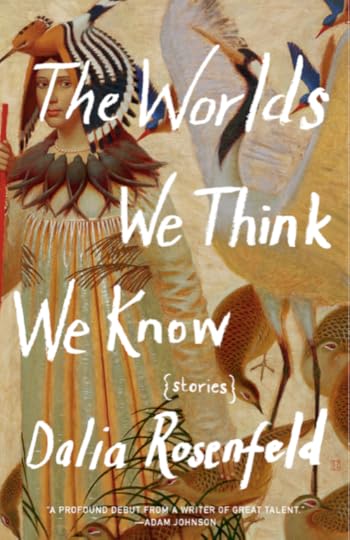
First thing first, I have to mention that the cover for this short story collection is utterly mind-blowing with its detailed beauty. There's just so much to let sink in and the color scheme only adds to it. I mean:
This debut collection of stories takes readers from the United States to Israel—and back—to examine the mystifying reaches of our own minds and hearts.
The characters of The Worlds We Think We Know are swept up by forces beyond their control: war, adulthood, family—and their own emotions, as powerful as the sandstorm that gusts through these stories. In Ohio, a college student cruelly enlists the help of the boy who loves her to attract the attention of her own crush. In Israel, a young American woman visits an uncommunicative Holocaust survivor and falls in love with a soldier. And from an unnamed Eastern European country, a woman haunts the husband who left her behind for a new life in New York City.
It never fails to feel refreshing to read twenty short stories set around Jewish main characters living either in Israel or the United States. (Though, I personally found the Israeli chapters to be a bit more enjoyable because of the Hebrew references.) Plus, coming into this right after having finished Suddenly, a Knock on the Door by Etgar Keret put me in the perfect mindset. The quiet and subtle energy surrounding Dalia Rosenfeld's tales pulled me into the collection a tenfold.
Though some tales were a bit confusing to wrap my head around, I still really enjoyed immersing myself in this exploration of immigrants, Holocaust survivors, Yiddish literature (Mendele Mocher Sforim, Shalom Aleichem, Isaac Bashevis Singer), and that feeling of getting caught up in your favorite book while ignoring your surroundings for days to come. Speaking of the latter, here's a paragraph that gets me on a whole new level:
“Those seven days were like a shivah for me that I marked not by sitting on a low stool and covering the mirrors, but by ordering takeout and letting dust accumulate in every corner of the house. If the cast of characters had been able to stand up and take a bow at the end of the book, the week would have been much easier for all of us to get through—not just for me, but for everyone in my family, who knew to stay away from me whenever I had the book in my hand. It was the double dying that made it so hard, the fiction interchangeable with the fact.”
There is undeniably a quiet beauty to this book. Full of moving stories circling the ordinary and extraordinary, The Worlds We Think We Know is a keeper from the start.
Plus, I'm incredible thankful that this collection made me discover and add a ton of new authors to my to-read list, thanks to the many mentions of classic Yiddish literature.
ARC kindly provided by the publisher in exchange for an honest review.
Publication Date: May 16th, 2017
4/5 stars
Note: I'm an Amazon Affiliate. If you're interested in buyingThe Worlds We Think We Know, just click on the image below to go through my link. I'll make a small commission!
Support creators you love. Buy a Coffee for nat (bookspoils) with Ko-fi.com/bookspoils
Happy release day to The Worlds We Think We Know by Dalia Rosenfeld! I recently read this beautiful collection of short stories, and ended up really enjoying it! The Worlds We Think We Know is a glimpse into the lives of people who are full of joy and full of sadness. It is a journey from Israel to America, and a tale of war and love, religion and peace. In this collection of short stories, we meet people who are completely different from one another, living thousands of miles apart, yet still the stories fall perfectly into each other, creating a beautiful whole. As I mentioned above, I ended up really enjoying this collection! It was full of the unexpected, and beautifully written as well! Rosenfeld was able to capture an entire life in a few sentences, or a whole personality in a single scene. It was both funny and heartbreaking, and it challenged the conventional, in bringing attention and meaning to the strangest objects or situations, showing us what longed to be discovered in a world we thought we knew. Rosenfeld's voice is truly unique, and she tells her tales with great confidence! Most of the stories were quite slow reads, but I didn't mind that much, as I truly enjoyed the depth and attention to detail in each story. The only thing I struggled a bit with was the Israelic/Jewish expressions and terms throughout the book. I really enjoyed learning more about Jewish culture, and loved how authentically everything was written, but as I didn't know much about this subject before picking up this book, I missed a few points here and there. Overall though, I genuinely enjoyed this wonderful debut! I'm excited to pick up more of her work in the future.
4/5 stars! 🌟
I requested this book for review from Milkweed Editions and they very kindly sent me a copy to read.
This is one of those reviews where I waffle over the star rating because there's definitely books (the 4.5s) that I like more than this one. I'm giving it a low 4.
A lot of Rosenfeld's stories feel like snippets of something, without enough meat on the bones to actually be considered fully cooked. I'm ok with stories that don't have a definitive sense of an ending, so long as there's something to hold onto. I'll particularly harp on the stories with the character Igor as just going in one ear and out the other.
My favorite stream of consciousness story is "Bargabourg Remembers," where a New York professor tries to capture the swift remembrances of his being robbed. His thoughts meld into unresolved issues with a recent ex. On the opposite end, "Thinking in the Third Person" felt like a thinly sketched writing exercise.
"A Foggy Day" left me grasping at straws. Moved too quickly from piano instructors to Holocaust neighbors, couldn't get a sense of the character's drives. Same with "The Other Air," where the narrator's sighing condition feels more real than any of the other characters introduced. Perhaps that's the point, but it was underwhelming.
Otherwise, my favorite stories are "Flight," where a girl asks a friend to teach her a complicated piano piece to impress another guy, "Amnon," where a woman feels trapped between her Israeli boyfriend and desire to return to America, "Daughters of Respectable Houses," where a shut-in fosters a surprising relationship with her husband's female colleague over books, "Vignette of the North," where a vegetable seller engages in a tense relationship with a neurotic painter, "Floating on Water," where a woman secretly competes with a girlfriend about relationships with men, and "Naftali," where a woman personifies her relationship to Jerusalem with the titular character.
Speaking of titles, I remembered reading the titular story when freelance editing for Moment magazine, where it was first published! I feel like I remember the relationship between the protagonist and the soldier feeling more fleshed out, then, but maybe that was due to multiple readings during a short amount of time.
I also seem to remember one paragraph in the story "Invasions," where the protagonist fantasizes about the European Jewish ghettos of old, despite her mother sending her Yiddish novels of hardship, lol. It was published in a "Fiction" volume..should scour my shelves to see if I have it! Ooo, exciting to actually remember snippets from short fiction! :D
Lots of themes repeat in Rosenfeld's stories, beyond Jews who live either in Jerusalem or Ohio. Enough stories feature classical piano playing and allusions to Yiddish authors to make me think that she has a special proficiency for these topics. Guess it works in this case to write what you know! But overall, I'm disappointed that I didn't connect more to her writing style. I think I'm drawn to something more grounded and realist.
What a beautiful collection of stories. Rosenfeld writes about subtle yet powerful interactions between people, events that are small to outsiders but hold all the weight in the world to the people who experience them. (Generally, this is my favorite kind of short story to read.) Overall, the collection left me with a feeling of having been where Rosenfeld’s characters are and experienced their lives alongside them for a few hours or days.
An odd collection of stories which highlighted how everyone is lost and confused as they try to manage in this thing called life. We can not know ourselves and we definitely can not know others.
Perhaps what there is to know has been under our noses all along. In the title story in this debut collection of twenty short stories, the narrator, a young American woman living in Israel, falls in love with a man she learns is the son of the gentleman her job is to interview. As she comes to know the taciturn old man through his soldier son, the narrator falls in love with the pair of them, the chance to unlock their secrets bit by bit. Subtle revelation rather than nonstop action drives these stories. Rosenfeldt sets seemingly disparate “primal elements” -- vegetables, window screens, a hospital gown, piano lessons, a sigh, a pastry, soup, a pebble in a shoe, a doppelganger, a painting -- alongside one another in quirky new compositions for us to interpret. Think Judy Budnitz and Molly Antopol. With punchy prose, Rosenfeldt invites readers to set aside what we think we know and pay attention to what calls to us, “look at me: I have tapped you on the shoulder and you have stopped.”